Fulfil or Fulfill: What’s the Difference? (With Examples)
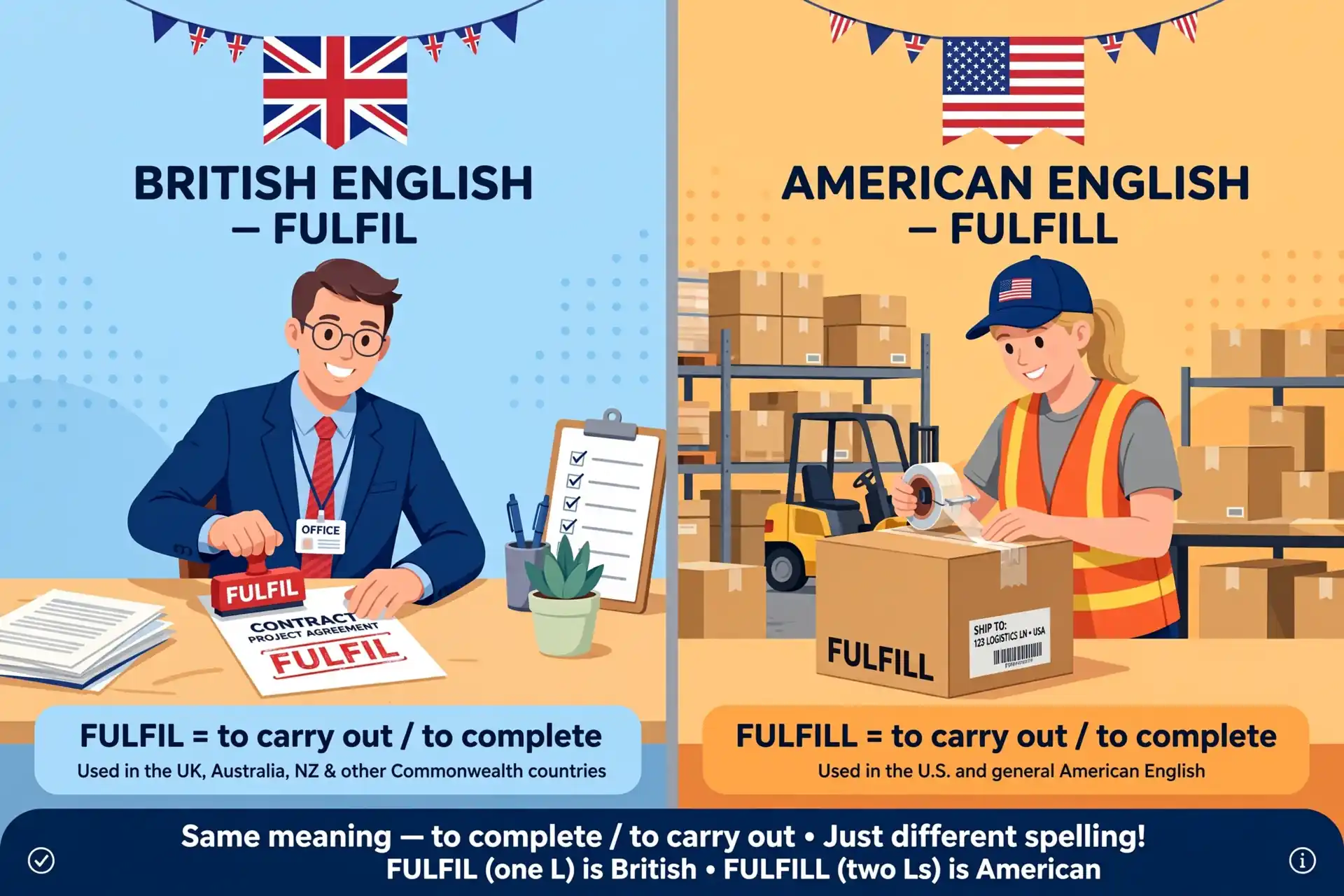
Fulfil and fulfill are the same word spelled two ways. Both are correct — fulfill is the American spelling, while fulfil is the British one. For example, a US company writes “we fulfill every order within 48 hours”, while a UK company writes “we fulfil every order within 48 hours”. The meaning never changes; only the audience does.
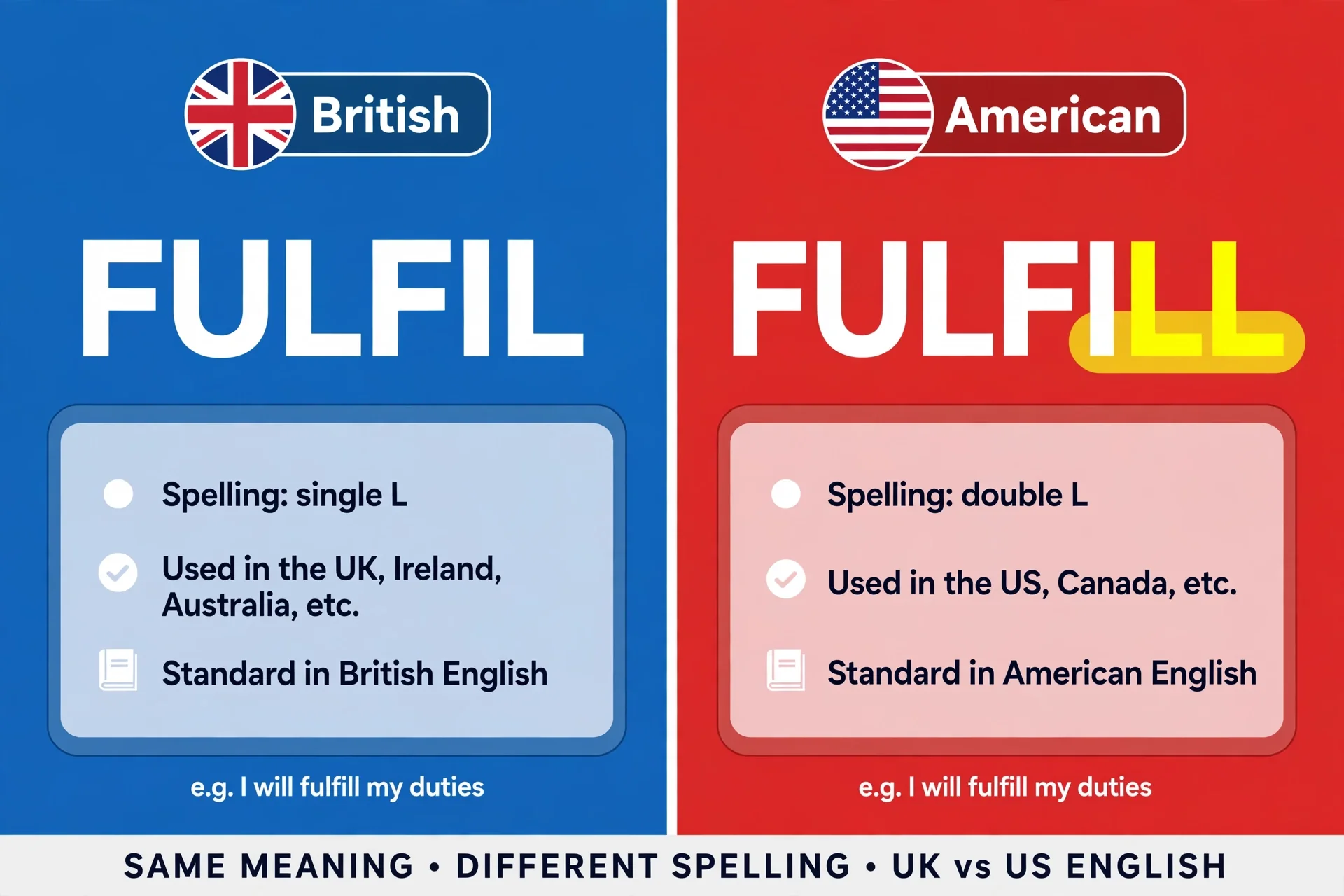
Table of Contents
Quick Answer
| Word | Part of Speech | Main Meaning | Example |
|---|---|---|---|
| Fulfill | Verb | To carry out or achieve (US spelling) | She worked hard to fulfill her dream. |
| Fulfil | Verb | To carry out or achieve (UK spelling) | She worked hard to fulfil her dream. |
Simple rule: American audience → fulfill with double L. British audience → fulfil with single L.
Why Two Spellings?
American and British English split on many words where a final l gets doubled. In the US, Noah Webster’s spelling reforms of the early 1800s standardized doubling the consonant in stressed syllables (fulfill, canceled was actually the opposite — but for fulfill the double L won out). In the UK, the older single-L form fulfil survived and is still the standard in British dictionaries today.
This same split shows up across the language:
| Meaning | American (US) | British (UK) |
|---|---|---|
| To carry out | fulfill | fulfil |
| To call off | canceled | cancelled |
| To travel | traveled | travelled |
| To label | labeled | labelled |
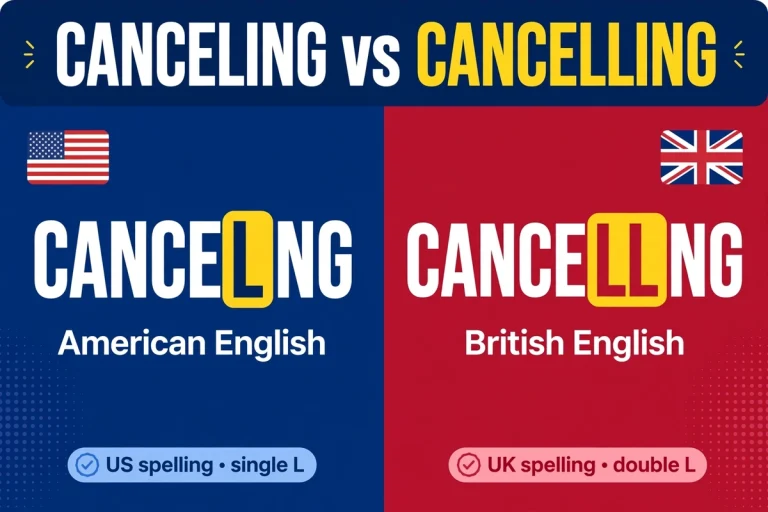
If you’ve ever hesitated over cancelled or canceled, you’re looking at the exact same US-vs-UK pattern.
What Does Fulfill Mean?
Fulfill (American spelling) is a verb meaning to carry out, complete, or bring to completion — a promise, a duty, an order, a dream, or a requirement. A store fulfills an order by shipping it; a person fulfills a promise by keeping it.
Examples:
- The charity fulfilled its promise to build ten schools.
- He finally fulfilled his childhood dream of becoming a pilot.
- Our warehouse can fulfill 5,000 orders a day.
- She fulfilled all the requirements for graduation.
- Taking the course fulfilled my sense of purpose.
What Does Fulfil Mean?
Fulfil (British spelling) is the exact same verb with the exact same meaning — to carry out or complete something. It appears in UK newspapers, British legal contracts, and Commonwealth school exams, where the double L would be marked wrong.
Examples:
- The charity fulfilled its promise to build ten schools.
- He finally fulfilled his childhood dream of becoming a pilot.
- Our warehouse can fulfil 5,000 orders a day.
- She fulfilled all the requirements for graduation.
- The contract was fulfilled ahead of schedule.
Dictionaries define the word under the American headword — see Merriam-Webster’s entry for fulfill — while British dictionaries list fulfil as the headword instead.
Fulfil vs. Fulfill: Key Differences
| Feature | Fulfill | Fulfil |
|---|---|---|
| Spelling | Double L | Single L |
| Region | United States, Canada | United Kingdom, Australia, Ireland |
| Meaning | To carry out / complete | Identical |
| Dictionary headword | US dictionaries | UK dictionaries (Oxford, Cambridge) |
| Related forms | fulfills, fulfilled, fulfilling | fulfils, fulfilled, fulfilling |
| Formality | Standard in US formal writing | Standard in UK formal writing |
Notice that the past tense fulfilled is spelled the same in both varieties — only the base form differs.
Fulfil or Fulfill in Real Sentences
At Home
“I promised the kids a beach day, and I intend to fulfill that promise.”
“I promised the kids a beach day, and I intend to fulfil that promise.”
Same promise, same beach — the only change is which side of the Atlantic you’re writing on.
At Work
“The supplier failed to fulfill the contract on time.”
A US legal team writes it with double L; a London firm would write fulfil in the identical sentence.
In Conversation
“Volunteering at the shelter really fulfills me.”
Spoken aloud, the spellings are indistinguishable — the difference lives entirely on the page.
In Writing
“She fulfilled every requirement of the program.”
This past-tense sentence looks the same in American and British English, since fulfilled is the shared form.
Common Mistakes with Fulfil and Fulfill
US-vs-UK pairs trip people up in a different way than look-alike words — the mistake is using the wrong region’s spelling, much like mixing up loose or lose is about mixing up meanings entirely.
Mistake 1: Using fulfill in British writing
❌ A UK university essay: “The study fulfills its objectives.”
✅ “The study fulfils its objectives.”
Why: British examiners and editors expect the single-L form; the double L reads as an Americanism.
Mistake 2: Using fulfil in American writing
❌ A US job application: “I am eager to fulfil this role.”
✅ “I am eager to fulfill this role.”
Why: American readers and spellcheckers flag fulfil as a typo.
Mistake 3: Mixing the forms in one document
❌ “We fulfill orders quickly and fulfil returns just as fast.”
✅ Pick one: “We fulfill orders quickly and fulfill returns just as fast.”
Why: Consistency matters more than which variant you choose.
Mistake 4: Writing “fullfill” with three L’s
❌ “They promised to fullfill the quota.”
✅ “They promised to fulfill the quota.”
Why: It’s ful- + fill, but the word takes only two L’s total, not three.
Pronunciation
Both are pronounced fool-FIL, with the stress on the second syllable. It rhymes with still and until. The single vs. double L makes no difference to how the word sounds.
How to Remember the Difference
Count the Ls with this link: the double LL in fulfiLL matches the LL in “aLL American”. The British keep it shorter: fulfil, one L, done.
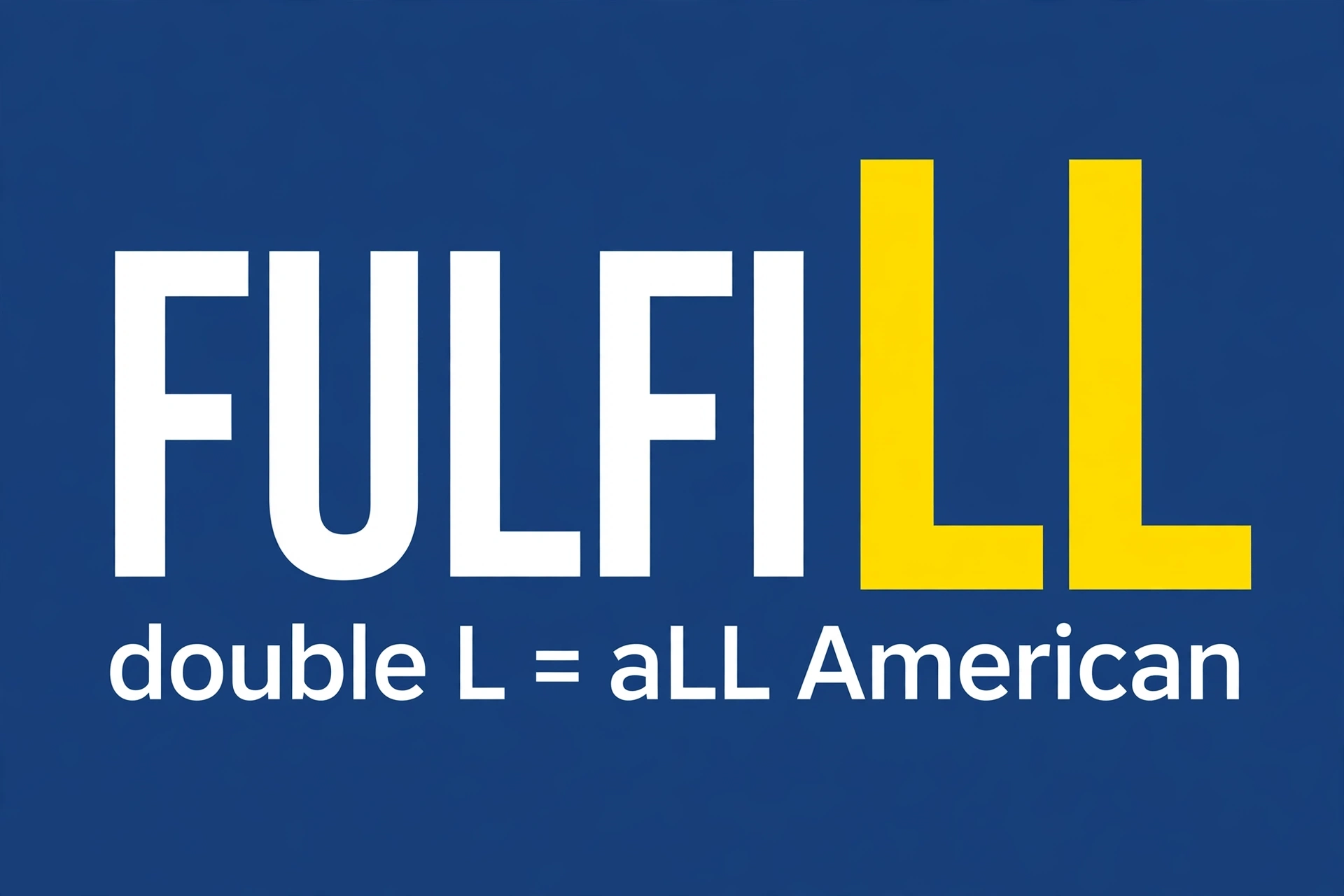
- Fulfill = American — double LL, like the LL in “aLL American”.
- Fulfil = British — the single L, listed first in Oxford and Cambridge dictionaries.
- Fulfilled (past tense) is identical in both — no decision needed.
- Never fullfill with three L’s.
Frequently Asked Questions
Is it fulfil or fulfill?
Both are correct. Fulfill is American English; fulfil is British English.
Which spelling should I use?
Match your audience: fulfill for American readers, fulfil for British, Australian, and Irish readers. International writing usually defaults to the American form.
Is fulfil a misspelling of fulfill?
No. In British English fulfil is the standard, dictionary-approved spelling — not an error at all.
What is the past tense — fulfilled or fulfil led?
Fulfilled in both varieties. The past tense doubles the L everywhere, so there’s only one form to learn.
Do other words follow this pattern?
Yes — cancelled/canceled, travelled/traveled, and labelled/labeled follow the same US-vs-UK doubling split.
Conclusion
Fulfill and fulfil are the same verb in two regional spellings — double L for American audiences, single L for British ones. Pick the one your readers expect, stay consistent, and the past tense fulfilled will never give you trouble.