Zucchini or Courgette: US vs UK Spelling Explained
Zucchini and courgette are two names for the same long green summer squash — Americans say zucchini, while Brits say courgette. One came from Italian immigrants, the other from French cookery, and both are perfectly correct in their own region. An American cook grates “zucchini into the batter,” while a British cook grates “courgette into the batter.”
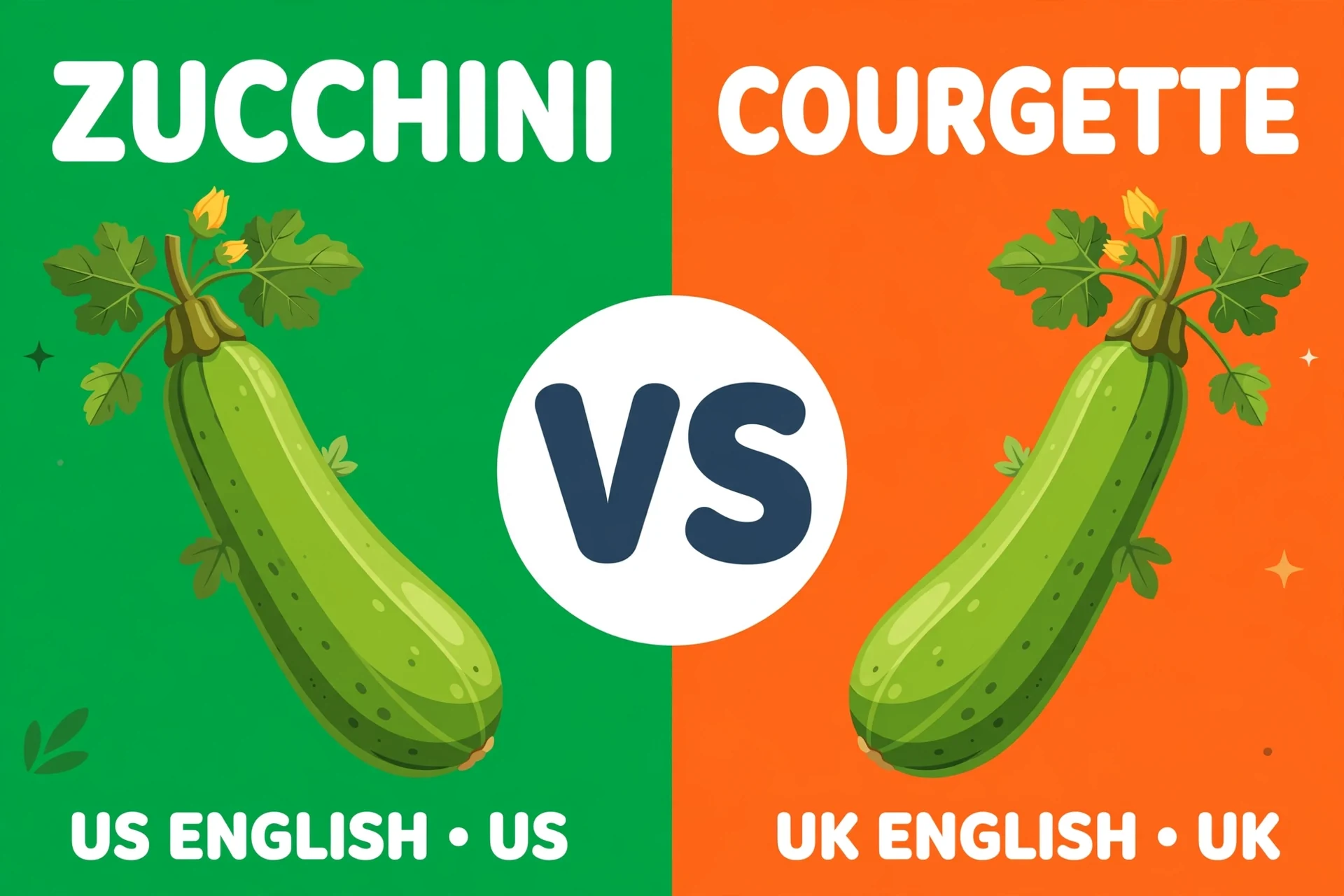
Table of Contents
Quick Answer
| Word | Spelling | Main Meaning | Example |
|---|---|---|---|
| Zucchini | American name | The long green summer squash | “She shredded zucchini into the chocolate cake.” |
| Courgette | British name | The exact same squash | “He grilled courgette with lemon and thyme.” |
Simple rule: write zucchini for American readers and courgette for British readers — one word per audience, never both in the same text.
What Does Zucchini Mean?
Zucchini is the American English name for the tender green summer squash harvested young. It came from Italian: zucchina is the diminutive of zucca (gourd or pumpkin), and zucchini is technically its plural — English borrowed the plural form as a singular, the way it did with “spaghetti.” Merriam-Webster defines zucchini as a smooth, cylindrical, usually dark-green summer squash. Italian immigrants brought the vegetable and its name to the US in the early 1900s, and by the 1920s American seed catalogs and cookbooks were using zucchini. Canada, Australia, and New Zealand use it too.
Examples:
- Zucchini bread stays moist for days and freezes beautifully.
- She spiralized two zucchinis for a low-carb pasta swap.
- Grilled zucchini picks up a lovely char in under five minutes.
- The garden produced more zucchini than we could give away.
- He stuffed the zucchini flowers with ricotta and fried them crisp.
What Does Courgette Mean?
Courgette is the British English name for the identical squash. It arrived from French courgette, the diminutive of courge (gourd or marrow). Britain already had the “marrow” — a larger, older version of the same species — and the small tender ones needed a name, so French provided it. The word took off in Britain in the 1960s and 70s, when cookery writers like Elizabeth David championed Mediterranean vegetables. Today no British supermarket labels the vegetable zucchini; it is courgette on the shelf, in the recipe, and on the menu.
Examples:
- Courgette and feta fritters make a brilliant light lunch.
- She sliced the courgette paper-thin for the salad.
- Courgettes grow so fast you have to check the plant daily.
- He roasted courgette with harissa and chickpeas.
- Two medium courgettes will feed four as a side dish.
Why Two Spellings?
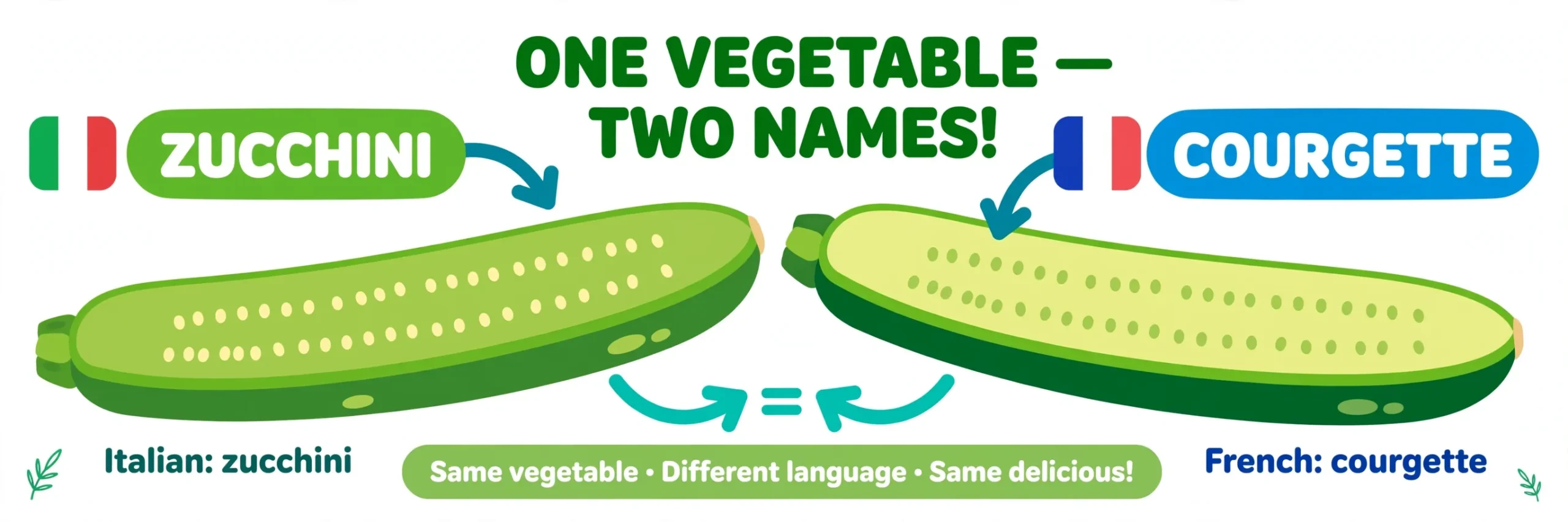
Each name records a different wave of immigration to the dinner table. Italian immigrants in the late 1800s and early 1900s planted their homeland’s gardens in American soil, and their word for the squash — zucchini — entered American English with the vegetable itself. Britain’s path ran through France instead: British cooks adopted the French courgette, and Elizabeth David’s influential books on Mediterranean cooking cemented it. One plant, an Italian passport in America, a French one in Britain.
Zucchini vs. Courgette: Key Differences
| Feature | Zucchini | Courgette |
|---|---|---|
| Region | US, Canada, Australia, New Zealand | UK, Ireland |
| Language source | Italian (zucchina, from zucca, gourd) | French (courgette, from courge, gourd) |
| Arrived via | Italian immigrants, early 1900s | French-influenced cookery writing, 1960s–70s |
| Grammar quirk | An Italian plural used as an English singular | Regular noun; plural adds s |
| The big version | Called a large zucchini | Called a marrow — a separate British word |
| Botanical name | Cucurbita pepo (same plant) | Cucurbita pepo (same plant) |
One plant, two passports: the squash never changed, only the language around it did.
Related US vs UK Word Pairs
| Pair | US | UK |
|---|---|---|
| Donut or Doughnut | donut | doughnut |
| Theater or Theatre | theater | theatre |
| Color or Colour | color | colour |
| Defense or Defence | defense | defence |
| Caramel or Carmel | caramel (carmel in speech) | caramel |
Zucchini and Courgette in Real Sentences
At Home
US: “I’m making zucchini muffins for the kids’ lunchboxes.” UK: “I’m making courgette muffins for the kids’ lunchboxes.” Same batter, same tin — only the cook’s country changes the word.
At the Market
US: “Grab a couple of zucchini while they’re firm and small.” UK: “Grab a couple of courgettes while they’re firm and small.” Shoppers on both sides pick the same vegetable by the same signs of freshness.
In Conversation
US: “My neighbor keeps leaving zucchini on my porch — it’s that time of year.” UK: “My neighbour keeps leaving courgettes on my doorstep — it’s that time of year.” The late-summer glut is universal; only the spelling of the surplus changes.
Common Mistakes
Regional food words trip up writers the same way donut vs doughnut and theater vs theatre do — the reader spots the wrong one immediately. Avoid these slips.
Mistake 1: Thinking they’re different vegetables
❌ “The dish uses zucchini, not courgette.”
✅ “The dish uses zucchini.” (or courgette, for a British audience)
Why: they are the same squash; the sentence accidentally bans the ingredient it needs.
Mistake 2: Writing “zucchinis” in a British recipe
❌ A UK blog writes: “Chop 2 zucchinis.”
✅ “Chop 2 courgettes.”
Why: British readers expect courgette; zucchini reads as an American import.
Mistake 3: Pronouncing courgette “kor-GET”
❌ “kor-GET, rhyming with baguette spelled wrong”
✅ “kor-ZHET, with a soft French zh like in ‘measure'”
Why: the double t doesn’t harden the sound — keep it soft and French.
Mistake 4: Assuming the plural works like Italian
❌ “One zucchino, two zucchini — I’ll be grammatically pure in English.”
✅ “One zucchini, two zucchinis (or just ‘zucchini’ as a mass noun).”
Why: English borrowed the Italian plural as a singular, so the “correct” Italian forms don’t apply here.
Pronunciation
Zucchini is pronounced zoo-KEE-nee, with the stress on the middle syllable; it rhymes with “bikini.” The z is a normal English z, and the double c sounds like k. Courgette keeps its French shape: kor-ZHET, stress on the second syllable, the g soft like the s in “measure.” It rhymes with “gadget” said softly — Americans attempting it sometimes say “KOR-get,” but the gentle zh is what makes it sound right.
How to Remember the Difference
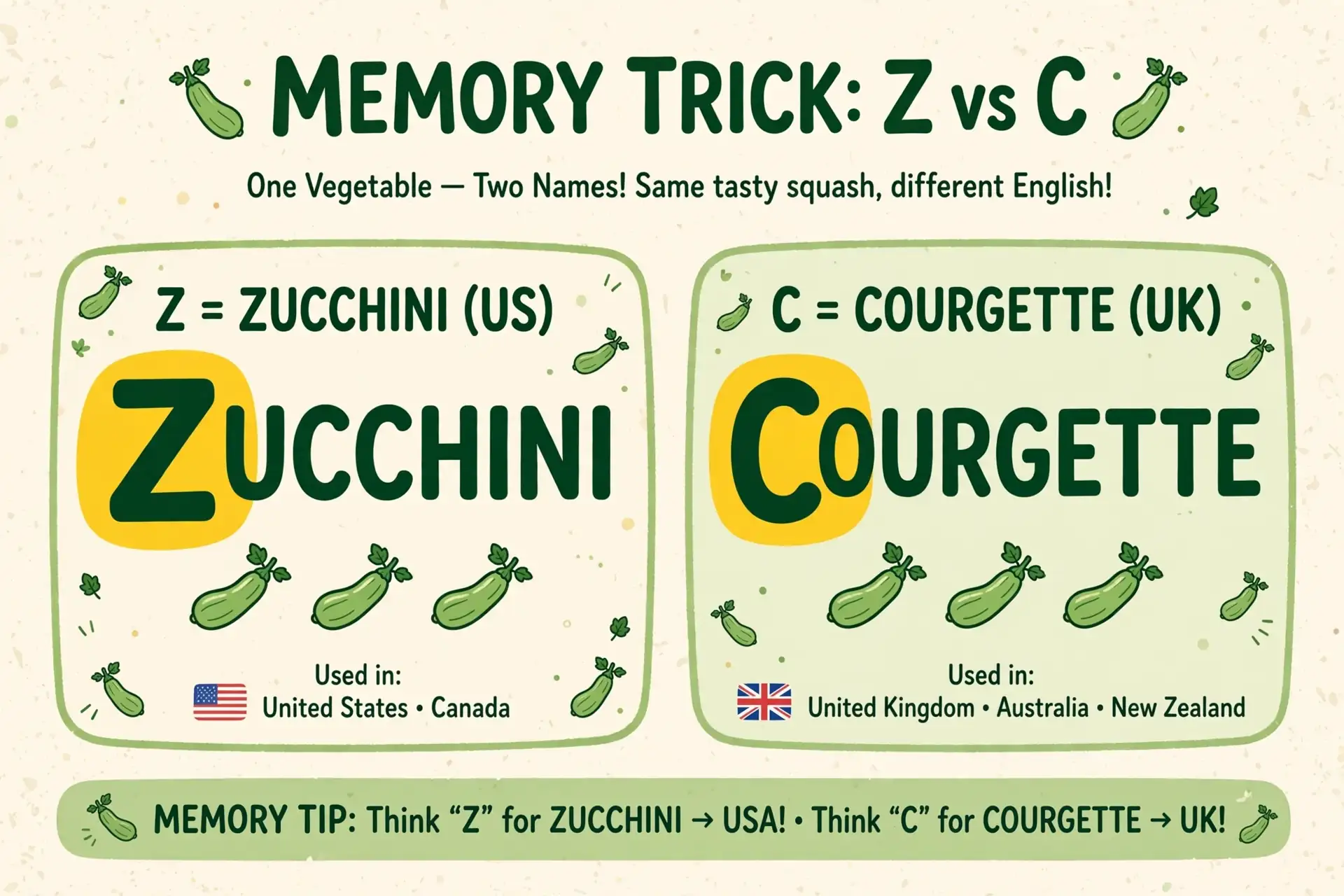
Zucchini starts with Z — think the Zany Italians who brought it to America. Courgette starts with C — think Classic French Cuisine, which is where Britain got it. Z = Italian-American; C = French-British.
- Zucchini — US (and Canada, Australia); Italian roots, pronounced zoo-KEE-nee.
- Courgette — UK (and Ireland); French roots, pronounced kor-ZHET.
- In Britain, the oversized version has its own word: marrow.
Frequently Asked Questions
Is it zucchini or courgette?
Both are correct regionally. Say zucchini in the US, Canada, and Australia; say courgette in the UK and Ireland.
Are zucchini and courgette exactly the same thing?
Yes — same species (Cucurbita pepo), same vegetable, picked young and tender. Any recipe works with either name on the label.
Why does English have two words for one squash?
America borrowed its word from Italian immigrants in the early 1900s; Britain borrowed its word from French cookery in the 1960s. Two immigration stories, one vegetable.
Is zucchini plural?
In Italian it is (singular zucchina), but English treats zucchini as a singular noun — “one zucchini, two zucchinis” is perfectly normal in American English.
What is a marrow in British cooking?
A marrow is the same species left to grow large and mature — Brits distinguish the small tender courgette from the big marrow, while Americans just call them all zucchini.
Can you eat zucchini raw?
Yes — thinly sliced raw zucchini (or courgette) in salads is common, and the blossoms are a delicacy when stuffed and fried.
Conclusion
Zucchini and courgette are the same summer squash wearing two different linguistic passports — Italian-American in the US, French-British in the UK. Use the word your audience shops with, pronounce courgette with its soft French zh, and the only thing left to debate is what to cook with it.