Labelling or Labeling: US vs UK Spelling Explained
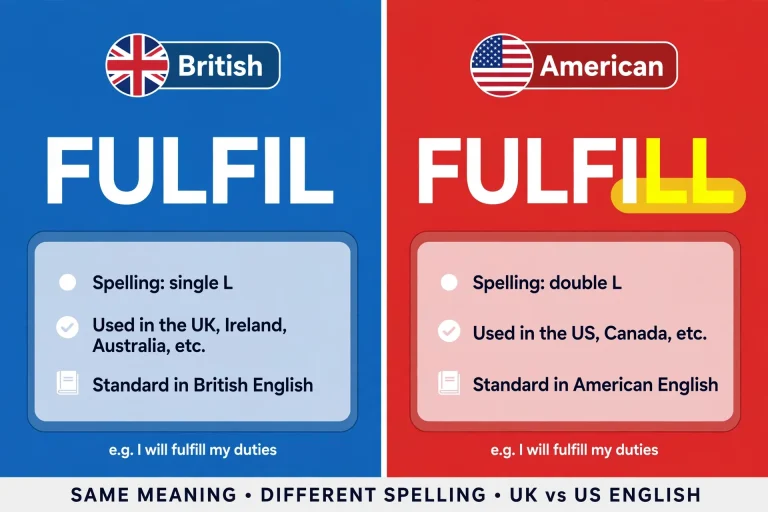
Is it labelling or labeling? Both are correct — they are simply the British and American spellings of the same word. Labelling (double L) is the UK spelling, labeling (single L) is the US spelling.
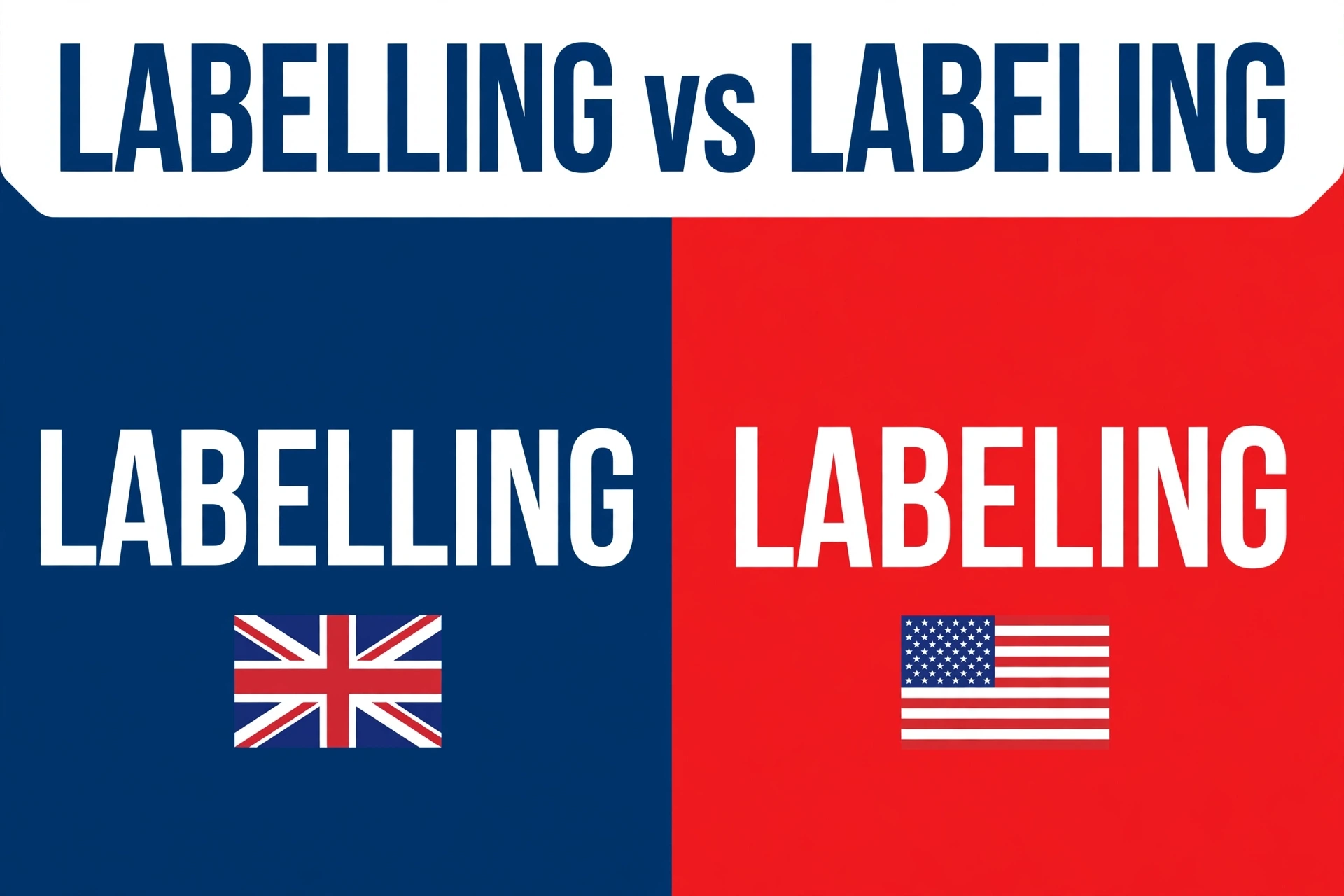
Table of Contents
Quick Answer
| Spelling | Region | Part of Speech | Example |
|---|---|---|---|
| Labelling | UK (British English) | Verb (present participle of “label”) | “The nurse is labelling the samples.” |
| Labeling | US (American English) | Verb (present participle of “label”) | “The nurse is labeling the samples.” |
Simple rule: match the spelling to your audience — labelling for British readers, labeling for American readers.
What Does “Labelling” Mean?
Labelling is the British English spelling of the present participle of label — the act of attaching a label, tag, or sticker to something, or marking it with identifying information.
Examples:
- “The warehouse staff are busy labelling the crates before dispatch.”
- “She earned extra money labelling envelopes for the election campaign.”
- “Labelling ingredients clearly helps people with allergies.”
- “The professor insisted on labelling every axis of the chart.”
- “After labelling the boxes, we stacked them in the attic.”
What Does “Labeling” Mean?
Labeling is the American English spelling of exactly the same word — the present participle of label. The meaning is identical; only the region changes. Merriam-Webster’s full entry for labeling lists it as the standard US form of the verb.
Examples:
- “The technician is labeling the test tubes one by one.”
- “He spent the morning labeling files in the office archive.”
- “Food companies must follow strict rules when labeling their products.”
- “The software helps scientists with labeling data for machine learning.”
- “He was labeling the moving boxes with a thick marker.”
Why Two Spellings?
The split goes back to Noah Webster, the American lexicographer behind the 1828 American Dictionary of the English Language. Webster believed English spelling should be simpler and more phonetic, so he trimmed doubled consonants in inflected forms wherever the final syllable was unstressed. In Britain, the tradition of doubling the final L before a suffix (labelling, labelled, cancelling) stayed put. Neither side is wrong — they are two national conventions that drifted apart over 200 years of separate dictionary traditions.
Most Commonwealth countries — Australia, New Zealand, South Africa, India — follow the British doubled-L convention, while the US, and often the Philippines, use the single L. Canada sits in the middle, officially preferring British forms but heavily exposed to American media. If you write for an international audience, either spelling is understood; just don’t switch between them in the same document.
Related Word Pairs
Once you spot the double-L pattern, a whole family of words falls into line:
| Word Pair | British | American |
|---|---|---|
| Labelled or labeled | labelled | labeled |
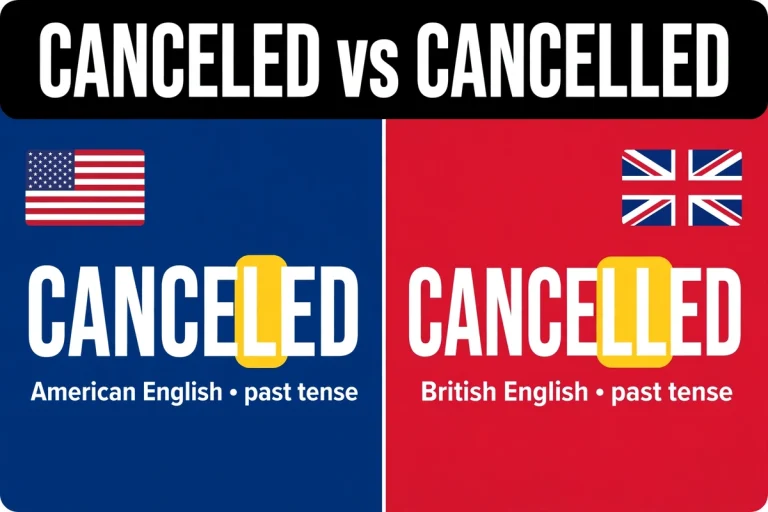
| Cancelling or canceling | cancelling | canceling |
| Cancelled or canceled | cancelled | canceled |
| Travelling or traveling | travelling | traveling |
| Modelled or modeled | modelled | modeled |
The rule of thumb is consistent: British English doubles the final L, American English keeps it single.
Usage in Real Sentences
At Home
UK: “She’s labelling the spice jars alphabetically.”
US: “She’s labeling the spice jars alphabetically.”
The sentence is identical apart from the doubled L — pick the version your reader expects.
At Work
UK: “Our team is labelling the server cables before the move.”
US: “Our team is labeling the server cables before the move.”
In a company style guide, one spelling is usually fixed for all documents.
At School
UK: “The teacher asked the class to practise labelling the diagram.”
US: “The teacher asked the class to practice labeling the diagram.”
Students should follow the spelling convention of their country — examiners notice.
Common Mistakes
The same double-L pattern trips people up in words like labelled or labeled and cancelling or canceling, so the errors below are worth avoiding:
Mistake 1:
❌ “I’m labelling the boxes” — in a US business email
✅ “I’m labeling the boxes”
Why: American style drops the extra L; the British spelling looks like a typo to a US reader.
Mistake 2:
❌ “She was labeling the files” — in a British university essay
✅ “She was labelling the files”
Why: British examiners and style guides expect the doubled L.
Mistake 3:
❌ Mixing both in one document (“labelling” in the introduction, “labeling” in the conclusion)
✅ Pick one spelling and stick with it throughout
Why: switching mid-document looks sloppy even though both forms are technically correct.
Mistake 4:
❌ Assuming “labelling” is a misspelling
✅ Recognize it as the standard British form
Why: spellcheckers set to the wrong region flag the other variant — the word itself is fine.
Pronunciation
Both spellings are pronounced exactly the same: “LAY-buh-ling”. It rhymes with cabling and tabling. No listener can tell which spelling you mean — only readers see the difference.
How to Remember the Difference
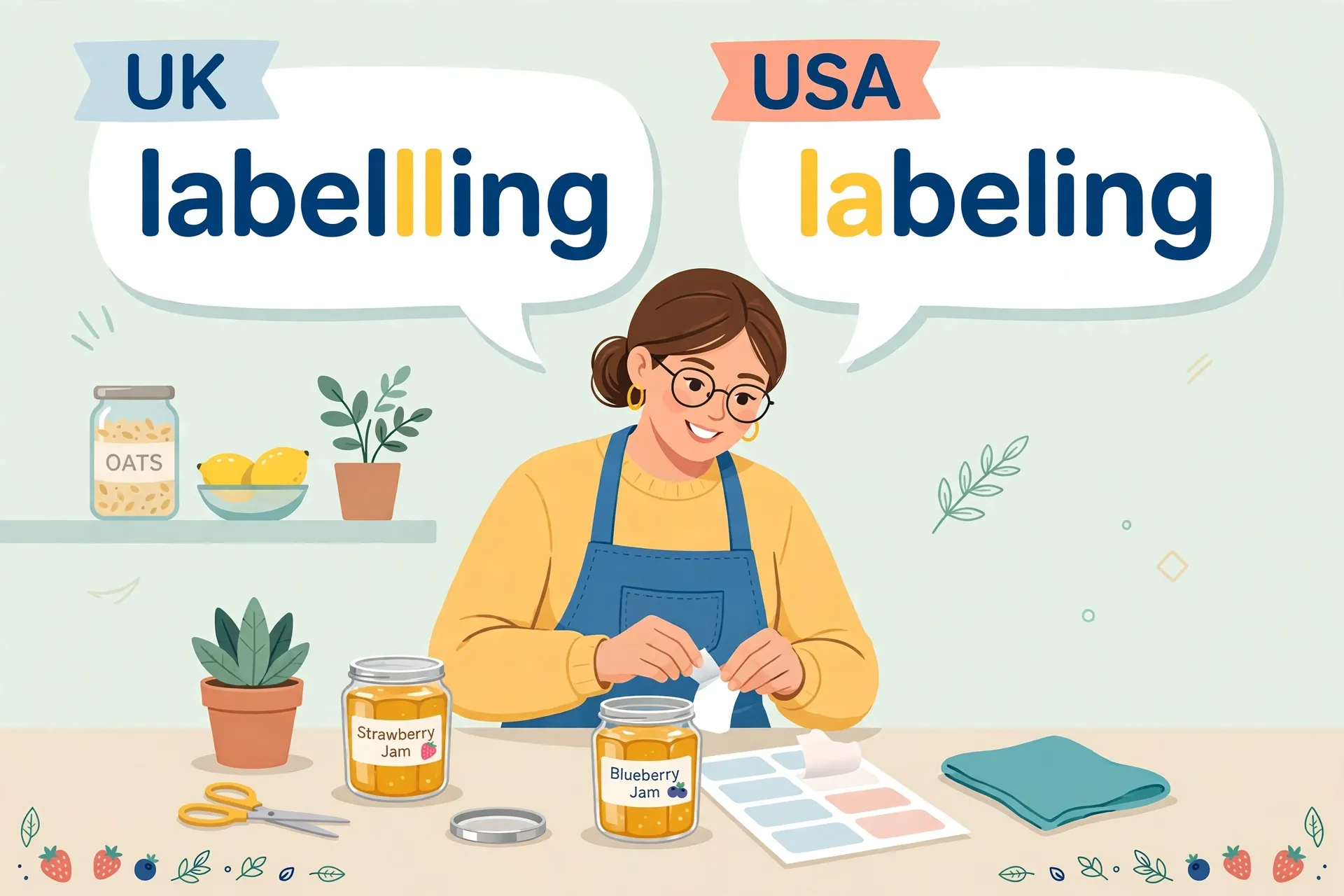
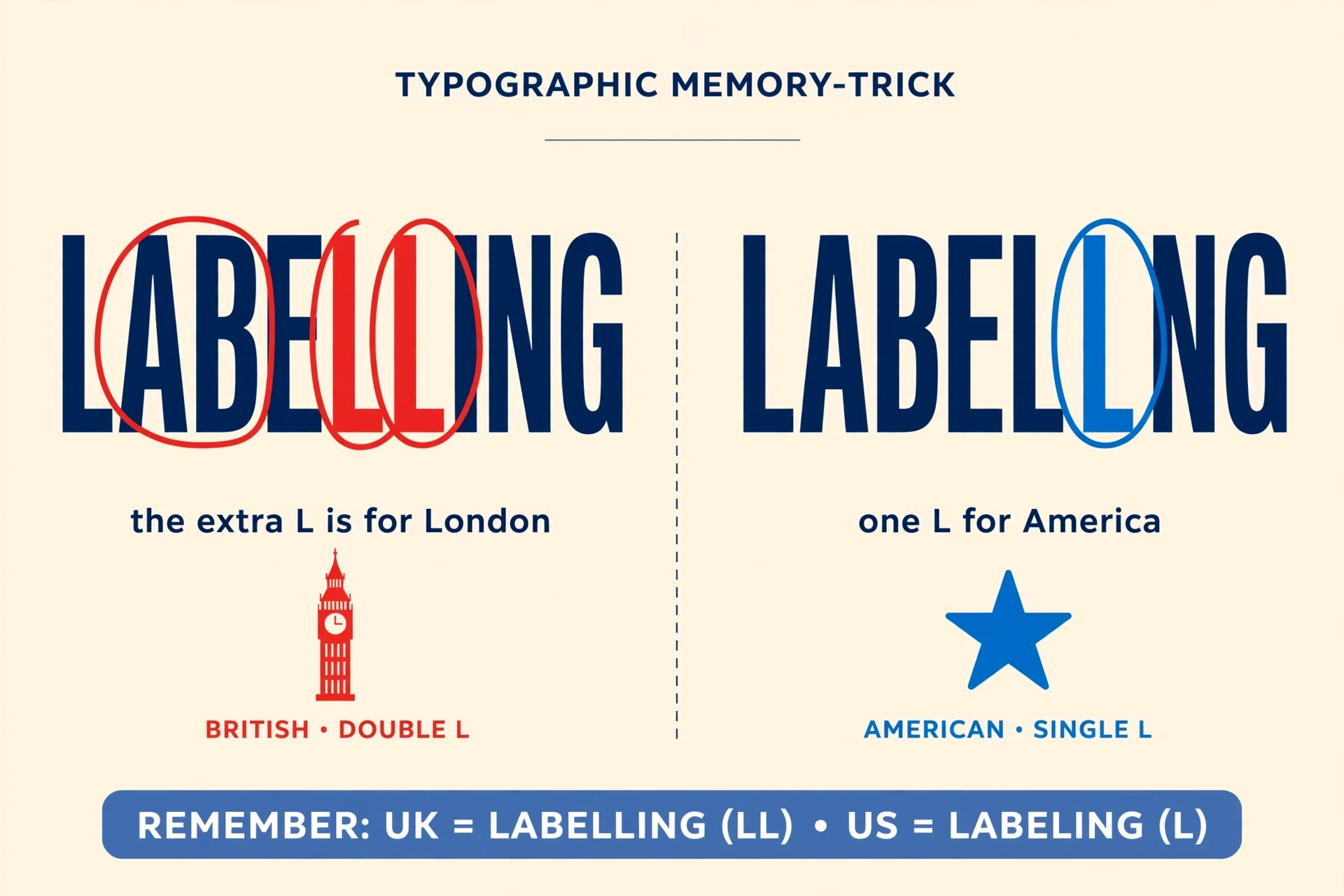
Think: the extra L is for London. Labelling with two Ls belongs to British English, while America’s Noah Webster trimmed one away, leaving labeling with a single L for the United States.
- Labelling = double L = London = British
- Labeling = single L = simplified = American
- Match the spelling to your audience, and stay consistent within a document.
Frequently Asked Questions
Is it labelling or labeling?
Both are correct — they are regional spellings of the same word. Use labelling in British English (UK, Australia, New Zealand) and labeling in American English. The key is matching your audience, not picking a “more correct” version.
Is labelling a real word?
Yes. It is the standard British spelling of the present participle of label, listed in the Oxford English Dictionary and used across the UK, Ireland, Australia, and New Zealand. Spellcheckers set to US English will flag it, but that reflects the dictionary setting, not the word’s validity.
Which spelling should Canadians use?
Canadian English generally follows British conventions, so labelling is the safer default — the Canadian Oxford Dictionary prefers it. That said, Canada’s closeness to the US means you will see labeling too, especially in business writing. Pick one and stay consistent.
Why do Americans drop the L?
Noah Webster’s 1828 American Dictionary deliberately simplified spellings he saw as redundant, including doubled consonants before suffixes in unstressed syllables. Americans adopted his reforms; Britain kept the older doubled-L tradition. Two centuries of separate dictionary traditions turned one preference into two national standards.
Do I double the L in “labelled” too?
In British English, yes — labelled with a double L, matching labelling. In American English it is labeled with a single L, matching labeling. The past tense and the -ing form always agree: whichever convention you follow, apply it to the whole word family.
Does the meaning change between the two?
No. Labelling and labeling mean exactly the same thing — the act of attaching a label or marking something with identifying information. Only the spelling differs by region. No reader will misunderstand you either way; at most, the “wrong” regional spelling looks slightly foreign.
Conclusion
Labelling and labeling are two regional spellings of the same word: double L for British English, single L for American. Choose the one your audience expects, keep it consistent throughout your writing, and you will never go wrong.