Leach or Leech: What’s the Difference? (With Examples)
Is it leach or leech? They sound identical but mean completely different things. Leach is a verb meaning to drain or wash out a substance; leech is the bloodsucking worm — or a freeloader who lives off others.
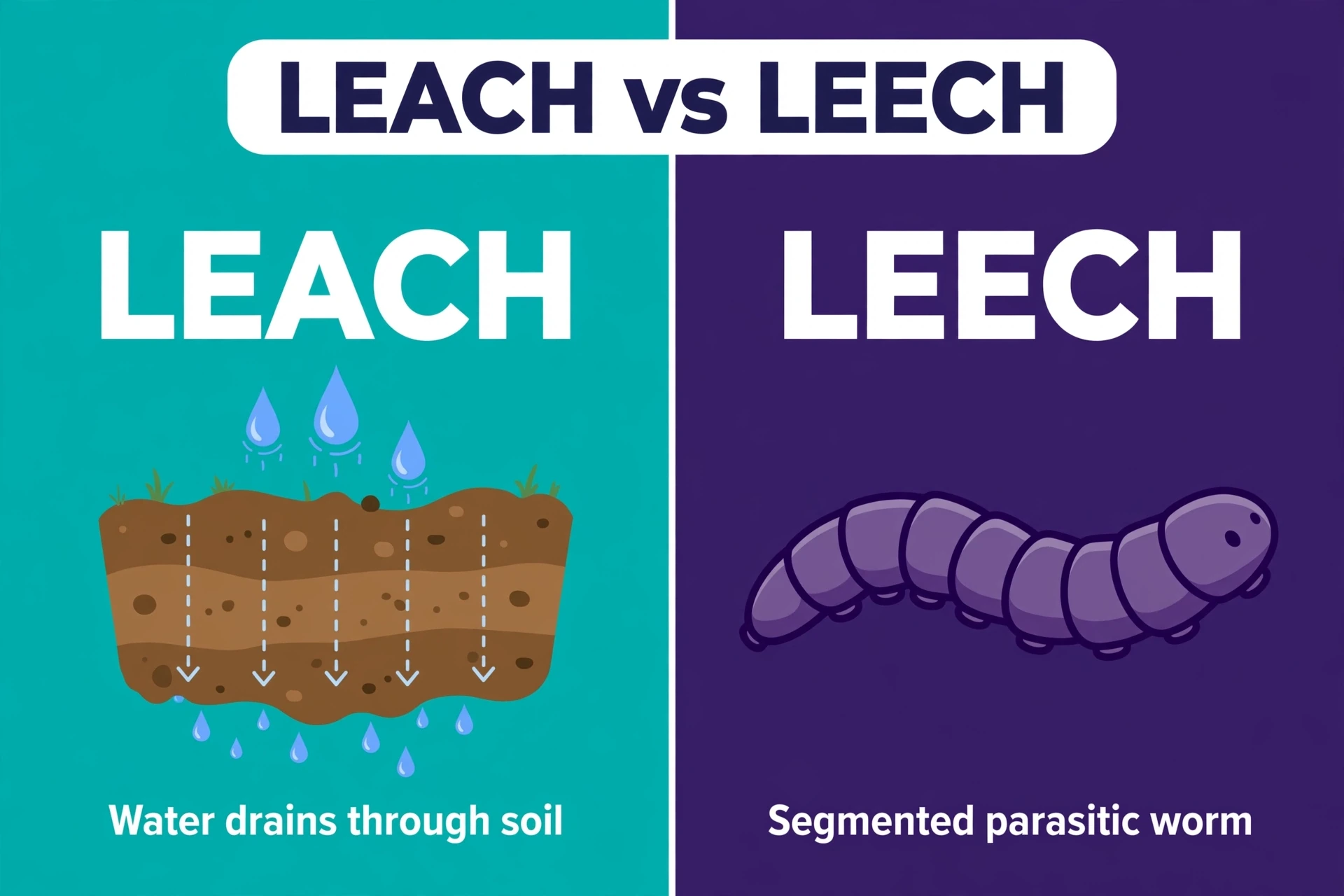
Table of Contents
Quick Answer
| Word | Part of Speech | Main Meaning | Example |
|---|---|---|---|
| Leach | Verb | To drain or wash out a substance | “Rain leaches salt from the soil.” |
| Leech | Noun (also verb) | Bloodsucking worm; a freeloader | “The doctor removed the leech.” |
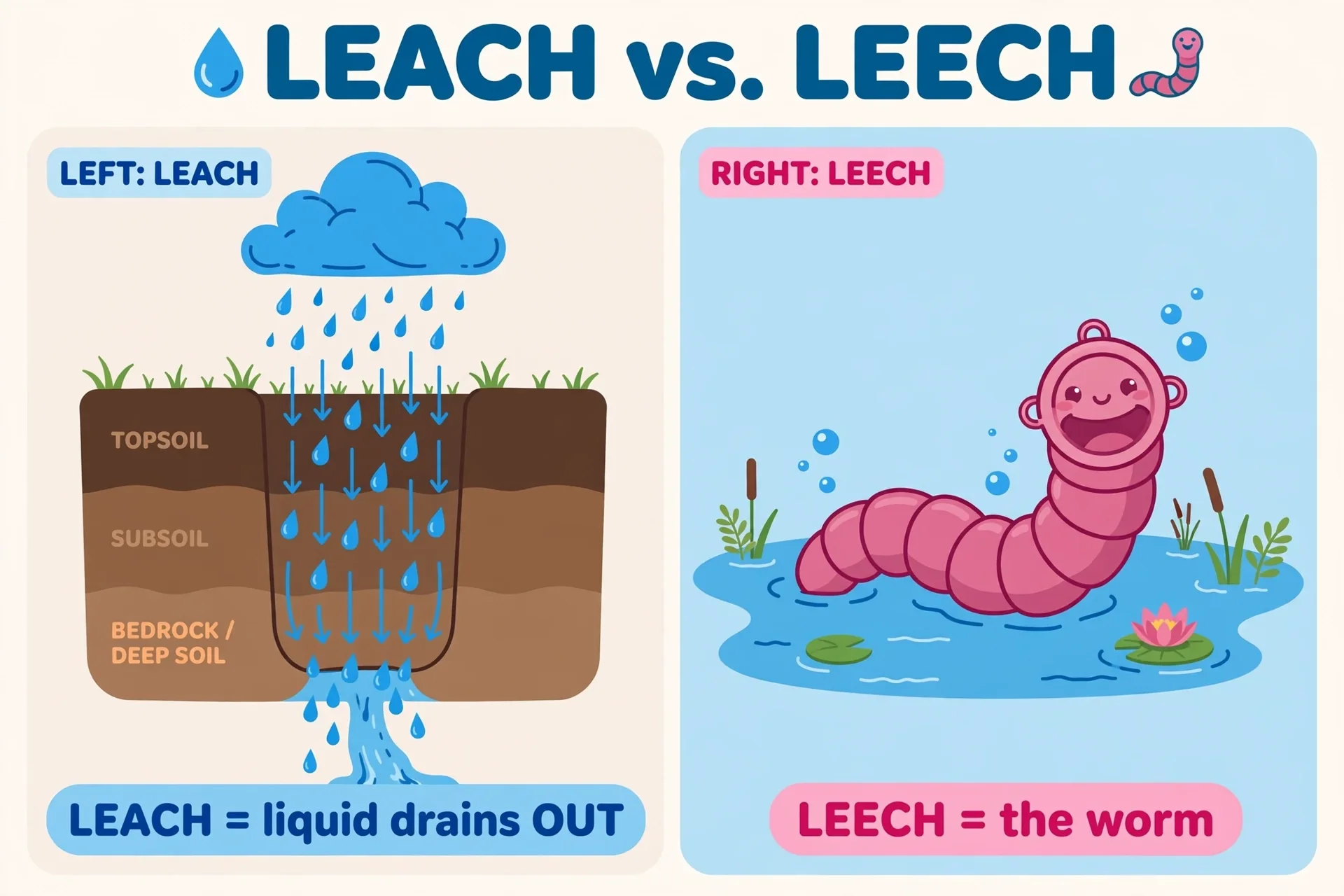
Simple rule: leach lets a substance flow out (think “leach” sounds like “leak”), while a leech is the worm — it has two E’s, like two eyes staring at you.
What Does “Leach” Mean?
Leach is a verb meaning to cause a substance to drain or wash out of a material, usually carried away by liquid. It is the word of chemistry labs, gardeners, and environmental scientists.
Examples:
- “Heavy rain leaches nutrients out of the topsoil.”
- “The tea leaves leached color into the hot water.”
- “Chemicals can leach from plastic bottles into your drink.”
- “Old lead pipes can leach poison into tap water.”
- “Miners leach gold ore with a solution to extract the metal.”
- “Watering too often leaches fertilizer out of potted plants.”
- “Acid rain leaches aluminum from the soil, harming tree roots.”
You will also meet leach in the term “leach field” — the part of a septic system where wastewater drains out through the soil. Same verb, same idea: liquid carrying something away.
What Does “Leech” Mean?
Leech is a noun with two related senses — the literal worm and the figurative freeloader. It can also be used as a verb. Merriam-Webster’s definition of leech covers both the bloodsucking worm and the hanger-on who seeks advantage.
The bloodsucking worm
- “Leeches were once used by doctors to draw blood.”
- “He pulled a leech off his leg after wading through the marsh.”
- “Anglers sometimes use leeches as live bait.”
The freeloader
- “Her brother-in-law is a leech, always borrowing money.”
- “Don’t be a leech — pay your own share of the bill.”
- “He’s been leeching off his parents for years.”
Leach vs. Leech: Key Differences
| Feature | Leach | Leech |
|---|---|---|
| Core meaning | To drain or wash out a substance | A bloodsucking worm; a freeloader |
| Part of speech | Verb | Noun (can also be a verb: “to leech off”) |
| Typical subject | Rain, chemicals, liquids | A creature or a person |
| Direction | Something flowing out | Something clinging on |
| Tone | Neutral, scientific | Unpleasant, insulting (for people) |
One drains things away; the other latches on and won’t let go.
Usage in Real Sentences
At Home
Leach: “Don’t leave the tea bag in too long or it will leach bitter tannins into the cup.”
Leech: “Her cousin is a total leech — he ate all our leftovers and never buys groceries.”
One sentence is about chemistry in a cup; the other is about an unwelcome houseguest.
In Conversation
Leach: “They say the fertilizer leaches into the groundwater after storms.”
Leech: “He keeps leeching rides off everyone instead of getting his own car.”
Note how leech can be a verb too — but only for the freeloader sense, never for draining substances.
In the News
Leach: “Tests showed lead leaching from the old pipes into the town’s water.”
Leech: “The article called the lobbyists leeches on the public purse.”
Swap the words here and both sentences turn absurd — which is exactly why the distinction matters.
In the Garden
Leach: “Overwatering leaches nutrients from the compost before the plants can use them.”
Leech: “She found a leech on the dog after their walk by the pond.”
The gardener worries about what washes away; the dog owner worries about what latched on.
Common Mistakes
Sound-alike mix-ups like this are common — see also loose or lose and desert or dessert — so watch out for these:
Mistake 1:
❌ “Chemicals leeched into the river after the spill.”
✅ “Chemicals leached into the river after the spill.”
Why: draining a substance is always leach; leech is a creature, not a process.
Mistake 2:
❌ “He’s such a leach on the team.”
✅ “He’s such a leech on the team.”
Why: the freeloader is spelled with double E — leech.
Mistake 3:
❌ “The soil was leeched of its nutrients.”
✅ “The soil was leached of its nutrients.”
Why: nutrients washing out is leaching, with an A.
Mistake 4:
❌ “She found a leach on her ankle after the hike.”
✅ “She found a leech on her ankle after the hike.”
Why: the worm is spelled l-ee-ch — you wouldn’t want to get this one wrong.
Pronunciation
Both words are pronounced exactly the same: “leech” (rhymes with beach, teach, and reach). Since they sound identical, only the spelling tells the reader which meaning you intend.
How to Remember the Difference
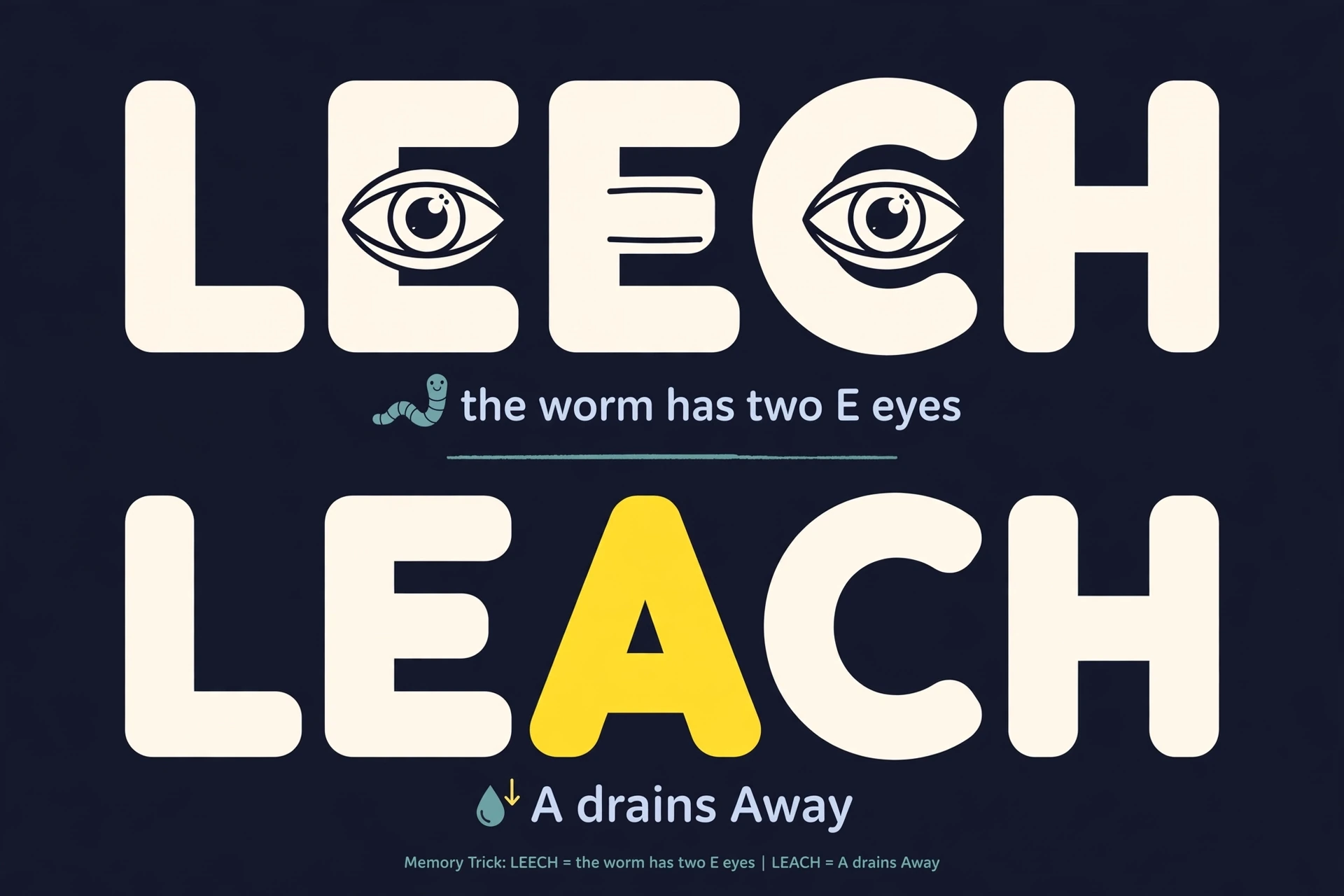
Picture the worm: a lEEch has two Es, like two beady eyes staring at you. Leach, with an A, is about something draining away.
- Leech = the worm (two E’s = two eyes)
- Leech = the freeloader (clings on like the worm)
- Leach = to drain away (A for “away”)
Frequently Asked Questions
Is it leach or leech?
It depends on the meaning: use leach when something drains or washes out, as in “rain leaches nutrients from the soil”. Use leech for the bloodsucking worm, or for a person who freeloads off others. If you can replace the word with “drain”, you want leach; if you mean the creature, you want leech.
What does leach mean in gardening?
In gardening, leach describes nutrients, salts, or chemicals washing out of the soil, usually after heavy rain or overwatering. Gardeners try to prevent it with mulch and compost, since leached soil loses the fertility plants need. A soil test can show whether key nutrients have leached away.
Can leech be used as a verb?
Yes. “To leech off someone” means to cling to them and live off their money, food, or effort — just as the worm clings to its host. It is always unflattering: calling someone a leech says they take without giving back. You would never use leech as a verb for draining liquids; that is leach‘s job.
What is the difference between leach and bleach?
They are unrelated words that only look similar. Leach means to drain or wash a substance out of something, while bleach means to whiten, lighten, or disinfect, usually with a chemical. You might say bleach leaches color from fabric — that is the one sentence where both appear, and it shows exactly how different they are.
Is a leech field spelled with leach or leech?
A septic “leach field” uses leach, because wastewater drains — leaches — out through the surrounding soil. The spelling follows the meaning: liquid flowing away, not a worm. It is one of the most common places people encounter the word leach outside of science class.
Are leeches still used in medicine?
Yes, in a limited but real way. Medicinal leeches are still used in some reconstructive surgeries to keep blood flowing through reattached tissue, a practice called hirudotherapy. Hospitals use specially bred, sterile leeches — not pond ones. It is a rare case where the creepy creature is genuinely helpful.
Conclusion
Leach is the verb for draining a substance out of something, while a leech is the bloodsucking worm — or anyone who lives off others like one. Remember the worm’s two E-eyes, and you’ll never mix them up again.