Elicit or Illicit: What’s the Difference?
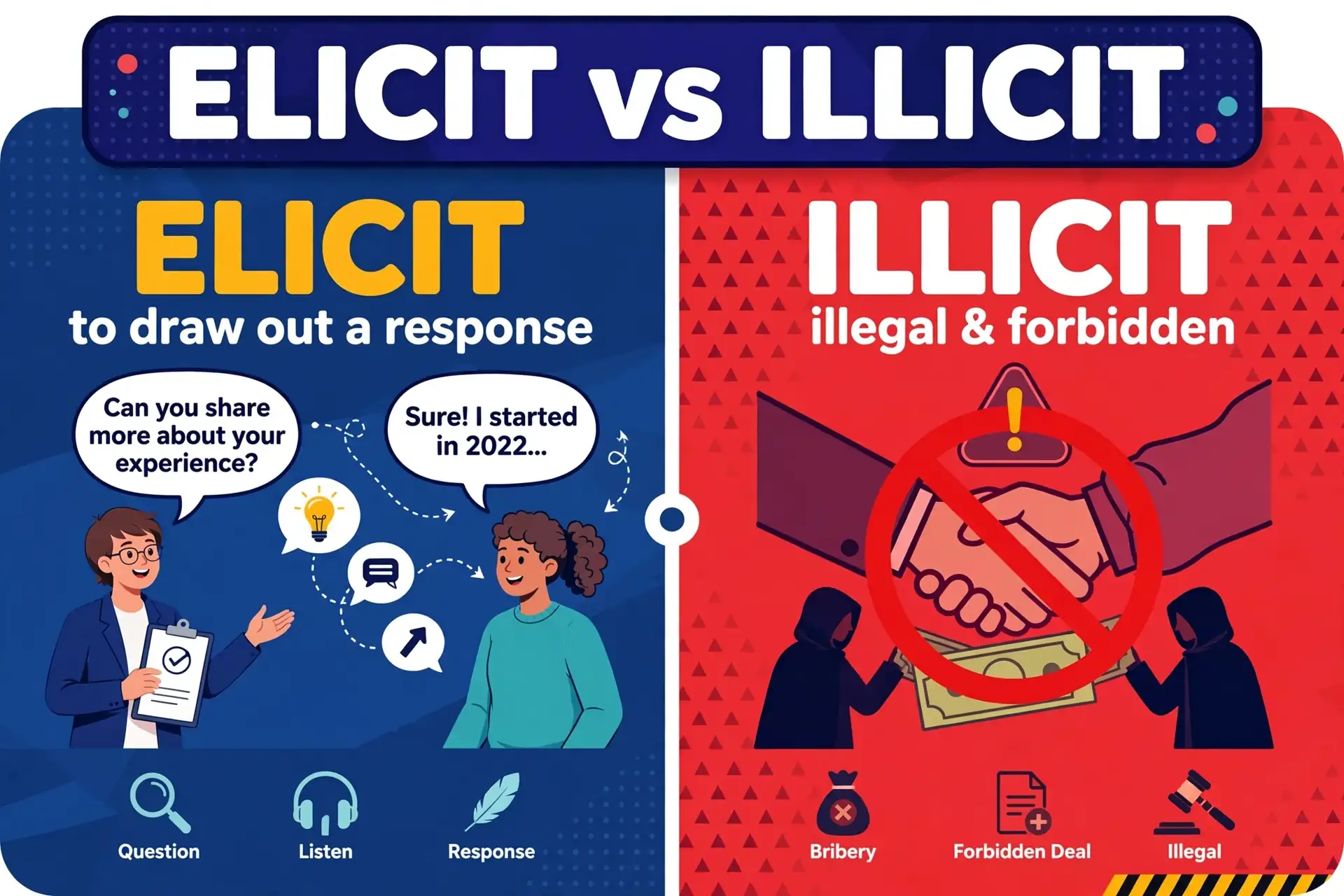
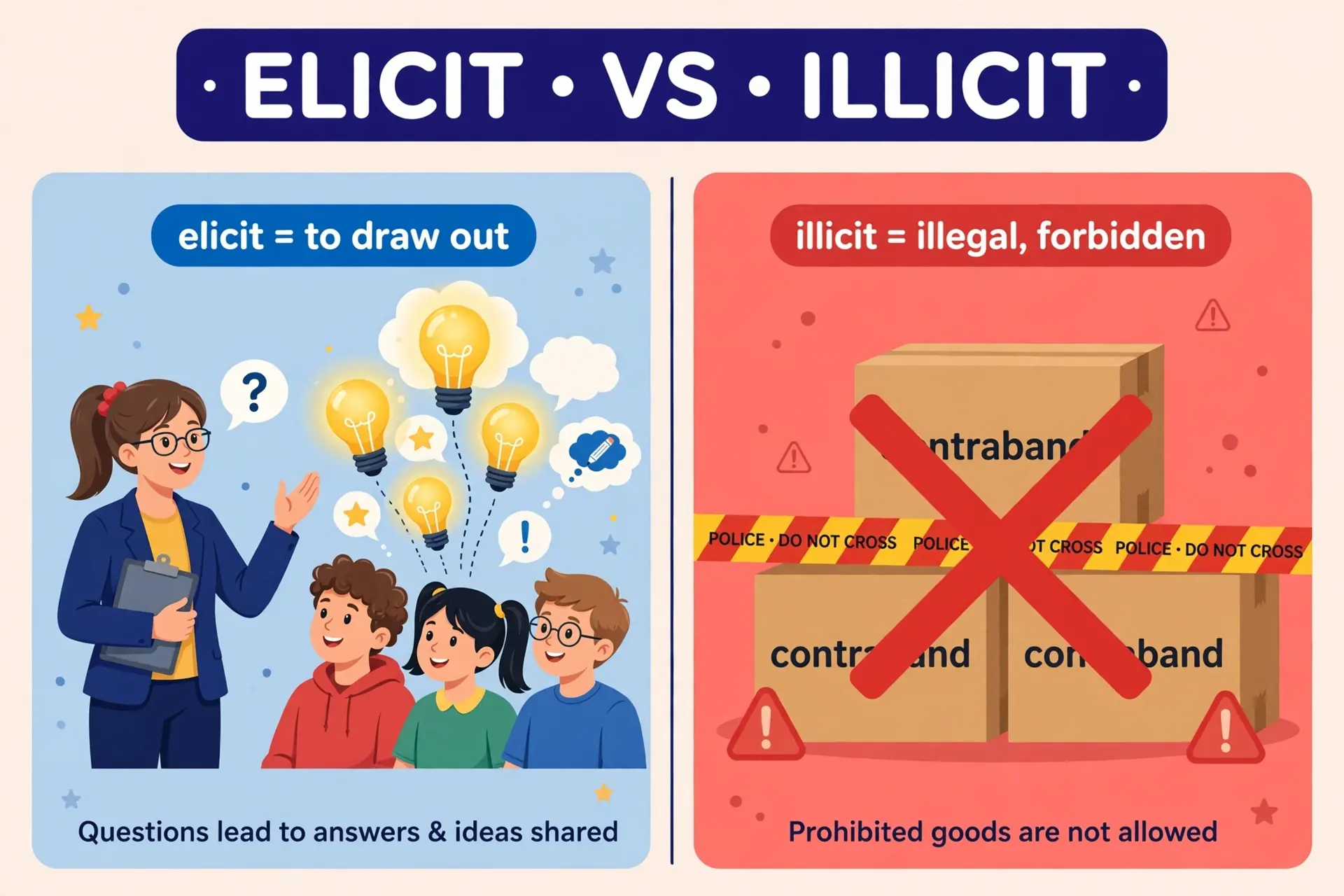
Elicit with an -e- is a verb meaning to draw out — a good question elicits an honest answer. Illicit with an -i- is an adjective meaning illegal or forbidden — an illicit deal breaks the law. One letter at the start decides whether you’re describing an action or a crime.
Quick Answer
| Word | Part of Speech | Main Meaning | Example |
|---|---|---|---|
| elicit | Verb | To draw out a response, answer, or reaction | ✅ “The joke elicited a laugh from the crowd.” |
| illicit | Adjective | Illegal, forbidden, or not allowed | ✅ “He was arrested for illicit trading.” |
Simple rule: If it’s an action that draws something out, it’s elicit with an -e-; if it’s something the law forbids, it’s illicit with an -i- for illegal.
What Does Elicit Mean?
Elicit is a verb meaning to draw out, evoke, or bring forth — a response, a reaction, information, or an emotion. Teachers elicit answers from students, interviewers elicit stories from guests, and a moving scene elicits tears. It comes from the Latin elicere, “to draw out,” and it always describes an action: someone does the eliciting, and something comes out as a result. Merriam-Webster’s entry for “elicit” defines it as “to call forth or draw out,” covering responses from laughter to confessions.
Examples:
- “The comedian’s story elicited roars of laughter.”
- “Her question elicited an honest answer at last.”
- “The survey was designed to elicit feedback from customers.”
- “The movie’s ending elicited tears from half the audience.”
- “Clever interviewing elicits details that direct questions miss.”
The noun form is “elicitation.” Because elicit is always a verb, it conjugates like one: elicits, elicited, eliciting. If the sentence needs an action — someone drawing something out of someone — elicit is the only choice.
What Does Illicit Mean?
Illicit is an adjective meaning illegal, unlawful, or forbidden by rules or custom. It describes things, not actions: illicit drugs, an illicit affair, illicit gambling, illicit trade. The word breaks down neatly — il- (not) + licit (lawful, permitted) — so “illicit” literally means “not lawful.” It never functions as a verb; you can’t “illicit” anything. When news reports mention crackdowns, smuggling, or scandals, illicit is usually the adjective doing the condemning.
Examples:
- “Police seized a shipment of illicit goods at the port.”
- “The novel exposes an illicit affair at the heart of the company.”
- “He was fined for running an illicit betting operation.”
- “The documentary traces the illicit wildlife trade.”
- “Sharing exam answers counts as illicit behavior at most schools.”
The adverb form is “illicitly” (“they met illicitly”), and the noun “illicitness” exists but is rare. If the sentence needs to label something as forbidden, illicit is the word.
Elicit vs. Illicit: Key Differences
| Feature | elicit | illicit |
|---|---|---|
| Word type | Verb (an action) | Adjective (a description) |
| Core meaning | To draw out a response | Illegal or forbidden |
| Starting letter | -e- (evoke, extract) | -i- (illegal, improper) |
| Conjugates? | Yes: elicits, elicited, eliciting | No — adjectives don’t conjugate |
| What it pairs with | A response: “elicit a laugh / an answer” | A noun: “illicit trade / affair / drugs” |
| Example | ✅ “The speech elicited applause.” | ✅ “The speech condemned illicit deals.” |
A verb draws things out; an adjective condemns things as forbidden. The first letter tells you which job the word is doing.
Elicit and Illicit in Real Sentences
At Work
✅ “The manager’s open question elicited three good ideas.”
✅ “The firm fired anyone involved in illicit billing.”
Meetings elicit ideas; compliance departments punish illicit behavior.
In Conversation
✅ “Mentioning the trip elicited a huge smile from her.”
✅ “He joked about his illicit midnight snacks during the diet.”
Everyday speech uses both: drawing out reactions, and confessing small forbidden pleasures.
In the News
✅ “The testimony elicited gasps from the courtroom.”
✅ “Authorities dismantled an illicit smuggling network.”
Courtrooms elicit reactions and expose illicit networks — sometimes in the same headline.
In Writing and School
✅ “The poem’s final stanza elicits a quiet sadness.”
✅ “Copying essays from the internet is illicit at every university.”
Literature elicits feeling; academic rules define what’s illicit.
Common Mistakes
Lookalike words with different jobs cause the same confusion everywhere — the “principal vs principle” classic word-pair mix-up is another verb/noun-style trap, and the “invision vs envision” similar-looking verb pair shows how one letter redirects a whole word. The elicit/illicit traps:
Mistake 1: Writing “illicit” when you mean “draw out”
❌ “The poll was designed to illicit honest opinions.”
✅ “The poll was designed to elicit honest opinions.”
Why: Drawing opinions out of people is an action — a verb job. “Illicit opinions” would mean the opinions themselves are illegal, which is a much darker sentence.
Mistake 2: Writing “elicit” when you mean “illegal”
❌ “He was caught in an elicit gambling ring.”
✅ “He was caught in an illicit gambling ring.”
Why: “Illegal gambling” needs an adjective to describe the ring. Elicit is a verb and can’t modify a noun — “elicit gambling ring” is grammatically broken.
Mistake 3: Using “elicit” as an adjective
❌ “The committee reviewed the elicit funds.”
✅ “The committee reviewed the illicit funds.”
Why: Funds obtained illegally are “illicit funds.” There is no adjective form of elicit — the verb can’t sit in front of a noun as a modifier.
Mistake 4: Confusing “elicit” with “illegal” by sound
❌ “Is it elicit to download that movie?”
✅ “Is it illicit to download that movie?” (or simply: “Is it illegal…?”)
Why: The question asks whether something is forbidden — an adjective’s job. “Is it elicit” accidentally asks whether the movie can draw something out, which makes no sense.
Pronunciation
Elicit and illicit are pronounced identically: ih-LISS-it, rhyming with “explicit.” The stress falls on the second syllable, and the opening vowel is a short unstressed “ih” in both. Your ears can’t tell them apart — only the spelling reveals whether it’s the verb or the adjective.
How to Remember the Difference
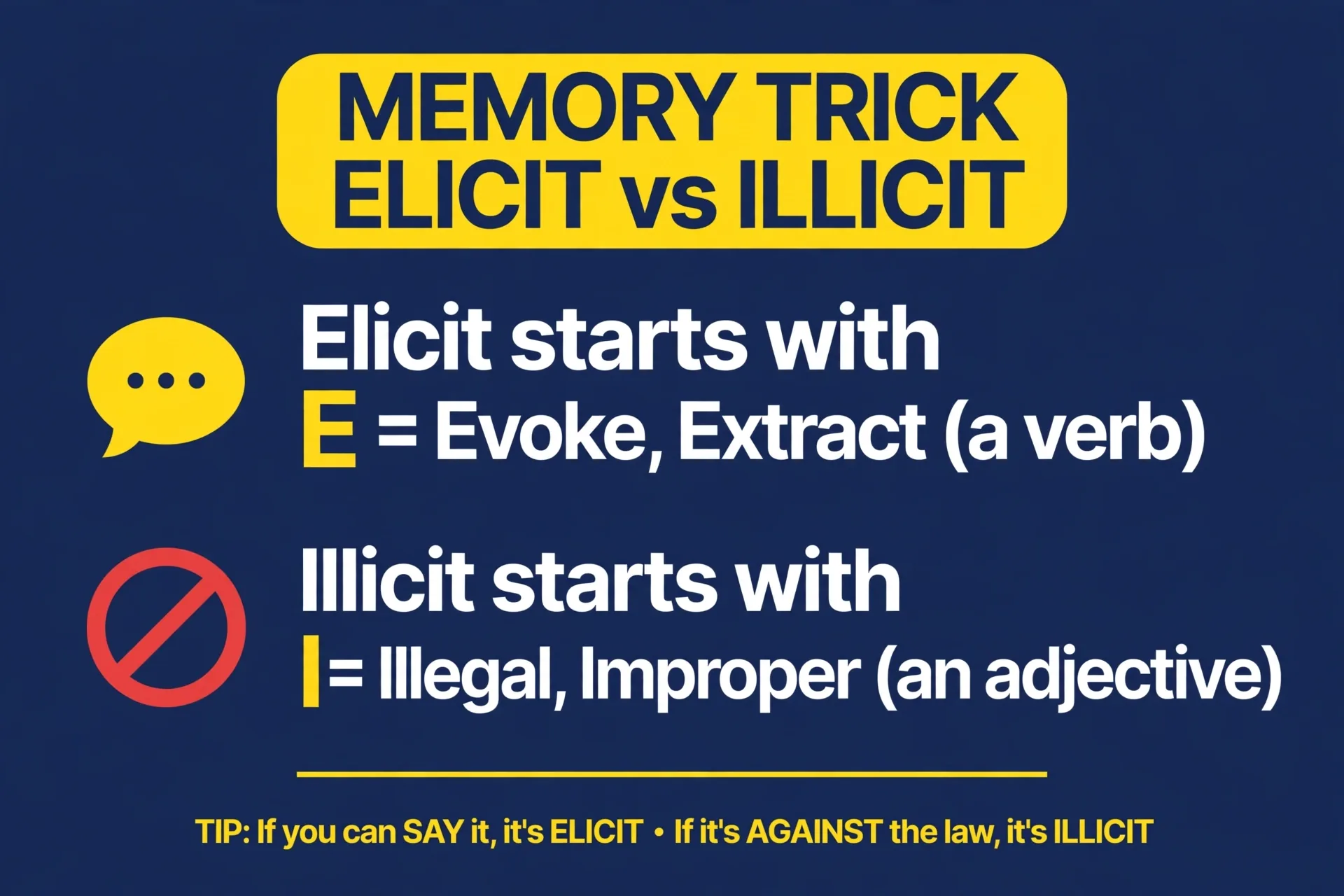
The first letter carries the whole meaning:
- Elicit starts with E — like evoke and extract. It’s the verb that draws things out.
- Illicit starts with I — like illegal and improper. It’s the adjective for what’s forbidden.
- Grammar check: if the sentence needs an action (someone drawing out a response), pick elicit; if it needs a label for something forbidden, pick illicit.
Frequently Asked Questions
Is it elicit or illicit behavior?
Illicit behavior — with an -i-. The phrase means behavior that is forbidden or against the rules, so it needs the adjective. (“To elicit behavior” would mean to draw behavior out of someone — a different idea entirely.)
What is the difference between elicit and illicit?
Elicit is a verb meaning to draw out a response, answer, or reaction. Illicit is an adjective meaning illegal, unlawful, or forbidden. They are homophones — pronounced identically, spelled differently, with unrelated meanings.
Can “elicit” be used as an adjective?
No. Elicit is always a verb. It has no adjective form, so it can never modify a noun the way “illicit drugs” or “illicit trade” does.
What is the noun form of elicit?
“Elicitation” — the act of drawing something out, as in “the elicitation of testimony.” The noun form of illicit is rarely used (“illicitness”), but the adverb “illicitly” is common.
Is “illicit” always about breaking the law?
Usually, but not always. It covers anything forbidden by rules or custom — an illicit affair breaks social rules rather than criminal law, and illicit exam answers break school policy.
Why do elicit and illicit sound exactly alike?
Both reduce their first vowel to a short unstressed “ih” in speech, so e- and i- openings merge. English is full of such pairs; only careful spelling keeps them distinct on the page.
Conclusion
Elicit with an -e- is the verb for drawing out a response, while illicit with an -i- is the adjective for what’s illegal or forbidden. Remember “E for evoke” and “I for illegal,” and you’ll always pick the right one.