Adverse or Averse: What’s the Difference?
Adverse and averse are both real English adjectives, but they do completely different jobs in a sentence. Adverse describes conditions or effects that are harmful or unfavorable — adverse weather, adverse reactions. Averse describes a person who is opposed to something or reluctant to do it — a risk-averse investor avoids risk.
Only two letters differ, yet the meanings never overlap. Adverse points outward at things that go against you; averse points inward at your own reluctance.
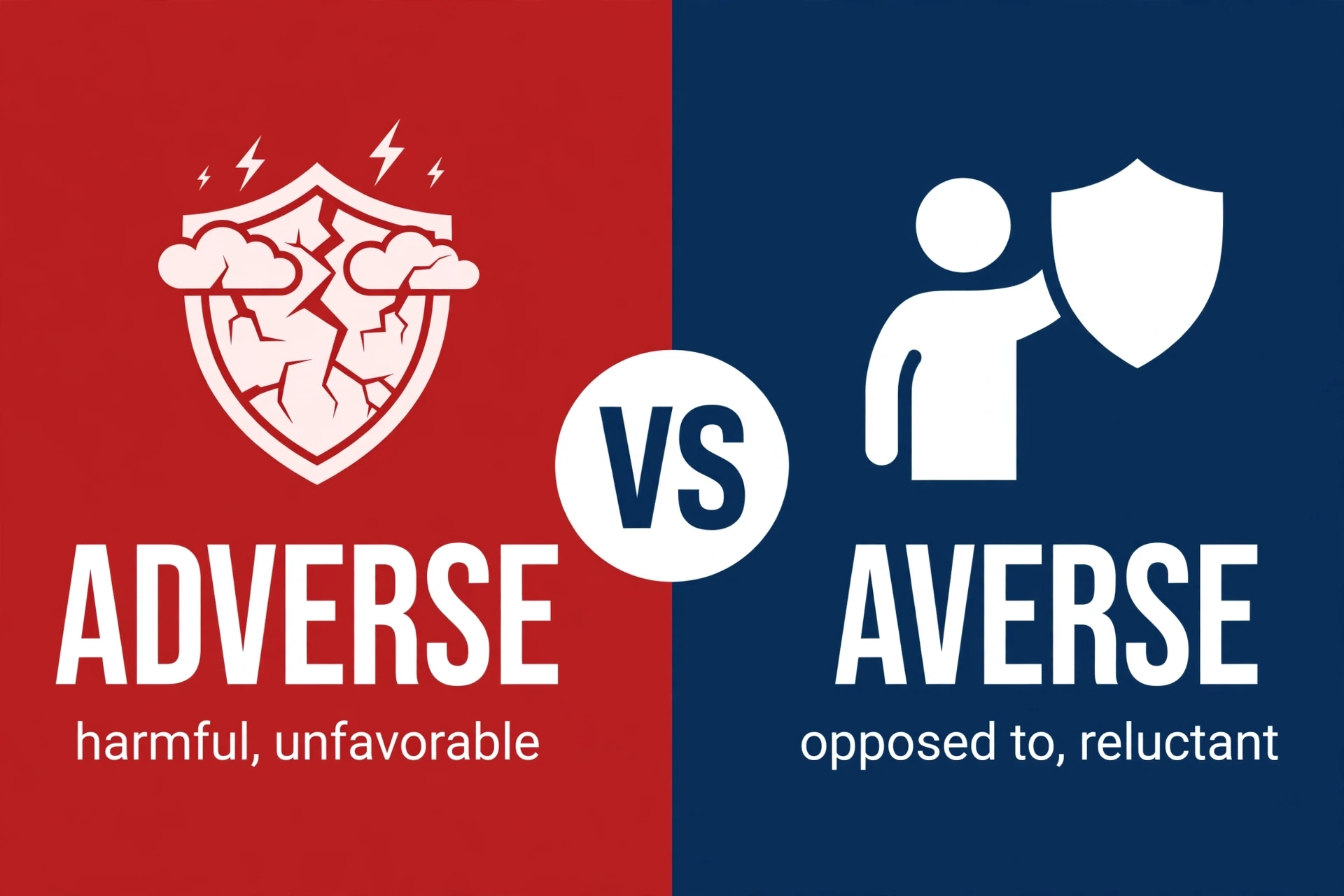
Table of Contents
Quick Answer
| Word | Part of Speech | Main Meaning | Example |
|---|---|---|---|
| adverse | adjective | harmful, unfavorable, going against someone’s interests | “The construction was delayed by adverse weather conditions.” |
| averse | adjective | opposed to something; reluctant or unwilling | “She is averse to taking unnecessary risks.” |
Simple rule: adverse describes bad conditions acting on you; averse describes your own reluctance toward something.
What Does “Adverse” Mean?
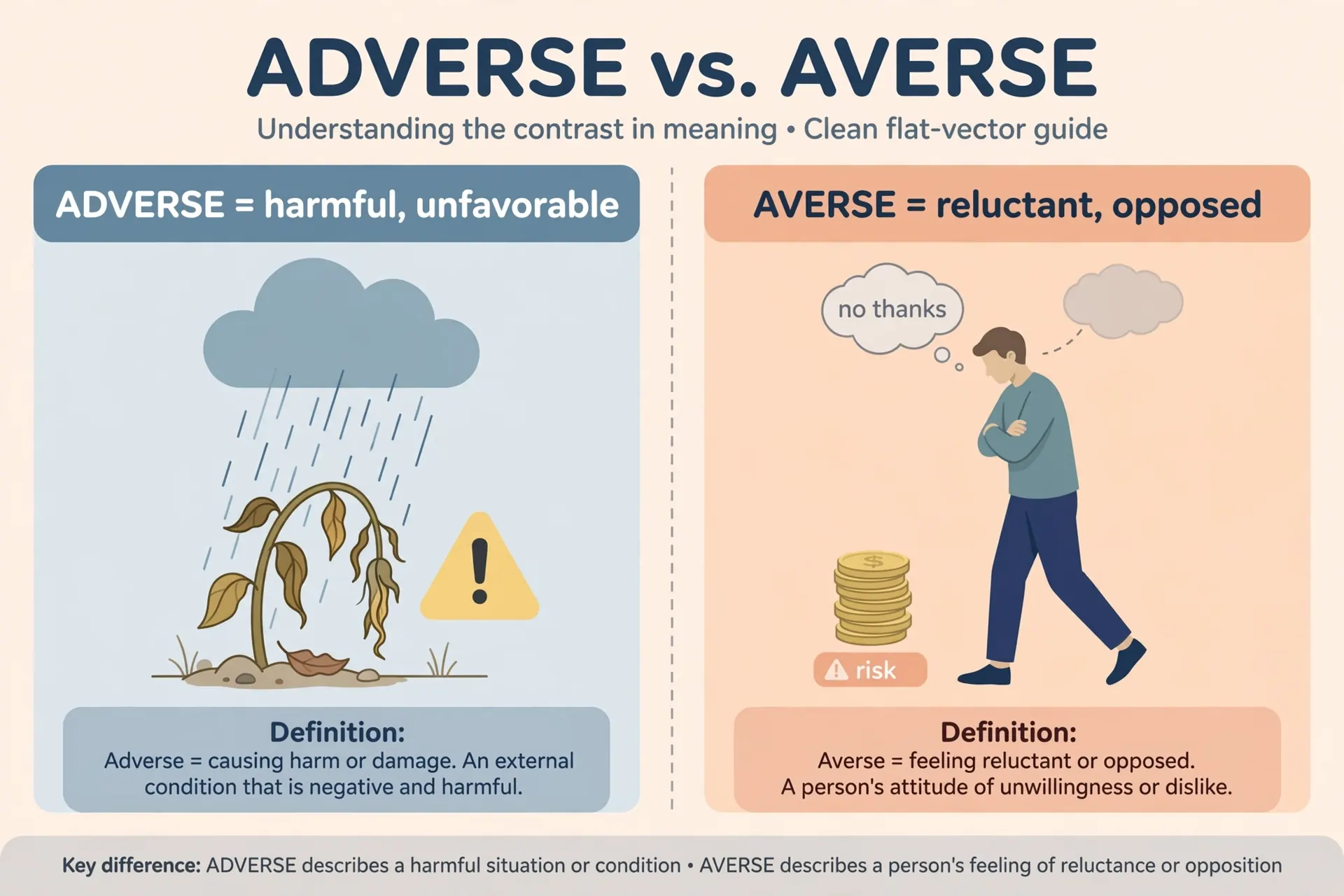
Adverse describes anything that works against you or causes harm. Weather, economic conditions, reactions, and rulings can all be adverse. The word almost always carries a negative charge — an adverse outcome is one nobody wanted.
- “The launch was postponed because of adverse weather along the flight path.”
- “The drug may cause adverse effects in patients with liver problems.”
- “High interest rates created adverse conditions for small businesses.”
- “The court issued an adverse ruling, and the company had to pay the fine.”
- “He stayed calm even when the odds turned adverse in the final round.”
What Does “Averse” Mean?
Averse describes a person’s attitude — being opposed to or unwilling to accept something. It almost always appears with to (“averse to”), and it frequently shows up in the compound form risk-averse, describing people or institutions that avoid risk.
- “She is averse to taking unnecessary risks with her savings.”
- “The board is famously risk-averse and rejects any untested strategy.”
- “He is not averse to a glass of wine with dinner.”
- “Many voters are averse to higher taxes, whatever the promised benefits.”
- “Cats are naturally averse to water and will avoid it whenever they can.”
Adverse vs. Averse: Key Differences
| Feature | Adverse | Averse |
|---|---|---|
| Core meaning | harmful, unfavorable | opposed to, reluctant |
| What it describes | conditions, effects, outcomes, weather, rulings | a person’s attitude or feeling |
| Direction | points outward — things acting against you | points inward — your own resistance |
| Typical grammar | stands alone before a noun (“adverse effects”) | usually paired with “to” (“averse to change”) |
| Tone | negative — something has gone wrong | neutral — a preference, not a disaster |
| Opposite | favorable, beneficial | willing, eager, open to |
You can be averse to risk precisely because you fear adverse outcomes — the two words often appear in the same sentence, describing opposite sides of one situation.
Usage Examples in Real Sentences
At Work
Adverse: “The merger went through despite adverse market conditions.” Averse: “The finance team is averse to borrowing, so the merger was funded in cash.” — The market conditions were harmful; the team was reluctant.
At the Doctor’s
Adverse: “Report any adverse reactions to the medication immediately.” Averse: “Some patients are averse to surgery and ask for other options first.” — The reactions are harmful side effects; the patients are reluctant.
In the News
Adverse: “The airline blamed adverse weather for the cancellations.” Averse: “Travelers averse to flying are choosing trains instead.” — The weather worked against everyone; the travelers are personally opposed to flying.
In Conversation
Adverse: “Nobody likes receiving adverse feedback, but it helps you improve.” Averse: “He’s not averse to criticism — he just wants it to be honest.” — The feedback is unfavorable; he is open to it rather than opposed.
Common Mistakes
This is one of the trickiest adjective pairs in English, up there with effective or affective and principal or principle. The typical slips:
Mistake 1: “Averse weather”
❌ “The match was canceled because of averse weather.”
✅ “The match was canceled because of adverse weather.”
Why: the weather was harmful to the plans — that is adverse. Averse describes a person, and weather has no feelings. See Merriam-Webster’s definition of adverse for the “acting against or in a contrary direction” sense.
Mistake 2: “Adverse to risk”
❌ “The investors are adverse to risk.”
✅ “The investors are averse to risk.”
Why: the investors are reluctant — the feeling belongs to them, so averse is the word.
Mistake 3: Swapping them in “not averse to”
❌ “She is not adverse to an early start.”
✅ “She is not averse to an early start.”
Why: “not averse to” is a fixed idiom meaning she does not mind it — a statement about her attitude, not about harmful conditions.
Mistake 4: Using “adverse” for people
❌ “My manager is adverse toward remote work.”
✅ “My manager is averse to remote work.”
Why: when the subject is a person with an opinion, use averse. Reserve adverse for the conditions, effects, or outcomes themselves.
Pronunciation
Adverse = /ædˈvɜːrs/ — “ad-VURS”, stress on the second syllable, rhymes with reverse (which shares its Latin root). Averse = /əˈvɜːrs/ — “uh-VURS”, also stressed on the second syllable. The two sound almost identical in fast speech — only the first vowel differs — so spelling is the reliable signal in writing.
How to Remember the Difference
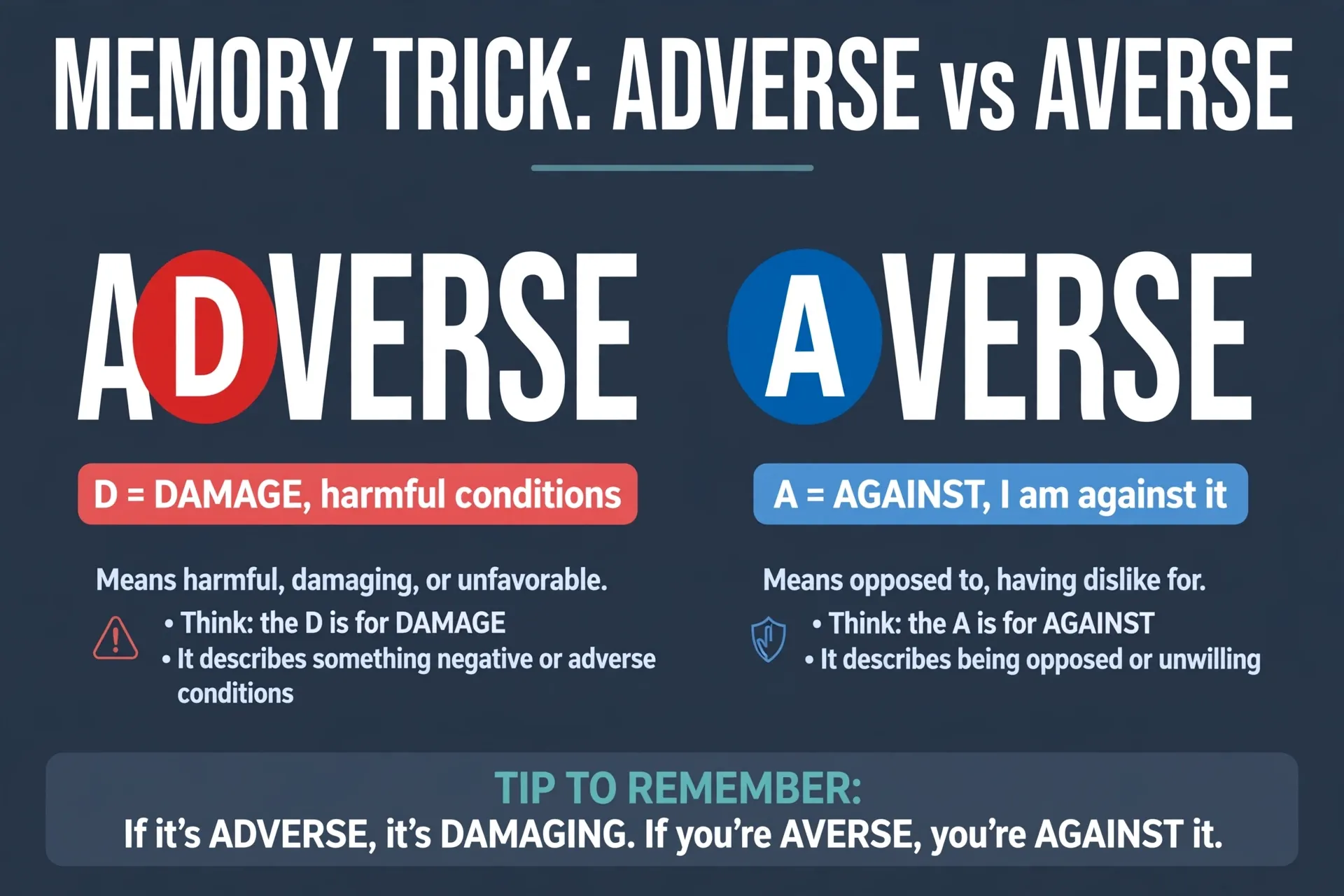
Look at the distinguishing letters. Adverse contains D — think Damage: harmful, unfavorable conditions. Averse pivots on A — think Against: “I am against it.” D for Damage describes the world acting on you; A for Against describes your own reluctance.
- Adverse = harmful or unfavorable conditions (D = Damage).
- Averse = opposed to or reluctant (A = Against).
- Adverse stands alone before a noun; averse takes to.
- Risk-averse people fear adverse outcomes.
Frequently Asked Questions
Is it adverse or averse to change?
Averse to change — the person is reluctant, so it is a statement about attitude. “Adverse change” would mean a change that is harmful in itself, a completely different claim.
What is the difference between adverse and averse?
Adverse means harmful or unfavorable (adverse weather, adverse effects), while averse means opposed to or reluctant (averse to risk). They differ by two letters and never mean the same thing — adverse describes bad conditions, averse describes a person’s resistance.
Can you say “averse effects”?
No — “adverse effects” is the correct phrase, standard in medicine and law for harmful side effects or outcomes. “Averse” cannot describe effects because it describes a person’s feelings, and effects do not have feelings.
Is “risk adverse” correct or is it “risk-averse”?
Risk-averse is correct, usually hyphenated when used as an adjective before a noun (“a risk-averse investor”) and often open otherwise (“she is risk averse”). “Risk adverse” is a common misspelling and always wrong.
What is the opposite of adverse? What is the opposite of averse?
The opposite of adverse is favorable or beneficial — conditions working for you instead of against you. The opposite of averse is willing, eager, or open to — a person who welcomes rather than resists.
Are adverse and averse related words?
Yes — both come from the Latin advertere, “to turn toward,” via adversus (“turned against”). That shared root is exactly why they look alike, but centuries of use have pulled their meanings into completely separate jobs.
Conclusion
Adverse describes harmful, unfavorable conditions that act against you; averse describes your own reluctance or opposition. Remember D for Damage and A for Against, and this pair will never trip you again.