Eyeing or Eying: What’s the Difference? (With Examples)
Good news: both eyeing and eying are accepted spellings of the present participle of the verb “eye.” The difference is frequency and style — eyeing is far more common and the safer default, while eying is a recognized variant that drops the silent e.
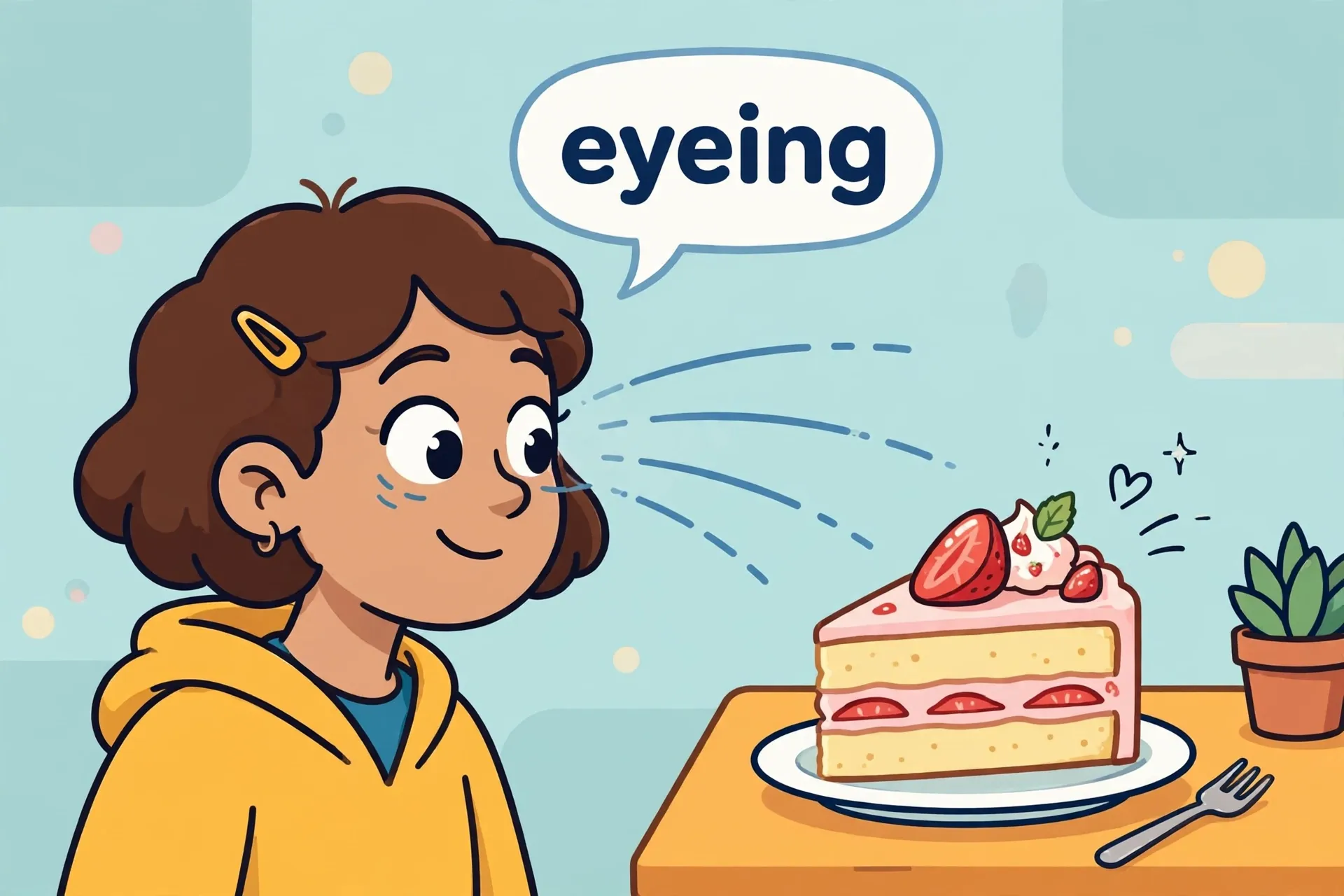
Example: “She was eyeing the last slice of cake.” Example: “She was eying the last slice of cake.” Same meaning, same pronunciation — just pick one and stay consistent.

Table of Contents
Quick Answer
| Word | Part of Speech | Main Meaning | Example |
|---|---|---|---|
| eyeing | Verb (present participle of “eye”) | Looking at something with interest, desire, or suspicion | “He was eyeing the new phone in the shop window.” |
| eying | Verb (present participle of “eye”) | The same meaning — a variant spelling of “eyeing” | “He was eying the new phone in the shop window.” |
Simple rule: keep the whole word EYE and add ING — eyeing is the spelling most readers expect.
What Does Eyeing Mean?
Eyeing is the present participle of the verb “to eye” — to look at something in a deliberate, noticeable way. Merriam-Webster lists eyeing as the standard participle form. The verb carries a few shades of meaning depending on context. It can signal desire, as in hungrily watching something you want. It can signal suspicion or wariness, as in watching someone you don’t trust. And it can signal consideration, as in sizing up an option before deciding.
Examples:
- She was eyeing the last slice of cake all through dinner.
- The guard was eyeing us suspiciously as we walked past.
- They’re eyeing a move to the coast next year.
- He sat in the corner, eyeing every person who entered the room.
- I’ve been eyeing those boots for weeks — I might finally buy them.
What Does Eying Mean?
Eying means exactly the same thing as eyeing — it is simply the e-dropping variant. English often drops a silent e before adding “-ing” (love → loving, make → making), and “eying” follows that pattern. Dictionaries accept it, but it appears far less often in modern books, news, and everyday writing. Because most readers are used to “eyeing,” the shorter form can momentarily look like a typo even though it isn’t one.
Examples:
- She was eying the last slice of cake all through dinner.
- The guard was eying us suspiciously as we walked past.
- They’re eying a move to the coast next year.
- I’ve been eying those boots for weeks — I might finally buy them.
Eyeing vs. Eying: Key Differences
| Feature | eyeing | eying |
|---|---|---|
| Correct? | Yes — accepted everywhere | Yes — an accepted variant |
| Spelling pattern | Keeps the base word “eye” intact | Drops the silent e before “-ing” |
| Frequency | Far more common in modern writing | Rare by comparison |
| Style guide preference | The recommended default | Tolerated, rarely recommended |
| Reader reaction | Looks normal to everyone | Can look like a typo at first glance |
| Meaning | Looking at with interest or suspicion | Identical meaning |
Since the meaning never changes, this is purely a spelling-style decision — and eyeing is the choice that never raises an eyebrow.
Usage in Real Sentences
At Home
Eyeing: “The kids were eyeing the cookie jar before lunch.” / Eying: “The kids were eying the cookie jar before lunch.” Both describe the same longing stare; the first version matches what most readers expect to see.
In Conversation
Eyeing: “‘Stop eyeing my fries,’ she laughed, sliding the plate away.” / Eying: “‘Stop eying my fries,’ she laughed, sliding the plate away.” Spoken aloud there’s no difference at all — the choice only exists on the page.
At Work
Eyeing: “Management is eyeing a second office downtown.” / Eying: “Management is eying a second office downtown.” In professional writing, eyeing is the safer pick because it never gets flagged or questioned.
In Writing
Eyeing: “He stood at the fence, eyeing the storm clouds gathering over the hills.” / Eying: “He stood at the fence, eying the storm clouds gathering over the hills.” Fiction editors overwhelmingly prefer eyeing — consistency with the common form keeps readers inside the story instead of tripping over the spelling.
Common Mistakes
Variant spellings trip people up all over English — writers argue over dieing or dying for the same e-before-ing reason, and cancelled vs canceled shows how two accepted forms can still have a clear favorite.
Mistake 1: “Correcting” eying to eyeing in someone else’s text
❌ Wrong: Flagging “eying” as a spelling error in a colleague’s draft.
✅ Right: Leaving “eying” alone — or suggesting “eyeing” only as a style preference.
Why: Eying is a legitimate variant, not a typo. “Correcting” it introduces an error of your own: misjudging the writer’s spelling.
Mistake 2: Mixing both spellings in one document
❌ Wrong: “She was eyeing the menu. He sat nearby, eying the door.”
✅ Right: “She was eyeing the menu. He sat nearby, eyeing the door.”
Why: Both forms are fine on their own, but switching between them looks sloppy. Pick eyeing (or eying) and use it every time.
Mistake 3: Confusing it with “dying” / “dyeing”
❌ Wrong: “The fabric was dying blue” (meaning colored).
✅ Right: “The fabric was dyeing blue” — and “eyeing,” unlike “dyeing,” never needs its e to avoid confusion.
Why: “Dyeing” keeps its e so readers don’t read “dying.” Eyeing has no such lookalike, which is exactly why the shorter “eying” survives as a variant.
Mistake 4: Using the participle without a helper verb
❌ Wrong: “I eyeing the job listing yesterday.”
✅ Right: “I was eyeing the job listing yesterday.” / “I eyed the job listing yesterday.”
Why: Eyeing needs “was/were/been” or a similar helper; on its own for the past tense, use “eyed.”
Pronunciation
Both spellings are pronounced “EYE-ing” — two syllables, stress on “eye,” then a quick “-ing” like the end of “flying.” It rhymes with “sighing,” “crying,” and “flying.” The silent e in “eyeing” makes no sound at all, which is why dropping it in “eying” changes nothing you hear.
How to Remember the Difference
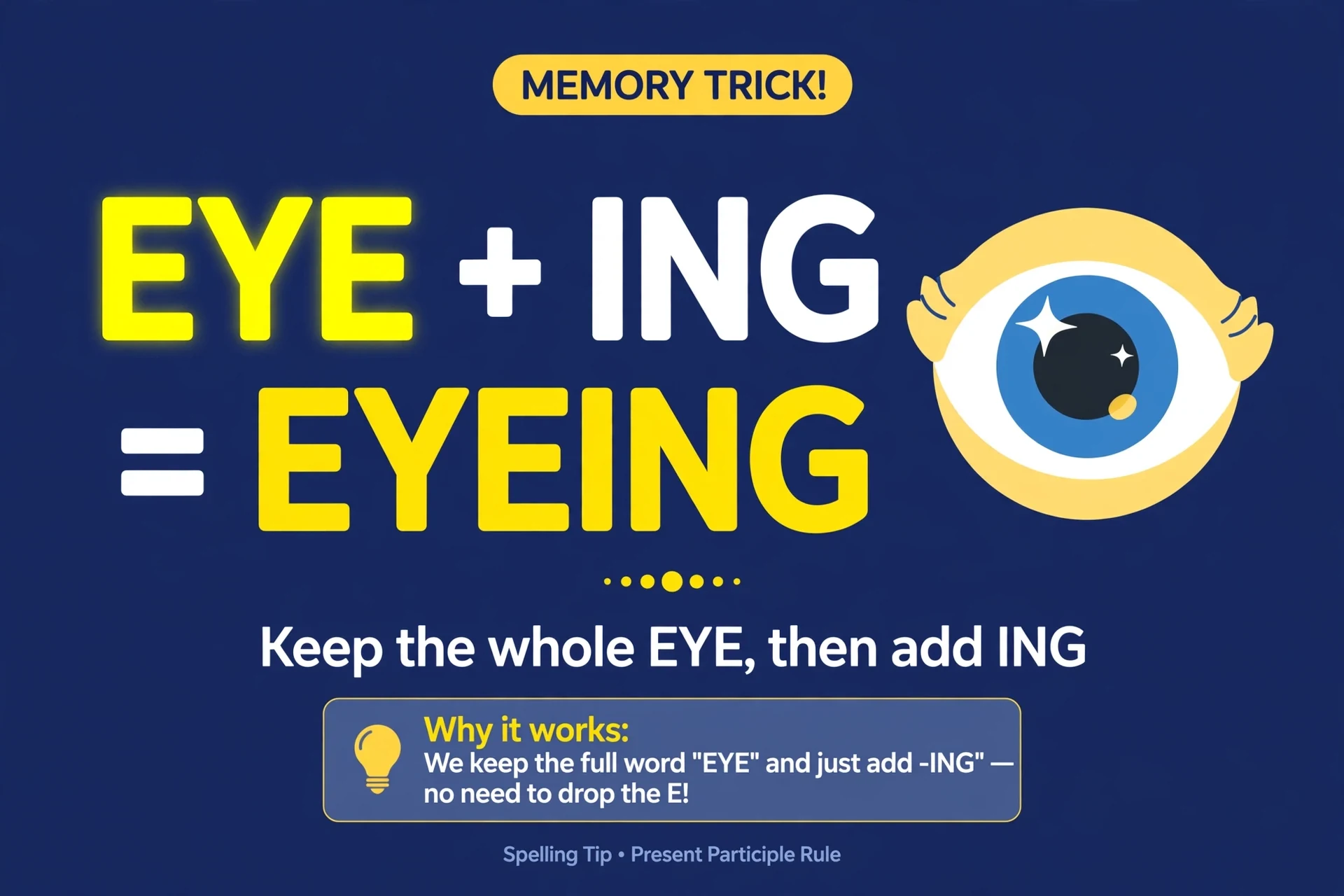
Think of it as simple addition: EYE + ING = EYEING. Don’t overthink the silent e — just keep the whole little word “eye” intact and stick “-ing” on the end. If you can spell “eye,” you can spell “eyeing.”
- Eyeing = the common, recommended spelling — EYE stays whole.
- Eying = accepted variant that drops the silent e.
- When in doubt, keep the e — no reader will ever question eyeing.
Frequently Asked Questions
Is it eyeing or eying?
Both are correct. Eyeing is the more common spelling and the one most style guides recommend, while eying is an accepted variant. If you want the choice nobody will question, use “eyeing.”
Which spelling is more common?
Eyeing, by a wide margin. It dominates modern books, newspapers, and websites. “Eying” appears occasionally — often in older texts or from writers following the drop-the-silent-e pattern — but it’s the clear minority form today.
Why does the “e” sometimes disappear?
Because English routinely drops a silent e before “-ing”: love becomes loving, make becomes making. “Eying” simply applies that same habit to “eye.” The catch is that most writers keep the e here so the little word “eye” stays visible and recognizable.
Will my spellchecker flag “eying”?
Some will, some won’t — it depends on the dictionary your checker uses. That’s a practical reason to prefer eyeing: it passes every spellchecker, while “eying” can trigger a red underline in stricter tools even though it’s legitimate.
What is the past tense of “eye”?
“Eyed” — as in “She eyed him warily.” The past tense has no spelling debate at all, so if the participle choice is stressing you out, rephrasing with “eyed” sidesteps it entirely.
Is there a British vs. American split here?
Not a meaningful one. Eyeing is the preferred form on both sides of the Atlantic. Unlike pairs such as “cancelled/canceled,” this isn’t a regional divide — it’s just a common form and a rare variant everywhere.
Conclusion
Eyeing and eying are both correct, but eyeing is the spelling most readers expect and no spellchecker questions. Keep the whole word EYE, add ING, stay consistent — and this pair stops being a problem.