Flakey or Flaky: What’s the Difference? (With Examples)
Flakey and flaky get mixed up constantly — in texts, on menus, even in published articles. The truth is simple: only one of them is standard English. Flaky is the correct spelling, whether you mean an unreliable friend or a buttery croissant. Flakey is just a common misspelling of it.

Table of Contents
Quick Answer
| Word | Part of Speech | Main Meaning | Example |
|---|---|---|---|
| Flaky | Adjective | Unreliable; or breaking into thin flakes | He is so flaky — he canceled again. |
| Flakey | — | Not a standard word (misspelling of flaky) | ❌ “The pastry was flakey.” |
Simple rule: If you want the spelling everyone accepts, always write flaky.
What Does Flaky Mean?
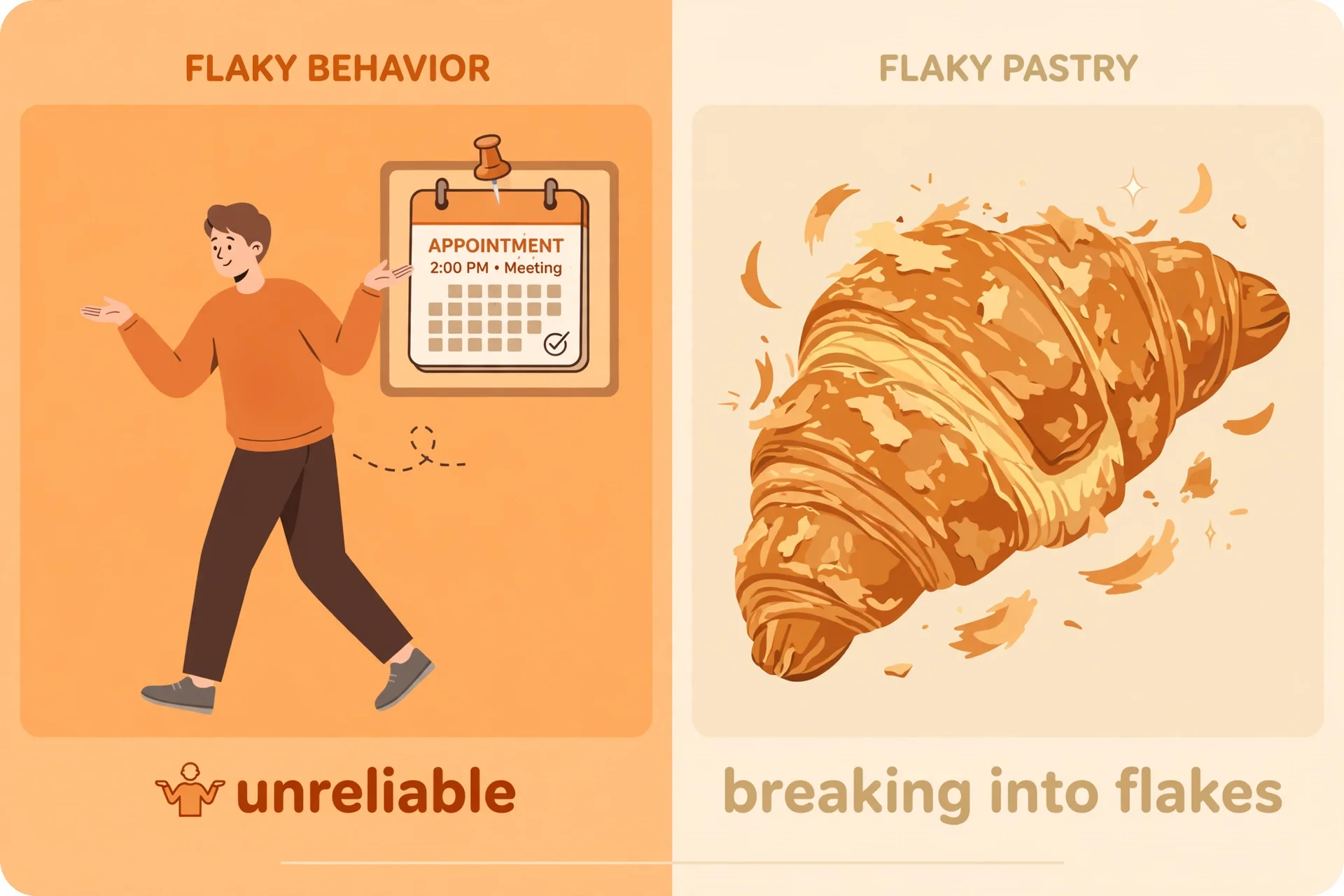
Flaky is an adjective with two main meanings. The first describes a person who is unreliable or inconsistent — someone who cancels plans, shows up late, or forgets promises. The second is literal: something that breaks apart into thin, flat layers, like pastry or dried skin.
Examples:
- My roommate is too flaky to rely on for the road trip.
- She made a flaky pie crust that melted in the mouth.
- The paint on the old fence was flaky and peeling off.
- Don’t be flaky about deadlines — the client is waiting.
- We ate flaky croissants with coffee every morning in Paris.
What Does Flakey Mean?
Flakey is not recognized by standard dictionaries. It is a misspelling of flaky, and it usually appears because of the spelling pattern people see in words like turkey → turkeys or because the “ey” ending looks natural after a “k”. A few brand names and usernames spell it flakey on purpose as a style choice, but in normal writing it reads as an error.
Examples:
- ❌ “The recipe called for a flakey crust.” → ✅ “The recipe called for a flaky crust.”
- ❌ “He’s been really flakey lately.” → ✅ “He’s been really flaky lately.”
- ❌ “Her scalp looked flakey.” → ✅ “Her scalp looked flaky.”
- Some bakery brands spell it “Flakey’s” as a marketing choice — that doesn’t make it standard English.
Major dictionaries such as Merriam-Webster’s entry for flaky list only the single form, with no “flakey” variant.
Flakey vs. Flaky: Key Differences
| Feature | Flaky | Flakey |
|---|---|---|
| Status | Standard, dictionary-approved spelling | Common misspelling |
| Meanings | Unreliable person; breaking into flakes | None of its own |
| US and UK usage | Same spelling on both sides of the Atlantic | Avoid in both |
| Spellcheck | Passes everywhere | Flagged as an error by most spellcheckers |
| Formal writing | Safe to use | Looks sloppy in essays, emails, and reports |
| Brand names | Standard form | Only as a deliberate stylistic choice |
The core distinction is not about meaning at all — it is about correctness. Flaky carries both meanings; flakey carries none.
Flakey or Flaky in Real Sentences
At Home
❌ “This pie dough is too flakey to roll out.”
✅ “This pie dough is too flaky to roll out.”
Pastry talk is where the misspelling shows up most — the “ey” looks right next to “pastry” and “bakery”, but flaky is the only form dictionaries accept.
At Work
❌ “Our supplier has been flakey with deliveries this month.”
✅ “Our supplier has been flaky with deliveries this month.”
Calling a supplier unreliable is already a strong statement; spelling it wrong weakens the email.
In Conversation
“She’s nice but a little flakey — don’t count on her for the airport run.”
Spoken aloud, both sound identical, so the difference only matters in writing.
In Texting
❌ “sry, been super flakey lately”
✅ “sry, been super flaky lately”
Even casual texts read cleaner with the standard spelling — and autocorrect will usually fix it for you.
Common Mistakes with Flakey and Flaky
Mixing up look-alike words is one of the most common spelling problems — just like recieve vs receive or desert or dessert, the error usually comes from writing by sound instead of by rule.
Mistake 1: Writing “flakey” for flaky pastry
❌ “She folded the dough to make it flakey.”
✅ “She folded the dough to make it flaky.”
Why: The adjective is formed from flake + -y, and the e drops out. There is no “ey” version in standard English.
Mistake 2: Writing “flakey” to mean unreliable
❌ “He’s been flakey about the wedding plans.”
✅ “He’s been flaky about the wedding plans.”
Why: The slang meaning uses the exact same standard spelling as the pastry meaning.
Mistake 3: Assuming both spellings are regional variants
❌ “I thought flakey was the British spelling.”
✅ Flaky is standard in both American and British English — there is no regional split here.
Why: Unlike cancelled/canceled, this pair is not a US-vs-UK difference. It’s simply right vs. wrong.
Mistake 4: Trusting a brand name as proof
❌ “The bakery calls itself Flakey’s, so it must be fine.”
✅ Brand names play with spelling on purpose; everyday writing should use flaky.
Why: Marketing spellings (like “Krispy” or “Donut” branding) don’t change dictionary rules.
Pronunciation
Both are pronounced the same way: FLAY-kee — the “a” sounds like the one in day, and the stress falls on the first syllable. It rhymes with shaky, cakey, and flakey-sounding words like achy.
How to Remember the Difference
Remember the word shaky — nobody writes “shakey”. Flaky works exactly the same way: flake drops its e and adds -y, no extra e sneaking back in.

- Flaky = the only correct spelling.
- Flakey = a common misspelling — the extra e is the error.
- Think of shaky: same pattern, no “ey”.
- Flaky works for both meanings: unreliable people and crumbly pastry.
Frequently Asked Questions
Is it flakey or flaky?
It is flaky. That is the only spelling standard dictionaries recognize; flakey is a common misspelling.
Is flakey ever correct?
Not in standard English. Some brand names and usernames use flakey as a deliberate style choice, but in school, work, or published writing it reads as an error.
What does flaky mean when describing a person?
It means unreliable or inconsistent — someone who cancels plans, forgets commitments, or is hard to count on.
Why do so many people write “flakey”?
Because the “ey” ending feels natural after words like cakey, gooey, and honey. But flaky comes from flake + -y with the silent e dropped, following the same pattern as shaky.
Is flakey the British spelling?
No. There is no US-vs-UK split for this word — flaky is correct in both.
Conclusion
Flaky is the standard spelling for both the unreliable-person meaning and the crumbly-pastry meaning. Flakey is a common misspelling with no dictionary backing. Drop the extra e, and you’ll never get it wrong.