Loafs or Loaves: What’s the Difference? (With Examples)
Is it loafs or loaves? For more than one loaf of bread, the answer is always loaves — the F turns to V. Loafs is only ever a verb (he loafs around).
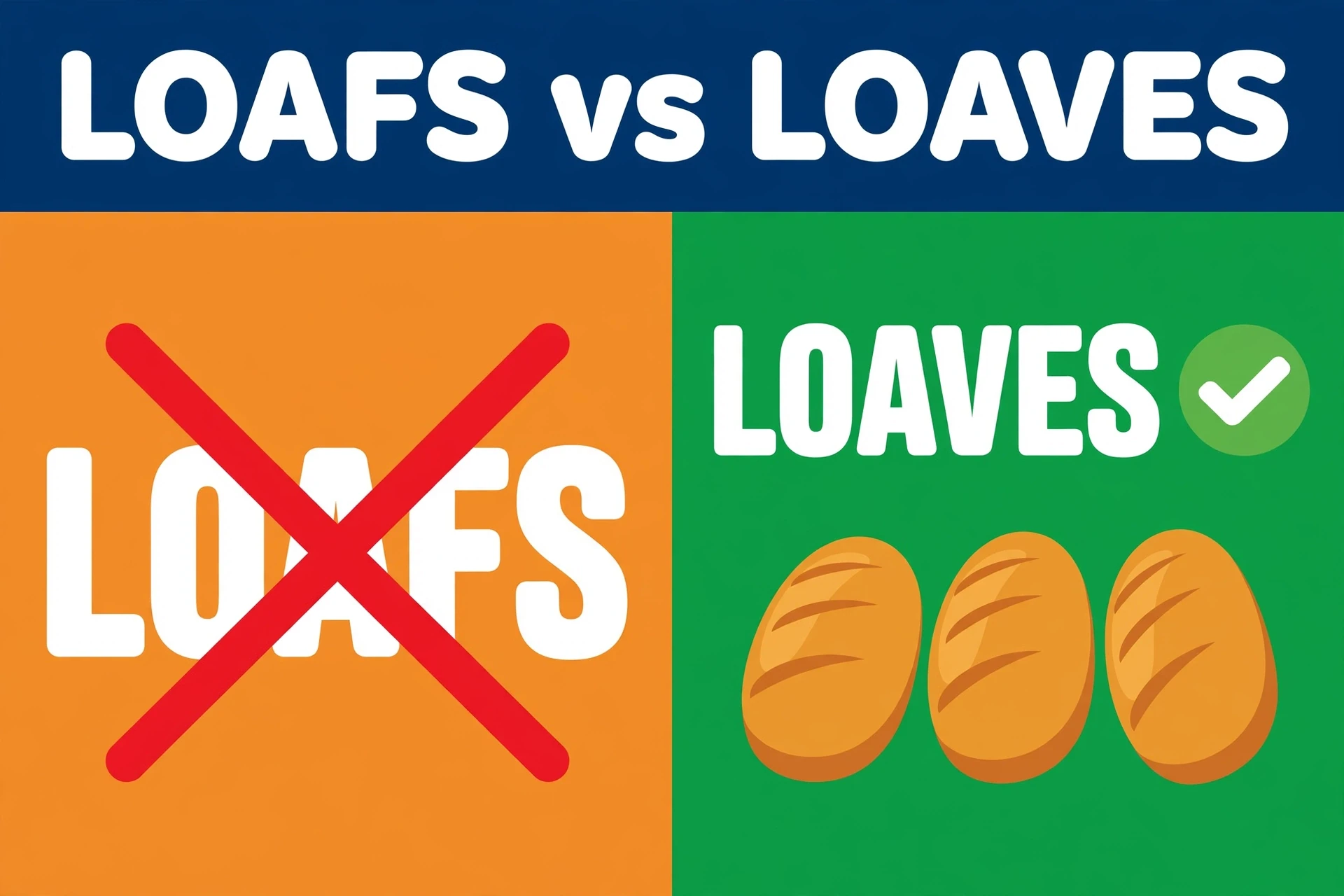
Table of Contents
Quick Answer
| Word | Part of Speech | Correct? | Example |
|---|---|---|---|
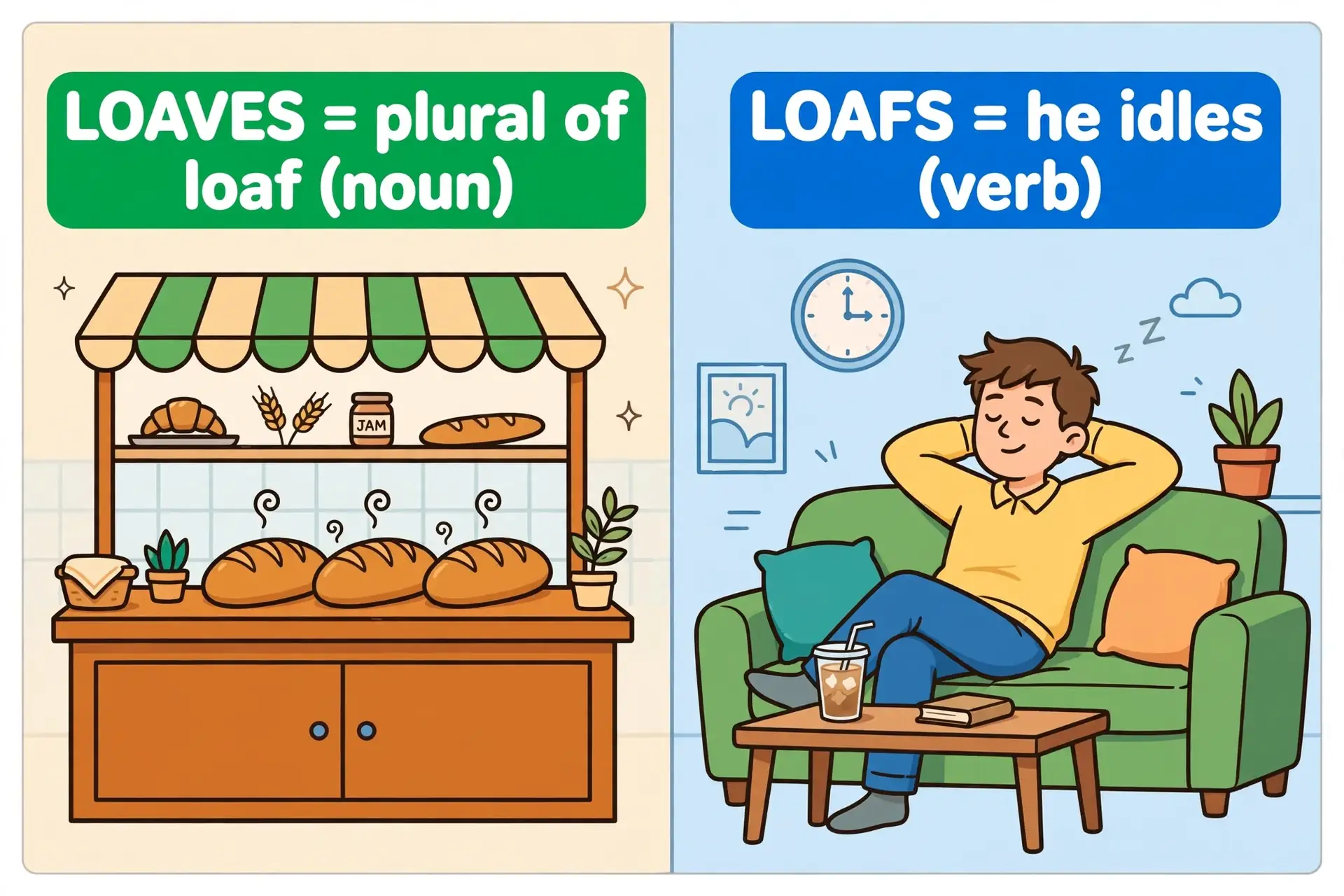
| Loaves | Noun (plural of loaf) | ✅ Correct | “She baked three loaves of bread.” |
| Loafs | Verb (he/she/it loafs) | ⚠️ Only as a verb | “He loafs on the couch all day.” |
Simple rule: for more than one loaf, always write loaves. Loafs as a plural is a misspelling.
What Does “Loaves” Mean?
Loaves is the standard plural of loaf — a shaped mass of bread (or sometimes another food, like meatloaf). It follows the old English pattern where a final F turns to V before the plural ending. Merriam-Webster’s entry for loaf confirms loaves as the plural form.
Examples:
- “The bakery sells fresh loaves every morning.”
- “She sliced two loaves for the party sandwiches.”
- “They loaded the loaves into the delivery van.”
- “Nothing beats the smell of warm loaves from the oven.”
- “He bought three loaves and a dozen eggs.”
The f→v change also applies to compounds: meatloaf becomes meatloaves, and a bakery selling many kinds of bread talks about its loaves, never its “loafs”. New learners sometimes assume English plurals always just add -S, but a small family of old Germanic nouns — leaf, life, knife, wife, wolf, thief, shelf, calf — all switch F to V before -ES. Loaves is simply the bread member of that family.
What Does “Loafs” Mean?
Loafs is not a plural at all. It is the third-person singular of the verb to loaf, meaning to idle or hang around doing nothing — “he loafs“, “she loafs“. When people write “loafs of bread”, they are simply misspelling loaves.
Examples:
- “When he’s not working, he just loafs on the couch.”
- “She loafs through her mornings before starting work.”
- “He loafs around the park instead of jogging.”
- ❌ “Two loafs of bread” — this is the misspelling to avoid.
Loafs vs. Loaves: Key Differences
| Feature | Loafs | Loaves |
|---|---|---|
| Plural of loaf? | No | Yes |
| Part of speech | Verb (“he loafs”) | Noun (plural) |
| “Two ___ of bread” | ❌ Wrong | ✅ Correct |
| Follows the f→v rule? | No (keeps the F) | Yes (F becomes V) |
| Related pairs | — | leaf/leaves, wife/wives, knife/knives |
The F-to-V switch is the whole story: loaves belongs to the noun, loafs belongs to the verb.
Usage in Real Sentences
At the Bakery
Loaves: “The baker pulled six golden loaves from the oven.”
Loafs: “The baker never loafs — he’s up at 4 a.m. daily.”
Same root word, completely different jobs: one counts bread, the other describes idleness.
At Home
Loaves: “We froze two loaves so we’d have bread all week.”
Loafs: “On Sundays he just loafs around the house.”
The noun feeds the family; the verb describes the laziest member of it.
In Conversation
Loaves: “Those sandwich loaves from the corner shop are excellent.”
Loafs: “Stop loafing about and help me carry these.”
British speakers also say “use your loaf” (meaning “use your head”) — where loaf is rhyming slang, and its plural would still be loaves.
At the Bakery Counter
Loaves: “How many loaves should I get for the weekend?”
Loafs: “The assistant loafs behind the counter when the boss is away.”
One sentence asks about bread quantity; the other complains about a lazy employee — the spelling tells you which.
Common Mistakes
The f→v plural pattern confuses many writers — see also heros or heroes and tomatos or tomatoes — so steer clear of these:
Mistake 1:
❌ “She bought two loafs of bread.”
✅ “She bought two loaves of bread.”
Why: the plural of loaf changes F to V: loaves.
Mistake 2:
❌ “The bakery’s loafes are always fresh.”
✅ “The bakery’s loaves are always fresh.”
Why: English drops the F entirely and uses V before -ES — never “loafes”.
Mistake 3:
❌ “He loaves around the house all day.”
✅ “He loafs around the house all day.”
Why: the verb to loaf keeps its F — only the noun plural switches to V.
Mistake 4:
❌ “One loave of bread” (singular with a V)
✅ “One loaf of bread”
Why: the V appears only in the plural; the singular always keeps its F.
Pronunciation
Loaf is pronounced “lohf” (rhymes with oaf), while loaves is pronounced “lohvz” (rhymes with groves and stoves). Loafs the verb sounds like “lohfs”. In connected speech, “two loaves” flows with a soft buzzing V, while “he loafs” ends with a crisp F — native speakers hear the difference even in fast conversation, so getting the spelling right also matches how the words actually sound.
How to Remember the Difference
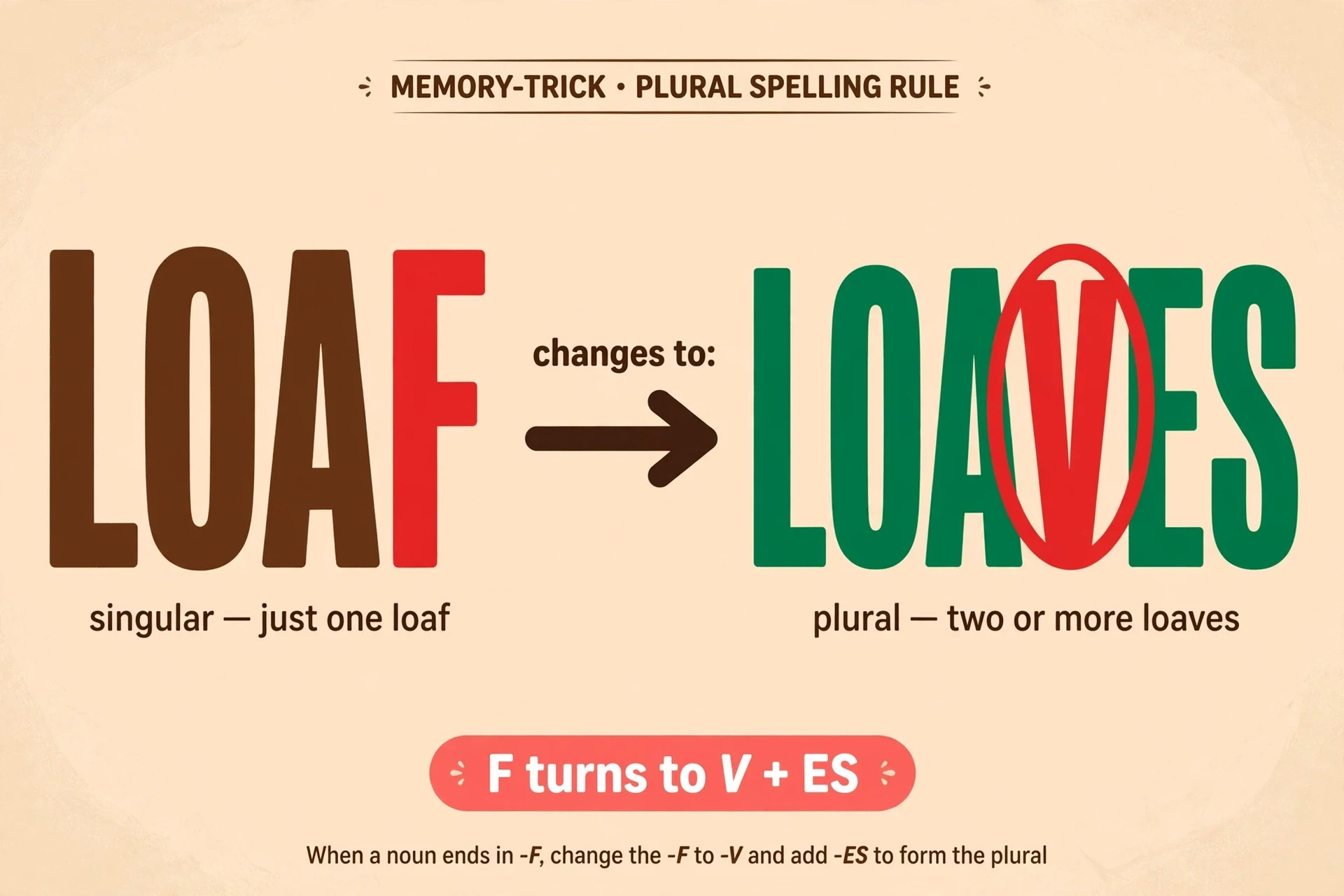
The F turns into a V and takes -ES: loaF → loaVes. Picture the V as a little heart — loaves are made with love.
- Loaves = plural noun (F → V + ES)
- Loafs = verb only (“he loafs around”)
- Same family: leaf/leaves, wife/wives, knife/knives
Frequently Asked Questions
Is it loafs or loaves?
For the plural of loaf, it is always loaves — one loaf, two loaves. Loafs is never the plural; it only works as the third-person singular of the verb to loaf, as in “he loafs around”. If you are counting bread, the V spelling is the only correct choice.
What is the plural of loaf?
Loaves — one loaf, two loaves. Like leaf/leaves and wife/wives, the final F changes to V and the word takes -ES. You will see this listed in dictionaries right after the headword: “loaf, plural loaves”.
Why does the F change to V?
It is a leftover from Old English pronunciation: between vowel sounds, an F was voiced and sounded like V, so “loaves” was pronounced with a V centuries before the spelling caught up. Modern English kept the V in the plural spelling even though the pronunciation rule faded. That is also why the singular loaf keeps its F — the change only happens in the plural.
Is loafs ever correct?
Yes, but only as a verb. “He loafs around on weekends” is perfectly correct — loafs is the he/she/it form of to loaf, meaning to idle. What it can never be is the plural of the noun: “two loafs of bread” is always a misspelling.
What is the plural of meatloaf?
Meatloaves. Compound words built on loaf follow the same f→v rule: two meatloaves, not “meatloafs”. The same goes for any loaf compound — the second half of the word behaves exactly like loaf on its own.
Do other words work like loaf/loaves?
Yes: leaf/leaves, wife/wives, knife/knives, life/lives, wolf/wolves, thief/thieves, and shelf/shelves all switch F to V in the plural. They are all old Germanic words that kept this ancient pattern. Once you know the family, loaves stops looking strange and starts looking consistent.
Conclusion
Loaves is the plural of loaf — the F becomes a V before -ES. Loafs is only ever a verb meaning “he idles”. Keep the V for bread and the F for laziness, and the spelling takes care of itself.