Possum or Opossum: What’s the Difference? (With Examples)
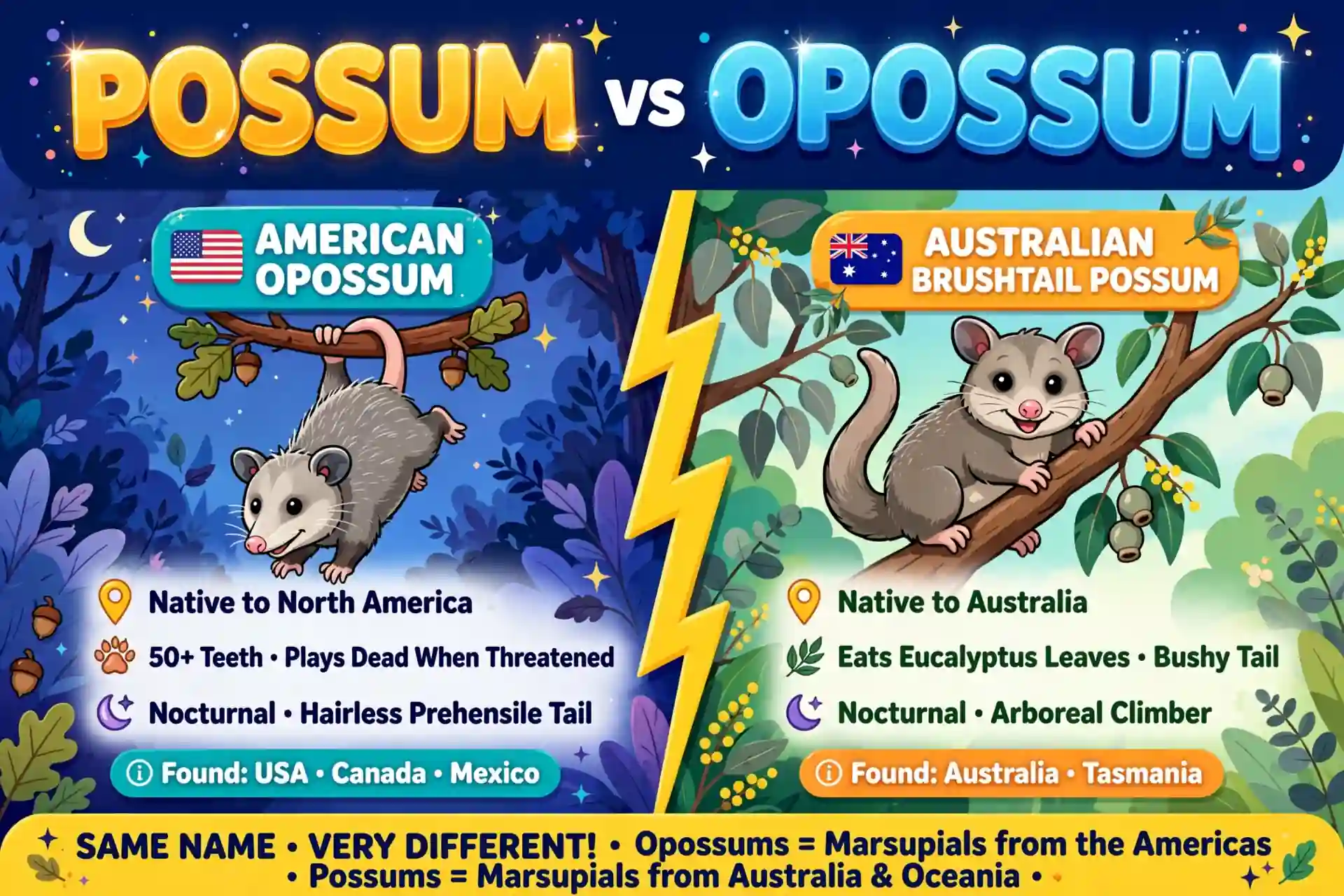
Opossum and possum look like two spellings of the same word, but that single missing letter hides a real distinction. An opossum is the American marsupial that famously “plays possum,” while a possum is an Australian marsupial — although in everyday American speech, “possum” is also a casual shortening of “opossum.” So when your neighbor says a possum raided the trash, they mean the Virginia opossum, not the Australian animal.
Quick Answer
| Word | Part of Speech | Main Meaning | Example |
|---|---|---|---|
| Opossum | Noun | American marsupial, e.g. the Virginia opossum | “An opossum waddled across the lawn.” |
| Possum | Noun | Australian marsupial, e.g. the brushtail possum; also a casual US shortening of “opossum” | “A possum raided our trash.” |
Simple rule: write “opossum” for the American animal in formal writing and “possum” for the Australian animal — and don’t be surprised when Americans call the American animal a “possum” in conversation.
What Does Opossum Mean?
An opossum is a marsupial native to the Americas, most famously the Virginia opossum (Didelphis virginiana) — North America’s only native marsupial. These nocturnal scavengers are best known for “playing possum”: when threatened, they collapse into a death-like trance called thanatosis, complete with bared teeth and a foul smell, until the danger passes. Britannica’s opossum profile describes a range stretching from Canada down through South America.
Examples:
- An opossum wandered across our porch last night, sniffing around the cat food.
- The Virginia opossum is North America’s only native marsupial.
- Cornered by the dog, the opossum simply played possum until it gave up and left.
- Opossums eat thousands of ticks every season, so gardeners are happy to see them.
- A mother opossum carries her babies clinging to her back.
What Does Possum Mean?
A possum is a small, tree-dwelling marsupial native to Australia and nearby islands, such as the common brushtail possum. These are genuinely different animals from American opossums — they belong to the order Diprotodontia, the same group as kangaroos and koalas. In the United States, “possum” also works as an everyday shortening of “opossum” (an aphaeretic form), so context decides which animal a speaker actually means.
Examples:
- Brushtail possums are a common sight in Sydney backyards.
- The possum curled its tail around the branch and dozed through the daylight hours.
- A possum raided our trash and scattered it across the driveway.
- In Texas, everyone just calls the opossum a possum.
- Australian brushtail possums are protected in some areas.
Opossum vs. Possum: Key Differences
| Feature | Opossum | Possum |
|---|---|---|
| Native range | The Americas, from Canada to Argentina | Australia, New Guinea, and nearby islands |
| Animal group | American marsupials (Didelphimorphia) | Australian marsupials (Diprotodontia) |
| Best-known species | Virginia opossum | Common brushtail possum |
| Pronunciation | “POSS-um” — the O is silent | “POSS-um” — identical |
| Famous behavior | “Playing possum” (feigning death) | Nocturnal climbing; some, like sugar gliders, glide between trees |
| US casual speech | Formal name of the American animal | Also nicknames the American animal |
So the O is the marker: it signals the American animal, but dropping it is standard in casual American conversation.
In Nature
Opossum: “An opossum rustled through the dry leaves, hunting for insects.”
Possum: “A brushtail possum clung to the eucalyptus branch overhead.”
In the wild, the words point to genuinely different animals on different continents — no overlap at all.
In Conversation
Opossum: “I saw an opossum under the shed last night.”
Possum: “A possum got into the trash again last night.”
In casual American speech, both sentences can describe the very same animal — “possum” is simply the relaxed way of saying “opossum.”
In Writing
Opossum: “The Virginia opossum is the only marsupial native to North America.”
Possum: “Possums are protected native wildlife in Australia.”
Formal writing keeps the distinction: the O stays for the American animal and drops for the Australian one.
Common Mistakes
Close-sounding words trip everyone up — the same thing happens with quiet vs quite — and possum/opossum has its own classic mix-ups.
Mistake 1: Using “possum” for the American animal in formal writing
❌ Wrong: “The possum (Didelphis virginiana) is North America’s only native marsupial.”
✅ Right: “The opossum (Didelphis virginiana) is North America’s only native marsupial.”
Why: In formal writing, the American animal takes its full name, “opossum.” “Possum” is the casual nickname — fine for conversation, off for an essay.
Mistake 2: Treating them as one species
❌ Wrong: “Australian possums and American opossums are the same animal.”
✅ Right: “Australian possums and American opossums belong to different marsupial groups.”
Why: American opossums are Didelphimorphia while Australian possums are Diprotodontia. They share a name and a pouch, and little else.
Mistake 3: Calling it a US vs UK spelling split
❌ Wrong: “Opossum is just the British spelling of possum.”
✅ Right: “‘Opossum’ names the American animal; ‘possum’ names the Australian one and nicknames the American one in the US.”
Why: This is not a regional spelling difference — it’s two different animals plus one widely used nickname.
Mistake 4: Pronouncing the O
❌ Wrong: “oh-POSS-um”
✅ Right: “POSS-um”
Why: The O in “opossum” is silent, so both words sound exactly alike. The difference lives only on paper.
Pronunciation
Opossum and possum are pronounced the same way: “POSS-um” (/ˈpɒsəm/), rhyming with “blossom.” The opening O is a silent leftover from the word’s early spelling — which is also why dropping it in speech changes nothing, and why Americans shorten “opossum” to “possum” without a second thought.
How to Remember the Difference
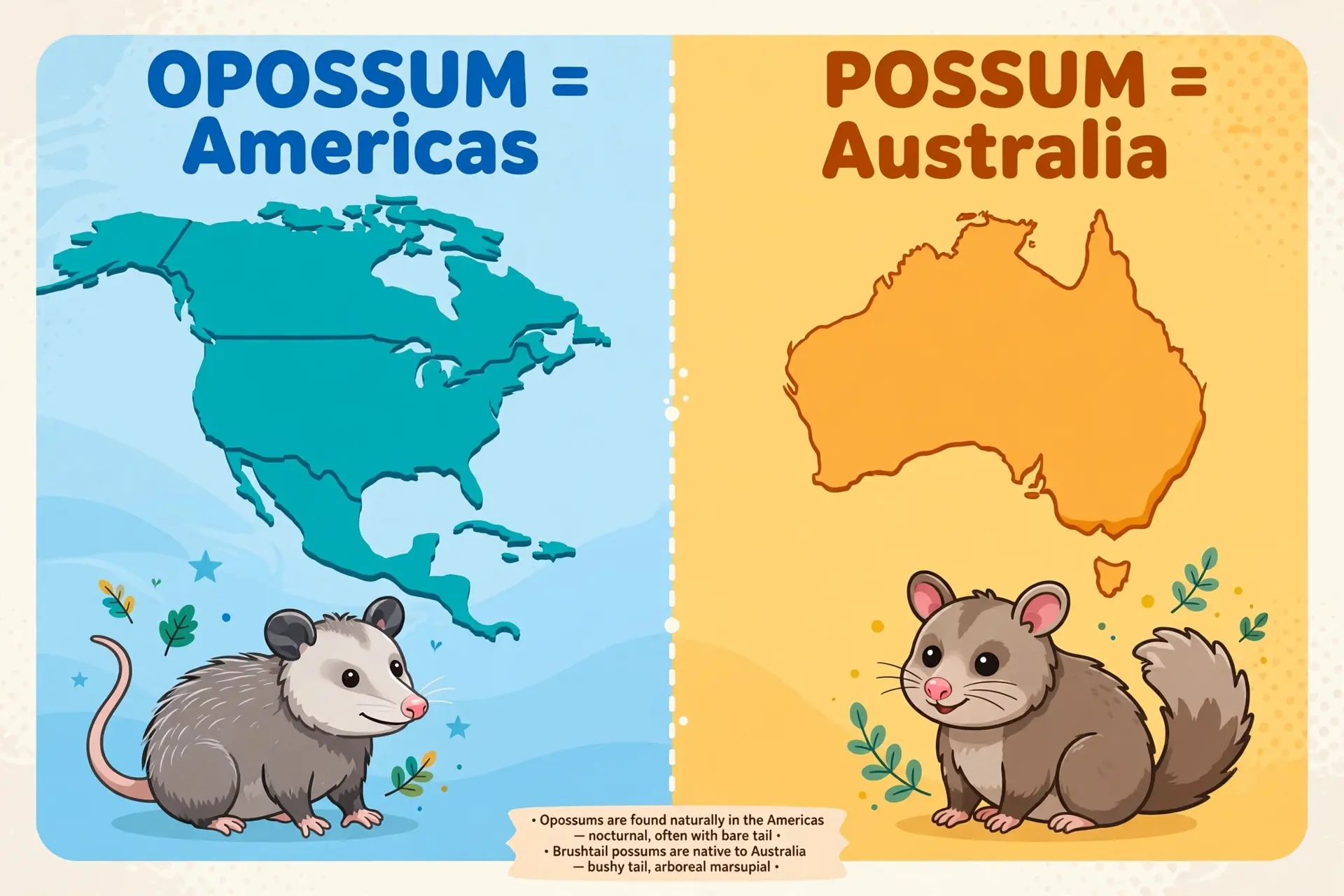
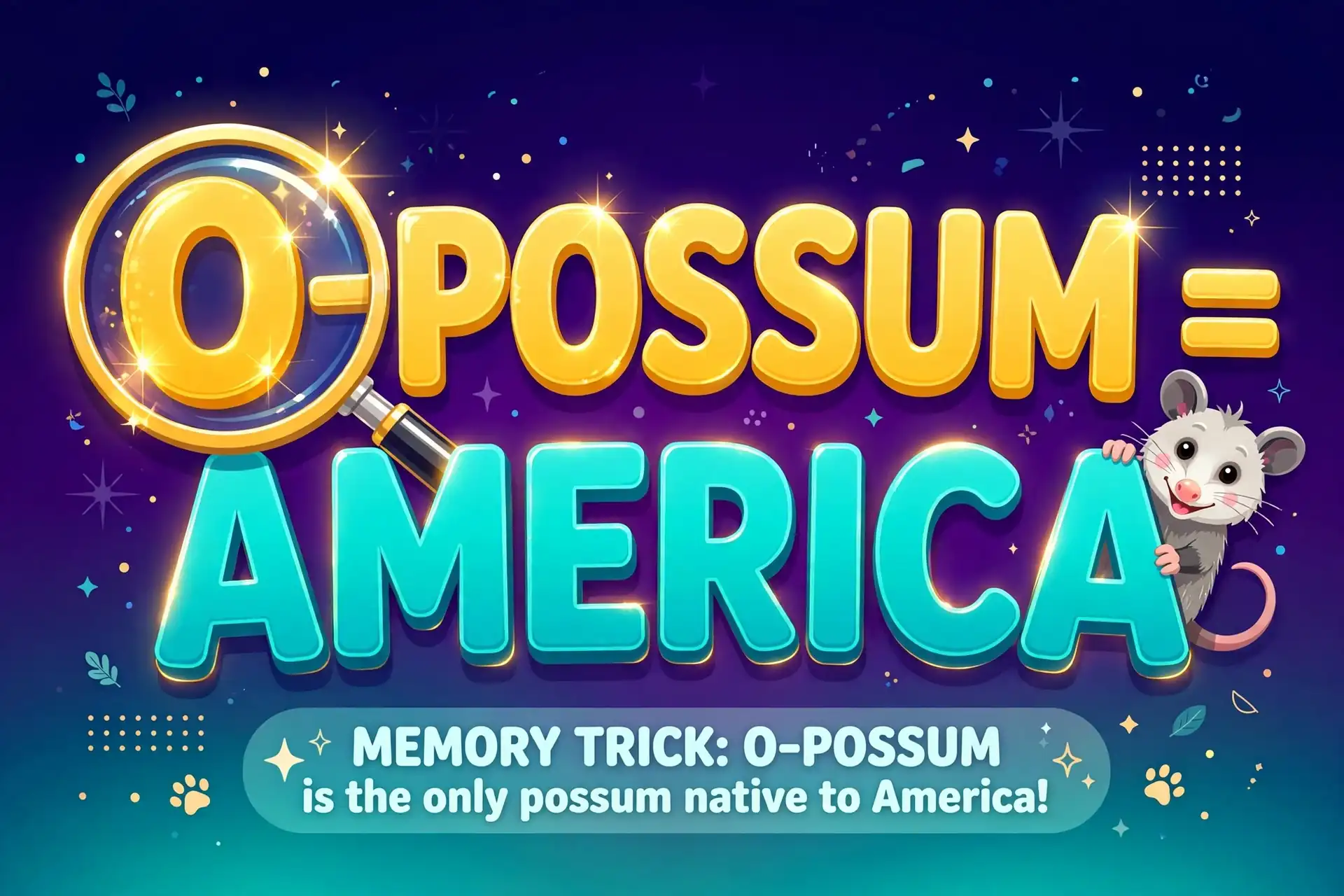
Lock onto the O: the O in opossum marks the Original American animal — “O-possum = America.” No O? Then it’s the Australian possum.
- Opossum (with the O) = American marsupial, North America’s only native one.
- Possum (no O) = Australian marsupial, like the brushtail.
- In casual US speech, “possum” also nicknames the American opossum.
- Both are pronounced “POSS-um.”
Frequently Asked Questions
Is it possum or opossum?
For the American animal, the formal name is “opossum,” though “possum” is a widely accepted casual shortening in the US. For the Australian animal, only “possum” is correct. Lookalike pairs cause this kind of doubt all the time — see whether vs wether for another example.
Are possums and opossums the same animal?
No. American opossums and Australian possums belong to different marsupial orders and live on different continents. The shared name is a historical accident from early explorers who thought the Australian animals resembled the American ones.
What does “playing possum” mean?
It means pretending to be dead, asleep, or unaware — drawn from the opossum’s defense trick of collapsing into a death-like trance (thanatosis) to fool predators. People also use it figuratively, for instance when someone feigns ignorance to dodge a question.
Is the O in opossum silent?
Yes. “Opossum” is pronounced “POSS-um,” identical to “possum,” which is exactly why the two words get tangled so easily.
Which spelling should I use in an essay?
Use “opossum” when writing about the American animal and “possum” when writing about the Australian one. The casual “possum” for the American animal is fine in conversation but avoid it in formal writing.
Conclusion
Technically, opossum is the American marsupial and possum the Australian one — but in the US, “possum” also works as an informal nickname for the American animal. Keep the O for formal writing about the Virginia opossum, drop it for the Australian possum or casual chat, and you will always land on the right word.