Lable or Label: Which Spelling Is Correct?
Table of Contents
“Lable” looks like it could be a real word. It has the same letters as “label,” it sounds exactly the same when spoken, and it appears in typed messages and documents all the time. But it is not a word. The correct spelling is “label,” with the B before the E and the L at the end, and “lable” is one of the most common letter-swap misspellings in English. If your spellchecker has ever underlined it, the spellchecker was right.
The mistake is a small one — two letters in the wrong order — but it is the kind of small error that stands out in a resume, a business email, or a school assignment. “Label” is also a word people use constantly: on food packaging, on clothing tags, on file folders, on medicine bottles, and in everyday speech. It is worth getting right, and fortunately it is easy to fix once you know what to look for.
Quick Answer: “Label” is correct. “Lable” is a misspelling. The right order is L-A-B-E-L — the B comes before the E, and the word ends with L.
Lable or Label — Which One Is Correct?
“Label” is the only correct spelling. It is the form used in every standard English dictionary, in American English and British English alike. “Lable” does not appear in any dictionary as a word of its own. It is simply “label” with the last two letters swapped, the kind of error that happens when fingers move faster than the brain or when a writer is unsure of the letter order and guesses.
Merriam-Webster defines “label” as a slip of paper or other material attached to something to identify it, and the entry confirms the spelling L-A-B-E-L. There is no entry for “lable,” and no dictionary treats it as an accepted variant. The two spellings sound identical, which is exactly why the mistake survives: nothing in speech tells you the letters are in the wrong order, so only reading and writing practice can fix it.
It is worth being clear about this because “lable” is not a rare typo. It shows up in product descriptions, classroom worksheets, office memos, and online posts. Some people write it for years without anyone correcting them, especially in informal settings where spellcheckers are switched off. But in any formal context, it will be marked as an error, and in professional writing it can quietly damage the reader’s impression of the writer. The fix is simple, and this article will show you exactly how to remember it.
What Does “Label” Mean?
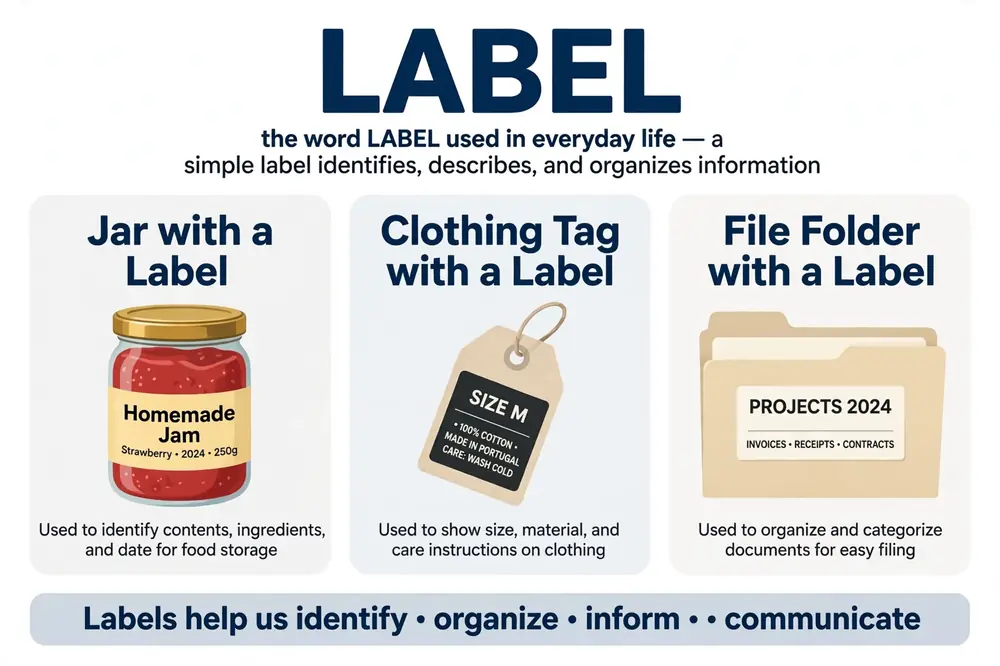
A label is a piece of paper, fabric, plastic, or other material that is attached to something to give information about it. The information is usually a name, a description, instructions, or a warning. The label on a jar of jam tells you what is inside and when it expires. The label on a shirt tells you the size and how to wash it. The label on a medicine bottle tells you the dose and the risks. In each case, the label exists to identify and inform.
The word comes from Old French, where “label” meant a ribbon or a strip of cloth. That history explains the spelling: the word was borrowed into English centuries ago with its letters in the order L-A-B-E-L, and the spelling has stayed that way ever since. There was never a time when “lable” was the standard form. The two letters at the end, E and L, have simply always been in that order.
Beyond physical tags, “label” has a figurative meaning that is just as common. To label something is to describe it or classify it, often in a way that sticks. A person can be labeled “lazy” or “talented.” A product can be labeled “organic” or “handmade.” A news story can be labeled “breaking.” In all of these uses, the spelling is the same, and the core idea is the same too: a label is a name or description attached to something.
Label as a Noun
As a noun, “label” covers a wide range of everyday objects. The most familiar is the sticky tag on a product: a food label, a price label, a shipping label, a name label on a school bag. But the noun goes further than that. In music, a record label is the company that produces and sells an artist’s recordings. In fashion, a label is a brand name, and “designer label” means expensive, high-status clothing. In computing, a label is a name given to a file, a folder, or a section of code.
Here are some common noun phrases built around “label”:
- a warning label on a bottle of chemicals
- a nutrition label on the back of a cereal box
- a mailing label on a parcel
- a designer label on a handbag
- a record label signing a new band
- a luggage label on a suitcase
- a price label in a shop window
In each of these, “label” names a thing that identifies or describes something else. The word is so common that most people read it dozens of times a day without noticing it — on food, on clothes, on screens. That familiarity is actually part of the problem: because the word is everywhere, people rarely stop to check how it is spelled, and the wrong version can slip into their writing unnoticed.
Label as a Verb
“Label” is also a verb, and it is used just as often. To label something is to attach a label to it, or to describe it with a particular word. A shop worker labels the shelves with prices. A teacher labels the parts of a diagram. A journalist might label a policy “controversial.” The verb form follows the same spelling, and it follows the standard rules for adding endings: “labeled” or “labelled,” “labeling” or “labelling.”
That last point is worth a closer look, because it confuses many writers. In American English, the past tense and the “-ing” form use one L: “labeled” and “labeling.” In British English, the L is doubled: “labelled” and “labelling.” Both are correct in their own variety of English. The difference comes from the doubling rule: British English doubles the final L before a vowel suffix, American English usually does not. The base word, however, is spelled “label” in both varieties. “Lable” is wrong in American English and wrong in British English.
The verb is often used figuratively, and that figurative use is where tone matters. Saying someone “labeled the idea as foolish” is neutral reporting. Saying someone “was labeled a troublemaker” suggests an unfair judgment. The word carries the idea that a description, once attached, is hard to remove — just like a sticky label. Writers who use it well are aware of that weight.
Examples of “Label” in Sentences
Here are examples of “label” used correctly, as both a noun and a verb:
- Please read the label before you take the medicine.
- She put a label on every box before the move.
- The shirt had a label that said “dry clean only.”
- He works for a small independent record label.
- The shop labels all of its products with clear prices.
- Do not label the whole group based on one person’s mistake.
- The wine label showed the year and the region.
- She was labeled the best player on the team after the final match.
- Check the label on the jar for the expiry date.
- The company labels its packaging in three languages.
Read through these sentences and notice how the spelling looks the same every time. L-A-B-E-L. The consistency is the point: once you train your eye on the correct order, the wrong order starts to look strange. That is the moment the spelling is fixed for good.
Why Do People Write “Lable”?
The main reason is that the two letters at the end of “label” are easy to swap. The sounds “el” and “le” are very close, and when people spell by sound, they often put the letters in the wrong order. This is the same kind of error behind other famous misspellings. For a similar letter-order mistake, see our guide to separate vs seperate, where the middle letters get mixed up in exactly the same way.
Typing speed is the second reason. When people type quickly, their fingers can transpose two letters without the writer noticing, especially at the end of a word. “Lable” is one of the most common transposition errors in English because the E and L sit next to each other and the mistake still produces something that looks like a word. Spellcheckers usually catch it, but not every app has one, and not everyone reads the red underline.
A third reason is that some people simply never learned the correct order. “Label” is a word most people learn by sight rather than by rule. Nobody sits down and teaches the letter order of “label” the way they teach the doubling rule for “putting.” So if a person first sees or writes “lable” and nobody corrects it, the wrong version can settle in and feel right. The cure is the same as for any habit: a clear rule, a memory trick, and a little practice.
It is also worth noting that “lable” is not the only letter-swap error of this kind. English is full of them: “definately” for “definitely,” “seperate” for “separate,” “occured” for “occurred.” Each one has its own fix, but the underlying lesson is the same — sounding a word out is not always enough, and the letter order has to be learned. Our guide to definitely vs definately covers another word where the letters get mixed up in the middle.
How to Remember the Correct Spelling
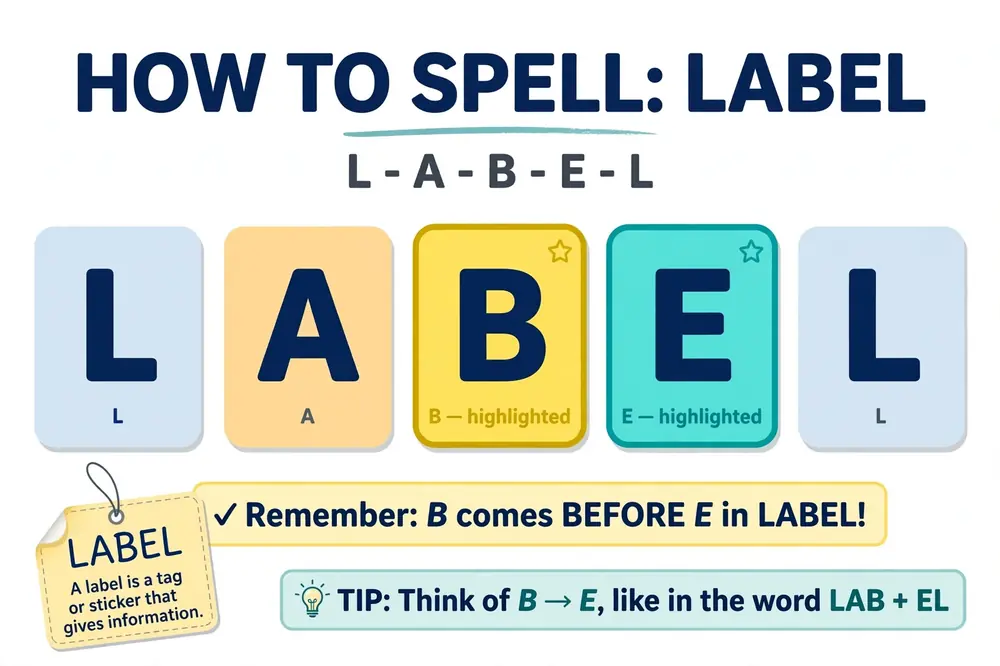
The best memory trick for “label” is the word “bel” inside it. Look at the spelling: L-A-B-E-L. The middle three letters spell “bel,” as in the name “Bel” or the word “bell” without its second L. If you remember “bel,” you remember that the B comes before the E, and the word ends with L. Say it to yourself: “la-BEL.” The stress falls on the second syllable, and that syllable is “bel.” “Lable” breaks that pattern completely — it has no “bel” in it at all.
Another trick is to connect the word to its meaning. A label is something you stick on a thing, and the word “label” itself ends with “el,” like the word “shelf” or “label” on a “shelf.” That is a weaker link, so the “bel” trick is the one to rely on. Write the word five times, saying “la-bel” out loud each time, and the correct order will start to feel automatic.
A final check that works in the moment: if you are unsure, ask yourself whether the word ends in “el” or “le.” Words ending in “el” include “label,” “travel,” “model,” and “cancel.” Words ending in “le” include “table,” “apple,” and “little.” There is no rule that tells you which ending a word takes — it has to be learned word by word — but once you know “label” belongs to the “el” group, the doubt goes away. The safest habit is simply to picture the word “bel” in the middle and let the rest follow.
Frequently Asked Questions
Is “lable” a word?
No. “Lable” is not a word in standard English. It is a misspelling of “label,” with the final E and L swapped. No dictionary lists it as an accepted spelling.
Is “lable” correct in British English?
No. British English spells the word “label” as well. The only British-American difference is in the verb forms: British English uses “labelled” and “labelling” with a double L, while American English uses “labeled” and “labeling” with a single L. The base word is “label” in both.
What is the difference between “label” and “lable”?
There is no difference in meaning, because “lable” has no meaning — it is simply a misspelling. “Label” is the correct word, used as a noun for a tag or sticker that identifies something, and as a verb meaning to attach such a tag or to describe something with a particular word.
How do you spell the past tense of “label”?
In American English, the past tense is “labeled” with one L. In British English, it is “labelled” with two L’s. The “-ing” forms follow the same pattern: “labeling” in American English and “labelling” in British English. Both forms are correct in their own variety.
What is a good trick to remember “label”?
Remember the word “bel” inside it: L-A-BEL. Say “la-BEL” out loud, with the stress on the second syllable. If you can see “bel” in the middle, you know the B comes before the E and the word ends with L — and “lable” will look wrong every time.