Time Flies or Time Flys: Which Spelling Is Correct?
The correct spelling is “time flies.” “Time flys” is a misspelling — the word “flys” is not correct English in any context. The confusion is easy to understand: “fly” ends in “y,” and many people simply add an “s” to make the third-person form. English has a different rule for verbs ending in a consonant plus “y,” and that rule gives us “flies.” This guide gives you the verdict, explains the rule in plain language, and shows you how to remember it for good.
Is It “Time Flies” or “Time Flys”?
“Time flies” is correct. “Time flys” is wrong. There is no exception, no dialect, and no informal use where “flys” is accepted — British and American English agree on this one.
| Spelling | Correct? | Why |
|---|---|---|
| Time flies | Yes | Follows the consonant + y rule (fly → flies) |
| Time flys | No | Breaks the rule; “flys” is not a word |
If you have written “time flys” in an essay, a post, or a message, fix it to “flies” and the sentence is correct. The rest of this guide explains why the rule works this way, so the mistake does not come back.
What Does “Time Flies” Mean?
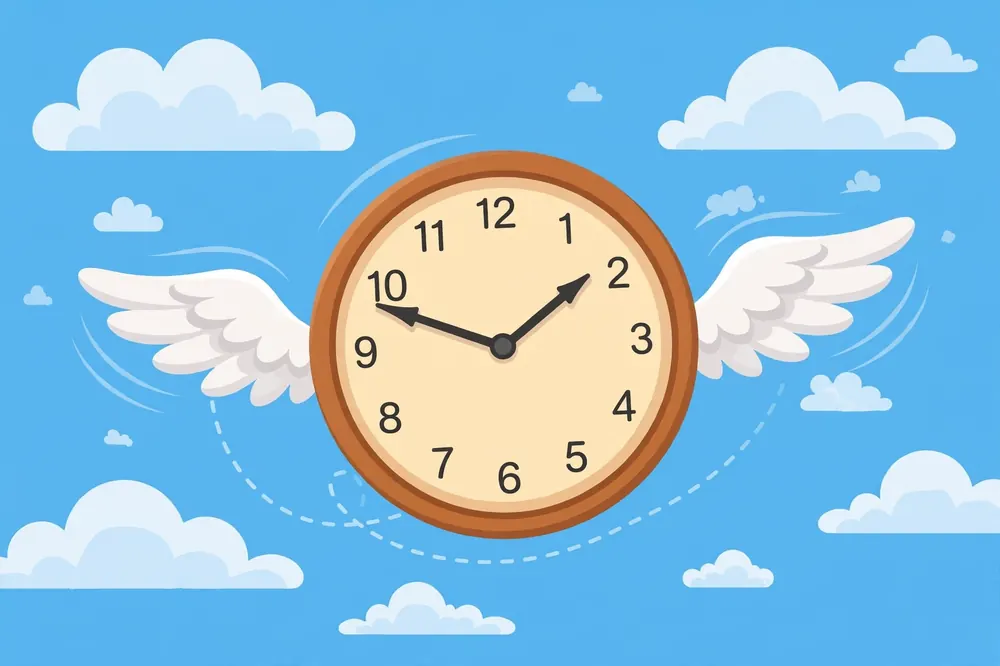
“Time flies” is an idiom. It means that time seems to pass very quickly, usually when you are busy or enjoying yourself. Nobody means that time has wings. The phrase describes the feeling that hours or years slipped past faster than expected.
Here are some examples of the idiom in real sentences:
- Time flies when you are having fun.
- I cannot believe the year is over already — how time flies!
- Time flies when you are busy with work you love.
- It feels like only yesterday that we started school, but time flies.
People reach for this idiom at birthdays, school reunions, graduations, and the last day of a holiday — any moment when the past suddenly feels close and the present feels short. A parent watching a child start school says it; so does a friend meeting an old classmate after ten years. The feeling is the same in every case: the days passed quietly while nobody was counting them, and now the distance between “then” and “now” feels surprisingly small.
The idea behind the phrase is very old. It comes from the Latin phrase tempus fugit, meaning “time flees,” which appears in the Roman poet Virgil’s Georgics. English speakers have used “time flies” in its current form for hundreds of years, and it is now one of the most common idioms in the language.
Why Is “Flies” Correct and Not “Flys”?
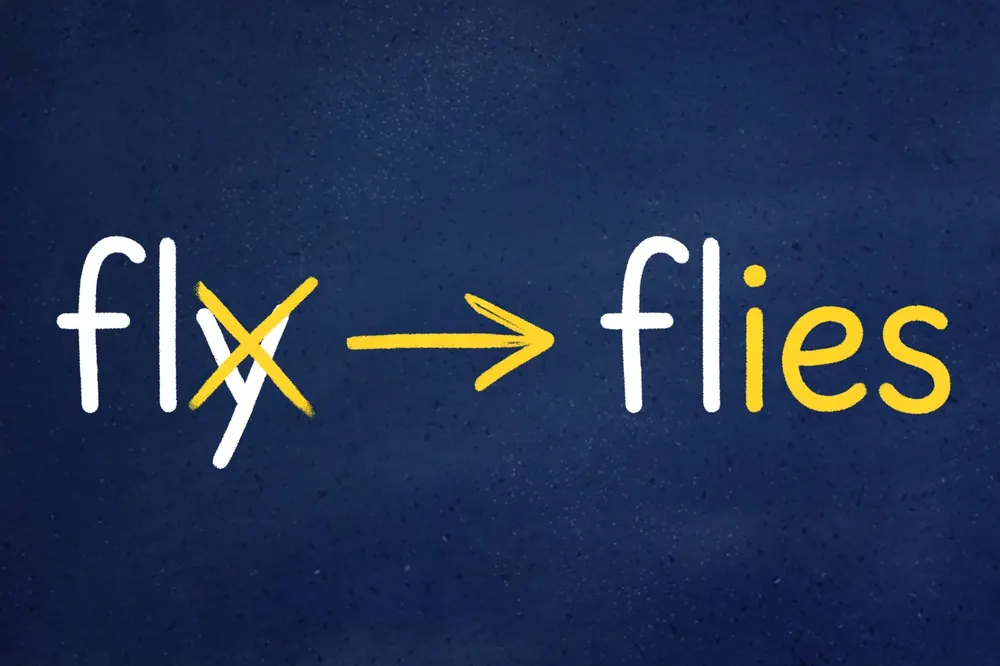
The answer is a simple spelling rule: when a verb ends in a consonant followed by “y,” you change the “y” to “i” and add “es” for the third-person singular (he, she, it). “Fly” ends in “l” (a consonant) plus “y,” so it becomes “flies.”
The same rule works for many common verbs:
- fly → flies
- try → tries
- cry → cries
- dry → dries
- carry → carries
- study → studies
“Flys” ignores this rule and simply sticks an “s” on the end. That is why it looks almost right but is always marked wrong. Merriam-Webster lists “flies” as the standard third-person singular form of “fly” — “flys” does not appear as a form at all.
The rule changes when a vowel comes before the “y.” Verbs like “play,” “enjoy,” and “stay” end in a vowel plus “y,” so they simply add “s”: plays, enjoys, stays. That is the key test: consonant + y means change the “y” to “i” and add “es”; vowel + y means just add “s.”
English spelling rules trip people up in other places too — doubled letters cause the same kind of trouble, as explained in our guide to beginning vs begining.
Verb vs. Noun: Two Different “Flies”
“Flies” is also the plural of the noun “fly,” the insect. That is a different word with the same spelling, and it follows the same y-to-ies rule for nouns: one fly, two flies.
- As a verb: Time flies when you are busy. (The verb “fly” in third-person form.)
- As a noun: Flies buzzed around the picnic table. (More than one insect.)
In the phrase “time flies,” the word is always the verb. Time is the subject, and “flies” is what time does. If you ever wonder which “flies” you are dealing with, ask whether the word describes an action or a thing. An action means the verb; a thing means the insect.
Related Verb Forms of “Fly”
The full set of forms of “fly” is worth learning together, because the same y-to-ies pattern shows up in the past tense too:
| Form | Spelling | Example |
|---|---|---|
| Base form | fly | Birds fly south in winter. |
| Third person (he/she/it) | flies | Time flies. |
| Past tense | flew | We flew to London last year. |
| Past participle | flown | She has flown this route before. |
| -ing form | flying | He is flying to Paris tomorrow. |
Notice that “flying” keeps the “y.” The y-to-i change happens before “es” and “ed,” but not before “ing.” That is another small rule worth remembering: fly → flying, try → trying, cry → crying.
Common Mistakes People Make
Writing “flys” instead of “flies.” This is the most common error, and it comes from sounding the word out. “Flys” sounds right when you say it, but the spelling is wrong. Every time you write the third-person form of “fly,” use “flies.”
Adding an apostrophe: “time fly’s.” An apostrophe shows possession or a missing letter, and neither applies here. “Fly’s” would mean “belonging to the fly,” which makes no sense in this phrase.
Writing “times flies.” “Time” is singular in this idiom, so it stays “time,” not “times.” The verb “flies” already agrees with the singular subject.
Confusing “flies” with “flees.” “Flee” means to run away, and “time flees” is understandable — but it is not the idiom. The fixed phrase is “time flies,” and changing the verb changes the expression.
Doubling the wrong letter. Spelling trouble often comes from doubled consonants in words like “occurred” and “beginning.” If you struggle with those too, our guide to occurrence vs occurance explains the doubling rule in the same plain way.
Easy Ways to Remember the Spelling
Think of “tries” and “cries.” If you can spell “he tries” and “she cries,” you can spell “time flies.” All three verbs follow the same rule, so one memory covers the whole group.
Remember the joke. The classic sentence “Time flies like an arrow; fruit flies like a banana” is funny because “flies” does two jobs in it — a verb in the first half, a noun in the second. The joke only works with the correct spelling.
Picture the “y” turning into “i.” The letter “y” changes into “i” and then takes “es.” Say it as a tiny story: the “y” gives way to “ies.” Once you see it that way, “flys” starts to look wrong on the page.
Check with a short test. Cover the word and ask yourself: does this verb end in a consonant plus “y”? If yes, the ending is “-ies.” Fly, try, cry, dry, carry, study — all of them end in “-ies” in the third person.
Is “Time Flies” Formal or Informal?
“Time flies” is neutral — it works in formal writing, business emails, and casual conversation alike. It is not slang, and it is not old-fashioned. You will find it in novels, speeches, and everyday messages.
Common variations of the phrase include:
- How time flies! — a short exclamation, often used when meeting someone after a long time.
- Time flies by. — adds “by” for the sense of passing.
- Time flies when you’re having fun. — the full version of the idiom.
- Where does the time go? — a different phrase with the same meaning.
In formal writing, use the plain form: “Time flies, and the project deadline is already here.” In casual writing, the exclamation works well: “Can you believe it? How time flies!” In a speech or a toast, the phrase often opens a reflection: “Time flies, and it feels like only yesterday we all met for the first time.” The idiom is flexible enough for all three settings, which is one reason it has stayed in everyday use for so long.
Frequently Asked Questions
Is “time flys” ever correct?
No. “Flys” is never a correct spelling of any form of “fly.” The third-person singular is always “flies,” in both American and British English.
What is the past tense of “time flies”?
The past tense is “time flew”: “The summer flew by so fast.” The past participle is “flown”: “The years have flown past.”
Why do people write “flys”?
Because it sounds right. Spoken English does not show the y-to-i change, so people spell the word the way it sounds. The written rule is easy to miss if nobody has pointed it out.
Is it “time flies” or “time flys” in British English?
It is “time flies” in British English too. The y-to-ies rule applies in all forms of English, and “flys” is wrong everywhere.
Can “flies” be a noun in the phrase “time flies”?
No. In “time flies,” the word “flies” is a verb — it is what time does. The noun “flies” means the insects, as in “flies buzzed around the picnic.”