Occurrence or Occurance: What’s the Difference?
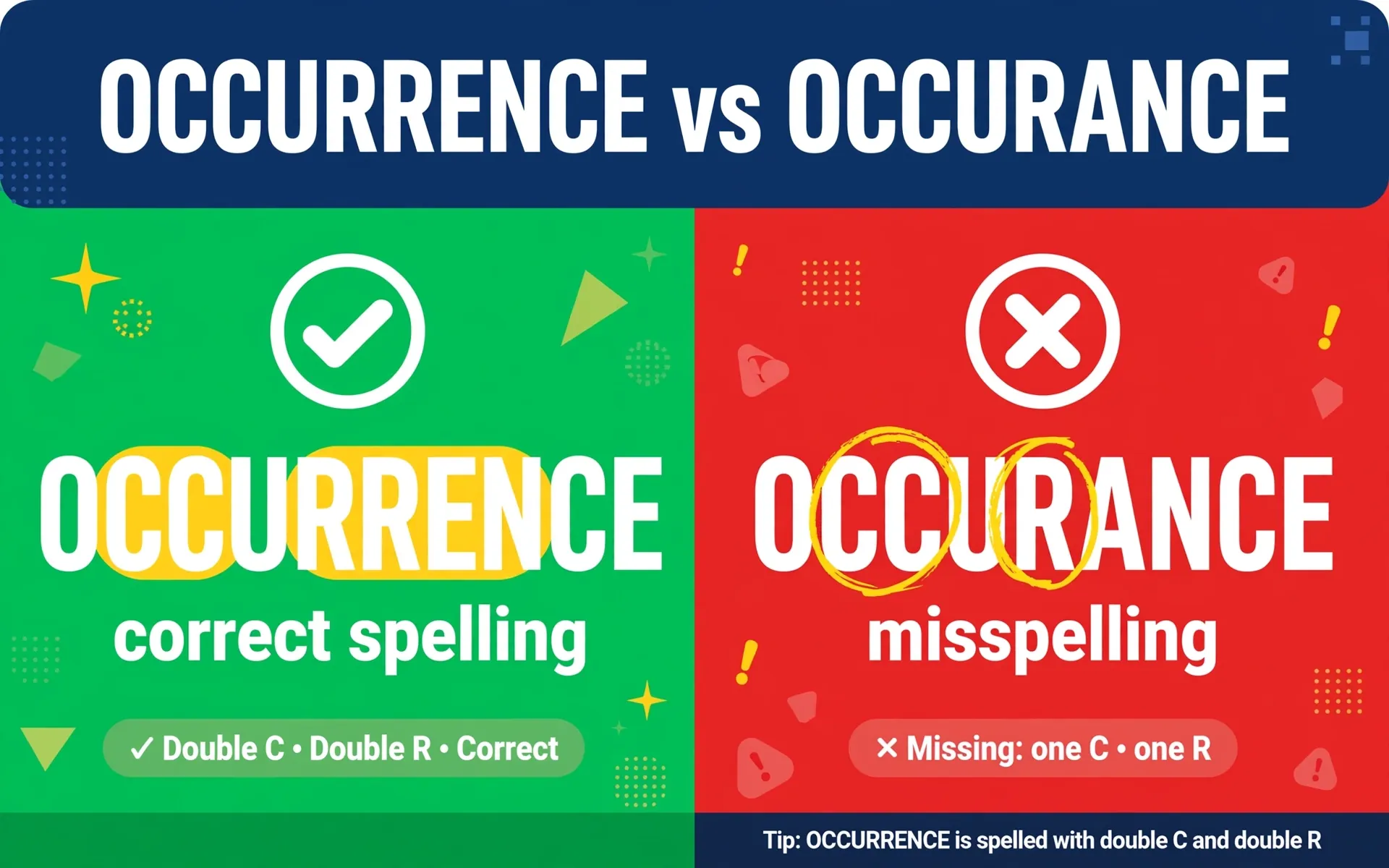
Occurrence is a noun meaning an incident or event — something that happens, as in “a rare occurrence.” Occurance is not a word at all; it is the common misspelling that drops a letter from the doubled consonants. If you can spell the verb “occur” correctly, you are already halfway to getting “occurrence” right.
Quick Answer
| Word | Part of Speech | Main Meaning | Example |
|---|---|---|---|
| Occurrence | Noun | An incident or event; something that happens | ✅ “Power cuts are a daily occurrence here.” |
| Occurance | Not a word | A common misspelling of “occurrence” | ❌ “Power cuts are a daily occurance here.” |
Simple rule: Spell it occurrence — with a double C and a double R: the word “crashes” into itself twice, oc-cur-rence.
What Does Occurrence Mean?
Occurrence is a noun for an incident, event, or instance of something happening. A traffic jam is an occurrence; a meteor shower is a rare occurrence; a software bug that keeps reappearing is a recurring occurrence. It is built directly on the verb “occur” (to happen), keeping the verb’s double R and doubling the C as well. Merriam-Webster defines “occurrence” as “something that occurs,” alongside the sense of the frequency or incidence of an event.
Examples:
- “Snow in April is an unusual occurrence in this city.”
- “The festival is an annual occurrence that draws huge crowds.”
- “Strange coincidences are a common occurrence in small towns.”
- “The report lists three separate occurrences of the fault.”
- “A total eclipse is a once-in-a-lifetime occurrence.”
The plural is occurrences — just add S, keeping both doubled pairs intact.
What Does Occurance Mean?
Occurance means nothing; it is a misspelling with no dictionary entry. It appears because “occurrence” asks the writer to double two different consonants back to back — an unusual demand — and the hand quietly drops one of them. The result usually loses either a C or an R, producing “occurance,” “occurrance,” or “occurence,” none of which are words.
Where you will see it:
- ❌ “It was a strange occurance.” (essays and articles)
- ❌ “Such occurances are rare.” (reports)
- ❌ “A one-time occurance.” (emails)
- ❌ “The occurance of errors increased.” (technical writing)
- ❌ “A daily occurance in our office.” (forum posts)
Every one of those should read occurrence (or occurrences). Because it shows up in otherwise polished writing, this misspelling is especially costly — it undermines an article or report that is correct in every other way.
Occurrence vs. Occurance: Key Differences
| Feature | Occurrence | Occurance |
|---|---|---|
| Status | A real English word | A misspelling — not a word |
| Part of speech | Noun | None |
| Spelling pattern | Double C + double R (oc-cur-rence) | One or both doubles missing |
| Root verb | Occur (keep its spelling, add -rence) | No root — a guess at the spelling |
| Plural | Occurrences | Does not exist |
| Spellcheck | Passes | Flagged everywhere |
The correct spelling keeps every letter of “occur” and doubles the C on top of it — two collisions, CC and RR, in a single word.
Occurrence and Occurance in Real Sentences
At Home
✅ “Burnt toast is a daily occurrence in this kitchen.”
❌ “Burnt toast is a daily occurance in this kitchen.”
Domestic disasters deserve correct spelling too — and the double R from “occur” is already doing half the work.
At Work
✅ “System outages should be a rare occurrence, not a routine one.”
❌ “System outages should be a rare occurance, not a routine one.”
In incident reports and status updates, “occurrence” is the standard term — the misspelling stands out to every technical reader.
In the News
✅ “The earthquake was the strongest occurrence of the decade.”
❌ “The earthquake was the strongest occurance of the decade.”
Journalists reach for this word constantly; getting its doubles right is part of the job description.
In Conversation
✅ “Running into old classmates here is a common occurrence.”
❌ “Running into old classmates here is a common occurance.”
Speech hides the error completely — the ear cannot hear a missing C. Only the page reveals it.

Common Mistakes
Consonant doubling trips up even careful writers: the “accidently” vs “accidentally” doubling rule shows how one missing L changes a word, and the “combatting” vs “combating” consonant-doubling rule shows when the extra letter is mandatory. The occurrence traps:
Mistake 1: Dropping a C — “occurance”
❌ “It was a strange occurance.”
✅ “It was a strange occurrence.”
Why: The most common version of the error. The word needs two Cs (oc-) and two Rs (-cur-): oc-cur-rence.
Mistake 2: Doubling the wrong pair — “occurrance”
❌ “Such occurrances are unusual.”
✅ “Such occurrences are unusual.”
Why: Writers who remember “there are doubles” sometimes double the R twice instead of the C. The pattern is C-C first, then R-R: oc-cur.
Mistake 3: Using the verb as a noun — “a strange occur”
❌ “It was a strange occur.”
✅ “It was a strange occurrence.”
Why: “Occur” is the verb (things occur); “occurrence” is the noun (the thing that happened). Swapping them is like writing “it was a strange happen.”
Mistake 4: Mangling the plural — “occurences”
❌ “Multiple occurences were logged.”
✅ “Multiple occurrences were logged.”
Why: The plural only adds S; the doubles stay exactly where they are. Re-spell the singular first, then add the S.
Pronunciation
Occurrence is pronounced uh-KUR-uhns, with the stress on the second syllable and the final syllable reduced to a quick “uhns.” It rhymes with “concurrence” and “recurrence” — both of which share the same double-C, double-R skeleton from the Latin root meaning “to run together.” No pronunciation difference exists between the correct spelling and any misspelling; the doubles are purely a written convention.
How to Remember the Difference
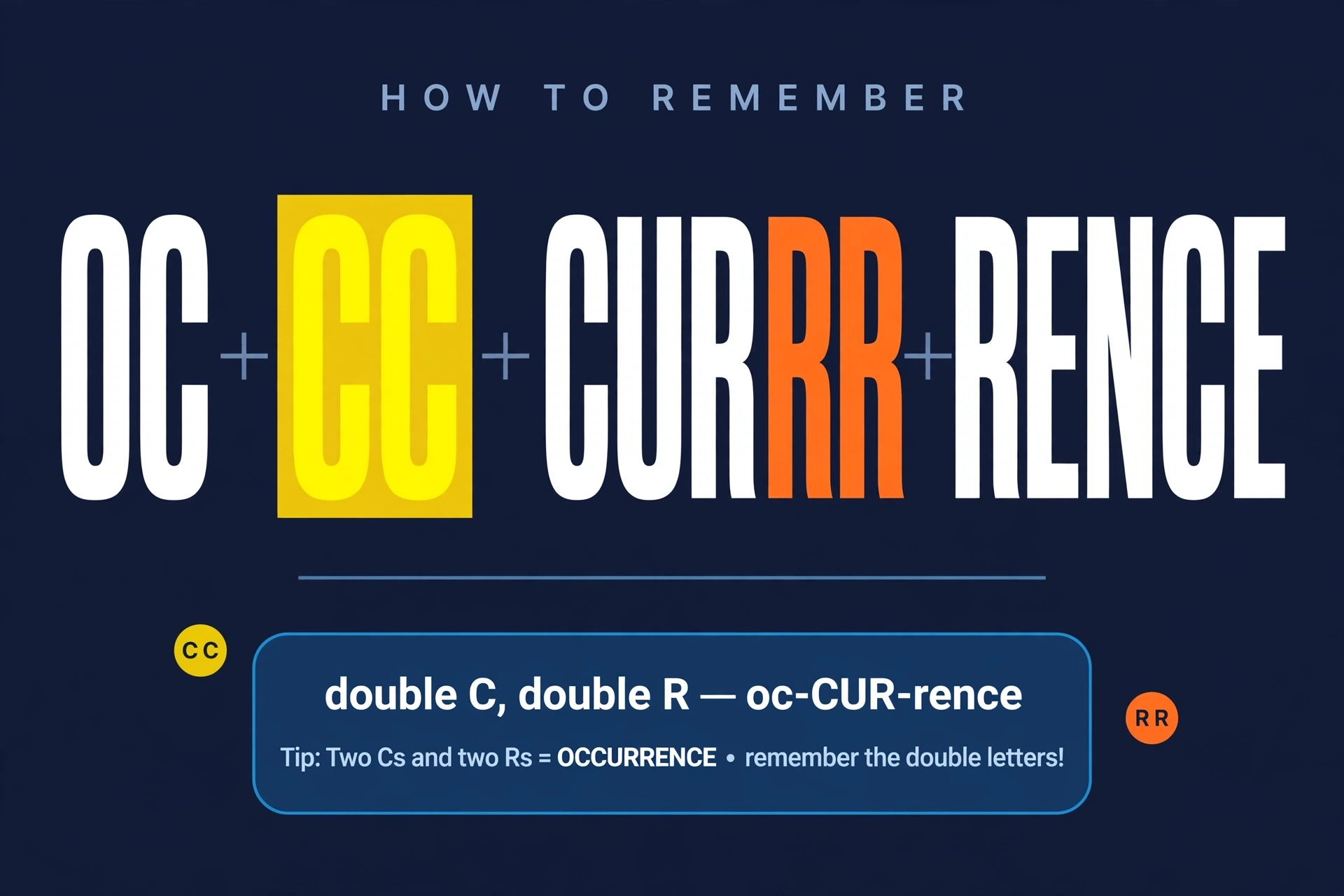
Start from the verb occur — which you already spell with a double R. To make the noun, keep every letter of “occur” and add “-rence,” doubling the C along the way: oc-cur-rence. The word quite literally runs into itself twice — two Cs, then two Rs.
- Verb-first test: write “occur” correctly, then add “-rence” and double the C.
- Double-double test: the correct spelling has two doubled pairs (CC and RR); any version with only one pair is wrong.
- Syllable test: say it as oc-CUR-rence — three syllables, two of them carrying a doubled consonant.
Frequently Asked Questions
Is it occurrence or occurance?
Always “occurrence.” “Occurance” is a misspelling — it is never correct in any dialect or context.
Why is “occurrence” spelled with double letters?
It inherits the double R from the verb “occur” and doubles the C when the noun ending “-rence” is added. The pattern mirrors “concurrence” and “recurrence,” built the same way.
What is the plural of “occurrence”?
“Occurrences” — simply add S to the singular. The doubled C and doubled R stay exactly where they are.
Is “occurance” a British spelling?
No. British and American English agree completely here: “occurrence” is the only correct spelling in both.
What is the verb form of “occurrence”?
“Occur” — as in “these errors occur frequently.” Its present participle is “occurring” (double R kept) and the past tense is “occurred.”
What is the difference between “occurrence” and “incident”?
They overlap heavily: an “incident” usually suggests something disruptive or noteworthy, while an “occurrence” is neutral — anything that happens, from a sunrise to a system crash.
Conclusion
Occurrence is the only correct spelling — a noun meaning an event or incident, built from “occur” with a doubled C and a doubled R. Occurance is never right, in any dialect. Write “occur,” add “-rence,” and the doubles will fall into place.