Peek or Peak: What’s the Difference? (With Examples)
Peek and peak are homophones — they sound identical but mean completely different things. Peek means a quick, often secret look (“take a peek”), while peak means the highest point of something, like a mountain top or a career high. Mix them up and “a peak at the gift” becomes a mountain instead of a glance.

Quick Answer
| Word | Part of Speech | Main Meaning | Example |
|---|---|---|---|
| Peek | verb / noun | a quick or secret look | “She took a peek at the presents.” |
| Peak | noun / verb | the highest point; to reach a maximum | “We reached the peak at sunrise.” / “Sales peaked in December.” |
Simple rule: peek is about looking; peak is about being at the top.
What Does Peek Mean?
Peek means to look quickly, briefly, or secretly at something. As a noun, a peek is that short look itself. The Merriam-Webster entry for peek defines it as “to look furtively” — a glance you were not quite meant to take.
- “He peeked through the curtains to see who was at the door.”
- “Take a peek at the dessert menu before you decide.”
- “The cat peeked out from under the bed.”
- “She peeked over her sunglasses at him.”
- “The trailer gave fans a peek at the new season.”
What Does Peak Mean?
Peak names the highest point of something — a mountain top, the best moment of a career, the busiest hour of the day. As a verb, to peak means to reach that maximum.
- “We reached the mountain peak just after sunrise.”
- “She is at the peak of her career.”
- “Traffic peaks between five and seven in the evening.”
- “The mountain peak was covered in snow.”
- “His novel sold best in the peak holiday season.”
Peak as a Verb
- “Website traffic peaked during the product launch.”
- “Athletes train for years to peak at the Olympics.”
Peek vs. Peak: Key Differences
| Feature | Peek | Peak |
|---|---|---|
| Core meaning | A quick, secret look | The highest point or maximum |
| Part of speech | Verb and noun | Noun, verb, and adjective (“peak hours”) |
| Relates to | Eyes, seeing, glancing | Mountains, maxima, best moments |
| Typical phrase | “take a peek,” “sneak peek” | “mountain peak,” “peak performance” |
| Opposite idea | Staring, gawking | Valley, low point, bottom |
| Memory hook | Two es = two eyes looking | A = the top of a mountain |
The words share a sound but nothing else — one is a glance, the other is a summit.

Peek and Peak in Real Sentences
At Home
Peek: “The kids peeked into the oven to check the cake.”
Peak: “The laundry pile reached its peak before the guests arrived.”
A glance through the oven door is a peek; a mountain of laundry is a peak.
At Work
Peek: “I took a quick peek at the agenda before the meeting.”
Peak: “Our website traffic peaked during launch week.”
You peek at documents; numbers and traffic peak at their highest point.
In Conversation
Peek: “Peek through the window — the baby just fell asleep.”
Peak: “His story was funniest at its peak, right before the punchline.”
The first is about looking; the second is about reaching the best moment.
Common Mistakes
Homophone mix-ups are classic English traps — the same kind of error as desert or dessert or the look-alike pair loose or lose. Sound it out all you like; only meaning tells you which spelling to use.
Mistake 1: “Peak” for a Look
❌ “Take a peak at this report.”
✅ “Take a peek at this report.”
Why: looks are peeks; summits are peaks. If eyes are involved, you want peek.
Mistake 2: “Peek” for a Maximum
❌ “Sales peeked in December.”
✅ “Sales peaked in December.”
Why: reaching the highest point is peaking — think mountain top, not a glance.
Mistake 3: Confusing Both with “Pique”
❌ “You peaked my interest.”
✅ “You piqued my interest.”
Why: pique is a third, separate word meaning to arouse or stimulate (interest, curiosity). It comes from French and has nothing to do with looking or mountains.
Mistake 4: Spelling “Peek-a-Boo” with an A
❌ “Peak-a-boo!”
✅ “Peek-a-boo!”
Why: the children’s game is about suddenly looking — a peek, not a mountain.
Pronunciation
Peek and peak are pronounced identically: /piːk/ (“PEEK”). They rhyme with week, seek, and speak — which is exactly why the spelling has to be chosen by meaning, not by sound.
How to Remember the Difference
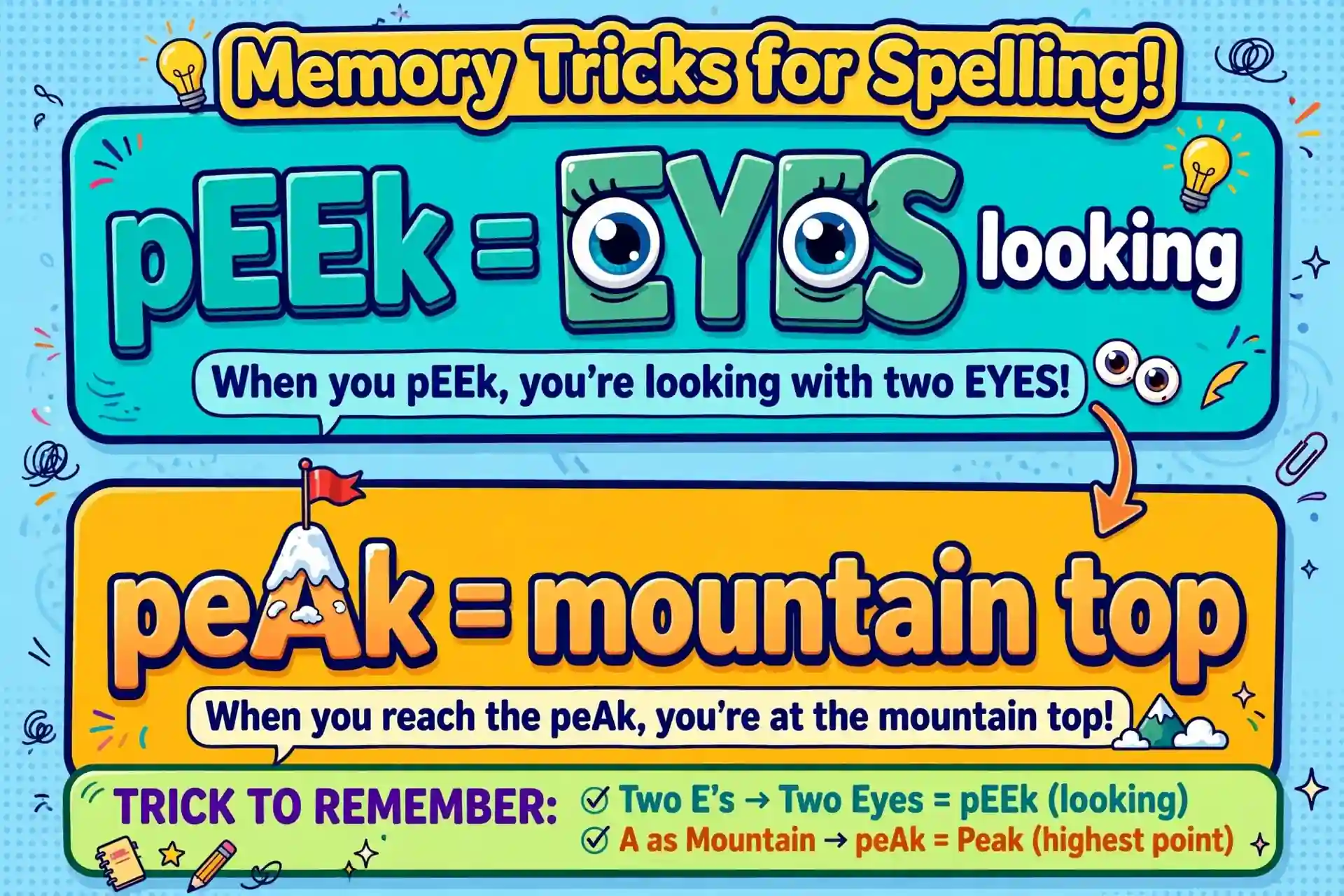
Peek has two e‘s — like two eyes taking a quick look. Peak has an a — shaped like a mountain top at its highest point.
- Peek = two es = two eyes looking.
- Peak = a like the top of a mountain.
- Pique = the odd one out, for arousing interest.
Frequently Asked Questions
Is it peek or peak?
It depends on meaning: peek for a quick look (“take a peek”), peak for a highest point (“mountain peak”).
What is the difference between peek and peak?
Peek is about looking — a glance, usually quick or secret. Peak is about height — the top of a mountain, career, or trend.
What about “pique”?
Pique is a third distinct word meaning to arouse or provoke, as in “pique someone’s curiosity.” It is neither a look nor a summit.
Is it “sneak peek” or “sneak peak”?
“Sneak peek” — it is a secret advance look, so the eye-word peek is correct.
Can “peak” be a verb?
Yes. To peak means to reach a maximum: “Sales peaked in December,” “Interest in the story has peaked.”
Is it “peak hours” or “peek hours”?
“Peak hours” — the busiest, highest-traffic hours of the day.
Conclusion
Peek is a quick look, peak is a highest point, and pique is the arousal of interest — three different words that happen to sound alike. Let meaning, not sound, choose your spelling: eyes get two e‘s, summits get an a.