Segway or Segue
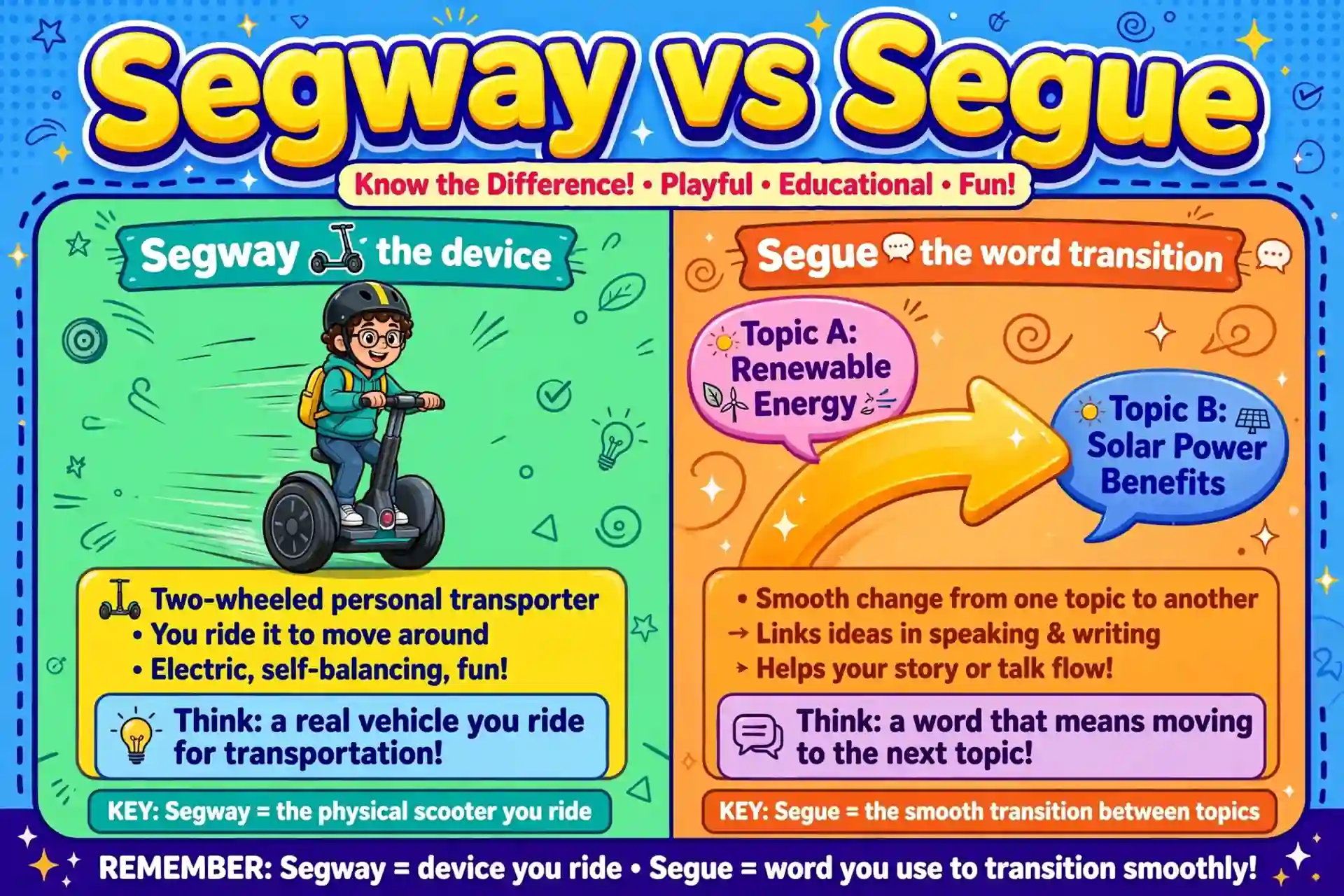
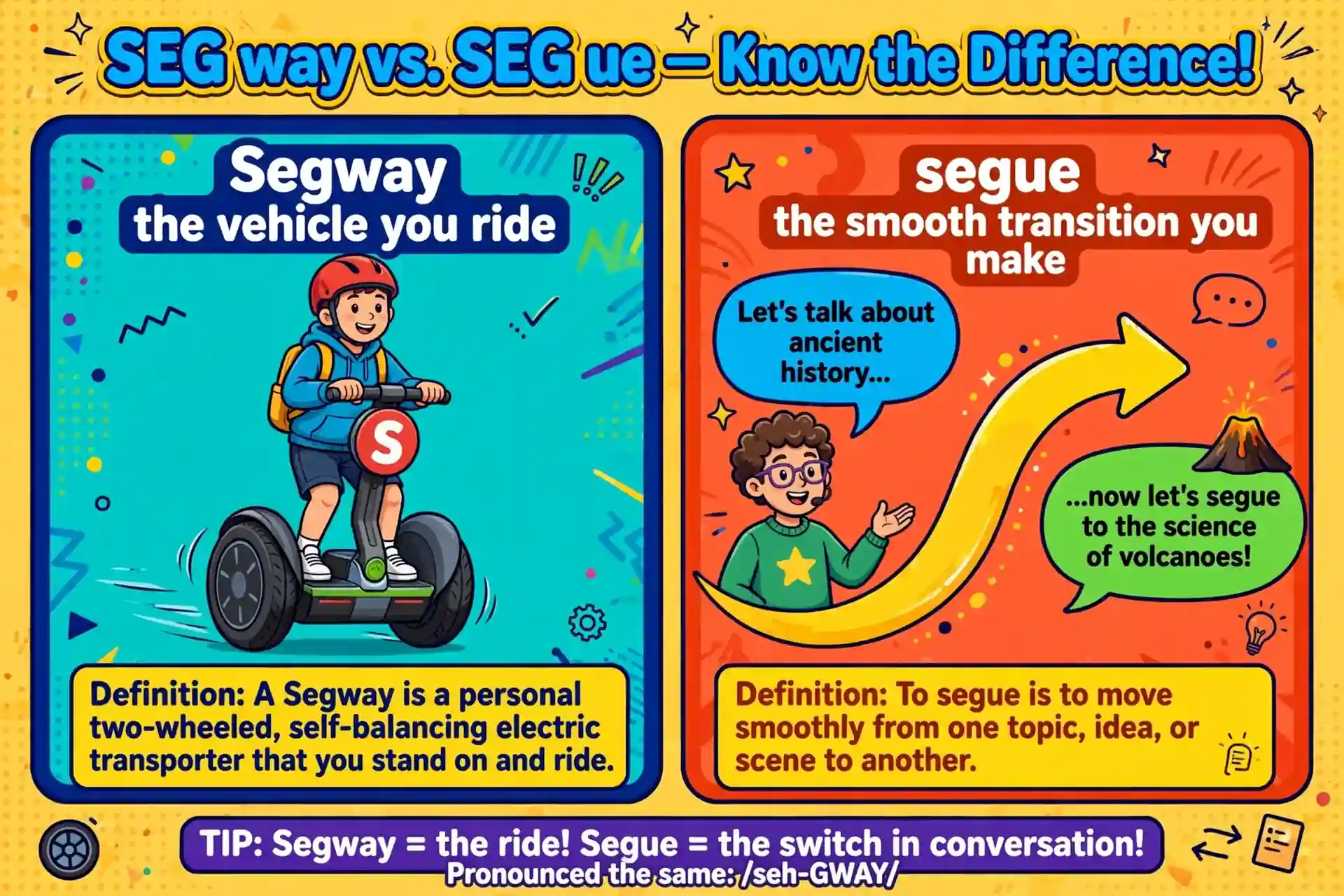
Segway and segue sound exactly the same, but they could hardly be more different. A Segway is a two-wheeled, self-balancing personal transporter — a brand name that always takes a capital S. A segue is a smooth, seamless transition from one topic, scene, or piece of music to another. Mix them up and your sentence about a meeting’s smooth transition turns into a vehicle gliding across the conference room.
Quick Answer
| Word | Part of Speech | Main Meaning | Example |
|---|---|---|---|
| Segway | Proper noun | Brand name of the self-balancing two-wheeled personal transporter | “The security guard patrolled the mall on a Segway.” |
| segue | Noun / verb | A smooth transition from one thing to another | “With a quick segue, she moved on to the budget report.” |
Simple rule: You ride a Segway; you make a segue.
What Does Segway Mean?
Segway is a trademarked brand name (owned by Segway Inc.) for a two-wheeled, self-balancing electric personal transporter that riders steer by leaning. Because it is a proper noun, it is always capitalized, even in the middle of a sentence.
Examples:
- The tour guide led the group through the old town on Segways.
- He rented a Segway to explore the beachfront without walking.
- Warehouse staff use Segways to cover long aisles quickly.
- She stepped off the Segway and grabbed her coffee.
- The Segway was once seen as the future of city commuting.
What Does Segue Mean?
Segue describes a smooth, unbroken transition — from one topic to the next in conversation, from one scene to another in a film, or from one musical passage to the next without a pause. As a verb, it means to make that transition: “She segued into the next question.” The word comes from Italian segue (“it follows”), a direction in classical music scores telling musicians to continue into the next movement without stopping. You can confirm the definition in the Merriam-Webster entry for segue.
Examples:
- With a smooth segue, the host moved from sports to weather.
- The band played a perfect segue from the opening song into the encore.
- Let me segue into our second topic: pricing.
- His awkward segue from the apology back to sales made everyone cringe.
- The movie used a dream sequence as a segue between the two timelines.
Segway vs. Segue: Key Differences
| Feature | Segway | segue |
|---|---|---|
| Capitalization | Always capitalized (brand name) | Always lowercase (common noun/verb) |
| Pronunciation | /ˈsɛɡweɪ/ (SEG-way) | /ˈsɛɡweɪ/ (SEG-way) — identical |
| Meaning | A two-wheeled self-balancing vehicle | A smooth transition between things |
| Part of speech | Proper noun | Noun or verb |
| Origin | Trademark coined around 2001 | Italian musical term meaning “it follows” |
| Plural | Segways | segues |
The identical pronunciation is the entire source of the mix-up: in speech you cannot tell them apart, but in writing the capital S and the context make the intended word obvious.
Segway and Segue in Real Sentences
At Home
Segway: “The kids begged to ride the neighbor’s Segway around the block.”
segue: “Over dinner, Dad used dessert as a segue into talking about the vacation.”
The vehicle stays in the garage; the transition stays in the conversation.
At Work
Segway: “The new intern joked that a Segway would cut her commute across campus in half.”
segue: “Our manager segued from the sales numbers straight into hiring plans.”
One is a thing you stand on; the other is a move you make with words.
In Conversation
Segway: “Have you ever tried riding a Segway? It balances itself.”
segue: “Speaking of travel, that’s a perfect segue into your Italy photos.”
Context is the giveaway: vehicles get ridden, topics get transitioned.
Common Mistakes
These two are confused almost entirely because they sound identical, just like the sound-alike mix-ups in lier or liar and loose or lose. Watch for these traps:
Mistake 1: Using “segway” for a transition
❌ “Let’s segway into the next topic.”
✅ “Let’s segue into the next topic.”
Why: a transition between topics is always a segue — no vehicle is involved.
Mistake 2: Lowercasing the brand name
❌ “He arrived on a segway.”
✅ “He arrived on a Segway.”
Why: Segway is a trademarked proper noun, so it keeps its capital S everywhere.
Mistake 3: Assuming they are spelled the same
❌ “She made a smooth segway from the intro to the chorus.”
✅ “She made a smooth segue from the intro to the chorus.”
Why: in music, the term comes from the Italian direction “segue” (it follows) — it ends in -gue, not -way.
Mistake 4: Pluralizing the brand with an apostrophe
❌ “There were three Segway’s parked outside.”
✅ “There were three Segways parked outside.”
Why: the plural of the brand is simply Segways; apostrophes are for possession, not plurals.
Pronunciation
Both words are pronounced identically: /ˈsɛɡweɪ/ — “SEG-way.” They rhyme with “leg day” said quickly, or think of “seg” + “way.” Because there is no audible difference, you have to choose the spelling from context: if someone is riding it, it is a Segway; if someone is transitioning smoothly, it is a segue.
How to Remember the Difference
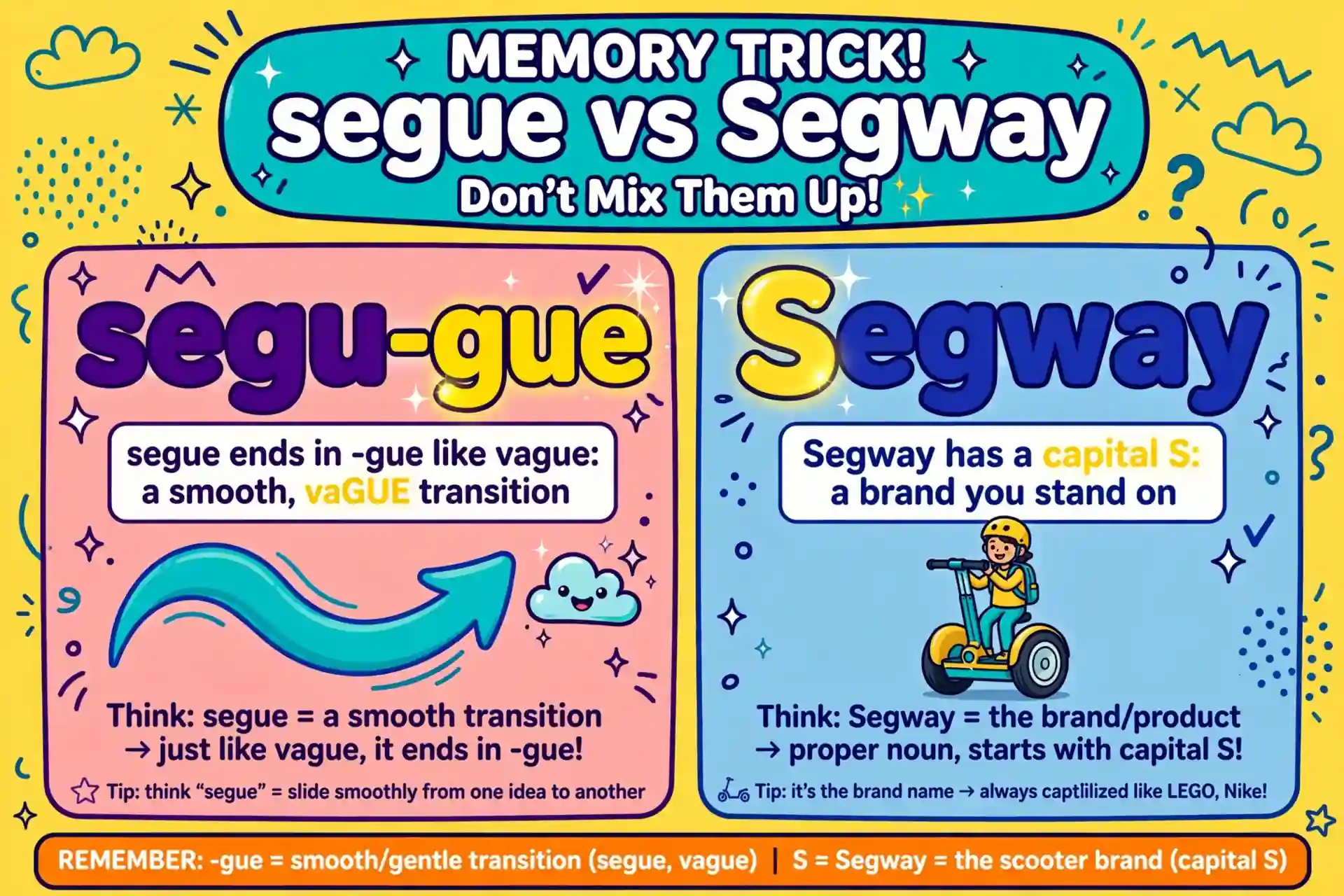
Segue ends in -gue, like vague — think of a “vaGUE, smooth transition” with no sharp edges. Segway has a capital S for a brand name you can stand on — the S stands tall like the rider.
- segue = transition (ends in -gue, like vague, league, rogue)
- Segway = the vehicle (capital S = brand name, something you ride)
- Same sound, different spelling: let the meaning pick the letters
Frequently Asked Questions
Is it segway or segue when changing topics?
Segue. Any smooth shift from one topic, scene, or song to another is spelled s-e-g-u-e, lowercase. Save Segway (capital S) for the vehicle.
Is Segway always capitalized?
Yes. Segway is a registered trademark, so it is capitalized even mid-sentence. Lowercase “segway” is a spelling error when you mean the transporter.
Why do segway and segue sound the same?
The brand name was coined to echo the musical term — a Segway glides smoothly from one place to another, just as a segue glides smoothly from one passage to the next. The shared sound is deliberate, which is exactly why the spelling mix-up is so common.
What is the plural of segue?
Segues: “The DJ strung the tracks together with seamless segues.” Note the verb forms too: segues, segued, segueing.
Can segue be used as a verb?
Yes, and it often is: “She segued from the weather into politics.” The noun form (“a smooth segue”) and verb form are equally standard.
Conclusion
Segway is the capitalized brand name of the self-balancing transporter; segue is the lowercase word for a smooth transition. The shared pronunciation causes the confusion, but context and capitalization make the right choice clear. Ride a Segway, make a segue — and spell each one accordingly.