Free Rein or Free Reign: What’s the Difference?
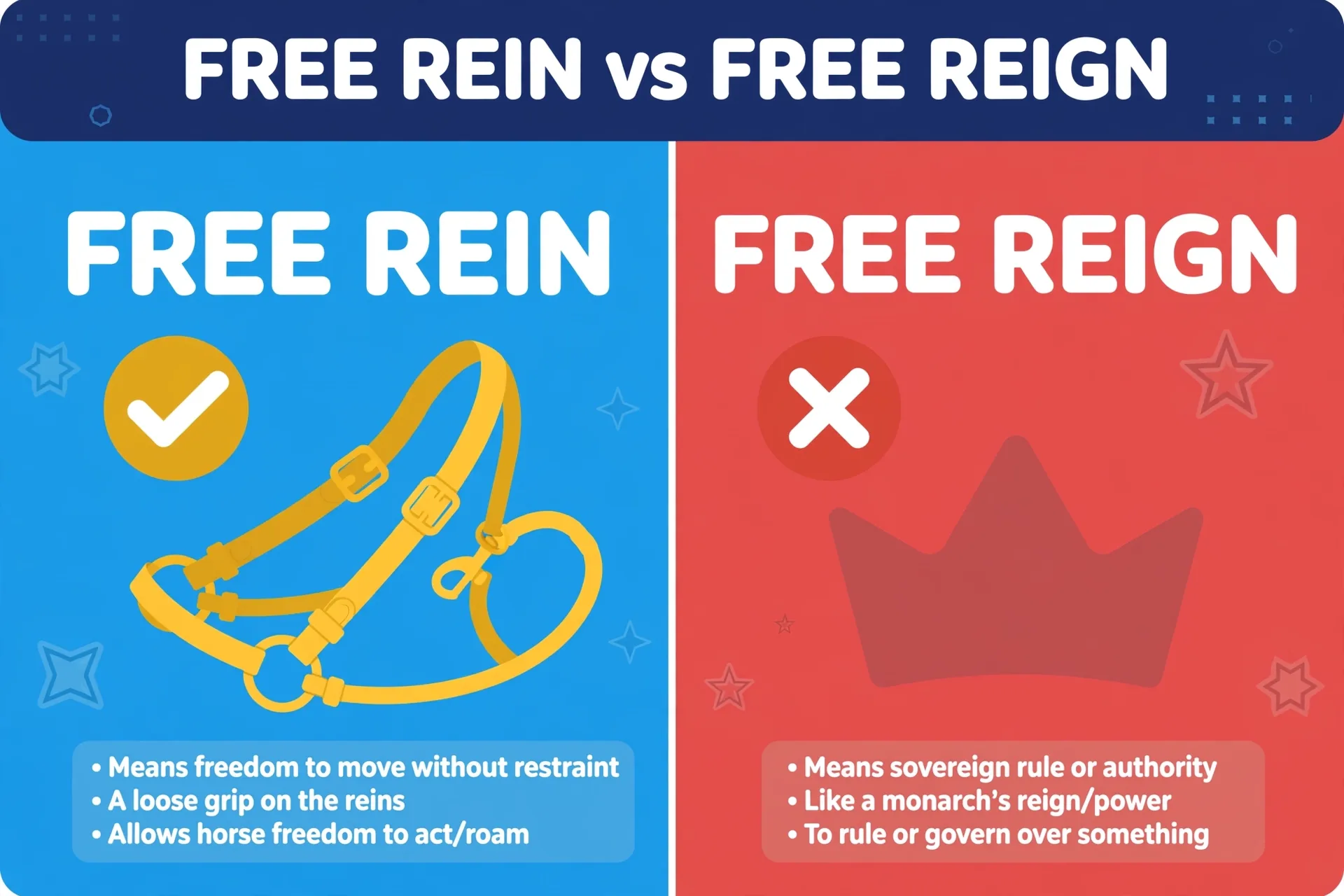
Free rein is correct — free reign is always wrong. The idiom means complete freedom to act, and it comes from horseback riding: give a horse “free rein” and you loosen the straps, letting it choose its own pace. “Reign” means a monarch’s rule, which has nothing to do with it. “She was given free rein over the project” is right; “free reign” hands the crown to a horse.
Quick Answer
| Word | Part of Speech | Main Meaning | Example |
|---|---|---|---|
| free rein | Idiom (noun phrase) | Complete freedom to act as one wishes | ✅ “He gave her free rein.” |
| free reign | — (error) | Not a standard idiom | ❌ “He gave her free reign.” |
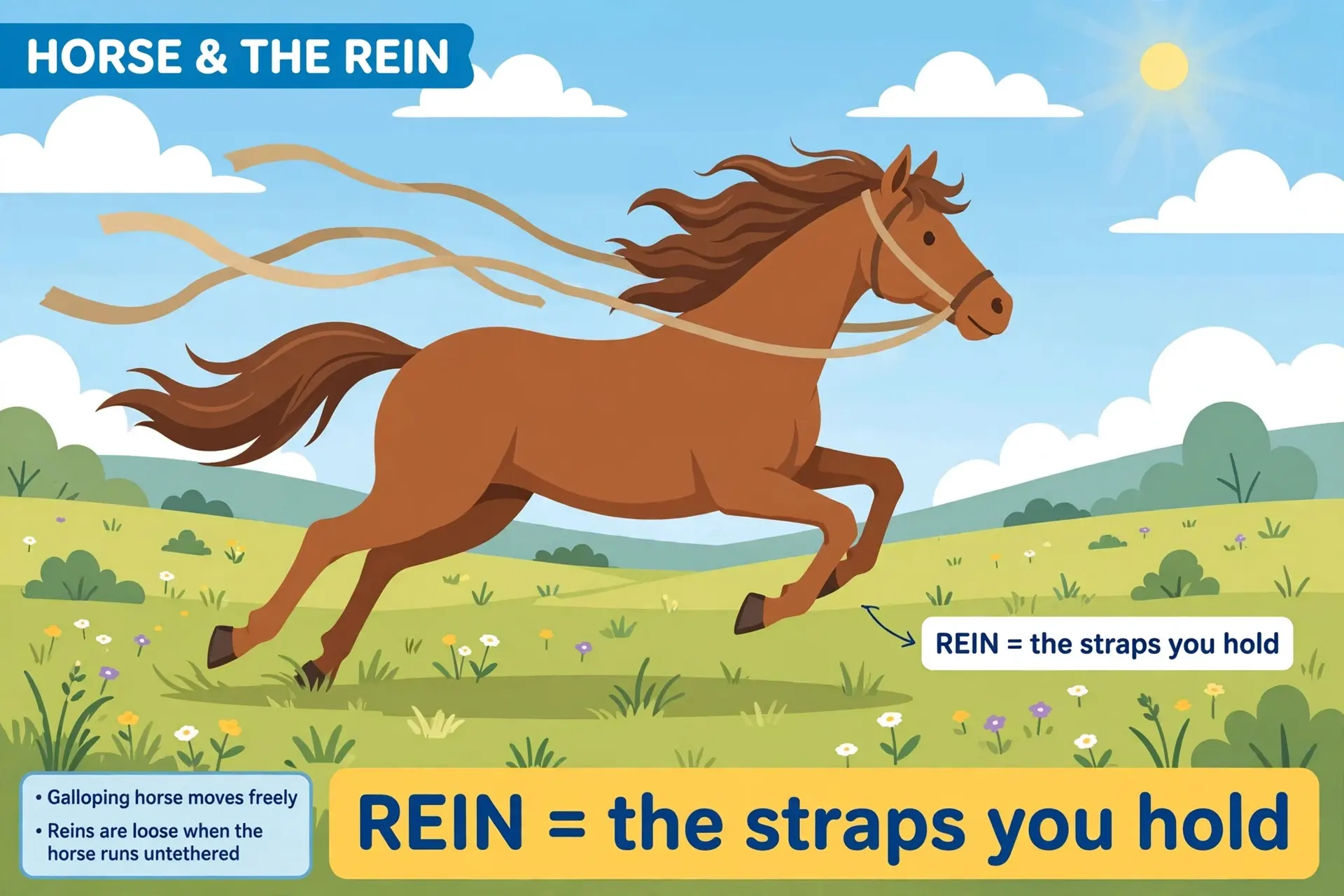
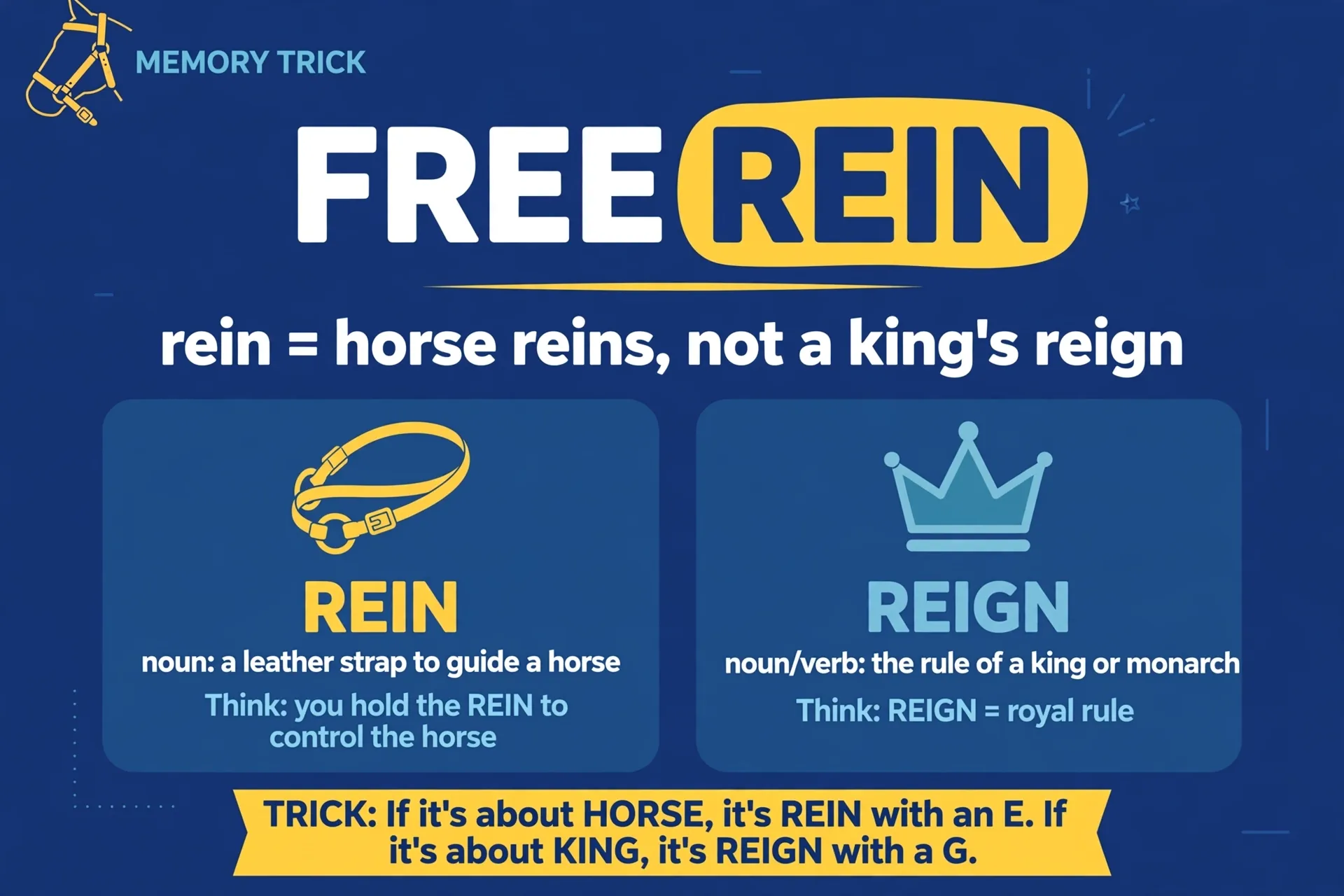
Simple rule: Rein = the straps you hold on a horse. Reign = a king’s rule. Freedom comes from loosened straps, not crowns.
What Does Free Rein Mean?
Free rein means unrestricted freedom — permission to act without interference. A rider gives a horse “free rein” by slackening the reins so the animal picks its own speed and direction; transferred to people, it means the same trust. “The director gave the team free rein” means: decide for yourselves, I won’t micromanage. Merriam-Webster’s entry for “rein” lists the idiom directly: “free rein” — “unrestricted liberty of action or decision.”
Examples:
- “The new chef was given free rein over the menu.”
- “Children need some free rein to explore.”
- “She had free rein in designing the campaign.”
- “The researchers were given free rein and a big budget.”
- “Give your imagination free rein.”
The phrase always suggests trust — someone in authority deliberately stepping back.
What Does Free Reign Mean?
As an idiom, nothing — free reign is an error. “Reign” is a real word meaning a sovereign’s rule (“during the queen’s reign”) or the verb “to rule,” but “free reign” would mean something like “unrestricted monarchy,” which is not what anyone intends. Writers choose it because “reign” is the more familiar word — most people meet kings before horses — and it sounds identical.
Examples of the error (all incorrect):
- ❌ “The manager gave us free reign.”
- ❌ “Artists need free reign to create.”
- ❌ “She took free reign over the project.”
- ❌ “Let your creativity have free reign.”
It is one of the most common eggcorns in business writing — and one of the most avoidable once you know the horse.
Free Rein vs. Free Reign: Key Differences
| Feature | Free rein | Free reign |
|---|---|---|
| Status | Correct, standard idiom | Common error (eggcorn) |
| Key word | Rein — horse’s straps | Reign — monarch’s rule |
| Origin image | Loosened reins, horse runs free | No coherent image |
| Meaning | Unrestricted freedom | None (“free monarchy”?) |
| Example | ✅ “Free rein” | ❌ “Free reign” |
The horse decides: rein is what you loosen to grant freedom, while reign is what kings do — and nobody is crowning anyone here.
Free Rein and Free Reign in Real Sentences
At Home
✅ “We gave the kids free rein in the garden.”
❌ “We gave the kids free reign in the garden.”
Backyard freedom is rein-freedom — unless you’re raising royalty.
At Work
✅ “The CEO gave her free rein over hiring.”
❌ “The CEO gave her free reign over hiring.”
In leadership writing, “free reign” accidentally suggests the employee is staging a coup.
In Conversation
✅ “Give your dog free rein at the park.”
❌ “Give your dog free reign at the park.”
Dogs, like horses, understand reins far better than reigns.
Common Mistakes
Homophone idioms breed eggcorns — the “peek” vs “peak” homophone confusion shows one-letter sound-alikes, and the “cue” vs “queue” word confusion shows lookalikes with separate lives. The rein family:
Mistake 1: Writing “free reign”
❌ “They gave him free reign.”
✅ “They gave him free rein.”
Why: The idiom is equestrian — loosened straps, not a crown. Picture the horse and the spelling is obvious.
Mistake 2: Writing “reign in” for “rein in”
❌ “We need to reign in spending.”
✅ “We need to rein in spending.”
Why: “Rein in” means to restrain — pulling the horse’s straps tight. “Reign in” would mean to rule over, which makes no sense with spending.
Mistake 3: Using “reign” for weather
❌ “The reign is coming down hard.” (meant: rain)
✅ “The rain is coming down hard.”
Why: Rain/reign/rein are a triple homophone set — three spellings, three meanings, one sound. Keep a mental picture for each.
Mistake 4: Assuming the familiar word wins
❌ “Reign is more common, so ‘free reign’ must be right.”
✅ “Idioms keep their history, not their popularity.”
Why: “Reign” feels safer because you’ve seen it more — but idioms preserve the older, rarer word. Familiarity is not evidence.
Pronunciation
Free rein is pronounced free rayn — “rein” rhyming with “reign” and “rain,” all three identical in sound. The triple homophone is exactly why the error is so durable: no pronunciation difference exists to warn you.
How to Remember the Difference
Hold imaginary reins in your hands — leather straps, a horse, an open field. Now let them go slack: that looseness is freedom. A reign needs a throne, a crown, and a kingdom — none of which appear when someone says “do whatever you want.”
- Horse test: can you picture a horse? Then it’s rein. Crowns mean reign.
- Opposite pair: “rein in” (restrain) vs “free rein” (release) — same straps, opposite directions.
- Rain trio: rain (weather), reign (kings), rein (horses) — three pictures, zero confusion.
Frequently Asked Questions
Is it “free rein” or “free reign”?
“Free rein.” “Free reign” is a common error — the idiom comes from horseback riding, not monarchy.
What does “rein in” mean?
To restrain or control — the opposite of “free rein.” A rider pulls the reins tight to slow the horse.
Are “rein,” “reign,” and “rain” related?
Only by sound — they are triple homophones with separate meanings and histories: straps, monarchy, weather.
Why do people write “free reign”?
“Reign” is the more familiar word, and all three sound identical. Familiarity plus identical sound equals a durable eggcorn.
Is “free reign” ever acceptable?
No — style guides mark it wrong. Some note it as a common variant, but careful writers always use “rein.”
What does “give free rein to” mean?
To allow someone complete freedom in a task — “she was given free rein to redesign the site” means no micromanagement.
Conclusion
Free rein loosens the horse’s straps and sets freedom running; free reign crowns a monarch nobody elected. Picture the horse, hold the reins, and the idiom will never throw you again.