Cue or Queue: Meaning, Difference, and Examples
Cue and queue are pronounced exactly the same (“kyoo”), but they mean completely different things. A cue is a signal or prompt — like an actor’s cue to enter the stage — while a queue is a line of people waiting, or a list of things waiting their turn.
For example, “The stage manager gave her the cue” is about a signal. “We stood in a queue for an hour” is about a line. Same sound, different spelling, different world.

Quick Answer
| Word | Part of Speech | Main Meaning | Example |
|---|---|---|---|
| Cue | Noun / verb | A signal or prompt; a pool stick | Wait for my cue before you start. |
| Queue | Noun / verb | A line of people; things waiting in order | Join the queue at the counter. |
Simple rule: A signal or hint is a cue. A line of people (or files, songs, print jobs) is a queue.
What Does Cue Mean?
A cue is a signal that tells someone it is their turn to act. In theater, an actor’s cue might be a line of dialogue or a lighting change. In everyday life, a cue can be any hint or reminder — a raised eyebrow can be a cue to stop talking.
Examples:
- Wait for my cue before bringing out the cake.
- The actor missed his cue and entered late.
- Her smile was his cue to continue the story.
- The newsreader took her cue from the producer’s nod.
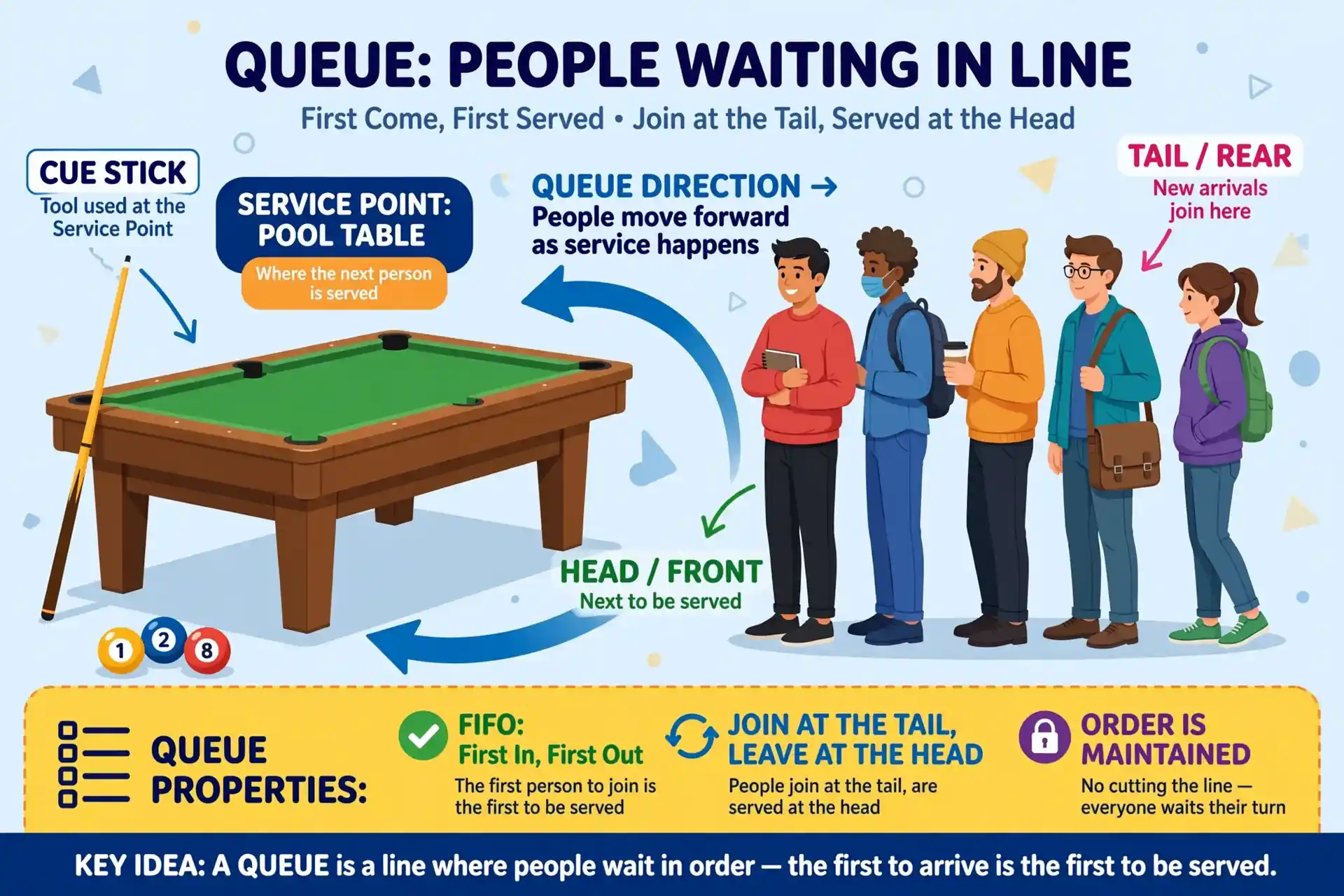
Cue is also the long stick used in pool, snooker, and billiards: “He chalked his cue before the shot.” And as a verb, it means to give someone a signal: “Cue the applause.”
What Does Queue Mean?
A queue is a line of people waiting for something — the normal British English word for what Americans usually call a “line.” It also means any ordered list of things waiting their turn: songs in a playlist queue, documents in a printer queue.
Examples:
- We joined the queue outside the bakery.
- The queue for tickets stretched around the block.
- She added three songs to the queue.
- The printer queue showed five waiting documents.
- Please queue here for check-in.
In computing, queue is a core concept: items are processed first-in, first-out, exactly like people in a line.
See queue on Cambridge Dictionary for definitions, pronunciation, and more examples.
Cue vs. Queue: Key Differences
| Feature | Cue | Queue |
|---|---|---|
| Core meaning | Signal, prompt | Line, waiting list |
| Pronunciation | “Kyoo” (/kjuː/) | “Kyoo” (/kjuː/) |
| Spelling note | Short: 3 letters | Long: 5 letters, four vowels in a row |
| Common setting | Theater, conversation, pool | Shops, airports, computers |
| Example | That was my cue to leave. | The queue moved slowly. |
The two are perfect homophones, which is why spellcheckers will not save you — only meaning can, as with other sound-alike pairs where context is everything.
Examples of Cue and Queue in Real Sentences
At the Theater
Cue: “The lighting change was her cue to walk on stage.”
Queue: “After the show, a queue formed at the stage door.”
One cue starts the performance; one queue ends the evening.
At the Airport
Cue: “The announcement was our cue to head to the gate.”
Queue: “We waited in the security queue for forty minutes.”
The announcement signals; the line waits.
On a Computer
Cue: “The beep was his cue to press Enter.”
Queue: “The download queue had six files pending.”
A sound can be a cue; a list of waiting files is a queue.
Common Mistakes With Cue and Queue
Writers swap these constantly because they sound identical — a classic mix-up, like confusing regional spellings that look similar but are not interchangeable.
Mistake 1: Writing “Queue” for a Signal
❌ That was my queue to start talking.
✅ That was my cue to start talking.
Why: A signal or prompt is always cue. Queue is only for lines and waiting lists.
Mistake 2: Writing “Cue” for a Line
❌ Please join the cue at the door.
✅ Please join the queue at the door.
Why: People waiting in order form a queue, never a cue.
Mistake 3: “On Cue” vs “In Queue”
❌ The bus arrived in cue.
✅ The bus arrived on cue. / We waited in queue.
Why: The idiom is “on cue” (right on signal). Waiting happens “in a queue” (or “in line”).
Pronunciation: Cue vs. Queue
Both are pronounced “kyoo” (/kjuː/), rhyming with few and new. There is no difference in sound at all.
Because of this, you must choose by meaning: signal = cue, line = queue. No pronunciation clue will help.

How to Remember the Difference
Memory trick: Queue has five vowels in a row (u-e-u-e… well, q-u-e-u-e) — a long line of letters, just like a long line of people. Cue is short and quick, like a quick signal.
- Queue = long word = long line of people.
- Cue = short word = quick signal.
- British “queue” = American “line” (at the shop).
See a long word with a tail of vowels? That is the line of people: queue.
Frequently Asked Questions
Is it cue or queue for a line of people?
Queue. “Join the queue” means join the line. Cue is never correct for a line.
What does “on cue” mean?
“On cue” means exactly at the expected signal or moment: “The rain started right on cue.” It uses cue, the signal word.
Do cue and queue sound the same?
Yes. Both are pronounced “kyoo” (/kjuː/). Only the spelling and meaning differ.
Is queue only British English?
Queue for a line of people is standard in British English; Americans usually say “line” or “wait in line.” But queue is universal in computing (printer queue, song queue).
What is a cue stick?
The long stick used to hit balls in pool, snooker, and billiards. It is spelled cue, from the same “signal/pointer” family of meanings.
Conclusion
Cue is a signal or prompt; queue is a line of people or things waiting their turn. Remember the long line of vowels in queue, and these homophones will never trip you up again.