Accommodate or Accomodate: What’s the Difference?
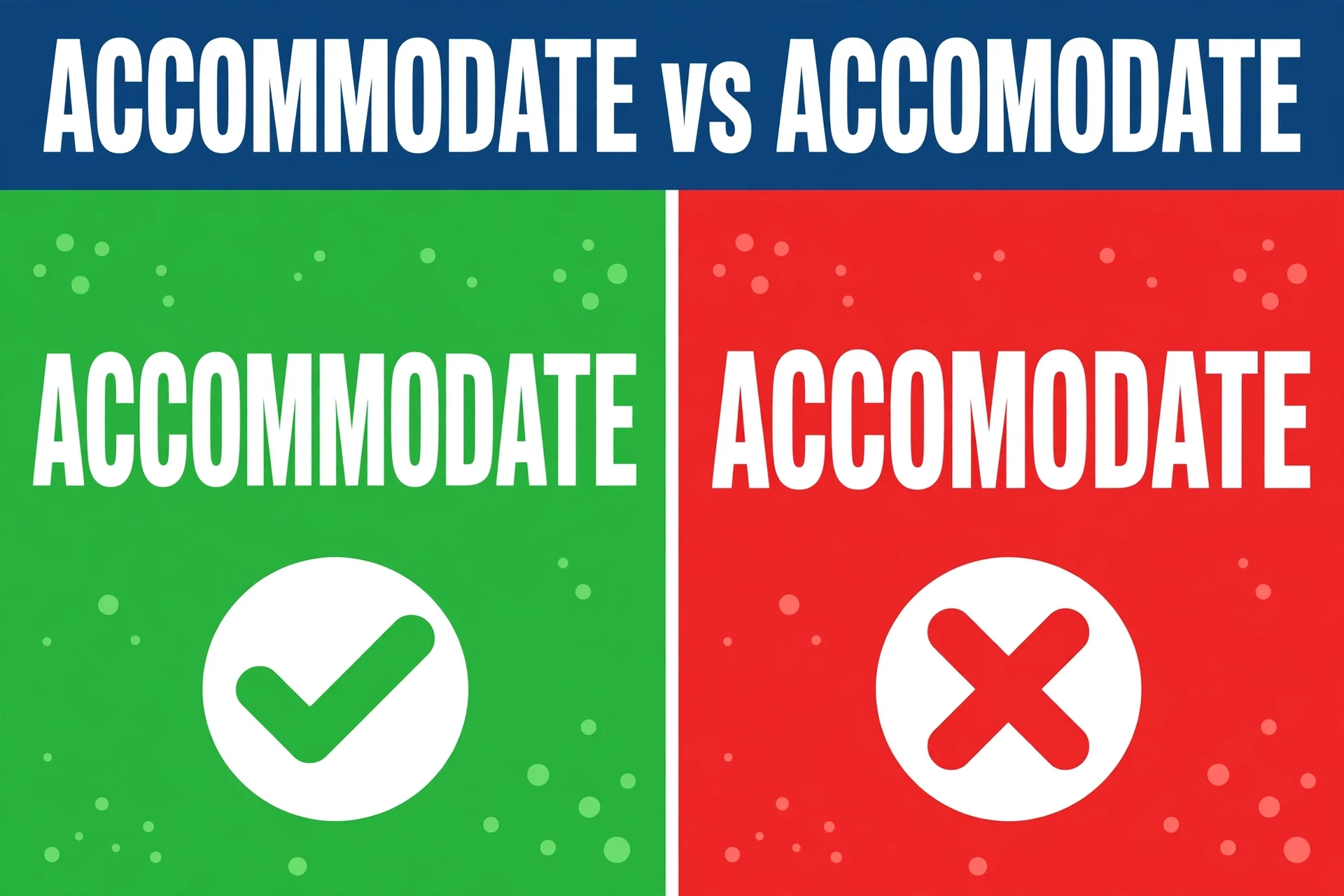
Accommodate is the correct spelling — the verb meaning to make room for someone, to provide what is needed, or to adapt to a situation. Accomodate with a single M is not a word at all; it is one of the most common spelling errors in English, tripping up writers precisely because the double letters feel like one pair too many. If you have ever hesitated over how many C’s and M’s this word takes, this guide settles it for good.
Quick Answer
| Word | Part of Speech | Main Meaning | Example |
|---|---|---|---|
| accommodate | Verb | To make room for; to provide lodging or needed things; to adapt to | ✅ “The hotel can accommodate 300 guests.” |
| accomodate | — | Not a word — the common single-M misspelling of “accommodate” | ❌ “The hotel can accomodate 300 guests.” |
Simple rule: Two C’s and two M’s — accommodate doubles both pairs of letters; the single-M accomodate is always wrong.
What Does Accommodate Mean?
Accommodate is a verb with three closely related senses: to provide space or lodging for someone, to supply someone with something they need, and to adapt or adjust to a situation. A hotel accommodates guests, an employer accommodates a request, and a flexible schedule accommodates last-minute changes. Merriam-Webster’s entry for “accommodate” lists all three senses, from providing room to making oneself agreeable to another’s wishes.
Examples:
- “The conference center can accommodate up to five hundred attendees.”
- “The airline accommodated our request for an earlier flight.”
- “Please let us know if we need to accommodate any dietary restrictions.”
- “Her flexible schedule could accommodate the late meeting.”
- “The new software accommodates both Mac and Windows users.”
The noun form is accommodation (lodging, or an adjustment made for someone’s needs), and it doubles the same two letters: two C’s, two M’s. If you can spell the verb, you can spell the noun.
What Does Accomodate Mean?
Strictly speaking, accomodate means nothing — it appears in no standard dictionary as an accepted spelling. It is simply the way a huge number of people spell “accommodate” when they double only the C and forget the M (or double only the M and forget the C). The error is so widespread that spellcheckers flag it constantly, and it shows up in emails, hotel reviews, and even business proposals.
Where the misspelling shows up — and the fix:
- ❌ “We can accomodate your party of six.” → ✅ “We can accommodate your party of six.”
- ❌ “The policy accomodates remote workers.” → ✅ “The policy accommodates remote workers.”
- ❌ “They accomodated us with extra chairs.” → ✅ “They accommodated us with extra chairs.”
- ❌ “Please accomodate my schedule.” → ✅ “Please accommodate my schedule.”
- ❌ “The venue cannot accomodate wheelchairs.” → ✅ “The venue cannot accommodate wheelchairs.”
Notice that the conjugated forms (accommodates, accommodated, accommodating) keep the same double letters — once the base spelling is right, every form follows.
Accommodate vs. Accomodate: Key Differences
| Feature | accommodate | accomodate |
|---|---|---|
| Dictionary status | Correct, standard spelling | Misspelling — not in dictionaries |
| The C’s | Doubled: ac-commodate | Doubled (the one pair people remember) |
| The M’s | Doubled: accommodate | Single: the pair people forget |
| Part of speech | Verb (to house, supply, or adapt) | None — it has no meaning or function |
| Spellchecker reaction | Accepted everywhere | Red underline in most editors |
| Example | ✅ “They accommodated every request.” | ❌ “They accomodated every request.” |
The whole contest is about one letter: keep both pairs doubled and you never have to think about this word again.
Accommodate and Accomodate in Real Sentences
At Work
✅ “Can you accommodate a 4 PM call?”
❌ “Can you accomodate a 4 PM call?”
The single-M version in a work email is the classic giveaway — readers notice, even if they say nothing.
While Traveling
✅ “The resort accommodates families with young children.”
❌ “The resort accomodates families with young children.”
Hotel and airline copy is where this error appears most, because staff write the word dozens of times a day.
At Home
✅ “We rearranged the living room to accommodate the new sofa.”
❌ “We rearranged the living room to accomodate the new sofa.”
Everyday writing is no exception — the double letters feel excessive until you train your eye to expect them.
In Conversation
✅ “I appreciate you accommodating my schedule.”
❌ “I appreciate you accomodating my schedule.”
Speech hides the error completely, which is why it survives so long in writing — nobody hears the missing M.
Common Mistakes
Doubled letters cause more grief than almost any other spelling quirk — the “accidently” vs “accidentally” spelling and the “combatting” vs “combating” double-letter spelling both turn on the same doubled-letter question. With accommodate, these are the traps:
Mistake 1: Doubling only the C
❌ “accomodate”
✅ “accommodate”
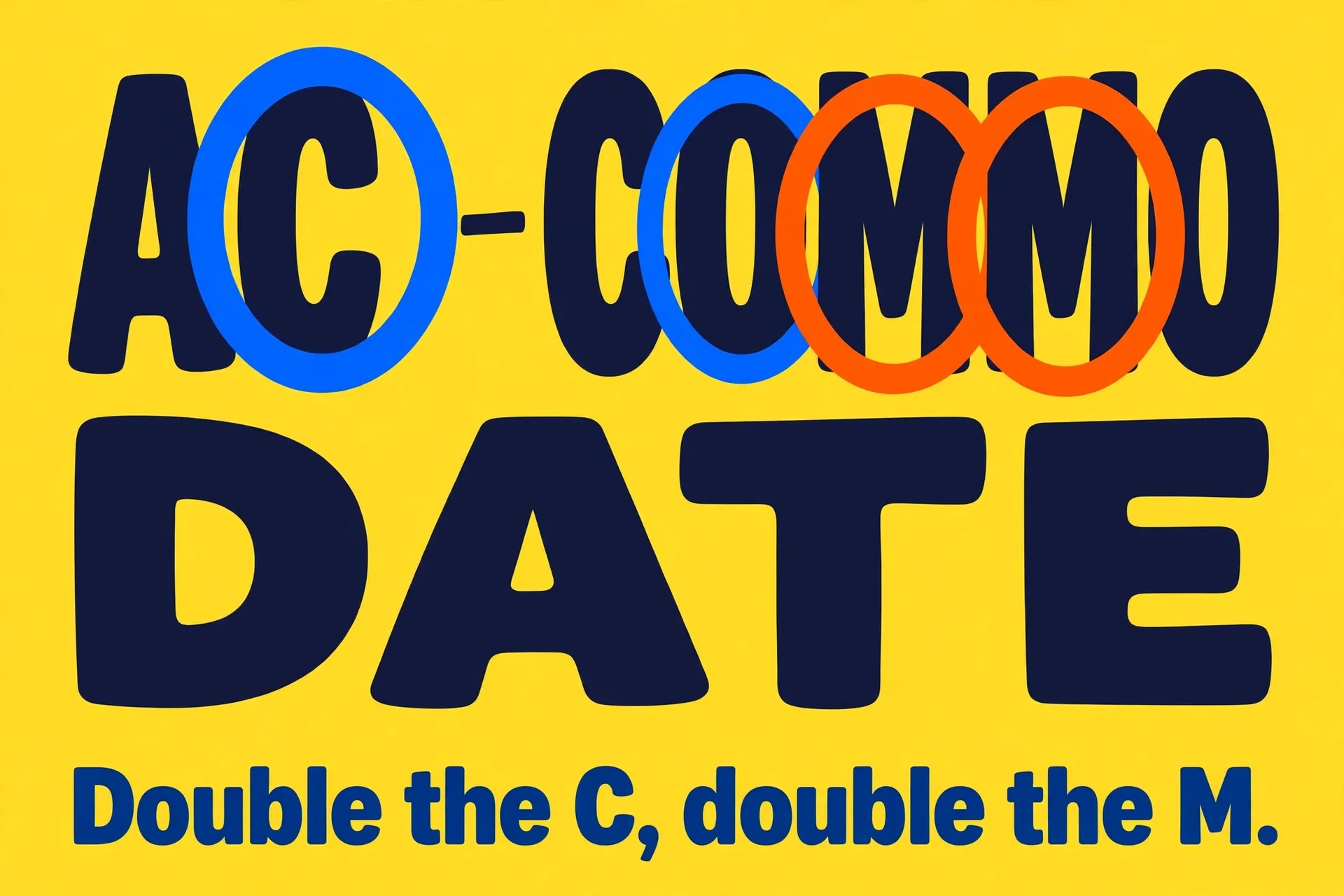
Why: Most people remember one doubled pair and drop the other. The C and the M are both doubled — ac-COMMO-date.
Mistake 2: Doubling only the M
❌ “acommodate”
✅ “accommodate”
Why: The reverse error is rarer but real. If you fixate on the M’s, the second C quietly disappears. Count both pairs every time.
Mistake 3: Misspelling the noun too
❌ “The hotel confirmed our accomodation.”
✅ “The hotel confirmed our accommodation.”
Why: “Accommodation” inherits the same double C and double M. Fixing the verb but not the noun leaves the error half alive.
Mistake 4: Letting autocorrect quietly “fix” it
❌ Typing “accomodate” and assuming the editor corrected it
✅ Typing “accommodate” deliberately, doubles included
Why: Autocorrect usually fixes this one — but on phones, in forms, and in PDFs it sometimes doesn’t. Own the spelling instead of outsourcing it.
Pronunciation
Accommodate is pronounced uh-KOM-uh-dayt — stress on the second syllable, rhyming with “update” and “date.” The misspelled accomodate would sound exactly the same, which is the whole problem: your ears give you no clue, so the spelling has to be learned by eye.
How to Remember the Difference
Break it into ac-COMMO-date: the prefix ac- supplies the second C, and COMMO (like “commodious,” meaning roomy) supplies the two M’s. Two C’s, two M’s — double them both, and the misspelling has nowhere to hide.
- The pair test: hold up two fingers for the two C’s and two for the two M’s — four doubled letters total.
- The COMMO link: think of a COMMOdious, roomy hotel — roomy enough to hold two M’s.
- The family test: accommodation, accommodating, accommodated all share the doubles — learn one, learn them all.
- The say-it-slow test: say “ac-COMMO-date” aloud, stressing each doubled pair until your fingers type it automatically.
Frequently Asked Questions
Is it accommodate or accomodate?
It is accommodate, with two C’s and two M’s. “Accomodate” with one M is a misspelling and is never correct in standard English.
Why is accommodate misspelled so often?
Two doubled letter pairs in one word is unusual, so writers remember one pair and drop the other. Speech gives no hint — both spellings sound identical — so the error survives unchecked in writing.
Is “accomodate” acceptable in British English?
No. British and American English agree completely here: “accommodate” is the only correct spelling in both varieties.
What does accommodate mean in a hotel context?
It means to provide rooms or space for guests — “the hotel can accommodate 300 guests” means it has room for that many people.
Is it “accommodation” or “accomodation”?
“Accommodation,” with two C’s and two M’s, matching the verb. The noun inherits the same double letters.
How can I remember the double letters?
Split it as ac-COMMO-date: the prefix gives you the double C, and COMMO (like “commodious,” roomy) gives you the double M. Two pairs, both doubled.
Conclusion
Accommodate — two C’s, two M’s — is the only correct spelling; accomodate with a single M is a misspelling that fools the ear but not the eye. Memorize ac-COMMO-date, and the double letters will take care of themselves.