Committed or Commited: What’s the Difference?
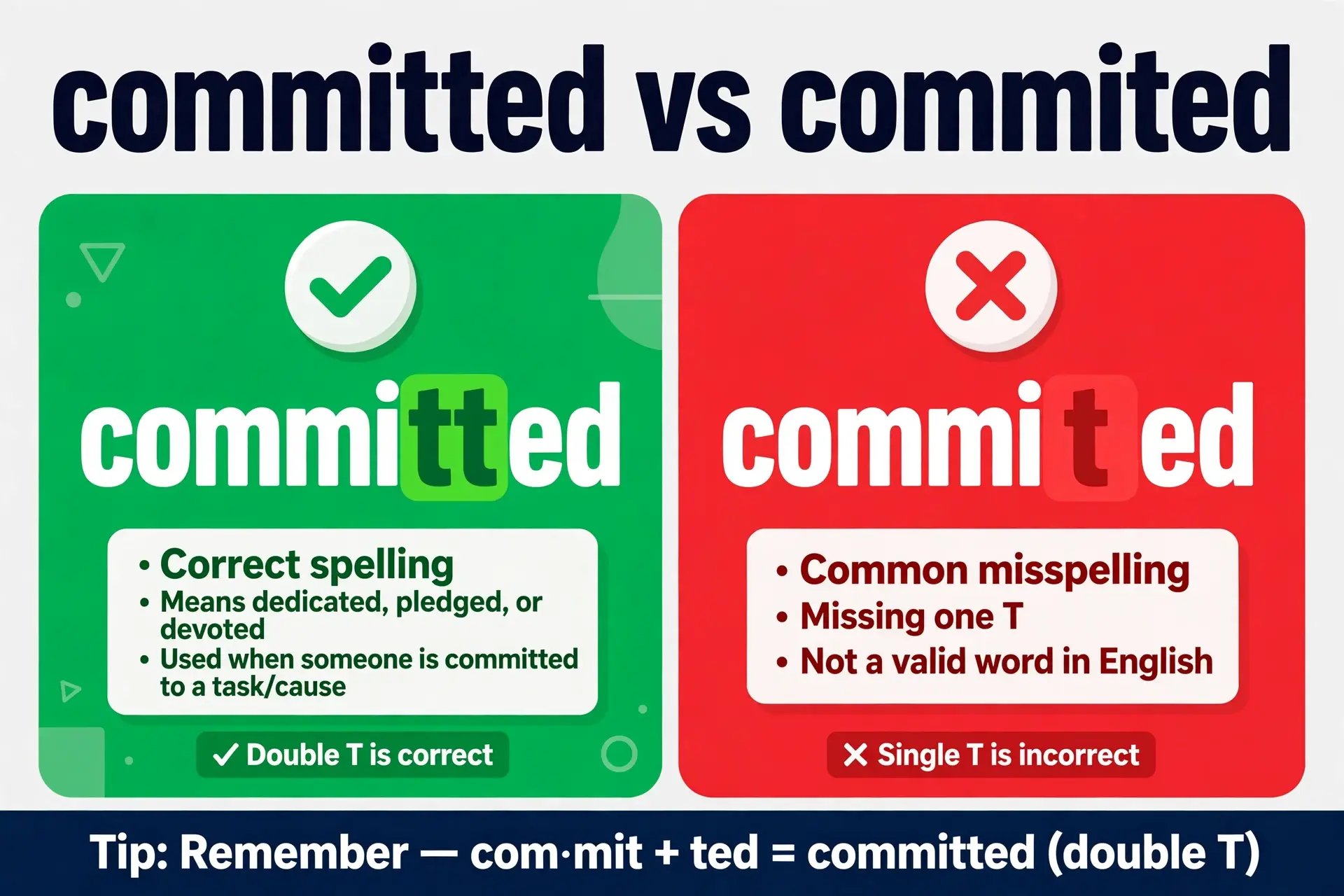
Committed with two T’s is the correct spelling — the past tense of “commit” and the adjective for dedication, as in “she is committed to the project.” Commited with one T is simply a misspelling; no dictionary lists it, and every spellchecker flags it. One lives in every dictionary, the other only in typos.
Quick Answer
| Word | Part of Speech | Main Meaning | Example |
|---|---|---|---|
| Committed | Verb form / adjective | Past tense of “commit”; dedicated, pledged, devoted | ✅ “She remains committed to her training.” |
| Commited | Not a word | A common misspelling of “committed” | ❌ “He commited a crime.” |
Simple rule: “Commit” ends in a stressed consonant-vowel-consonant pattern (com-MIT), so the T doubles before “-ed” — committed, never “commited.”
What Does Committed Mean?
Committed is the past tense and past participle of the verb “commit,” which covers a wide range of actions: to carry out (a crime or error), to pledge or bind yourself (to a cause), to entrust (funds or resources), and to consign someone to care. As an adjective, it means dedicated, loyal, and bound by promise — a “committed teacher” or a “committed relationship.” Merriam-Webster’s entry for “commit” lays out these senses, from committing resources to committing oneself to a belief.
Examples:
- “She committed herself to finishing the degree no matter how long it took.”
- “He committed a foul in the final minute of the match.”
- “The foundation committed two million dollars to the new hospital.”
- “After ten years together, they are fully committed to each other.”
- “The review praised her as a committed and tireless community organizer.”
The adjective sense is the one people reach for most in everyday writing — it signals seriousness of intent, whether about a diet, a deadline, or a person.
What Does Commited Mean?
Commited means nothing, because it is not an English word. It appears in no dictionary — not Merriam-Webster, not Cambridge, not Oxford — and every major spellchecker underlines it in red. It is purely a misspelling of “committed,” born from the fact that the base verb “commit” has only one T, which tempts writers to keep it that way when adding “-ed.”
That temptation is understandable but wrong: English doubles the final consonant of verbs like “commit” before a vowel suffix, and dropping the second T breaks the rule. Autocorrect will usually fix “commited” to “committed” for you, but in handwritten notes, exams, and job applications, no safety net exists — the double T has to come from memory.
Committed vs. Commited: Key Differences
| Feature | Committed | Commited |
|---|---|---|
| Status | A real English word | A misspelling, not a word |
| Spelling | Double T (com-mit-ted) | Single T (com-mit-ed) |
| Meaning | Dedicated; past tense of “commit” | None |
| Dictionary entry | Yes — all major dictionaries | No |
| Spellchecker | Passes everywhere | Flagged as an error |
| Use in writing | Always safe | Never correct |
Two T’s make it a word; one T makes it a typo.
Committed and Commited in Real Sentences
At Home
✅ “We are committed to saving for the house this year.”
❌ “We are commited to saving for the house this year.”
The first is a promise in writing; the second is the same promise with a spelling slip that a careful reader will notice.
At Work
✅ “Management committed additional staff to the deadline.”
❌ “Please confirm you are commited to the Friday launch.”
In professional email, “commited” quietly undermines the competence the sentence is trying to project.
In Conversation
✅ “He’s a committed volunteer — never misses a Saturday.”
❌ “She wrote that she’s commited to the plan.”
Speech hides the error completely, which is exactly why it survives into writing so often.
In Formal Writing
✅ “The report notes the country’s committed efforts toward reform.”
❌ “The defendant’s commited actions were reviewed by the court.”
Legal, academic, and journalistic writing has zero tolerance for this one — editors treat it as a basic error.

Common Mistakes
Final-consonant doubling trips up even strong spellers — the “labelled” vs “labeled” spelling pair shows how one letter divides whole dialects, and the “cancelled” vs “canceled” doubling rule is the closest cousin of the committed/commited problem. The traps:
Mistake 1: Writing “commited” because “commit” has one T
❌ “They commited to the schedule.”
✅ “They committed to the schedule.”
Why: The base verb’s single T is a trap. Adding “-ed” to a stressed CVC verb doubles the consonant — the root’s spelling does not carry over unchanged.
Mistake 2: Making the same error with “-ing”
❌ “She is commiting to the marathon.”
✅ “She is committing to the marathon.”
Why: The doubling rule applies to every vowel suffix, not just “-ed.” “Committing,” “committed,” and “committable” all keep both T’s.
Mistake 3: Thinking it is a US vs UK difference
❌ “Americans write ‘commited’ and Brits write ‘committed.'”
✅ “Both dialects spell it ‘committed.'”
Why: Unlike “cancelled/canceled,” this pair has no regional split. “Commited” is wrong on both sides of the Atlantic.
Mistake 4: Dropping a T in the negative form
❌ “The delegates remained uncommited.”
✅ “The delegates remained uncommitted.”
Why: Prefixes don’t change the rule — “uncommitted” keeps the double T just like “committed” does.
Pronunciation
Committed is pronounced kuh-MIT-id, with the stress firmly on the second syllable — and that stress is the whole reason the T doubles. It rhymes with “admitted,” “submitted,” and “permitted,” a family of words that all double their final consonant for exactly the same reason.

How to Remember the Difference
Say the verb out loud: com-MIT. The stress lands hard on that second syllable, and a stressed short vowel followed by one consonant always doubles that consonant before “-ed.” The word already tells you its spelling — com-MIT-ted — if you listen to where the emphasis falls.
- Stress test: stress on the last syllable (com-MIT) means double the T; no stress, no doubling.
- Family check: admit → admitted, submit → submitted, permit → permitted, omit → omitted — “commit” belongs to this doubling family.
- Red-flag test: if you see “commited” with one T, treat it like a typo alarm — add the missing T.
Frequently Asked Questions
Is it committed or commited?
It is always “committed” with two T’s. “Commited” with one T is a misspelling and is never correct in any context.
Is “commited” ever correct?
No. No dictionary recognizes it, no dialect uses it, and no style guide accepts it. It is simply an error.
Why does “committed” have two T’s?
Because “commit” ends in a stressed consonant-vowel-consonant pattern (com-MIT), English doubles the final consonant before vowel suffixes like “-ed” and “-ing” to preserve the short vowel sound.
Is it “committed to” or “committed for”?
“Committed to” is standard for dedication (“committed to the cause”), while the verb “commit” takes a direct object (“commit a crime,” “commit funds”). “Committed for” is rarely idiomatic.
Do British and American English spell it differently?
No — “committed” with two T’s is universal. This is not a US/UK split like “cancelled” vs “canceled.”
What about “committing” — one T or two?
Two: “committing.” The same doubling rule applies to “-ing,” so “commiting” with one T is just as wrong as “commited.”
Conclusion
Committed is the only correct spelling — the doubled T comes straight from English’s stressed-syllable rule. Commited is never right, in any dialect or context. Hear the stress on com-MIT, double the T, and the error disappears for good.