Kidnaped or Kidnapped: What’s the Difference?
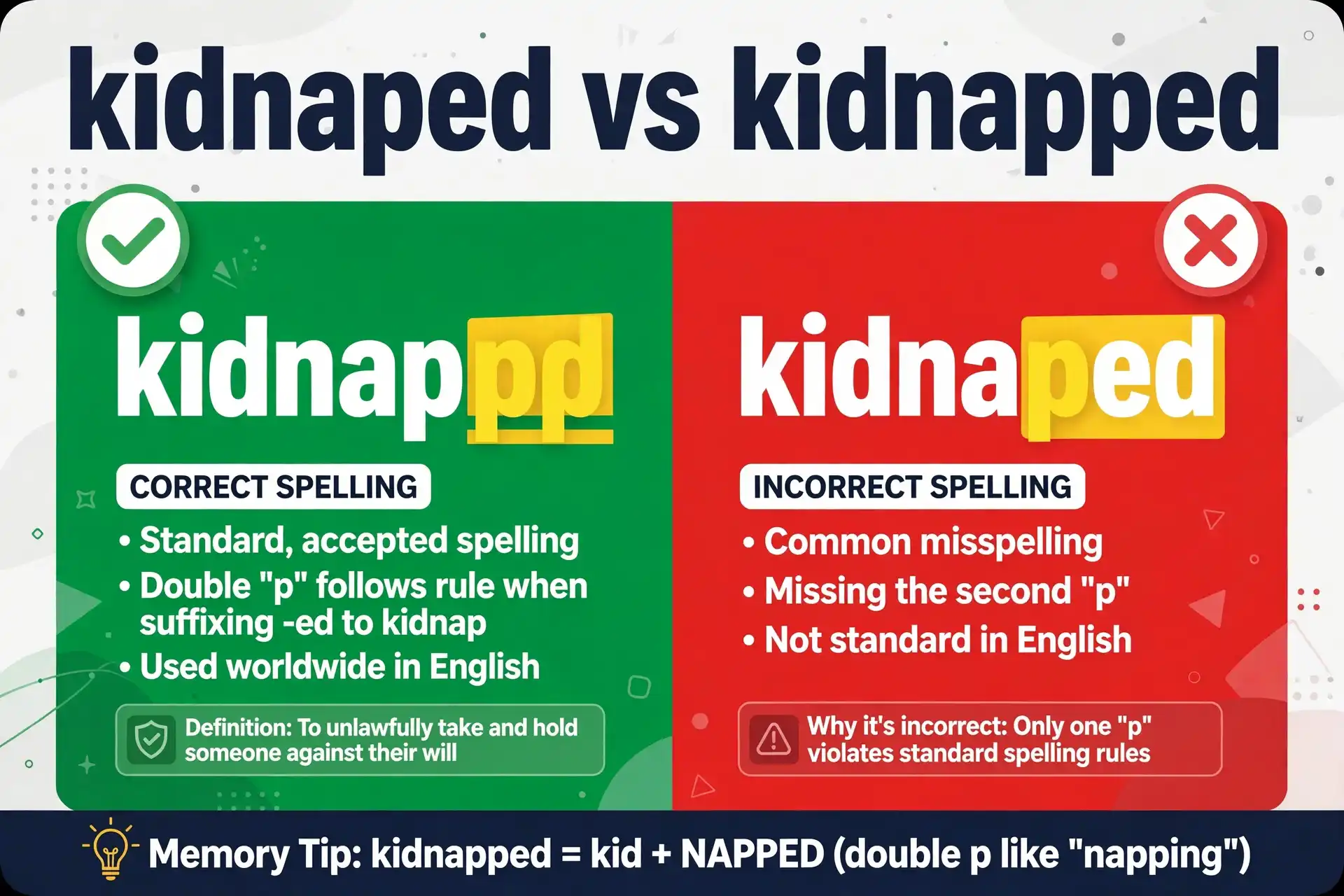
Kidnapped with two P’s is the standard, universally accepted spelling — the past tense of “kidnap,” as in “the child was kidnapped.” Kidnaped with one P does appear in some dictionaries as a rare variant, but it is so uncommon that most readers and spellcheckers treat it as an error. Use “kidnapped” every time and you will never be wrong.
Quick Answer
| Word | Part of Speech | Main Meaning | Example |
|---|---|---|---|
| Kidnapped | Verb form | Past tense of “kidnap” — to seize and hold someone unlawfully | ✅ “The ambassador was kidnapped in 2019.” |
| Kidnaped | Verb form (rare variant) | Listed by some dictionaries, but rarely used and often flagged | ⚠️ “Kidnaped” — technically listed, practically an error |
Simple rule: “Kidnap” ends in a stressed consonant-vowel-consonant pattern (kid-NAP), so the P doubles — kidnapped, kidnapping, kidnapper.
What Does Kidnaped Mean?
Kidnaped with one P means the same thing as “kidnapped” — it is recorded in a few dictionaries, including Merriam-Webster, as an alternate inflected form of “kidnap.” But “listed” and “used” are very different things: this spelling is vanishingly rare in books, news, and legal writing, and most spellcheckers underline it in red. Readers who see it almost always assume it is a typo.
Why does it exist at all? Some writers apply the consonant-doubling rule inconsistently, and because “kidnap” looks like it could follow the pattern of words that don’t double, the single-P form occasionally slips into print. Dictionaries record what appears in print — even rare forms — which is how “kidnaped” earned its footnote status without earning anyone’s recommendation.
What Does Kidnapped Mean?
Kidnapped is the past tense and past participle of “kidnap” — to seize, carry away, or hold a person against their will, usually for ransom or leverage. It is the spelling used by every major news organization, court system, and style guide in both American and British English. Merriam-Webster’s entry for “kidnap” gives “kidnapped” as the principal inflected form, with the single-P variant trailing behind it.
Examples:
- “The journalist was kidnapped while reporting near the border.”
- “Police believe the child was kidnapped by someone she knew.”
- “He claimed he had been kidnapped, but the evidence told another story.”
- “The novel opens with a businessman kidnapped for ransom.”
- “Two aid workers were kidnapped and released unharmed a week later.”
The related forms follow the same doubling: “kidnapping” (the act) and “kidnapper” (the person) — never “kidnaping” or “kidnaper” in standard use.
Kidnaped vs. Kidnapped: Key Differences
| Feature | Kidnaped | Kidnapped |
|---|---|---|
| Status | Rare dictionary variant | Standard spelling |
| Spelling | Single P | Double P |
| Meaning | Same as “kidnapped” | Past tense of “kidnap” |
| Usage frequency | Near zero in published writing | Universal |
| Spellchecker | Usually flagged | Passes everywhere |
| Reader reaction | Looks like a typo | Looks correct |
A dictionary footnote does not make a spelling safe — “kidnapped” is the only form readers trust.
Kidnaped and Kidnapped in Real Sentences
In the News
✅ “The tourists were kidnapped on their way to the airport.”
⚠️ “The tourists were kidnaped on their way to the airport.”
Every newsroom on earth uses the double P — the single-P version would never survive an editor’s desk.
In Legal Writing
✅ “He was charged after the victim was kidnapped from her home.”
⚠️ “The indictment spelled it ‘kidnaped’ throughout.”
Court documents demand the standard form; a variant spelling in a filing reads as carelessness.
In Conversation
✅ “Did you hear they were kidnapped and held for two days?”
⚠️ “She texted that he was ‘kidnaped’ — probably autocorrect failed her.”
Speech hides the difference entirely, which is why the error only ever surfaces in writing.
In Fiction
✅ “In chapter three, the detective himself is kidnapped.”
⚠️ “The self-published thriller used ‘kidnaped’ on every page.”
Copyeditors fix this one on sight — its rarity makes it stand out rather than blend in.

Common Mistakes
Consonant doubling is one of English’s most consistent troublemakers — the “cancelled” vs “canceled” doubling rule works the same stressed-syllable logic, and the “labelled” vs “labeled” spelling split shows how doubling divides dialects. The kidnap traps:
Mistake 1: Writing “kidnaped” because “kidnap” has one P
❌ “The victim was kidnaped at dawn.”
✅ “The victim was kidnapped at dawn.”
Why: The base verb’s single P is a trap. The stressed final syllable (kid-NAP) forces the doubling, just like “equip” becomes “equipped.”
Mistake 2: Forgetting the rule for “-ing” and “-er”
❌ “The kidnaping made headlines for weeks.”
✅ “The kidnapping made headlines for weeks.”
Why: Doubling applies to every vowel suffix: “kidnapping,” “kidnapper,” “kidnapped” — all double the P.
Mistake 3: Trusting the dictionary variant too far
❌ “It’s in the dictionary, so ‘kidnaped’ must be fine.”
✅ “Dictionaries record rare variants; style still demands ‘kidnapped.'”
Why: A variant listing describes what a few writers have done, not what careful writers should do. Frequency and reader expectation decide correctness here.
Mistake 4: Mixing up “kidnap” with non-doubling verbs
❌ “By that logic, ‘kidnaped’ is like ‘developed.'”
✅ “‘Develop’ has an unstressed final syllable (de-VEL-op), so it never doubles — ‘kidnap’ is stressed on NAP, so it does.”
Why: Stress decides everything. Unstressed endings (“develop,” “visit,” “listen”) keep one consonant; stressed endings (“kidnap,” “admit,” “refer”) double it.
Pronunciation
Kidnapped is pronounced KID-napt, with the stress on the first syllable and a crisp double-P stop in the middle. It rhymes with “kidnap” itself — the “-ed” simply adds a T sound. The identical pronunciation of both spellings is exactly why the single-P error persists in writing.

How to Remember the Difference
Break the verb into beats: kid-NAP. That stressed NAP is doing heavy lifting, and English rewards a stressed final syllable with a doubled consonant — kid-napped. Think of the two P’s as the two hands grabbing: one P is never enough for a kidnapping.
- Stress test: stress on NAP (kid-NAP) means double the P — the same reason “equip” becomes “equipped.”
- Family check: wrap → wrapped, trap → trapped, snap → snapped — short stressed verbs double up, and “kidnap” is one of them.
- Variant warning: “kidnaped” may sit in a dictionary footnote, but no editor, teacher, or spellchecker will thank you for using it.
Frequently Asked Questions
Is it kidnaped or kidnapped?
“Kidnapped” with two P’s is the correct standard spelling. “Kidnaped” is a rare dictionary-listed variant that most readers treat as a misspelling.
Is “kidnaped” ever acceptable?
Technically it appears in some dictionaries as a variant, but in practice no — teachers mark it wrong, spellcheckers flag it, and editors change it. Always write “kidnapped.”
Why does “kidnapped” have two P’s?
“Kidnap” ends in a stressed consonant-vowel-consonant pattern (kid-NAP), so English doubles the final P before vowel suffixes to keep the short “a” sound.
What about “kidnapping” and “kidnapper”?
Both double the P as well: “kidnapping,” “kidnapper.” The forms “kidnaping” and “kidnaper” are non-standard and should be avoided.
Is this a US vs UK difference?
No — “kidnapped” is standard in both American and British English. The single-P variant is rare in every dialect.
Why do dictionaries list “kidnaped” at all?
Dictionaries record spellings that appear in print, even uncommon ones. The listing documents the variant’s existence; it is not a recommendation to use it.
Conclusion
Kidnapped with two P’s is the spelling every reader expects and every authority recommends. Kidnaped survives only as a dictionary footnote — interesting, but never the right choice in real writing. Stress the NAP, double the P, and move on.