Busing or Bussing: What’s the Difference? (With Examples)
Is it busing or bussing? Both spellings exist in modern English, but busing with one s is the standard, preferred form in American dictionaries. Bussing with a double s is an accepted variant — and it’s the one many people learn first, by analogy with running and swimming.
The usual rule says double the final consonant before “-ing,” but bus is one of the exceptions: because it’s a short word and the pattern is already clear, dictionaries prefer busing.
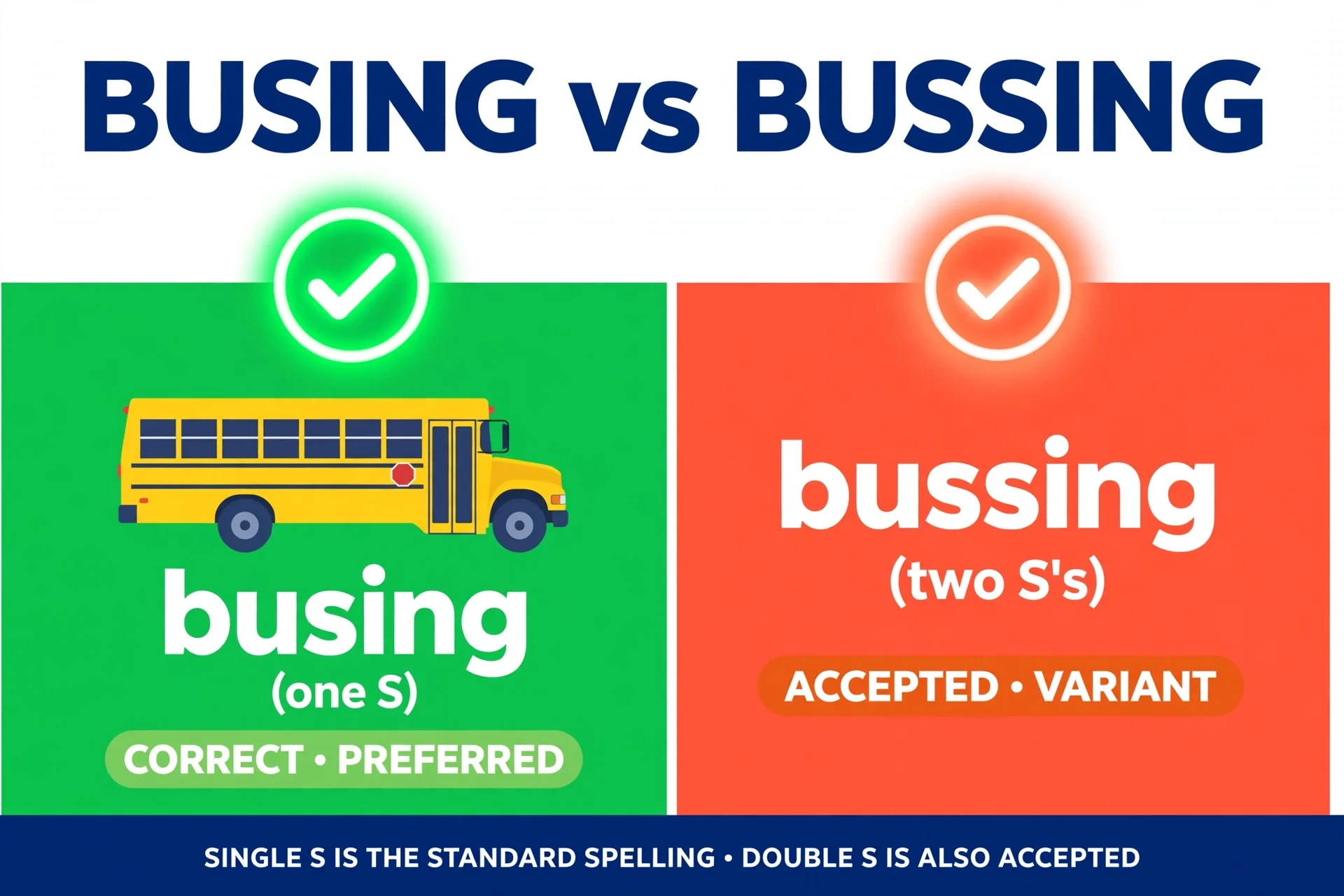
Table of Contents
Quick Answer
| Word | Part of Speech | Main Meaning | Example |
|---|---|---|---|
| busing | Verb (present participle) / noun | Transporting by bus | The district is busing students across town. |
| bussing | Verb (variant) | Same as busing | He spent the summer bussing tables. (kissing variant) |
Simple rule: default to busing with one s. Use bussing only when you mean the kiss (“buss”) or are quoting a source that doubles the s.
What Does Busing Mean?
Busing is the present participle of bus — to transport people by bus — and also a noun meaning the act of transporting by bus. Merriam-Webster lists busing as the headword, defining it as “the act of transporting by bus,” including the historical sense of transporting schoolchildren to achieve racial balance. American style guides and newspapers overwhelmingly use the single-s form.
Examples:
- The city is busing fans to the stadium on game day.
- Her commute involves busing across the river every morning.
- The school board voted to expand busing to the new neighborhoods.
- Busing children long distances remains controversial in some districts.
- The tour company handles all busing between hotels and venues.
What Does Bussing Mean?
Bussing is a recognized variant spelling of busing — same meaning, double s. You’ll find it in plenty of real-world writing, and no reader will misunderstand it. Dictionaries note it as a variant rather than the main entry, which is why editors and teachers usually change it to busing.
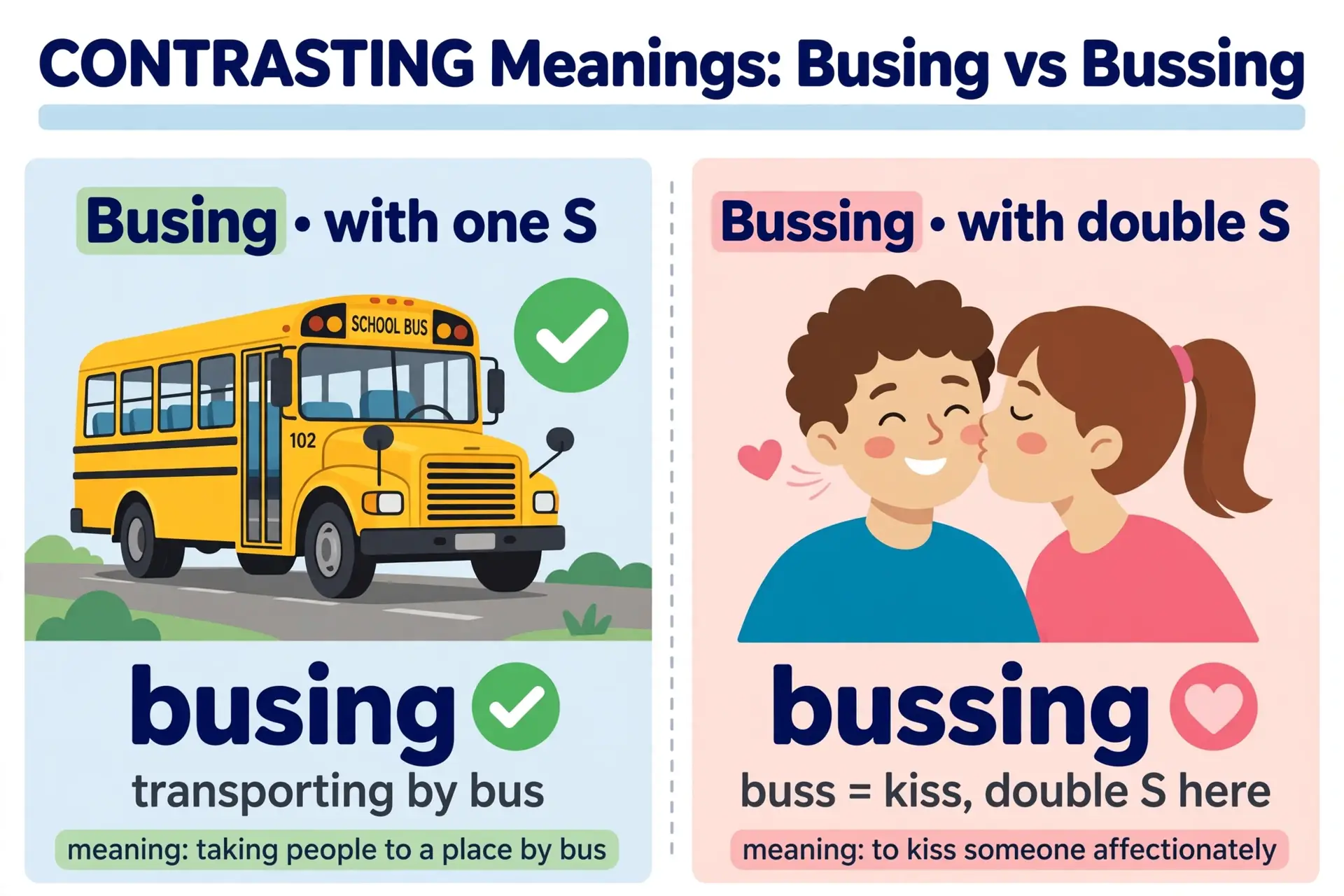
One special case: buss can also mean “kiss,” so “bussing” is the natural -ing form of that verb (“they were bussing each other on the cheek”). In that meaning, the double s isn’t a variant at all — it’s the only spelling.
Examples:
- ✅ The resort offers busing to the beach. (preferred spelling)
- ⚠️ The resort offers bussing to the beach. (accepted variant, not preferred)
- ✅ She gave the baby a buss on the forehead. (“buss” = kiss)
Busing vs. Bussing: Key Differences
| Feature | Busing | Bussing |
|---|---|---|
| Dictionary status | Main entry (preferred) | Listed variant |
| Meaning | Transporting by bus | Same meaning (variant) |
| Use in American style guides | Preferred | Usually corrected |
| Use in British English | Also common | Appears as variant |
| The “kiss” meaning | No | Yes — from buss |
| Safe choice everywhere | Yes | Mostly yes, occasionally edited |
Since both are understood, the practical advice is simple: busing is the safe default, and bussing is fine only if your audience or style guide accepts variants.
Usage in Real Sentences
At Home
✅ They’re busing the kids to grandma’s for the weekend.
✅ They’re bussing the kids to grandma’s for the weekend.
Both are understood here, but the single-s version matches what dictionaries list first.
At Work
✅ The company is busing employees from the north parking lot.
✅ The memo mentioned bussing employees from the north lot.
In formal writing, editors will almost always standardize to “busing”.
In Conversation
✅ “Are they still busing students to the new school?”
✅ “He spent last summer bussing tables at the diner.”
Spoken, they’re identical — the choice only matters on the page.
On Paper
⚠️ The district’s bussing program costs two million a year.
✅ The district’s busing program costs two million a year.
Newsrooms and style guides prefer the single s, so “busing” is the professional pick.
Common Mistakes
The doubling question trips up writers in several word pairs — see the plural rule in busses or buses and the single-vs-double-letter rule in cancelled or canceled. Here are the busing-specific errors:
Mistake 1: Assuming the double s is the only correct form
⚠️ The school is bussing students across town.
✅ The school is busing students across town.
Why: “Bussing” is a variant, not an error — but busing is what dictionaries and style guides prefer.
Mistake 2: Doubling the s in the plural “buses” too
⚠️ The city bought twelve new busses.
✅ The city bought twelve new buses.
Why: The preferred plural is buses with one s. “Busses” is the variant, same as here.
Mistake 3: Using “busing” for the kiss
❌ She was busing the baby on the cheek.
✅ She was bussing the baby on the cheek.
Why: Buss (to kiss) doubles its s like run → running. This is the one place the double s is required.
Mistake 4: Mixing both spellings in one document
❌ Busing starts Monday. The bussing schedule is online.
✅ Busing starts Monday. The busing schedule is online.
Why: Pick one spelling and stick with it. Editors treat inconsistency as sloppiness.
Pronunciation
Both spellings are pronounced the same: “BUH-sing” — a short “u” (like cup), then “sing.” It rhymes with cussing. The extra s changes nothing in speech; this is purely a spelling question.
How to Remember the Difference
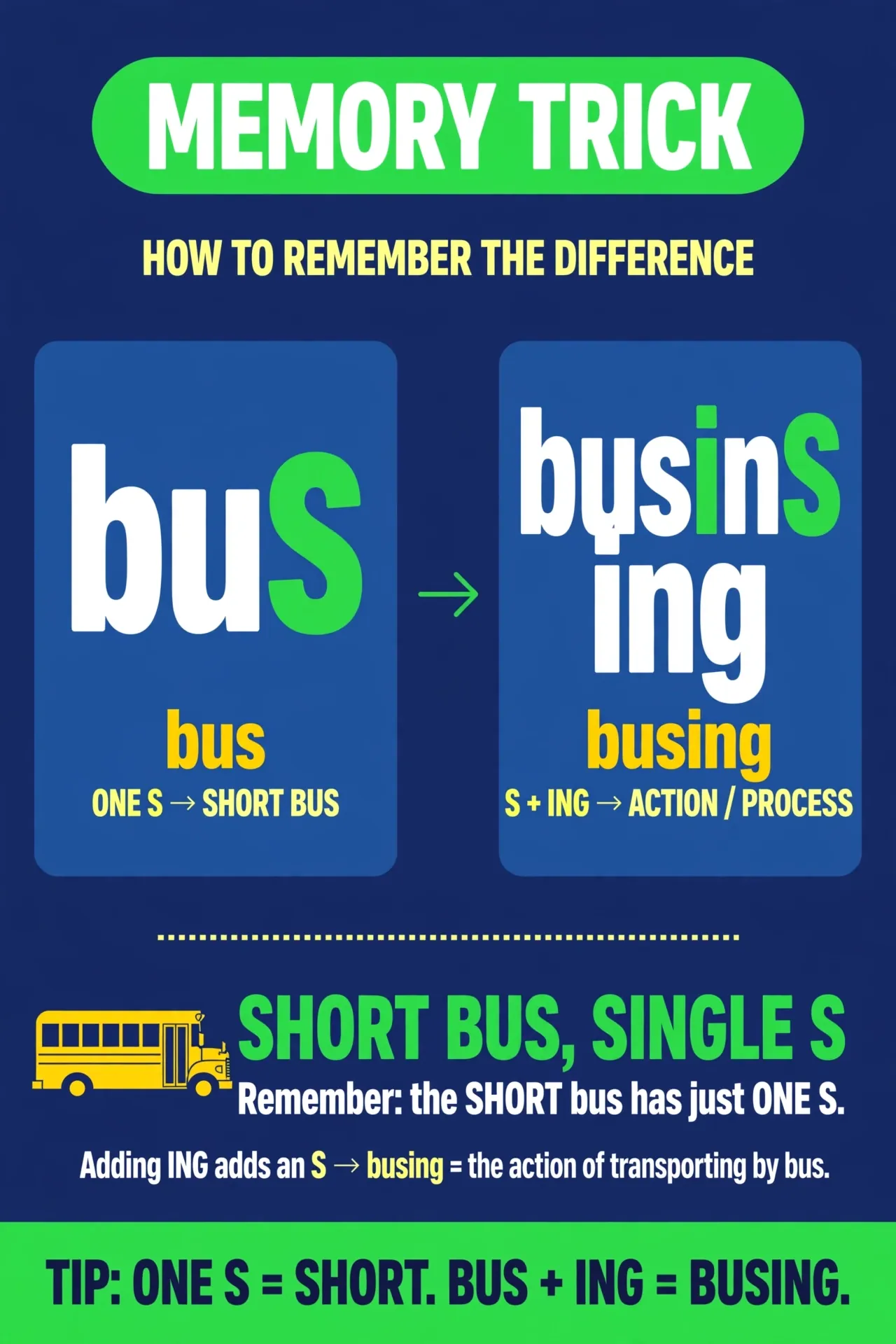
Think of it like the word itself: a bus is short, so its spelling stays short — one s is enough for the -ing form. If you want the kiss, you need the extra letter, so bussing gets the double ss.
- Bus → busing: one s, preferred spelling. Short word, short spelling.
- Buss → bussing: double s. Only for the kiss — “they were bussing goodbye.”
- When in doubt, use busing: it’s the dictionary headword everywhere.
Frequently Asked Questions
Is it busing or bussing?
Busing (one s) is the preferred spelling in American dictionaries. Bussing is an accepted variant.
Is bussing a word?
Yes. It’s a recognized variant of busing, and it’s also the only correct -ing form of buss (to kiss).
What is the past tense of bus?
Bused is preferred; bussed is the accepted variant. The same one-s rule applies.
Why doesn’t bus double its s like run does?
Honestly? Convention. Enough writers and dictionaries settled on busing and buses that the single-s forms became standard, even though the usual doubling rule would suggest otherwise.
Which spelling do newspapers use?
Busing. American style guides (AP, Chicago) and newsrooms overwhelmingly use the single-s form.
Conclusion
Busing with one s is the standard, preferred spelling for transporting by bus; bussing is an accepted variant — and the required spelling only when you mean the kiss. When in doubt, keep it short: one s.