Busses or Buses: Which Spelling Is Correct?
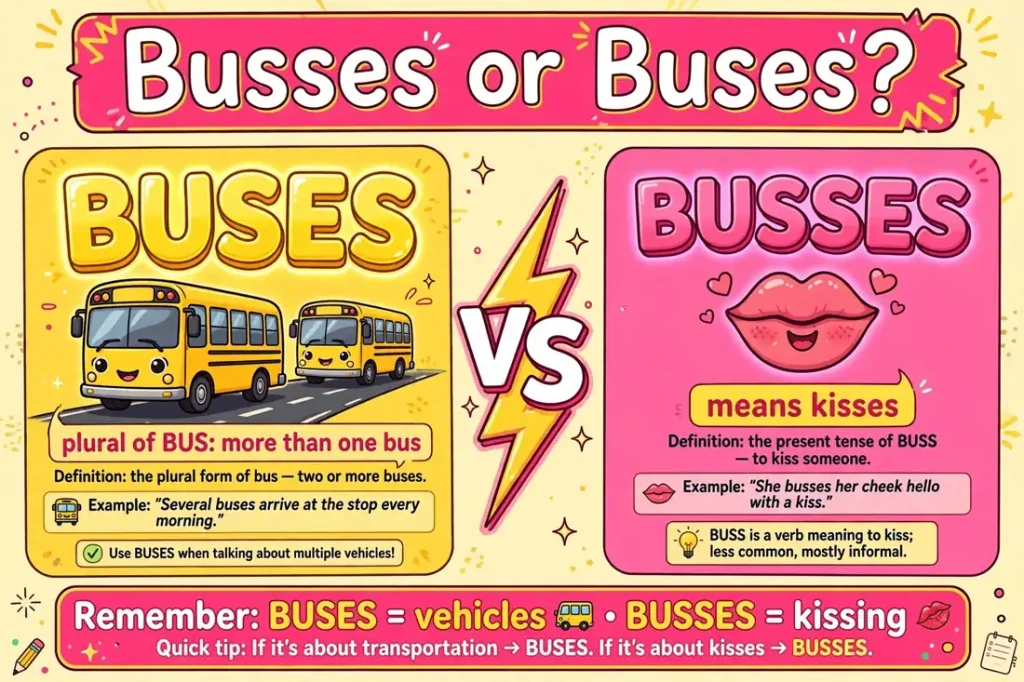
Buses is the standard plural spelling of bus. Busses is also a correct English word, but it usually means kisses or refers to the verb buss. The correct choice depends on your meaning.
When talking about public transportation, school transportation, or multiple vehicles, use buses. When referring to kisses, busses may be correct, though kisses is more common in everyday writing.
Quick Answer
Quick Facts: Buses vs. Busses
|
Word |
Meaning |
Common Use |
Example |
|
Buses |
Plural of bus |
Transportation |
The buses leave at 8 a.m. |
|
Busses |
Plural of buss, meaning kisses |
Literary or less common usage |
The character busses her hand. |
|
Busses |
A form of the verb buss |
Describing someone giving a kiss |
He busses his daughter goodbye. |
What Does Buses Mean?
Buses is the standard plural form of bus. A bus is a large road vehicle that carries passengers, usually along a set route.
Use buses when talking about two or more vehicles.
Examples of Buses in Sentences
In all these examples, buses refers to transportation vehicles.
Common Phrases With Buses
The word appears in many everyday expressions, including:
For example, “The school district replaced several old buses with electric models.”
What Does Busses Mean?
Busses is a real English word, but it has a different meaning from the transportation-related plural buses.
It is associated with the verb buss, which means to kiss. The word is uncommon in modern everyday writing and often appears in literary or older contexts.
Busses as a Noun
As a noun, busses is the plural of buss. A buss is a kiss.
Examples:
In modern writing, kisses would usually sound more natural.
Busses as a Verb
Busses can also be the third-person singular form of the verb buss.
Examples:
These sentences use busses to mean “kisses.” However, this usage is uncommon.
Buses or Busses: Key Differences
The main difference is meaning and frequency. Buses is the normal spelling for multiple transportation vehicles. Busses relates to kissing and is rarely used in everyday English.
|
Feature |
Buses |
Busses |
|
Correct spelling |
Yes |
Yes |
|
Main meaning |
More than one bus |
More than one kiss, or a form of buss |
|
Part of speech |
Plural noun |
Plural noun or verb form |
|
Transportation use |
Standard |
Not standard |
|
Everyday frequency |
Common |
Rare |
|
Example |
The buses are late. |
He busses her cheek. |
Why Is the Plural of Bus Buses?
The word bus ends in s. English commonly forms the plural of nouns ending in s, ss, sh, ch, or x by adding -es.
Examples include:
|
Singular |
Plural |
|
Bus |
Buses |
|
Class |
Classes |
|
Dish |
Dishes |
|
Box |
Boxes |
|
Church |
Churches |
|
Brush |
Brushes |
Therefore, the correct plural of bus is buses, not busses.
The spelling rule also helps explain why the plural of class is classes rather than classs.

Is Busses Ever Correct?
Yes. Busses is a valid spelling when it comes from the word buss, meaning a kiss.
However, it is not the standard plural spelling of bus.
Consider these examples:
The first sentence needs buses because it refers to vehicles. The third uses busses as a verb meaning “kisses.”
American vs. British English: Buses or Busses
There is no major American and British spelling difference for the transportation word.
Both American English and British English use buses as the plural of bus.
|
English Variety |
Correct Transportation Plural |
|
American English |
Buses |
|
British English |
Buses |
|
Canadian English |
Buses |
|
Australian English |
Buses |
For example:
The spelling remains the same across these varieties.
How to Use Buses in Different Contexts
The word buses fits many situations involving transportation.
1. Public Transportation
Use buses when discussing vehicles that carry passengers around a city or between locations.
Examples:
2. School Transportation
Use buses when referring to vehicles that transport students.
Examples:
3. Travel and Tourism
Use buses when discussing group travel, sightseeing, or transportation services.
Examples:
4. Business and Fleet Management
Use buses when describing a company’s transportation fleet.
Examples:
Common Mistakes With Buses and Busses
1. Writing Busses for Transportation Vehicles
Incorrect: The busses are waiting at the terminal.
Correct: The buses are waiting at the terminal.
Use buses for public, school, tour, and other transportation vehicles.
2. Assuming Busses Is Always Wrong
Incorrect assumption: Busses is never a real word.
Correct explanation: Busses is valid when it comes from buss, meaning a kiss.
It is simply not the standard plural of bus.
3. Using Bus’s Instead of Buses
These forms have different grammatical functions.
Examples:
Do not use an apostrophe to form a regular plural.
4. Confusing Buses With Bussing
The word bussing can have different meanings depending on context. It may refer to kissing, or it can describe clearing tables in a restaurant.
For transportation, the plural remains buses.
Examples:
These words serve different purposes.
How to Remember the Correct Spelling
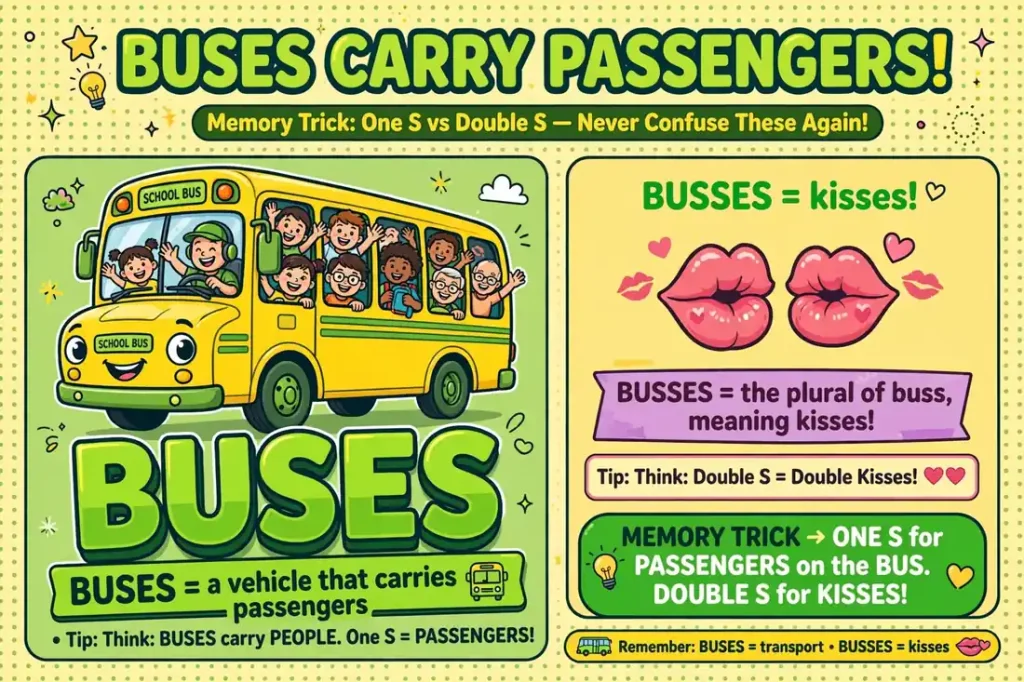
Use this simple rule:
More than one bus = buses.
The plural follows the usual pattern of adding -es to words ending in s.
You can also connect busses with buss, an uncommon word for a kiss.
Remember:
If your sentence discusses a school, station, route, fleet, or public transportation, choose buses.
Frequently Asked Questions
Is Busses or Buses Correct?
Both spellings are valid, but they have different meanings. Buses is the standard plural of bus. Busses can mean kisses or serve as a form of the verb buss.
Is Busses a Real Word?
Yes. Busses is a real word related to buss, meaning a kiss. It is uncommon in modern everyday English.
Why Is the Plural of Bus Buses?
English commonly adds -es to nouns ending in s. This makes buses the standard plural form of bus.
Is Buses Correct in American and British English?
Yes. American and British English both use buses when referring to multiple transportation vehicles.
What Is the Difference Between Buses and Bus’s?
Buses is the plural form of bus. Bus’s is the possessive form, showing that something belongs to one bus.
Example: “The buses arrived late” versus “The bus’s door was open.”
Should I Write School Buses or School Busses?
Write school buses. This is the standard spelling in both American and British English.
Conclusion
Buses is the correct standard plural of bus when discussing transportation. Busses is also a valid word, but it relates to kissing rather than vehicles.
For school buses, public transportation, tour vehicles, and bus fleets, always use buses. Remember that busses comes from the uncommon word buss, meaning a kiss.