Gases or Gasses: Which Spelling Is Correct?
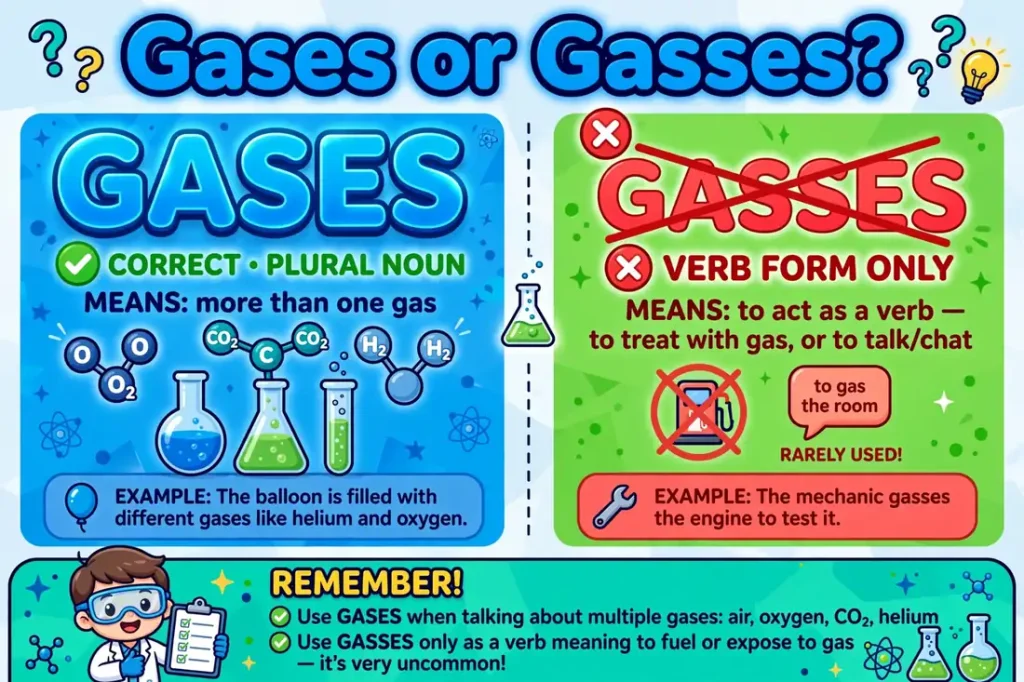
Gases is the standard plural spelling of gas. Gasses is also a correct English word, but it usually comes from the verb gas or refers to a rare verb meaning to attack with gas. When discussing multiple substances in the gaseous state, use gases.
For example, write “The atmosphere contains several gases,” not “The atmosphere contains several gasses.”
Quick Answer
Quick Facts: Gases vs. Gasses
|
Word |
Correct? |
Meaning |
Example |
|
Gases |
Yes |
Plural of the noun gas |
Several gases are present in the atmosphere. |
|
Gasses |
Yes |
Third-person singular form of the verb gas |
He gasses up the vehicle. |
|
Gasses |
Yes, in limited usage |
Plural form of gas in some informal or specialized contexts |
The text uses “gasses” as a variant plural. |
What Does Gases Mean?
Gases is the standard plural form of the noun gas. A gas is a state of matter that has no fixed shape or volume. It spreads to fill the space available to it.
Air contains several gases, including nitrogen and oxygen. Other familiar examples include carbon dioxide, helium, and hydrogen.
Examples of Gases in Sentences
In each sentence, gases refers to more than one gaseous substance.
Common Types of Gases
The word appears in science, industry, medicine, and everyday life.
Examples include:
For example, “The experiment examined how different gases react to heat.”
What Does Gasses Mean?
Gasses is a valid English spelling, but its use depends on the context. Most commonly, it is the third-person singular form of the verb gas.
The verb gas has several meanings. In everyday American English, to gas up means to fill a vehicle with fuel. In other contexts, to gas can mean to expose someone to gas or to make someone feel bloated.
Gasses as a Verb
Use gasses when the subject is he, she, it, or a singular noun.
Examples:
The exact meaning depends on the verb and the sentence.
Gasses in Informal Usage
In informal speech, people may use gasses in expressions related to fueling vehicles.
For example:
In these examples, gasses is a verb form, not a plural noun referring to substances.
Gases or Gasses: Key Differences
The main difference is grammatical function. Gases is the standard plural noun. Gasses is usually a verb form.
|
Feature |
Gases |
Gasses |
|
Standard plural of gas |
Yes |
No, not in standard scientific writing |
|
Common grammatical role |
Plural noun |
Verb |
|
Main use |
Multiple gaseous substances |
A person or thing performs an action involving gas |
|
Science writing |
Standard |
Avoid for the plural noun |
|
Example |
The gases expanded. |
He gasses up the car. |
Why Is the Plural of Gas Gases?
The standard plural of gas is gases. English often adds -es to nouns ending in certain sounds or letters, including s, ss, sh, ch, and x.
Examples:
|
Singular |
Plural |
|
Gas |
Gases |
|
Bus |
Buses |
|
Class |
Classes |
|
Box |
Boxes |
|
Dish |
Dishes |
|
Church |
Churches |
Although gas ends in a single “s,” its standard plural uses -es.
The extra “s” in gasses belongs to a different spelling pattern. It commonly appears when adding an ending to the verb gas.

Is Gasses Ever Correct?
Yes. Gasses is correct when it functions as a verb form.
For example:
The first sentence uses gasses as a verb. The second uses gases as a plural noun.
Some dictionaries also record gasses as a less common variant plural. However, gases is the usual and preferred spelling when discussing multiple gaseous substances.
American vs. British English: Gases or Gasses
There is no major American and British spelling difference for the standard plural of gas. Both varieties use gases.
|
English Variety |
Standard Plural |
|
American English |
Gases |
|
British English |
Gases |
|
Canadian English |
Gases |
|
Australian English |
Gases |
Examples:
The plural spelling remains the same across these varieties.
How to Use Gases in Different Contexts
The word gases appears in many subjects. Its meaning stays consistent: more than one gas.
1. Science and Chemistry
Use gases when discussing chemical substances in the gaseous state.
Examples:
2. Environmental Science
Use gases when discussing the atmosphere, pollution, or climate.
Examples:
3. Medicine and Health
Use gases when referring to substances used in medical settings or gases present in the body.
Examples:
4. Industry and Manufacturing
Use gases when describing materials used in production, welding, or processing.
Examples:
How to Use Gasses in a Sentence
Use gasses when it is the verb form of gas. The subject is usually singular and performs an action.
1. Talking About Fueling a Vehicle
In informal American English, gas up means to fill a vehicle with gasoline.
Examples:
2. Talking About Exposure to Gas
The verb gas can refer to exposing someone or something to gas.
Examples:
This usage is technical and depends on the process being described.
3. Talking About Bloating
The verb gas can also describe causing someone to develop gas in the digestive system.
Example:
– The food gasses him up.
This is informal. In more neutral writing, use “causes bloating” or “causes gas.”
Common Mistakes With Gases and Gasses
1. Using Gasses as the Plural of Gas in Science Writing
Incorrect: The experiment measured three different gasses.
Correct: The experiment measured three different gases.
Use gases for the standard plural noun.
2. Assuming Gasses Is Always Wrong
Incorrect assumption: Gasses is never a real word.
Correct explanation: Gasses is a valid verb form, as in “She gasses up the car.”
Its grammatical role determines whether the spelling works.
3. Confusing Gases With Gas’s
These forms have different functions.
Examples:
Do not use an apostrophe to form a regular plural.
4. Forgetting the Extra “E” in Gases
Incorrect: The gases in the tank were tested.
Correct: The gases in the tank were tested.
The correct spelling includes “es” after the final “s” in gas.
How to Remember the Difference
Use this simple rule:
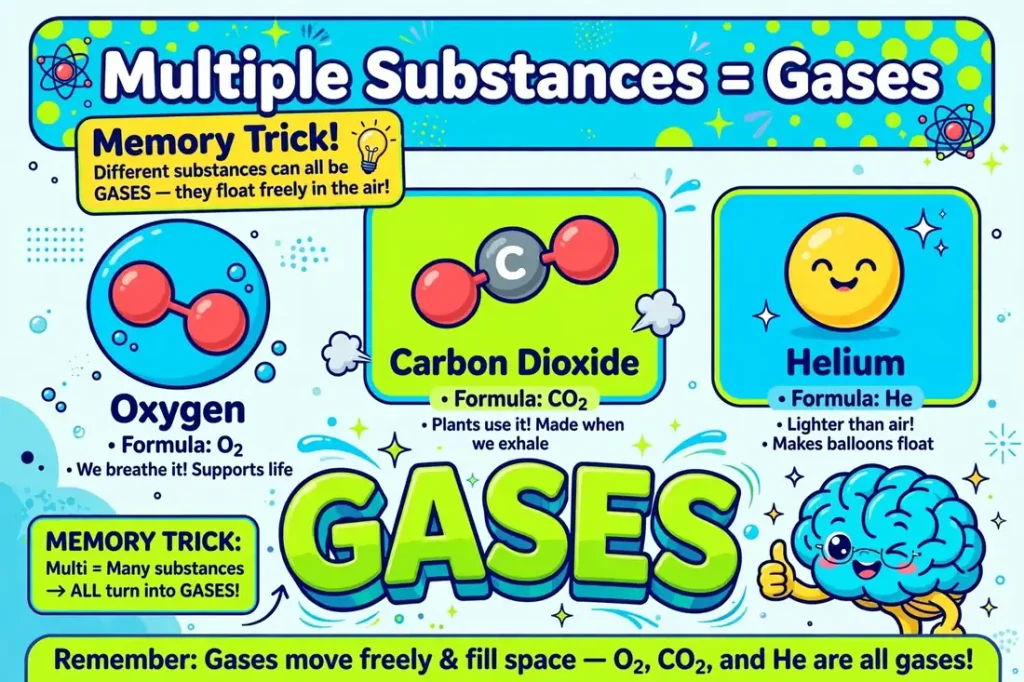
Multiple substances = gases.
If you can replace the word with “different types of gas,” use gases.
Examples:
Use gasses when the word describes an action performed by a person or thing.
Example:
– He gasses up the car before work.
Remember:
Frequently Asked Questions
Is Gases or Gasses Correct?
Both spellings exist, but they have different uses. Gases is the standard plural of gas. Gasses is usually the third-person singular form of the verb gas.
Is Gasses a Real Word?
Yes. Gasses is a real word. For example, “She gasses up her car” uses it as a verb. It is not the usual plural spelling for multiple gaseous substances.
Why Is the Plural of Gas Gases?
English forms the standard plural by adding -es to gas. The result is gases, following a common plural spelling pattern for nouns ending in “s.”
Is Gases Correct in American and British English?
Yes. Both American and British English use gases as the standard plural of gas. There is no regional spelling difference in this case.
What Is the Difference Between Gas’s and Gases?
Gas’s is the possessive form of the singular noun gas. Gases is the plural form.
Example: “The gas’s temperature changed” refers to one gas. “The gases changed temperature” refers to multiple gases.
Should I Write Greenhouse Gases or Greenhouse Gasses?
Write greenhouse gases. This is the standard spelling when referring to multiple gases that contribute to the greenhouse effect.
Conclusion
Gases is the standard plural of gas when discussing multiple substances in the gaseous state. Gasses is usually a verb form, such as “He gasses up the car.”
For science, environmental topics, medicine, and everyday references to multiple gases, choose gases. Remember that the extra “s” in gasses usually signals a verb form, not the standard plural noun.