Dyeing or Dying: Meaning, Difference, and Examples
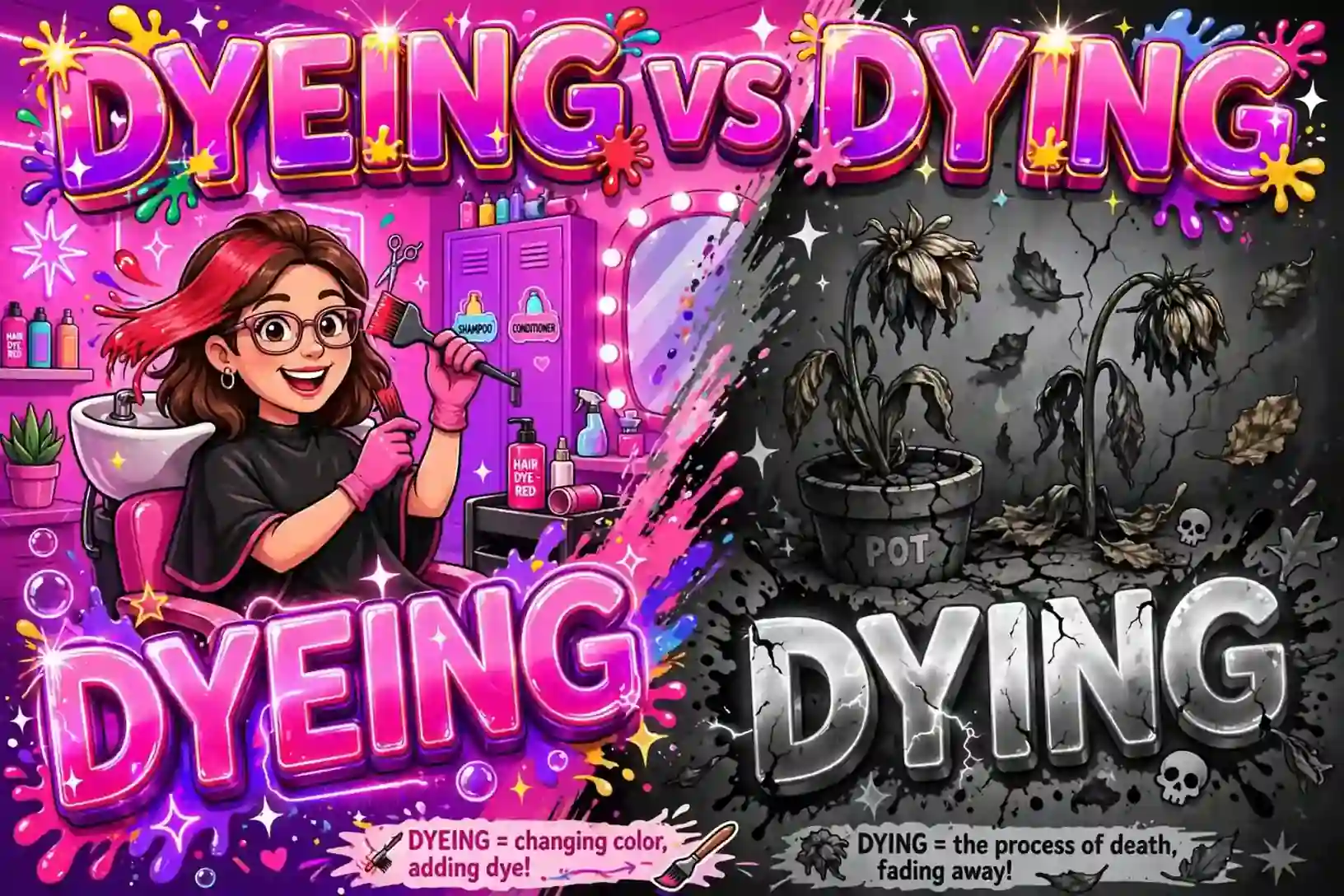
Dyeing means coloring something, such as hair or fabric. Dying means ceasing to live, and it is also the present participle of die in senses like “dying of curiosity.” Though they sound identical, the two words are never interchangeable.
For example, “She is dyeing her hair red” describes coloring hair. “The plant is dying” describes something losing life. Mixing them up can create accidentally dramatic sentences.
Quick Answer
| Word | Part of Speech | Main Meaning | Example |
|---|---|---|---|
| Dyeing | Verb form / noun | Coloring with dye | She is dyeing her hair. |
| Dying | Verb form | Ceasing to live; the -ing form of die | The flowers are dying. |
Simple rule: If color is involved, write dyeing. If death, endings, or the verb die is involved, write dying.
What Does Dyeing Mean?
Dyeing is the present participle of the verb dye, which means to color something using a dye. The e is kept before -ing to keep it distinct from dying.
Examples:
- She is dyeing her hair blonde for the summer.
- The factory specializes in dyeing cotton fabric.
- They spent the afternoon dyeing Easter eggs.
- He considered dyeing his beard to cover the gray.
As a noun, dyeing can also name the process itself: “Natural dyeing uses plant-based colors.”
See the full entry for dyeing on Merriam-Webster for more usage examples.
What Does Dying Mean?
Dying is the present participle of the verb die. Its most literal meaning is ceasing to live, but die also appears in many expressions.
Dying: Ceasing to Live
- The old tree is dying after the harsh winter.
- Doctors did everything they could for the dying patient.
Dying in Expressions
- I’m dying to see the new movie. (eager)
- She was dying of laughter at the joke. (overwhelmed)
- The tradition is slowly dying out. (disappearing)
- He is dying for a cup of coffee. (strongly wanting)
Note the related spelling question of dieing vs dying: dieing is never correct for any of these senses.
Dyeing vs. Dying: Key Differences
| Feature | Dyeing | Dying |
|---|---|---|
| Base verb | Dye (to color) | Die (to cease living) |
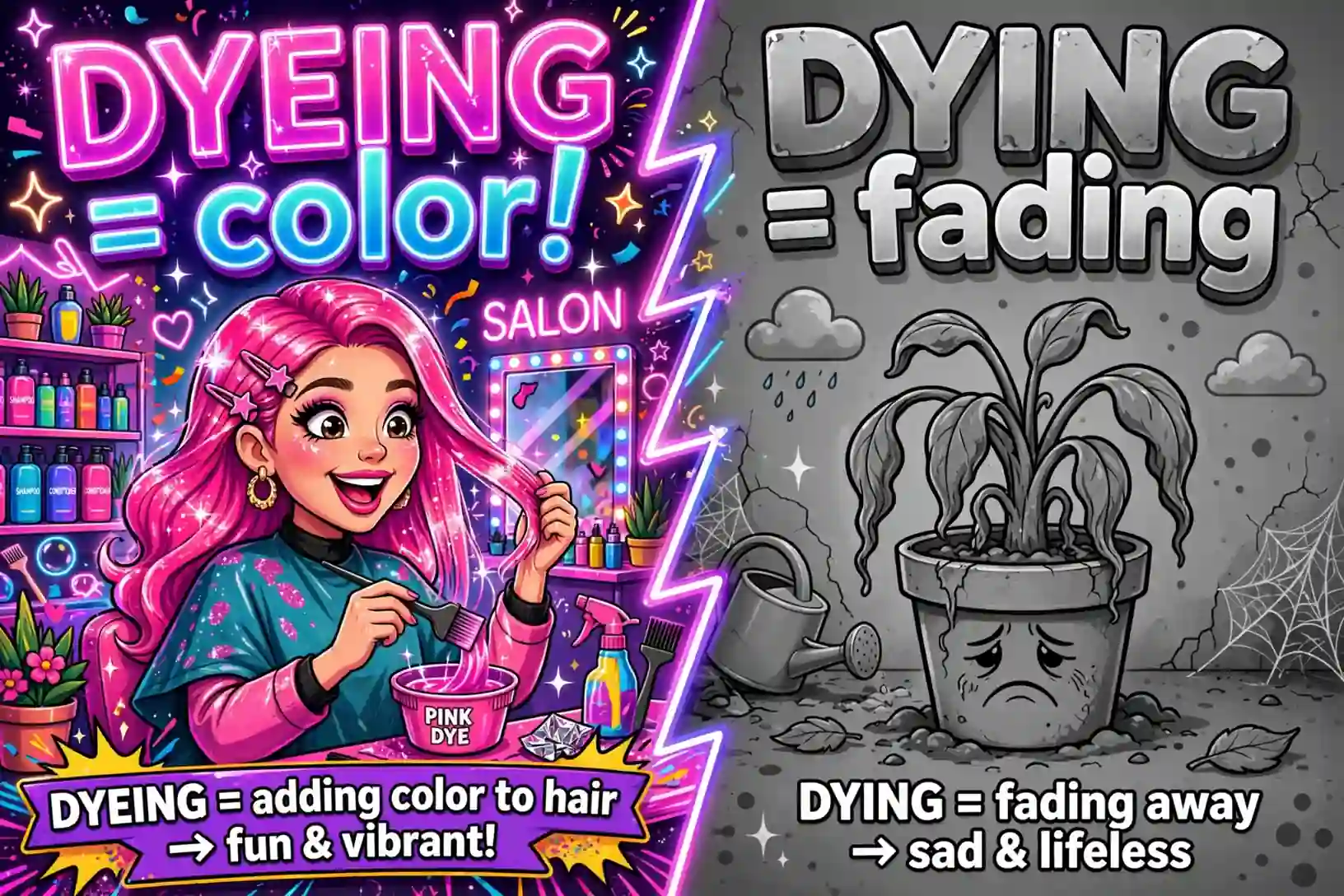
| Core meaning | Adding color | Ending, death, strong desire |
| Keeps the “e”? | Yes, to avoid confusion | No |
| Example | Dyeing the curtains blue. | The fire is dying down. |
English keeps the e in dyeing precisely so readers do not mistake it for dying. It is one of the rare cases where spelling actively prevents a mix-up.
Examples of Dyeing and Dying in Real Sentences
At the Salon
Dyeing: “She is dyeing her hair a deep shade of red.”
Dying: “Her old hair dryer is dying after ten years of use.”
The first sentence is about color. The second uses dying to mean wearing out.
In the Garden
Dyeing: “They tried dyeing white flowers with food coloring.”
Dying: “Without water, the flowers are dying.”
Same setting, completely different meanings.
In Conversation
Dyeing: “Are you dyeing your jeans black again?”
Dying: “I’m dying to hear what happened!”
The second sentence shows the figurative use of dying, similar to other easily confused everyday words.
Common Mistakes With Dyeing and Dying
Mistake 1: Writing “Dying” for Coloring Hair
❌ She is dying her hair pink.
✅ She is dyeing her hair pink.
Why: The sentence is about adding color, so it needs dyeing. The wrong version sounds alarming.
Mistake 2: Writing “Dyeing” for Something Fading Away
❌ The campfire is dyeing out.
✅ The campfire is dying out.
Why: The fire is going out, which comes from the verb die. Use dying.
Mistake 3: Writing “Dieing”
❌ He is dieing to meet you.
✅ He is dying to meet you.
Why: The -ing form of die is always dying, never dieing.
Pronunciation: Dyeing vs. Dying
Both words are pronounced /ˈdaɪɪŋ/, rhyming with crying and flying.
Since they sound exactly alike, spelling is the only way to show which meaning you intend.

How to Remember the Difference
Memory trick: Dyeing keeps the E from dye. Think of the E as the drop of color staying in the word.
- Dye + ing = dyeing (color stays, so the E stays).
- Die + ing = dying (the E drops, as in dying).
Ask yourself: “Is color involved?” If yes, keep the E and write dyeing.
Frequently Asked Questions
Is it dyeing or dying your hair?
Use dyeing for coloring hair: “She is dyeing her hair.” Dying would mean something entirely different.
What is the difference between dyeing and dying?
Dyeing means coloring with dye. Dying is the -ing form of die, meaning ceasing to live or, figuratively, strongly wanting something.
Is “dieing” ever correct?
No. The correct -ing form of die is dying. Dieing is always a misspelling.
Do dyeing and dying sound the same?
Yes. Both are pronounced /ˈdaɪɪŋ/. Context and spelling are the only clues to the meaning.
Can “dyeing” be a noun?
Yes. Dyeing can name the coloring process itself, as in “tie-dyeing” or “the dyeing industry.”
Conclusion
Dyeing is about color; dying is about the verb die. Keep the E when color is involved, drop it otherwise. A quick meaning check before you write will keep these homophones straight every time.