Goodmorning or Good Morning: Which Is Correct?
Type “goodmorning” into a text message and your phone probably will not flag it. That is part of the problem. The single word looks natural on a small screen, and plenty of people write it every day. But in standard English, “goodmorning” is not a word. The correct form is “good morning” — two words, with a space in the middle. This page explains why the two-word form is right, why the one-word version keeps showing up, and how to use the greeting correctly in messages, emails, and formal writing.
Quick Answer: “Good morning” is correct. “Goodmorning” written as one word is incorrect in standard English. Always write it as two words — “good” and “morning” — in messages, emails, schoolwork, and formal writing.
Table of Contents
The Short Answer: Good Morning Is Correct
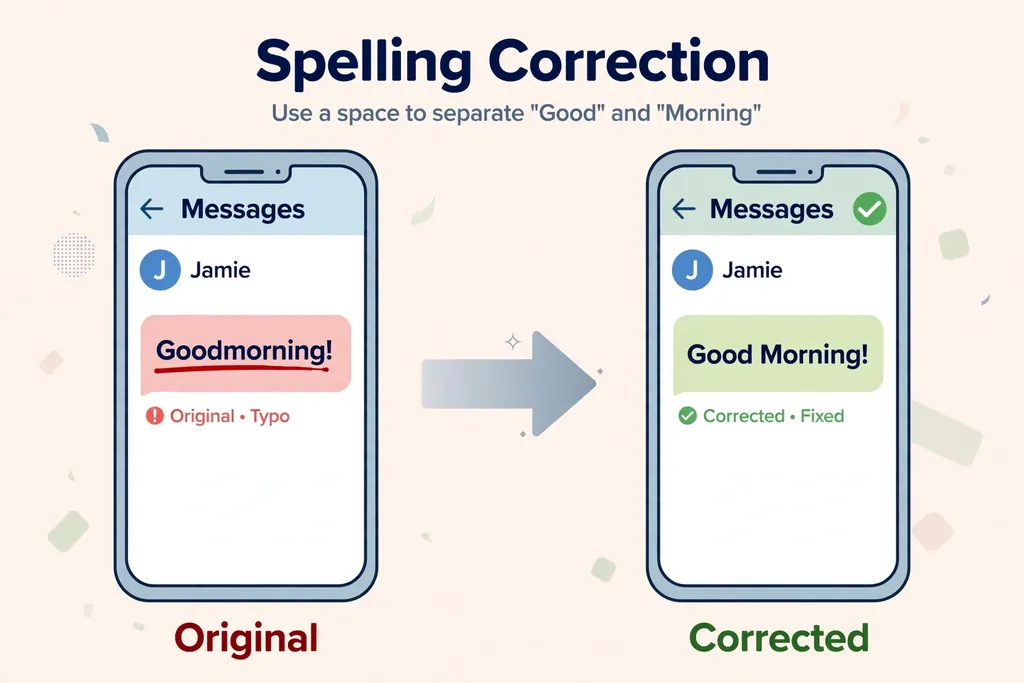
“Good morning” is correct, and “goodmorning” is not. The greeting is made of two separate words: the adjective “good” and the noun “morning”. The adjective describes the noun, exactly as it does in “good day”, “good afternoon”, and “good night”. English keeps this kind of greeting in two words, and no standard dictionary lists “goodmorning” as a word at all.
That matters because dictionaries are the record of standard spelling. If a spelling does not appear in a major dictionary, it is not an accepted variant — it is a mistake. “Good morning” appears in every major dictionary as a two-word phrase. “Goodmorning” appears in none of them. The space between the two words is part of the correct spelling, not an optional decoration.
The rule is simple to remember: if you are greeting someone in the morning, write two words. There is no context — formal or informal, spoken or written — in which the one-word version is the standard form.
Why “Goodmorning” Is Wrong
The first reason is dictionary evidence. The Cambridge Dictionary lists “good morning” as a two-word exclamation, defined as something you say to greet someone politely when you meet them in the morning. Oxford and Merriam-Webster list it the same way. None of them has an entry for “goodmorning”, and that absence is the point: the one-word form has never been accepted into standard English.
The second reason is how English builds compounds. Some phrases do fuse into one word over time. “Today” was once written “to day”, “tonight” was once “to night”, and “goodbye” started as the phrase “God be with ye”. Each of those closed up after centuries of heavy use. “Good morning” has not made that jump. It is still an open compound — two words that work together as a greeting but keep their space.
The third reason is what spellcheckers do. Type “goodmorning” into most word processors, email programs, and browsers, and you will see a red underline. The spellchecker is not being fussy; it is telling you the word is not in its dictionary. Splitting it into “good morning” clears the underline at once. That is a fast, practical test you can use any time you are unsure.
Finally, the one-word form hurts you in formal writing. In a job application, a school essay, or a work email, “goodmorning” reads as a typing error. The reader may still understand you, but the mistake weakens the impression your writing makes. Two words cost you one keystroke — a space — and they keep your writing clean.
Why People Write “Goodmorning”
If the one-word version is wrong, why does it appear so often? The main cause is speed. People type fast on phones, and a space is easy to skip when your thumbs are moving quickly. Once the mistake is typed a few times, the phone’s keyboard can even learn it and start suggesting it, which makes the error feel normal.
Sound plays a part too. Said quickly, “good morning” runs together, and the ear hears something close to a single word. Spoken English blurs words together all the time, which is also why many people write “could of” instead of could have. What sounds like one word is not always one word on the page, and greetings are a common place for that gap to show.
Social media adds to the confusion. A hashtag cannot contain a space, so #goodmorning is the only way to tag the phrase, and usernames work the same way. Seeing “goodmorning” in handles and hashtags every day makes the spelling look familiar, even though handles and hashtags follow different rules from ordinary writing. A username is a label, not a spelling lesson.
There is also a simple habit factor. People copy what they see. One friend writes “goodmorning” in a group chat, another copies it, and the misspelling spreads. None of that makes it correct — it only makes it common. Common and correct are two different things, and this is a good example of the difference.

Examples of “Good Morning” in Sentences
Seeing the greeting in real sentences makes the two-word rule easy to remember. Here are examples for different situations:
- Formal greeting: “Good morning, Mrs. Patel. Thank you for coming in today.”
- At work: “Good morning, team. Let us start with the sales numbers.”
- On the phone: “Good morning, this is Sarah from the clinic. How can I help you?”
- At school: “Good morning, class. Please open your books to page forty.”
- Casual text: “Good morning! Did you sleep well?”
- Mid-sentence: “She said good morning and poured herself a cup of tea.”
- In an email: “Good morning, Mr. Lee. I am writing about the meeting on Friday.”
- As a wish: “Good morning to you too — I hope your day goes well.”
Notice that the spelling never changes. Whether the greeting opens a sentence, sits in the middle of one, or starts an email, it is always “good morning” — two words. The capital letter changes with position, but the space never disappears.
“Good Morning” vs. Other Greetings
“Good morning” is part of a family of two-word greetings, and they all follow the same rule. “Good afternoon”, “good evening”, and “good night” are all written as two words. The pattern is steady: the word “good” plus the time of day, with a space between them.
| Greeting | Words | When to Use It |
|---|---|---|
| Good morning | Two | From early morning until around noon, to greet someone |
| Good afternoon | Two | From around noon until the early evening, to greet someone |
| Good evening | Two | From the early evening onward, to greet someone |
| Good night | Two | Late at night, to say farewell or before bed — not a greeting |
| Good day | Two | Any time of day, more common in British and Australian English |
“Good night” deserves a special note. It looks like the others, but it works differently: it is a farewell, not a greeting. You say “good night” when someone is leaving late in the evening or going to bed. You would not open a conversation with it. The spelling rule is the same, though — two words, never “goodnight” as a single word in standard writing.
A short form also exists. In casual speech, people often drop “good” and just say “Morning!” That is fine in conversation with friends and family. It is a shortened greeting, not a different spelling, and it does not make “goodmorning” correct either.
When Is “Good Morning” Capitalized?
Capitalization follows the normal sentence rules, and the greeting is not a proper noun. At the start of a sentence, capitalize the first word only: “Good morning, everyone.” In the middle of a sentence, both words are lowercase: “He wished her good morning and walked away.” That lowercase “g” in the middle of a sentence is correct, even though it can look odd to writers who are used to seeing the phrase at the start of a message.
Email openings follow the same pattern. “Good morning,” at the top of an email takes a capital “G” because it starts the line, not because the phrase is a title. The “m” in “morning” stays lowercase. The same goes for letters and chat messages: capitalize the first word when the greeting opens the message, and use lowercase when it appears later in a sentence.
The one place both words take capitals is a title. A book, song, or article called “Good Morning” uses title case, where the main words are capitalized. That is a rule about titles, not about the greeting itself. In ordinary sentences, “Good Morning” with two capitals is wrong.
“Good Morning” in Texts, Emails, and Social Media
Casual writing does not change the spelling. In a text message, “Good morning!” is still the correct form, and the two-word version is what most readers expect. The abbreviation “GM” has become common in casual texts — “GM! Ready for the meeting?” — and that is fine as shorthand between friends. It is an abbreviation, not a new spelling, and it belongs in casual messages only.
In work emails, the greeting sets the tone of the whole message. “Good morning, Ms. Chen,” is polite and professional. “Goodmorning, Ms. Chen,” starts the same message with a visible error. Since the email greeting is often the first thing the reader sees, the two-word form is worth the extra keystroke.
On social media, captions and comments follow standard spelling too. “Good morning from the beach!” is correct in a caption. The hashtag version, #goodmorning, is a separate case: hashtags cannot contain spaces, so the words run together by necessity. Nobody should copy hashtag spelling into a sentence. The tag is a label for search, not an example of how to spell the greeting.
Common Mistakes to Avoid
Four mistakes show up again and again with this greeting. The first is writing “goodmorning” as one word, especially in emails and schoolwork where the error is most visible. The second is writing “good mourning” — “mourning” means grieving for someone who has died, and it has nothing to do with the morning. The mix-up comes from the two words sounding almost the same, but their meanings are far apart.
The third mistake is capitalizing both words in the middle of a sentence: “She said Good Morning and left.” Unless the phrase is a title, only the first word takes a capital, and only at the start of a sentence. The fourth is dropping the space in a different way — writing “goodmorning” in a formal document after seeing it in a hashtag or a username. Small spelling slips add up, and the doubled letter in beginning vs begining catches out plenty of careful writers too. Checking the small words is what keeps writing clean.
One habit fixes all four: pause on the space. “Good” and “morning” are two words that belong together, and the space between them is part of the spelling. Type the space, and the rest of the greeting takes care of itself.
FAQ
Is “goodmorning” a word?
No. “Goodmorning” is not listed in any major dictionary, and it is not an accepted spelling in standard English. The correct form is “good morning”, written as two words.
Is it “good morning” or “goodmorning” in an email?
It is “good morning”, two words, in every kind of email — formal and casual. Write “Good morning, Mr. Lee,” with a capital “G” because the greeting opens the message, and keep “morning” lowercase.
Can I write “Good Morning” with both words capitalized?
Only at the start of a sentence or in a title. In the middle of a sentence, write “good morning” with both words lowercase, as in “She said good morning and left.” The phrase is not a proper noun, so it does not take capitals in normal use.
What is the short form of “good morning”?
In casual speech, people often say just “Morning!” In casual texts, the abbreviation “GM” is common. Both are fine with friends and family, but neither replaces the full “good morning” in formal writing.
Is “good morning” one word in any English-speaking country?
No. “Good morning” is two words in American, British, Canadian, and Australian English. No major variety of English writes it as one word, and no major dictionary lists “goodmorning” as a correct form.