Flammable or Inflammable: What’s the Difference?
Flammable and inflammable are not opposites — they mean exactly the same thing: able to catch fire and burn. Both describe gasoline, paper, dry leaves, and anything else that ignites easily. The trap is the little in- at the front of inflammable, which looks like the “not” prefix in incorrect or invisible.
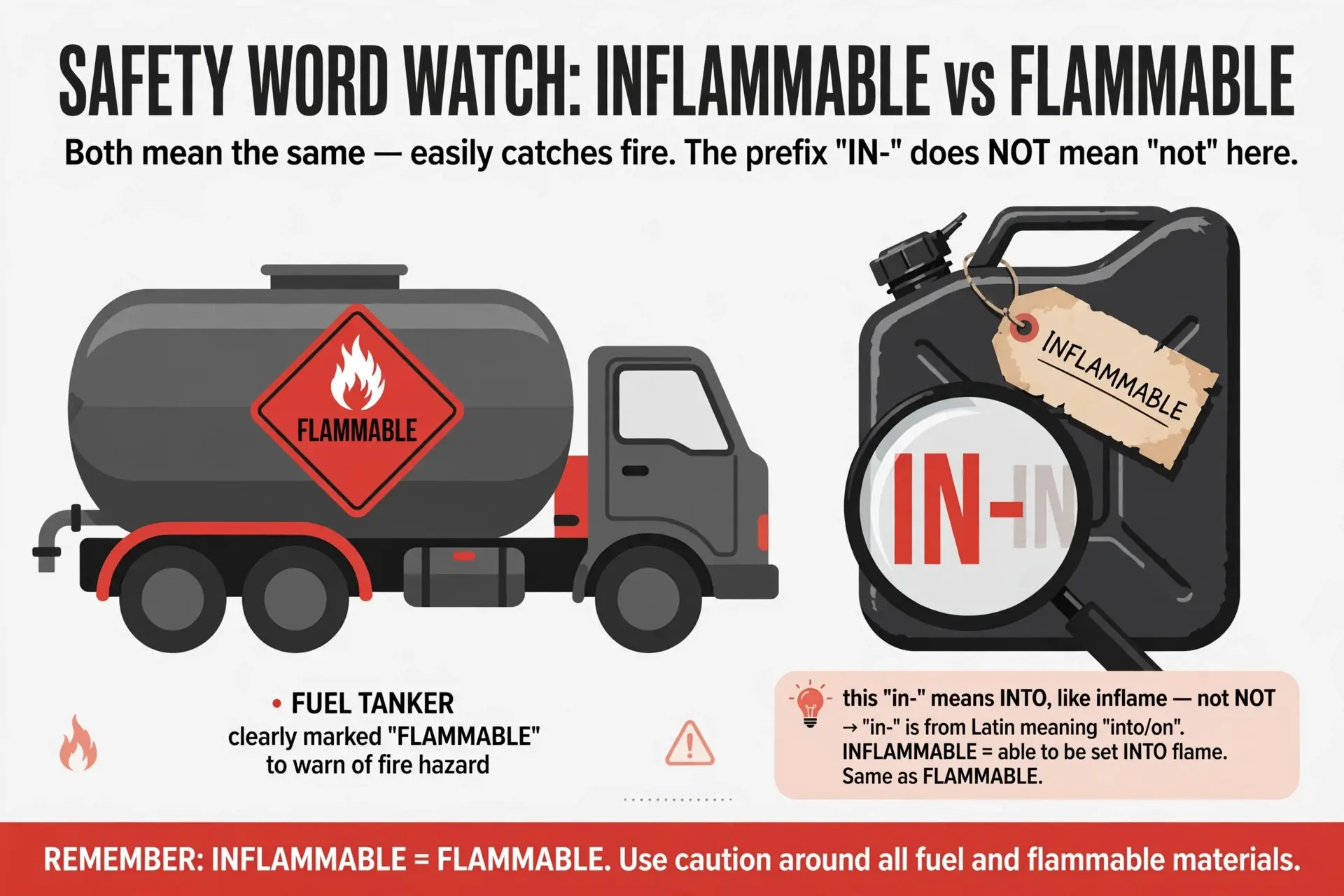
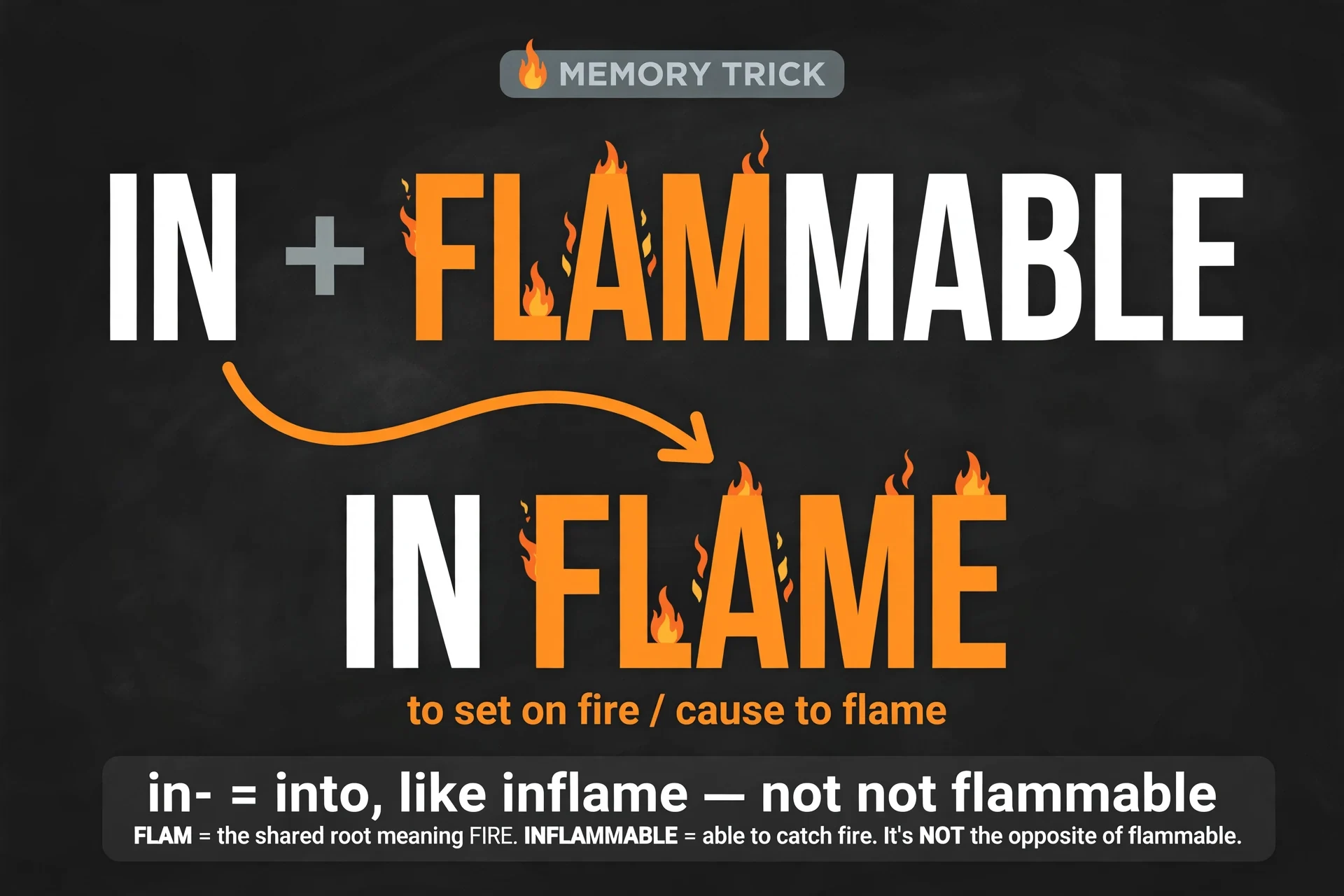
It is not. The in- in inflammable is the “into” prefix — the same one in inflame, meaning to set on fire. So inflammable literally means “able to be inflamed,” which is why flammable means the same thing.
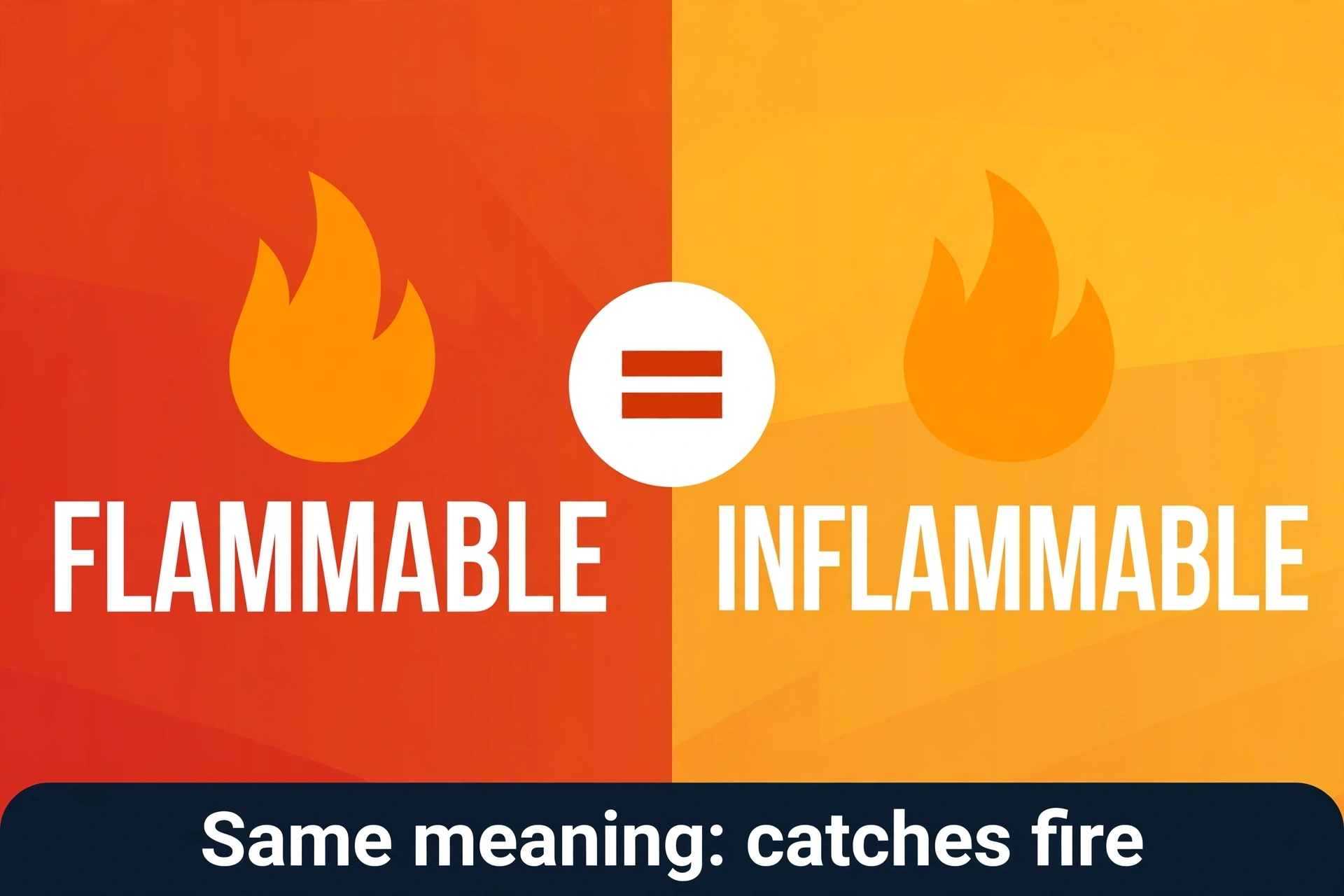
Table of Contents
Quick Answer
| Word | Part of Speech | Main Meaning | Example |
|---|---|---|---|
| flammable | adjective | able to catch fire and burn easily | “Gasoline is highly flammable, so keep it away from open flames.” |
| inflammable | adjective | able to catch fire and burn easily (same meaning) | “The old label warned that the solvent was inflammable.” |
Simple rule: both words mean combustible — flammable is the modern standard word, and inflammable is its older twin.
What Does “Flammable” Mean?
Flammable describes any material that ignites easily and burns readily. It is the word you see on safety labels, shipping regulations, and insurance documents — a deliberate choice made so nobody mistakes the label for “not flammable.”
- “Gasoline is highly flammable, so never smoke near a fuel pump.”
- “The label marked the paint thinner as flammable and required special storage.”
- “Dry grass in summer is dangerously flammable after weeks without rain.”
- “Aerosol cans are flammable and must not be left in hot cars.”
- “The fire department warned that the warehouse stored flammable chemicals.”
What Does “Inflammable” Mean?
Inflammable means exactly the same thing as flammable: able to be set on fire. It is the older of the two, built from the Latin inflammare (“to set on fire”) with the in- prefix meaning “into” — like inflame itself. The word is still correct English, but it has been falling out of everyday use for decades because it misleads readers into hearing “not flammable.”
- “The 1970s label described the cleaning fluid as inflammable.”
- “Textbooks used to call hydrogen an inflammable gas.”
- “Older dictionaries list inflammable as the standard form.”
- “The manual warned that the cargo was inflammable and must travel by ground.”
- “Poets sometimes prefer inflammable for its four syllables and rhythm.”
Flammable vs. Inflammable: Key Differences
| Feature | Flammable | Inflammable |
|---|---|---|
| Core meaning | able to catch fire easily | able to catch fire easily — identical |
| Prefix | none | in- meaning “into” (as in inflame), not “not” |
| Age | coined in the early 1800s as the clearer alternative | older, from Latin via French |
| Current status | the standard word in safety, legal, and everyday use | correct but fading; still in dictionaries |
| Where you meet it | warning labels, regulations, modern writing | old books, old labels, British literature |
| Risk of confusion | none | readers may wrongly read “not flammable” |
The meanings are twins; only the usage has diverged — safety regulators standardized on flammable because a misunderstood warning can cost lives.
Usage Examples in Real Sentences
At Home
Flammable: “Keep flammable liquids like paint thinner locked in the garage.” Inflammable: “Grandpa still calls kerosene inflammable, from the old labels.” — Same property described; the second reflects older usage.
At Work
Flammable: “OSHA requires all flammable materials to be stored in approved cabinets.” Inflammable: “The archive copy of the 1985 safety manual used inflammable throughout.” — Regulators say flammable today; inflammable survives in old documents.
In the News
Flammable: “Officials warned that the dry brush was flammable ahead of fire season.” Inflammable: “A 1960s newspaper clipping called the cargo ‘inflammable liquids’.” — One word reports today’s risk; the other quotes yesterday’s language.
In Conversation
Flammable: “Nail polish remover is flammable, so keep it off the stove.” Inflammable: “If you mean inflammable, yes — that’s exactly why I moved it.” — The second sentence corrects the vocabulary while agreeing on the danger.
Common Mistakes
The danger here is not mixing the two words up — it is misreading one of them. Similar spelling traps like firey or fiery and smokey or smoky are harmless; this one can be a safety issue:
Mistake 1: Reading “inflammable” as “not flammable”
❌ Seeing an old “INFLAMMABLE” drum and assuming it is safe near flames.
✅ Treating inflammable as a synonym of flammable — it burns just as easily.
Why: the in- here means “into,” not “not.” This misreading is exactly why safety authorities pushed flammable onto labels worldwide. See Merriam-Webster’s definition of flammable for the standard “capable of being easily ignited” sense.
Mistake 2: Writing “inflammable” in safety instructions
❌ “Store all inflammable materials in the yellow cabinet.”
✅ “Store all flammable materials in the yellow cabinet.”
Why: technically correct, but a reader in a hurry may skim it as “non-flammable.” In warnings, clarity beats tradition.
Mistake 3: “Correcting” inflammable to “unflammable”
❌ “The opposite of flammable is inflammable.”
✅ “The opposite of flammable is nonflammable.”
Why: English already has nonflammable for things that resist burning — fire doors, treated fabrics, some refrigerants.
Mistake 4: Assuming “inflammable” is always wrong
❌ Flagging every inflammable as a spelling error.
✅ Accepting it in older texts, quotes, and dictionaries while using flammable yourself.
Why: inflammable is legitimate English with centuries of history — it is just the less clear choice today.
Pronunciation
Flammable = /ˈflæməbl/ — “FLAM-uh-bul”, stress on the first syllable. Inflammable = /ɪnˈflæməbl/ — “in-FLAM-uh-bul”, stress on the second syllable. Say them aloud and the shared flammable core is obvious — another hint that they are the same word wearing different prefixes.
How to Remember the Difference
There is no difference in meaning — only a trap in the spelling. Remember that the in- in inflammable works like the in- in inflame (to set fire into something), not the in- in invisible (not visible). When in doubt, default to flammable — it is the word on every modern warning label for a reason.
- Flammable = catches fire easily; the modern standard.
- Inflammable = catches fire easily; same meaning, older word.
- in- = “into” here (like inflame), never “not.”
- The opposite of flammable is nonflammable.
Frequently Asked Questions
Is it flammable or inflammable?
Use flammable. Both are correct English and mean the same thing, but flammable is the modern standard and the word safety labels use. Inflammable survives mainly in older books and quotations — writing it today invites the misreading “not flammable.”
What is the difference between flammable and inflammable?
Nothing in meaning — both mean able to catch fire and burn easily. The difference is usage: flammable is current and unambiguous, while inflammable is older and confusing because its in- prefix looks like “not” but actually means “into,” as in inflame.
Why do labels say “flammable” instead of “inflammable”?
Safety authorities deliberately standardized on flammable in the 20th century after cases of people reading “inflammable” as “not flammable.” When a single misread word can start a fire, clarity wins over tradition — the shorter word removes the ambiguity entirely.
Is “inflammable” a real word?
Yes — it is the older of the two, with roots in Latin inflammare, and every major dictionary still lists it. It is not a mistake or a back-formation. It has simply lost ground to flammable in modern writing because of the confusion its prefix causes.
What is the opposite of flammable?
Nonflammable — describing materials that resist burning, like treated curtains or certain refrigerants. Never inflammable, which means the opposite of what the misreader thinks it means.
Do British and American English differ on flammable vs. inflammable?
Not in meaning — both varieties treat the words as synonyms. But inflammable hung on longer in British usage and literature, so you will meet it more often in older British texts. Modern style guides on both sides of the Atlantic now recommend flammable.
Conclusion
Flammable and inflammable are two spellings of one idea: catches fire easily. The in- means “into,” not “not” — and because that single prefix can mislead, modern labels say flammable. Use it, and keep inflammable for quoting history.