Fortuitous or Fortunate: What’s the Difference?
Fortuitous and fortunate look like cousins, but they answer different questions. Fortuitous describes something that happened by chance — a fortuitous meeting in the airport was unplanned, whether it turned out well or badly. Fortunate describes someone favored by good luck — a fortunate investor made money.
The sharp edge of the distinction: a fortuitous event can be unfortunate. Bumping into an old rival by accident is fortuitous; it is the opposite of fortunate.
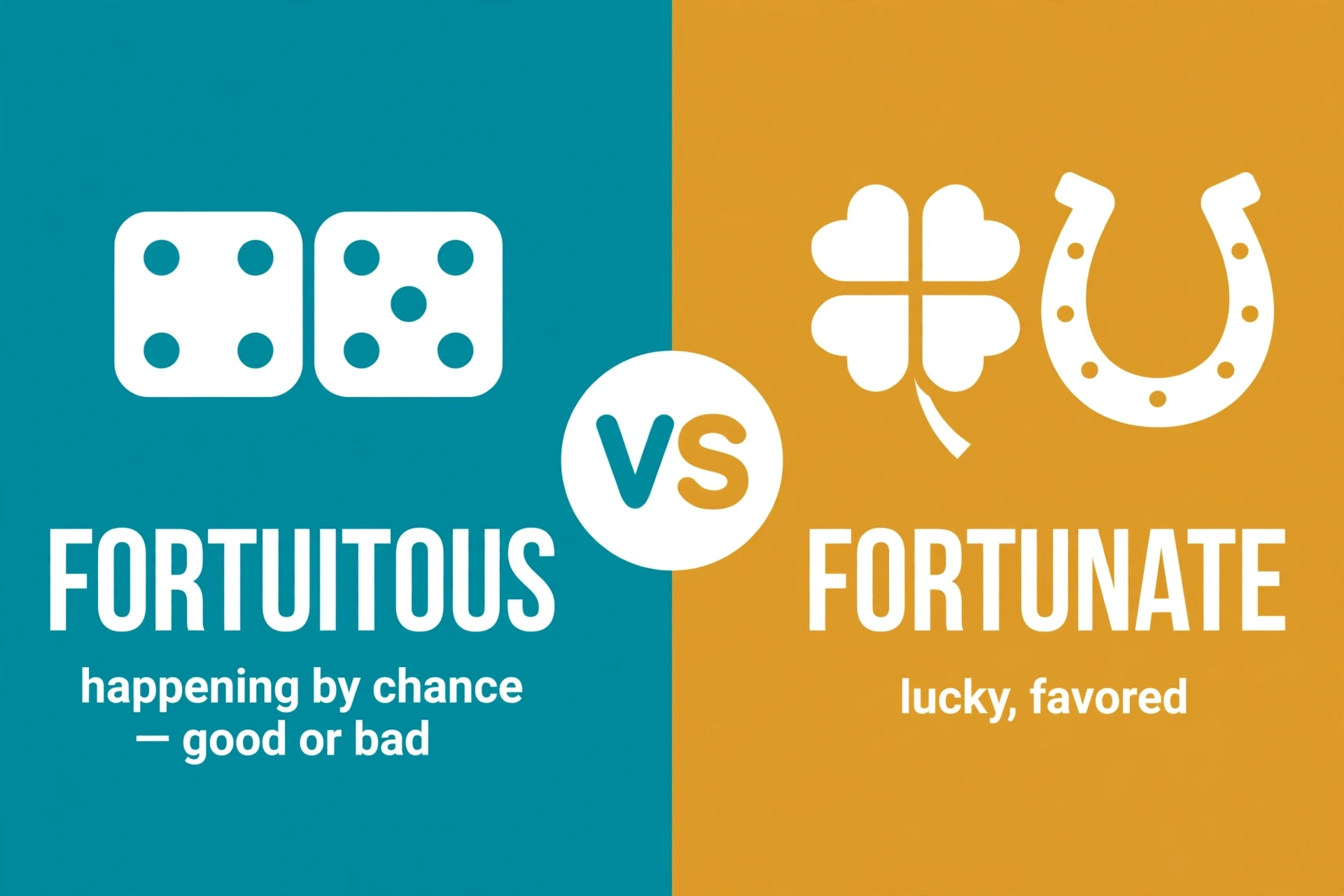
Table of Contents
Quick Answer
| Word | Part of Speech | Main Meaning | Example |
|---|---|---|---|
| fortuitous | adjective | happening by chance; accidental (can be good or bad) | “Their meeting at the airport was purely fortuitous.” |
| fortunate | adjective | favored by good fortune; lucky | “He was fortunate to escape the accident unhurt.” |
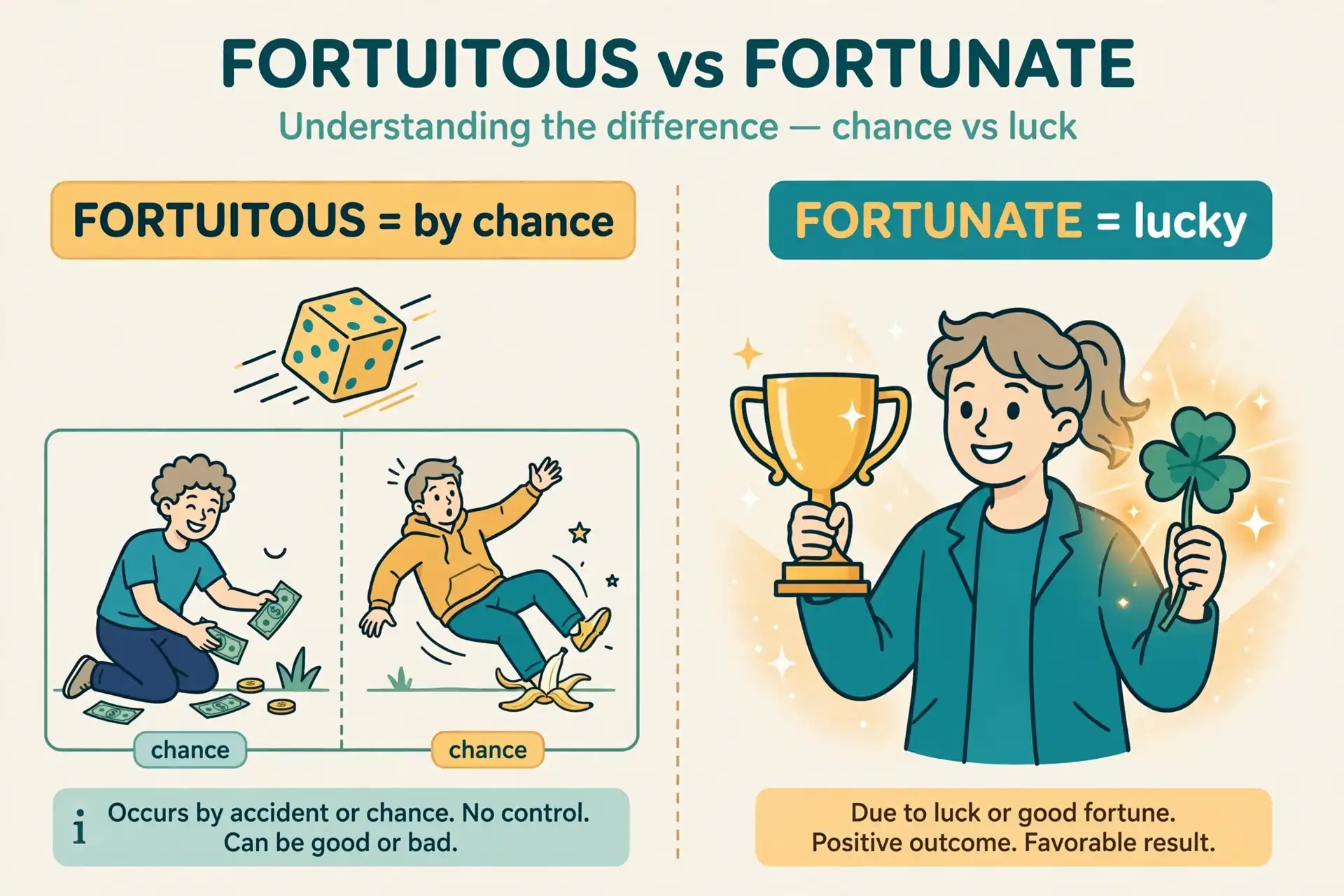
Simple rule: fortuitous = it happened by chance; fortunate = it turned out well for someone.
What Does “Fortuitous” Mean?
Fortuitous describes events that occur by accident or chance, with no planning behind them. Crucially, it says nothing about whether the outcome was good — a fortuitous discovery can make you rich or a fortuitous delay can make you miss your flight. Purists insist on this neutral sense, and dictionaries back them: “occurring by chance.”
- “Their meeting at the airport was purely fortuitous — neither knew the other was traveling.”
- “A fortuitous power cut forced everyone outside, where the real networking happened.”
- “The discovery of penicillin was famously fortuitous: a contaminated dish nobody planned.”
- “It was fortuitous that she checked her email twice; the second look caught the error.”
- “By a fortuitous coincidence, both brothers ended up at the same university.”
What Does “Fortunate” Mean?
Fortunate describes people or outcomes blessed by good luck — things that turned out well. It is always positive: a fortunate escape, a fortunate investor, “how fortunate for us.” Where fortuitous explains how something happened, fortunate judges that it happened well.
- “He was fortunate to escape the accident with only a scratch.”
- “We were fortunate that the storm missed our town entirely.”
- “She considers herself fortunate to have a job she actually enjoys.”
- “It was a fortunate decision to leave early — the roads were chaos by noon.”
- “The fortunate winners split a prize worth two million dollars.”
Fortuitous vs. Fortunate: Key Differences
| Feature | Fortuitous | Fortunate |
|---|---|---|
| Core meaning | happening by chance | lucky, favored by fortune |
| Value judgment | neutral — can be good or bad | always positive |
| What it describes | events, meetings, discoveries, coincidences | people, escapes, decisions, outcomes |
| Question it answers | “How did it happen?” — by accident | “How did it turn out?” — well |
| Common pairing | fortuitous encounter, fortuitous timing | fortunate enough, fortunate to |
| Opposite | planned, deliberate | unfortunate |
A single event can be both: winning the lottery on a ticket you bought by accident is a fortuitous event with a fortunate outcome — while a fortuitous delay that costs you the winning ticket is unfortunate.
Usage Examples in Real Sentences
At Work
Fortuitous: “A fortuitous overlap in our schedules made the merger talks possible.” Fortunate: “We were fortunate the client overlooked the typo in the first draft.” — The overlap happened by chance; overlooking the typo was lucky.
In Science
Fortuitous: “The cure was a fortuitous accident — the lab was testing something else.” Fortunate: “Mankind was fortunate that the accident happened in a supervised lab.” — The accident was unplanned; its safe setting was good luck.
On the Road
Fortuitous: “Taking the wrong exit proved fortuitous when the main road flooded.” Fortunate: “We were fortunate to have a full tank before the detour.” — The wrong turn was chance; the full tank was luck.
In Conversation
Fortuitous: “It was fortuitous that we both swiped right on the same day.” Fortunate: “I feel fortunate that a silly app led to something real.” — The timing was coincidence; the happy result is fortune.
Common Mistakes
Lookalike adjectives cause endless slips — see also effective or affective and momento or memento. With this pair, the signature errors:
Mistake 1: Using “fortuitous” to mean “lucky”
❌ “We were fortuitous to find the keys.”
✅ “We were fortunate to find the keys.”
Why: finding the keys was a good outcome for you — that is fortunate. Fortuitous would describe how it happened: “a fortuitous gust blew the rug aside, revealing the keys.” See Merriam-Webster’s definition of fortuitous for the strict “occurring by chance” sense.
Mistake 2: Calling a bad accident “fortunate”
❌ “It was fortunate that the pipes burst while we were away.”
✅ “It was fortuitous that the pipes burst while we were away — or rather, unfortunate, but lucky timing.”
Why: burst pipes are never fortunate. If the timing was chance, say fortuitous; if the outcome was bad, say unfortunate.
Mistake 3: “A fortuitous escape”
❌ “He made a fortuitous escape from the burning building.”
✅ “He made a fortunate escape from the burning building.”
Why: escaping unhurt is a good outcome — fortunate. “Fortuitous” would wrongly suggest the escape was merely accidental rather than lucky.
Mistake 4: Assuming they are interchangeable
❌ Swapping the two freely in formal writing.
✅ Using fortuitous for chance and fortunate for luck.
Why: casual speech blurs them, but careful readers — editors, examiners, hiring managers — notice the difference and judge accordingly.
Pronunciation
Fortuitous = /fɔːrˈtuːɪtəs/ — “for-TOO-ih-tus”, stress on the second syllable, rhyming loosely with gratuitous. Fortunate = /ˈfɔːrtʃənət/ — “FOR-chuh-nut”, stress on the first syllable. The stress pattern alone separates them in speech: for-TOO-ih-tus versus FOR-chuh-nut.

How to Remember the Difference
Two anchors, one per word. Fortuitous ends in -tous, rhyming with accidentous — and accidents are unplanned, which is what fortuitous means. Fortunate hides the whole word fortune inside it — and fortune means luck. Chance versus luck, accident versus fortune.
- Fortuitous = happening by chance (rhymes with accidental’s “-tous” idea).
- Fortunate = lucky (contains the word fortune).
- A fortuitous event can be unfortunate.
- Opposites: fortuitous ↔ planned; fortunate ↔ unfortunate.
Frequently Asked Questions
Is it fortuitous or fortunate?
It depends on what you mean. Say fortuitous when something happened by chance (“a fortuitous meeting”), and fortunate when the outcome was lucky (“a fortunate escape”). If you mean “lucky,” fortunate is almost always the word you want.
What is the difference between fortuitous and fortunate?
Fortuitous means happening by chance — neutral, good or bad — while fortunate means favored by good luck, always positive. A fortuitous delay can be unfortunate; that sentence is impossible if the two words meant the same thing.
Can fortuitous mean lucky?
Not strictly. Dictionaries define fortuitous as “occurring by chance,” and usage guides advise against using it as a synonym for lucky. In practice many speakers do blur the two, but in careful writing keep fortuitous for chance and fortunate for luck.
What does “fortuitous encounter” mean?
An unplanned meeting that happened by chance — two strangers striking up a conversation on a train, or bumping into an old friend in a foreign city. Whether the encounter turned out well or badly is left open; the word only claims it was accidental.
Is “unfortuitous” a word?
It exists in dictionaries but is vanishingly rare — most readers will take it for a mistake. The standard negative of fortunate is unfortunate, and the standard negative of fortuitous is simply “planned” or “deliberate.” Avoid unfortuitous in real writing.
Why do people confuse fortuitous and fortunate?
They share the first six letters, both are adjectives, and both orbit the idea of luck — fortunate openly, fortuitous through its Latin root fortuna (chance). That shared ancestry makes the confusion natural, but modern usage has split them: chance versus luck.
Conclusion
Fortuitous means it happened by chance — good or bad — while fortunate means it turned out well. A fortuitous meeting can be unfortunate; a fortunate one never is. Keep chance and luck separate, and the pair stays clear.