Protestor or Protester: What’s the Correct Spelling?
Both protestor and protester are accepted spellings meaning a person who protests — but protester is the standard, far more common choice of most style guides including AP.
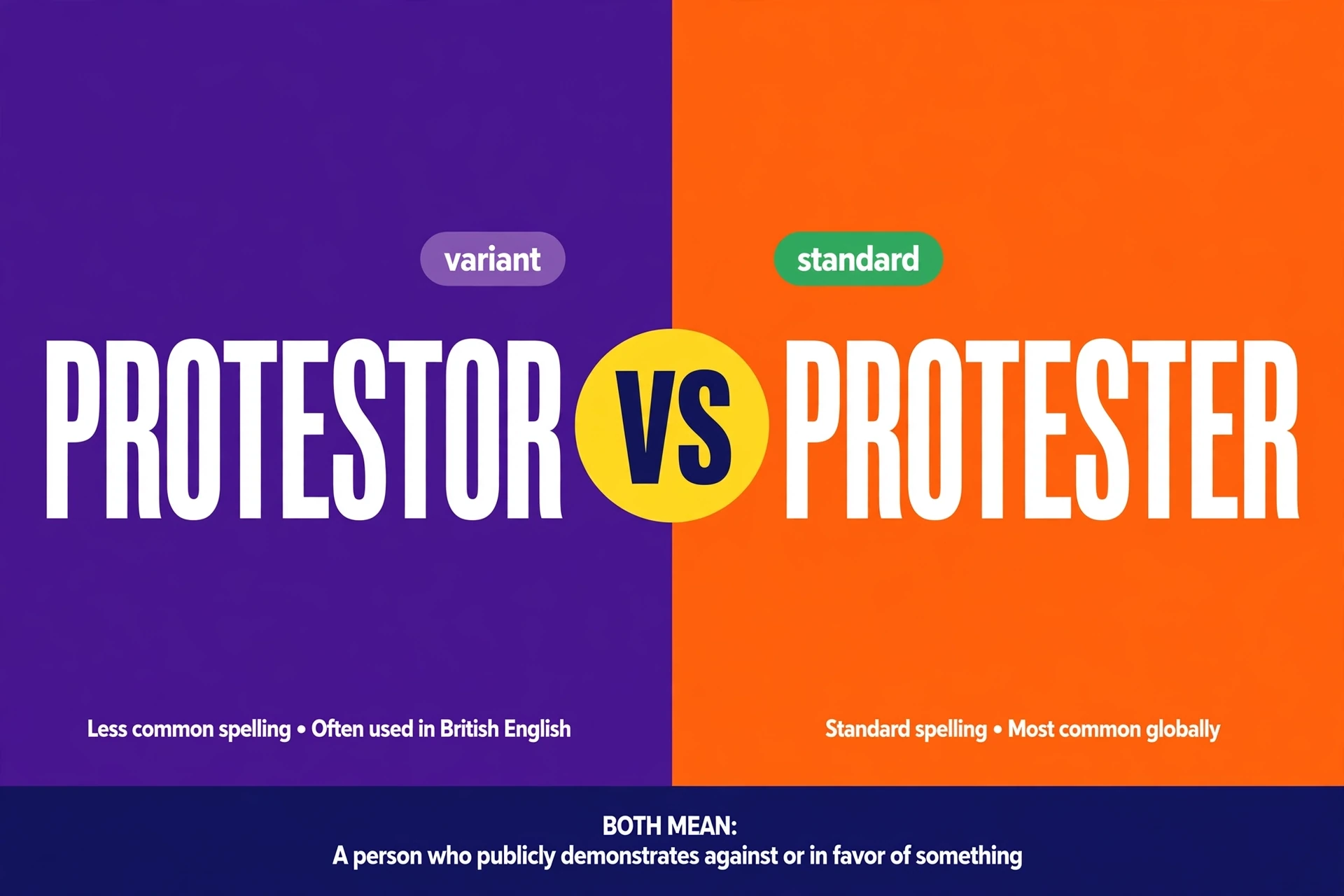
Table of Contents
Quick Answer
| Word | Part of Speech | Main Meaning | Example |
|---|---|---|---|
| Protester | Noun | A person who takes part in a protest | “Thousands of protesters filled the square.” |
| Protestor | Noun | Same meaning — less common variant | “Thousands of protestors filled the square.” |
Simple rule: when in doubt, spell it with -er: protester.
What Does Protester Mean?
Protester is a noun for someone who expresses objection or dissent — whether by marching with a sign, signing a petition, or simply voicing disagreement. Merriam-Webster defines a protester as “one that protests,” listing protestor as an accepted variant spelling of the same entry.
- The protesters marched peacefully down Main Street.
- A lone protester stood outside the courthouse with a handmade sign.
- She became a protester after the new zoning law passed.
- Police estimated the protesters numbered in the thousands.
- Every protester interviewed said the same thing: they wanted to be heard.
- Counter-protesters arrived an hour later, and police kept the two groups apart.
The noun comes straight from the verb to protest — a protester is simply “one who protests.” It applies to any scale of dissent, from a march of thousands to a single person writing a letter to the editor. Dictionaries also record a narrow financial sense — someone who formally protests a bill of exchange — but you’ll almost never meet that use outside banking law.
What Does Protestor Mean?
Protestor means exactly the same thing — it’s simply the -or variant of the same noun. English has a long history of -er/-or pairs (advisor/adviser, actor is -or only), and in this case the -er form won the popularity contest. You’ll still encounter protestor in some newspapers and older books, and no dictionary flags it as wrong.
- The protestors gathered outside city hall. (variant spelling)
- News coverage described the protestors‘ demands. (variant spelling)
- He was identified as one of the protestors arrested that night. (variant spelling)
- The protestor movement has grown steadily. (variant spelling)
- Editorials referred to the protestors as “demonstrators.” (variant spelling)
Why does the -or form persist at all? Part of the reason is analogy with Latin-derived agent nouns like actor, donor, and inventor, which never had -er forms. Some writers assume protestor belongs in that classical company. It doesn’t hurt comprehension — but it does mark the text as nonstandard to most editors, which is why the -er spelling remains the safer professional choice.
Protestor vs. Protester: Key Differences
| Feature | Protester | Protestor |
|---|---|---|
| Meaning | A person who protests | Identical |
| Frequency | Far more common | Minority variant |
| Style guides | Preferred (AP, Chicago) | Accepted variant |
| Dictionary status | Main entry | Listed variant |
| Pronunciation | pruh-TEST-er | Identical |
The meaning never changes — the only real difference is which spelling your reader (or your editor) expects to see.
Protestor or Protester in Real Sentences
At a Rally
Protester: “The protester handed out flyers explaining the cause.” Protestor: “The protestor handed out flyers explaining the cause.” Both are understood; the first matches standard usage.
At Work
Protester: “Our style guide says to use protester, not protestor.” Protestor: “Some older house styles still print protestor.” In professional writing, consistency with your publication’s guide matters more than the variant you pick.
In Conversation
Protester: “Was she one of the protesters on Saturday?” Protestor: “Was she one of the protestors on Saturday?” Spoken aloud, the two are indistinguishable.
In the News
Protester: “The article described the protesters‘ demands in detail.” Protestor: “A few outlets still print protestors in headlines.” News copy overwhelmingly uses the -er spelling, so it’s the one readers recognize instantly.
Common Mistakes
Unlike clear-cut typos, the protestor/protester question is about convention — similar to choosing between cancelled or canceled or labelled or labeled. The mistakes here are about consistency and audience, not meaning.
Mistake 1: Calling “protestor” a typo
❌ “He wrote protestor — that’s spelled wrong.”
✅ “He wrote protestor — it’s a variant, though protester is standard.”
Why: dictionaries list protestor as an accepted variant, so “correcting” it as a typo is itself an error.
Mistake 2: Switching spellings in one document
❌ “The protesters marched downtown, and the protestors chanted slogans.”
✅ “The protesters marched downtown, and the protesters chanted slogans.”
Why: pick one spelling and stick with it throughout a single piece of writing.
Mistake 3: Ignoring your style guide
❌ Using protestor throughout an article for a publication that mandates AP style.
✅ Using protester when the style guide requires it.
Why: house style beats personal preference — AP and most newsrooms standardize on protester.
Mistake 4: Confusing it with “protestant”
❌ “The protestants gathered outside the factory.”
✅ “The protesters gathered outside the factory.”
Why: Protestant (capital P) is a member of a Christian denomination — a completely different word.
Pronunciation
Both spellings are pronounced identically: “pruh-TEST-er,” with the stress on the second syllable. It rhymes with tester and jester. Since there’s no spoken difference, the choice between them is purely a spelling decision.
How to Remember the Difference
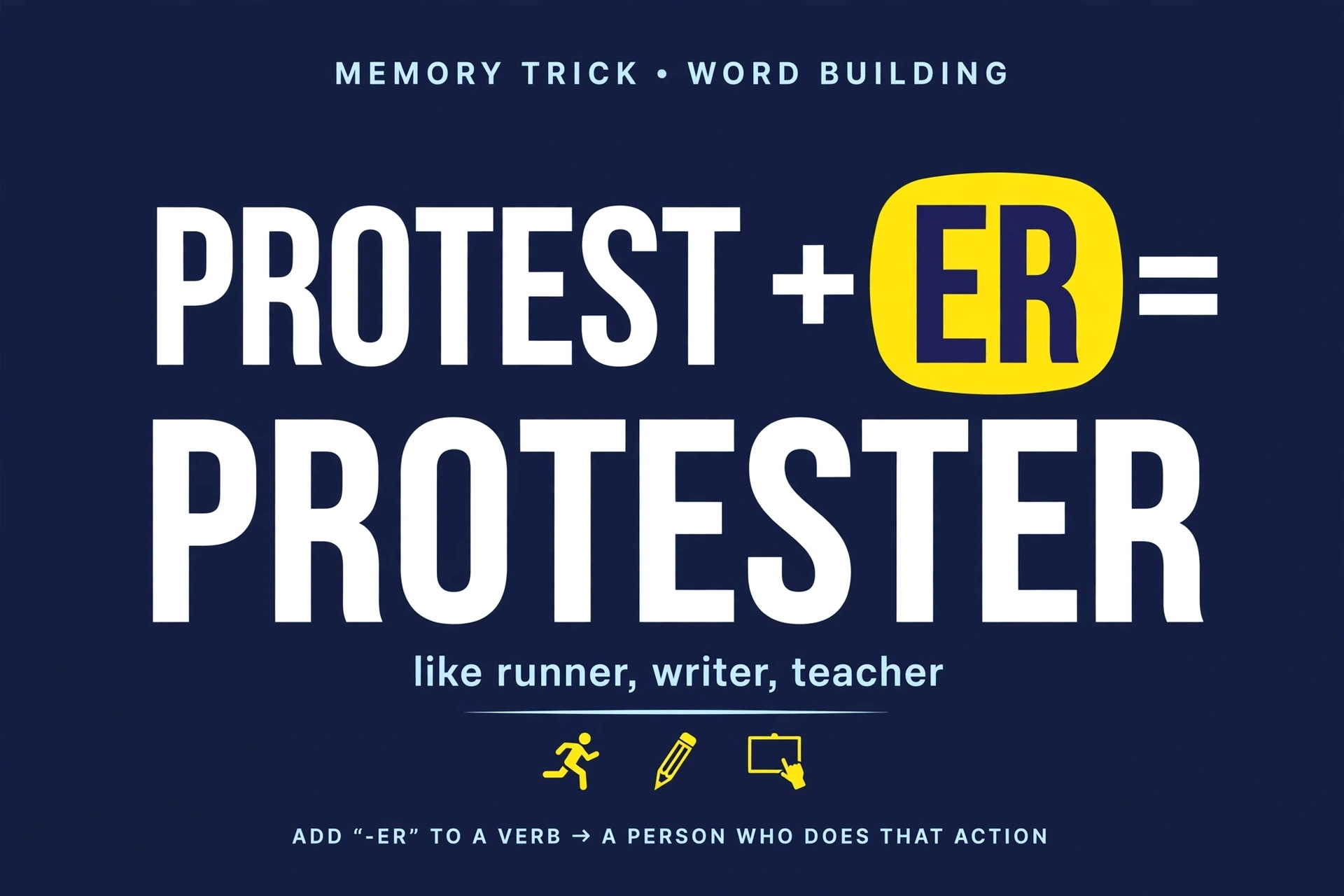
Think of the pattern: the protestER protests, just like the runnER runs and the writER writes. English agent nouns overwhelmingly end in -ER, and protester follows the crowd.
- ER = Everyone’s Recommendation — the standard spelling.
- If you write protestor, you’re not wrong — just in the minority.
- Newsrooms and exams almost always expect protester, so make it your default.
Frequently Asked Questions
Is it protestor or protester?
Protester is the standard spelling and the safer choice in almost every context. Protestor is an accepted variant with the same meaning, but it appears far less often and may be “corrected” by editors who don’t recognize it.
Is “protestor” a real word?
Yes. Major dictionaries list protestor as a variant of protester, so it’s not a misspelling — just an uncommon one. Think of it like adviser versus advisor: both exist, one is simply the default.
Which spelling does AP Stylebook use?
The AP Stylebook prefers protester, and most news organizations follow AP. That editorial weight is a big reason the -er form dominates in journalism and, by extension, in everyday usage.
Why do both spellings exist?
English inherited some agent nouns with Latin-style -or endings (actor, donor) alongside native -er forms (writer, teacher). With protest, the -er form became standard while -or survived as a variant — a historical leftover rather than a meaningful distinction.
Are protestor and protester pronounced differently?
No — both are pronounced “pruh-TEST-er,” with the stress on the second syllable. The difference exists only on the page, which is why the debate is purely about spelling convention.
Conclusion
Protester and protestor mean exactly the same thing: a person who protests. Protester is the standard, widely expected spelling — use it as your default, and save protestor for the rare style guide that asks for it.