Spelled or Spelt: What’s the Difference? (With Examples)
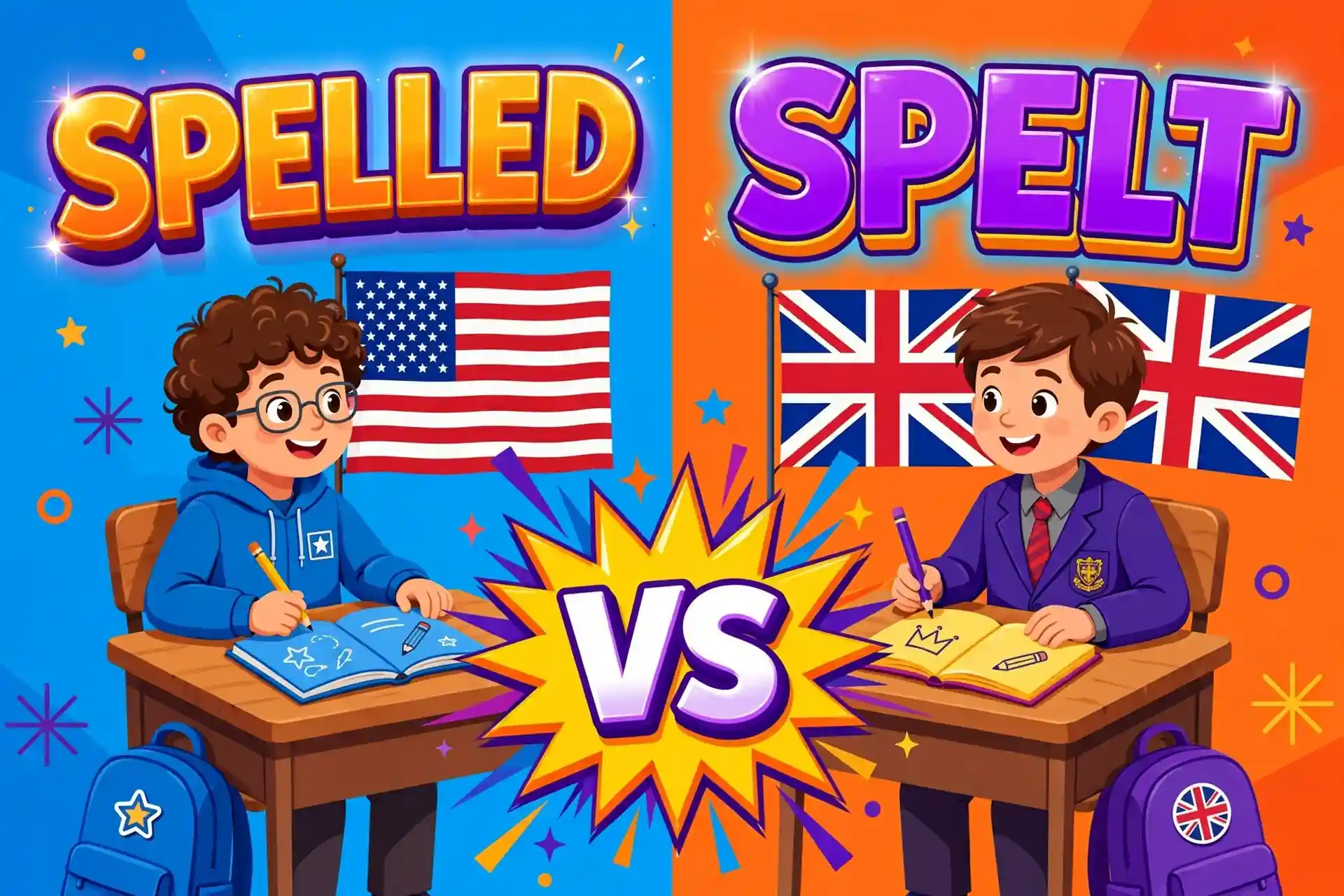
Spelled and spelt are both correct past tenses of the verb spell. The difference is purely regional: spelled is the standard form in American English, while spelt is common in British English. “She spelled her name slowly” (US) and “He spelt it wrong” (UK) mean exactly the same thing.
Quick Answer
| Word | Region | Main Meaning | Example |
|---|---|---|---|
| Spelled | American English (standard) | Past tense of “spell” | “I spelled my surname for the clerk.” |
| Spelt | British English (common) | Past tense of “spell” | “I spelt my surname for the clerk.” |
Simple rule: writing for an American audience, use spelled; writing for a British audience, spelt is perfectly fine — but spelled is never wrong in either variety.
What Does “Spelled” Mean?
Spelled is the past tense and past participle of spell (to form a word letter by letter, or to mean/signal something). It is the standard form in American English and is also widely accepted in British English. Merriam-Webster lists it as the primary past-tense form.
Examples:
- She spelled her first name for the receptionist.
- The teacher asked him to spell “necessary” on the board.
- They spelled out the address over the phone.
- That mistake spelled the end of his campaign. (meaning: it signaled doom)
- Have you ever spelled “mnemonic” correctly on the first try?
What Does “Spelt” Mean?
Spelt is the same past tense of spell, preferred by many British writers. Cambridge Dictionary recognises it as the standard British past-tense form. One important note: spelt is also a noun — an ancient grain (Triticum spelta), a variety of wheat. Context always tells them apart: “spelt bread” is the grain, “he spelt it wrong” is the verb form. Cambridge Dictionary’s entry for “spelt” lists both meanings clearly.
Examples:
- He spelt his surname wrong on the form. (UK)
- My grandmother always spelt “tomorrow” with two m’s.
- The note spelt trouble for the team. (meaning: it signaled trouble)
- She spelt it out letter by letter.
- I’ve never spelt “accommodation” right on the first attempt.
Why Two Spellings?
English once had many irregular past tenses ending in -t instead of -ed. British English kept several of these (spelt, burnt, learnt, dreamt), while American English regularised most of them to -ed (spelled, burned, learned, dreamed). This is the same -ed vs -t pattern behind dreamt vs dreamed. There is no meaning difference at all — it’s purely a spelling preference between the two varieties.
Spelled vs. Spelt: Key Differences
They differ in spelling and regional preference only; the verb meaning, pronunciation pattern, and grammar are identical.
| Feature | Spelled | Spelt |
|---|---|---|
| Spelling | -ed ending | -t ending |
| Primary region | American English | British English |
| Accepted in UK? | Yes, also common | Yes, traditional |
| Accepted in US? | Yes, standard | Rare / may look like a typo |
| Also a noun? | No | Yes — the grain |
| Pronunciation | /spɛld/ “SPELD” | /spɛlt/ “SPELT” |
In American Writing
✅ “She spelled ‘harassment’ with one r.” (US standard — spelled is expected here.)
✅ “He spelt ‘harassment’ with one r.” (UK standard — a British reader won’t blink.)
The contrast: same sentence, different ending; the American version with “spelt” could look like a spelling mistake to a US reader.
In British Writing
✅ “The sign spelt her name as ‘Clair’.” (Traditional British form.)
✅ “The sign spelled her name as ‘Clair’.” (Also fine in the UK — spelled is widely used there too.)
The contrast: British readers accept both, so pick one and stay consistent.
In a Classroom
✅ “Who can tell me the past tense? ‘Spell’ becomes ‘spelled‘ — or ‘spelt‘ in British English.”
The contrast: teaching both forms together helps students read books from both countries without confusion.
Common Mistakes
The biggest mix-ups come from assuming one form is always right, or confusing the verb with the grain. (Same story as cancelled vs canceled — regional spelling, not a different word.)
Mistake 1: Thinking “spelt” is always wrong
❌ “Spelt is a spelling mistake — the correct form is spelled.”
✅ “Both are correct: spelled is standard in American English, and spelt is common in British English.”
Why: “spelt” appears in the Oxford English Dictionary and Cambridge Dictionary as the British past tense of spell.
Mistake 2: Using “spelt” in formal American writing
❌ A US job applicant wrote, “I spelt my email address slowly.”
✅ “I spelled my email address slowly.”
Why: American style guides expect “spelled”; “spelt” can look like an error to US readers or spellcheckers.
Mistake 3: Reading “spelt” as the grain when it’s the verb
❌ “‘He spelt the word’ — what does grain have to do with it?”
✅ “He spelt the word” means he wrote it letter by letter; “spelt flour” is the grain.
Why: Spelt is both the British verb form and a noun (the ancient wheat). The sentence around it always makes the meaning clear.
Mistake 4: Mixing both forms in one document
❌ “She spelled her name, then spelt it again for clarity.”
✅ “She spelled her name, then spelled it again for clarity.”
Why: both are correct, but consistency matters — switching mid-text looks sloppy.
Pronunciation
Spelled is pronounced “SPELD” (/spɛld/) — rhymes with “held.” Spelt is pronounced “SPELT” (/spɛlt/) — rhymes with “felt.” Unlike many spelling pairs, they do not sound the same, so the regional difference is audible in speech.
How to Remember the Difference
T for Traditional Times (Britain kept the old -t form), and E for Everyday American -ed. When in doubt, “spell-ed” works everywhere — it’s the safest default for any English-speaking reader.
- Spelt with a T → Typically British.
- Spelled with -ed → the standard Ed ending Americans prefer.
- Spelt the noun = the grain → think “spelt spread” (bread!).

Frequently Asked Questions
Is it spelled or spelt?
Both are correct. Use spelled in American English and spelt (or spelled) in British English.
Which is correct in American English?
Spelled. American dictionaries and style guides treat “spelt” as a British variant, not the standard form.
Which is correct in British English?
Spelt is traditional in British English, but spelled is also widely used and fully accepted there.
Can “spelt” mean the grain?
Yes. Spelt is also a noun — an ancient variety of wheat (Triticum spelta) used in bread. Context separates it from the verb form.
Do spelled and spelt sound the same?
No. Spelled rhymes with “held” (/spɛld/); spelt rhymes with “felt” (/spɛlt/).
Are there other words like this?
Yes — the same pattern appears in burned/burnt, learned/learnt, and dreamed/dreamt, where British English kept the -t form and American English regularised to -ed.
Conclusion
Spelled and spelt are two correct past tenses of spell, split by region: America says “spelled,” Britain often says “spelt.” Pick the form your audience expects, stay consistent, and remember that “spelled” is the safe choice everywhere.