Gluing or Glueing: Which Is Correct?
Gluing is the standard spelling of the verb form of glue, while glueing is a rare and unnecessary variant of the same word. When you add -ing to a word that ends in a silent e, the e is dropped — so glue + ing becomes gluing, not glueing. Gluing is used everywhere from craft projects to construction: “She spent the afternoon gluing the photo frames back together.”
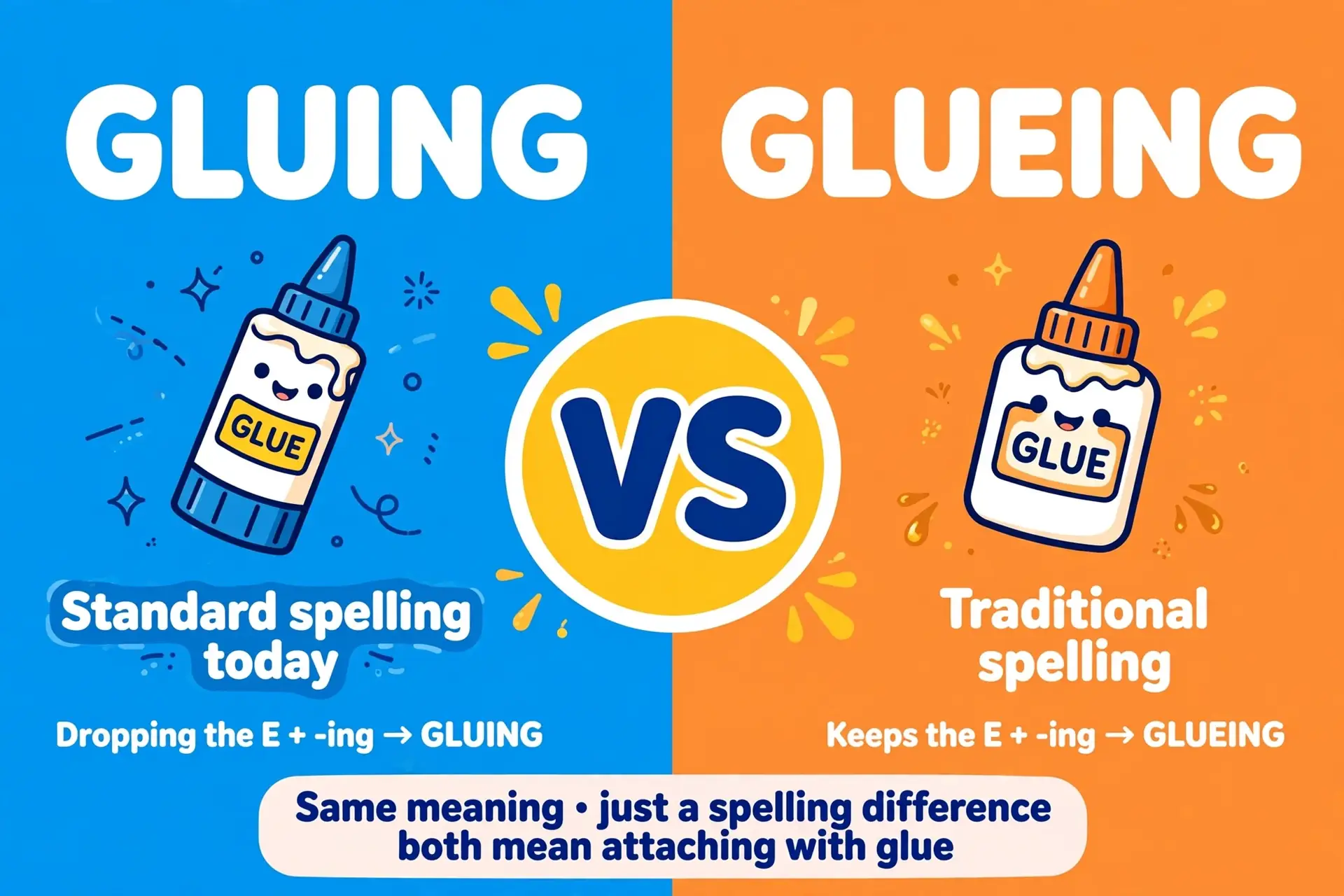
Table of Contents
Quick Answer
| Word | Part of Speech | Main Meaning | Example |
|---|---|---|---|
| Gluing | Verb (present participle) | Joining things together with glue | He is gluing the broken chair leg. |
| Glueing | Variant spelling | Same meaning, but nonstandard | Glueing is not recommended in modern writing. |
Simple rule: drop the silent e before -ing — glue becomes gluing.
What Does Gluing Mean?
Gluing is the present participle of the verb glue. It describes the action of attaching or joining two things together with glue or another adhesive.
Examples:
- I’m gluing the torn pages back into the book.
- She is gluing wooden blocks together for the model house.
- The carpenter spent hours gluing the table top in place.
- They finished gluing the tiles before the painters arrived.
- Gluing felt pads under the chair legs stopped the scratching noise.
What Does Glueing Mean?
Glueing is an alternative spelling of the same present participle of glue. It appears occasionally in print, but it is widely considered nonstandard. Dictionaries list gluing as the correct form; the e in glueing serves no purpose and breaks the normal -ing spelling rule.
Examples:
- The glueing process takes about ten minutes. (variant spelling)
- Some old manuals use “glueing” instead of “gluing.” (variant spelling)
- A spell-checker may flag “glueing” as a possible error. (variant spelling)
- Writers who keep the e are following an exception that doesn’t apply here. (variant spelling)
- If you see “glueing,” the writer meant “gluing.” (variant spelling)
Gluing vs. Glueing: Key Differences
| Feature | Gluing | Glueing |
|---|---|---|
| Correctness | Standard, dictionary-listed spelling | Rare, nonstandard variant |
| -ing rule | Follows the rule: drop silent e before -ing | Breaks the rule by keeping the e |
| Usage | Used in modern writing everywhere | Found in some older or informal texts |
| Meaning | Joining with glue | Same meaning |
| Spell-checkers | Accepted everywhere | Often flagged |
| Recommended in exams/essays | Yes | No |
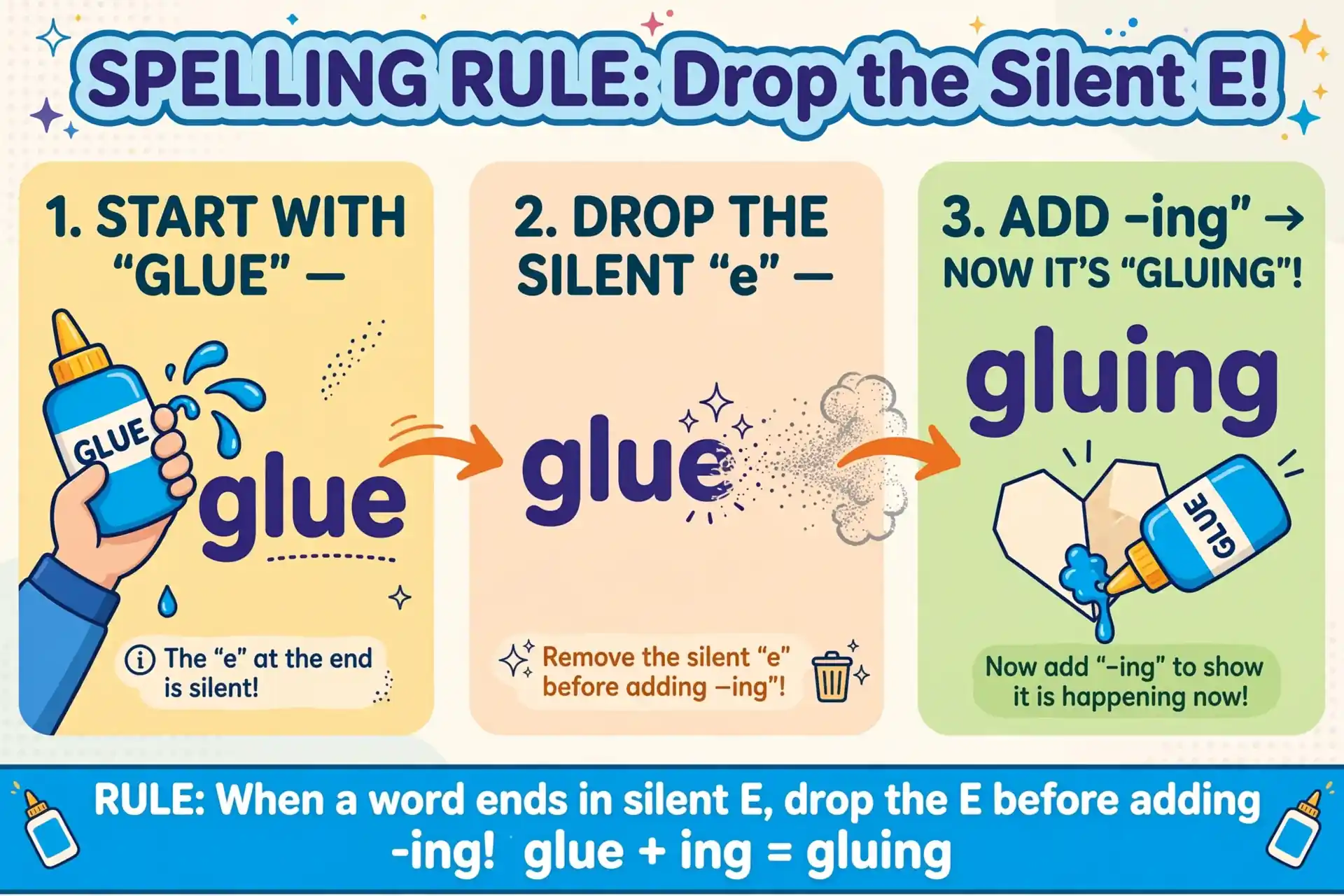
Both spellings mean the same thing, but only gluing follows the standard -ing rule — glue ends in a silent e, and a silent e is dropped before -ing, just like make → making and take → taking.
Gluing and Glueing in Real Sentences
At Home
Gluing: “Dad is gluing the broken vase in the garage.”
Glueing: “Dad is glueing the broken vase in the garage.” (nonstandard spelling)
The meaning is identical; gluing is the spelling to use.
At Work
Gluing: “The technician is gluing the circuit board components.”
Glueing: “The technician is glueing the circuit board components.” (nonstandard spelling)
In manuals and reports, gluing is the professional choice.
In Conversation
Gluing: “What are you doing?” “Gluing these photos into my scrapbook!”
Glueing: “What are you doing?” “Glueing these photos into my scrapbook!” (nonstandard spelling)
Spoken aloud, both sound the same — the difference only shows in writing.
In Crafting
Gluing: “Gluing the pieces first makes the model sturdier.”
Glueing: “Glueing the pieces first makes the model sturdier.” (nonstandard spelling)
DIY tutorials and craft blogs overwhelmingly use gluing.
Common Mistakes
Most mistakes with these spellings come from over-applying an exception. English usually drops a silent e before -ing, but a few words keep it — like the kept-E pattern in dyeing vs dying, where dyeing keeps the e to avoid confusion with dying. Glueing is not one of those exceptions, so always write gluing. Like common misspellings like recieve vs receive, it’s a mistake that a quick rule check would catch.
Mistake 1: Keeping the E
❌ She is glueing the puzzle together.
✅ She is gluing the puzzle together.
Why: The silent e in glue is dropped before -ing.
Mistake 2: Overgeneralizing from Dyeing
❌ Just like “dyeing” keeps its e, “glueing” keeps its e.
✅ Gluing drops the e, because it can’t be confused with another word.
Why: Dyeing keeps the e to avoid confusion with dying; gluing has no such twin, so the e goes.
Mistake 3: Using the Variant in Formal Writing
❌ The report described the glueing of the panels.
✅ The report described the gluing of the panels.
Why: Formal writing uses standard spellings; glueing will look like an error.
Pronunciation
Gluing and glueing are pronounced the same: GLOO-ing. It rhymes with doing and brewing. The extra e in glueing changes nothing in speech, which is why writers sometimes add it by mistake.
How to Remember the Difference
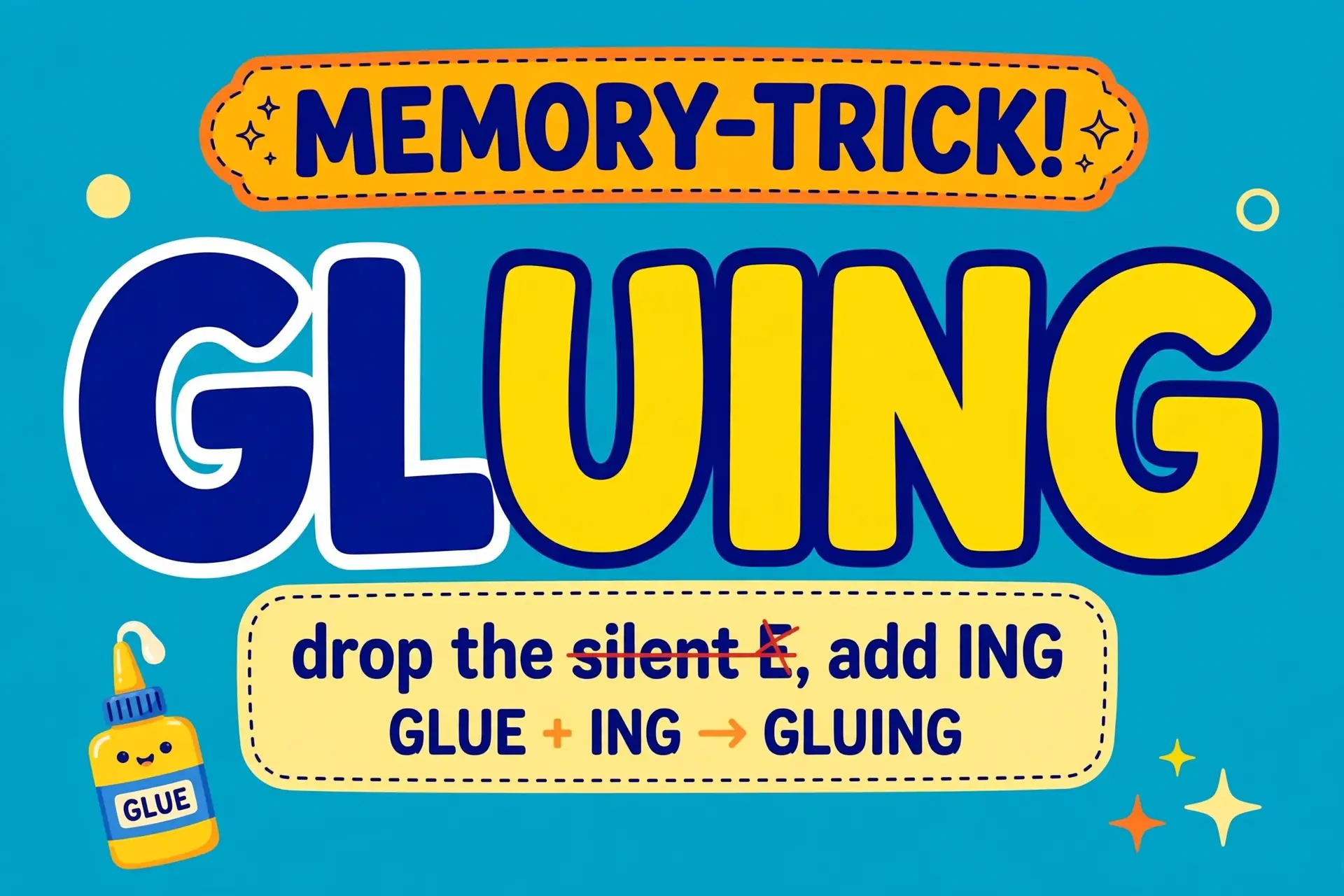
The trick: GLU-ing — when you add -ing, the silent e gets “glued away.” If a word ends in a silent e, drop it: bake → baking, hope → hoping, glue → gluing.
- Gluing = g-l-u + ing — the e is gone.
- Dyeing keeps its e only to avoid looking like dying — gluing has no such problem.
- One glance check: if you see uei in the middle (glueing), that’s the wrong one.
Frequently Asked Questions
Is it gluing or glueing?
It is gluing. The standard rule is to drop a silent e before -ing, so glue + ing = gluing. Glueing is a nonstandard variant.
Why does dyeing keep the e but gluing doesn’t?
Dyeing keeps the e to avoid confusion with dying (ceasing to live). Gluing can’t be confused with any other word, so the normal drop-the-e rule applies.
Is glueing ever correct?
It appears in some older texts, but modern dictionaries and style guides list gluing. In exams, essays, and professional writing, use gluing.
What is the past tense of glue?
The past tense is glued: “She glued the shelf back together.” The same drop-the-e pattern applies (glue + ed = glued).
What part of speech is gluing?
Gluing is the present participle of the verb glue. Check the entry for gluing on Merriam-Webster to see it listed as the standard spelling.
Conclusion
Gluing is the correct spelling: drop the silent e from glue before adding -ing, just like making and taking. Glueing is a rare variant that breaks the rule and isn’t needed, since there’s no dying-type confusion to avoid. Write gluing every time.