Calve or Calf: What’s the Difference? (With Examples)
Both calve and calf are correct English words, but one is an action and the other is a thing. A cow calves when she gives birth, while a calf is the baby cow she produces.
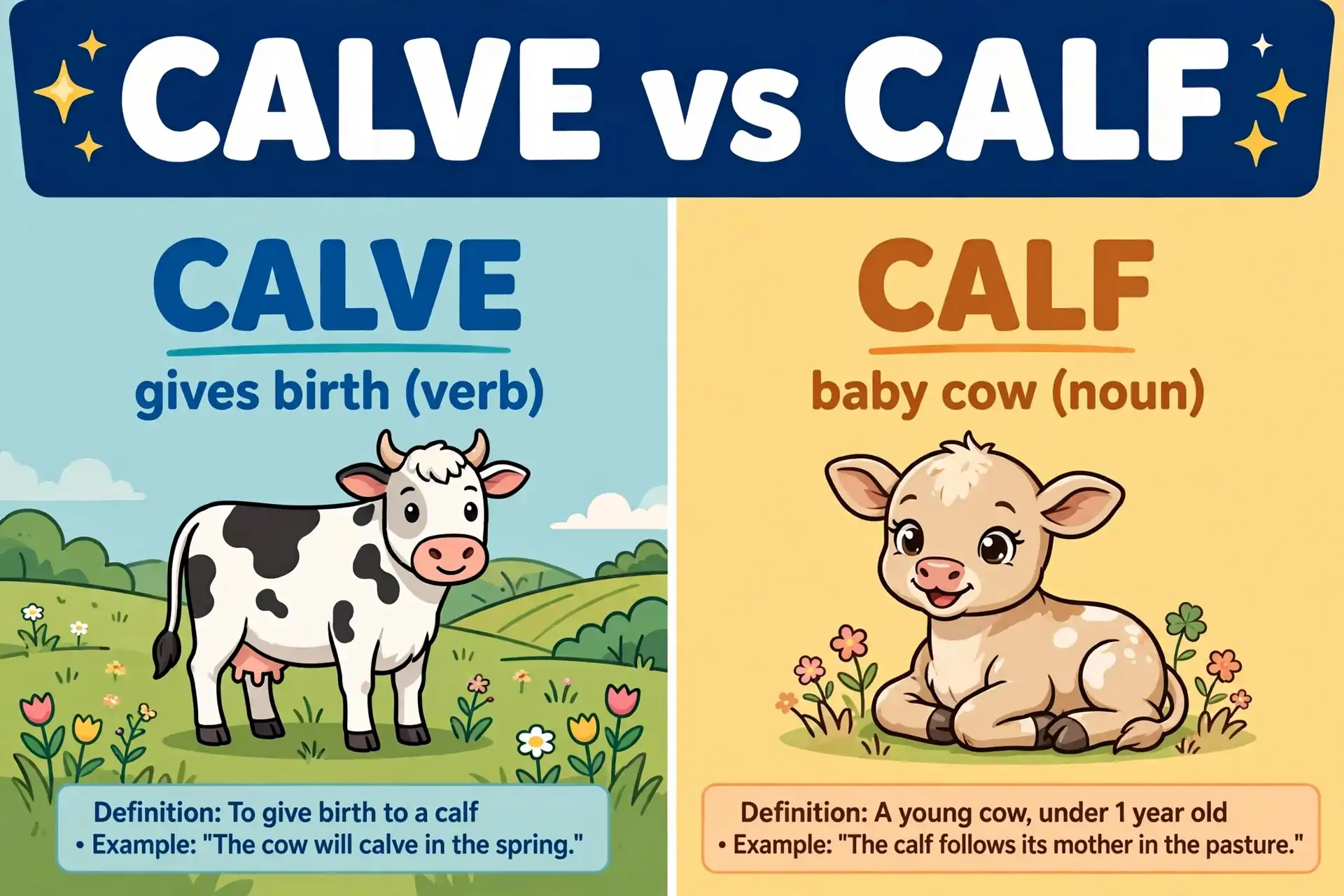
Table of Contents
Quick Answer
| Word | Part of Speech | Main Meaning | Example |
|---|---|---|---|
| calve | verb | to give birth to a calf (of a cow); for a glacier, to shed chunks of ice | “The cow will calve in the spring.” |
| calf | noun | a young cow or bull; also the fleshy back of the lower leg | “The farmer bottle-fed the newborn calf.” |
Simple rule: Calve is the verb — the action of giving birth; calf is the noun — the baby animal, or the muscle in your leg.
What Does Calve Mean?
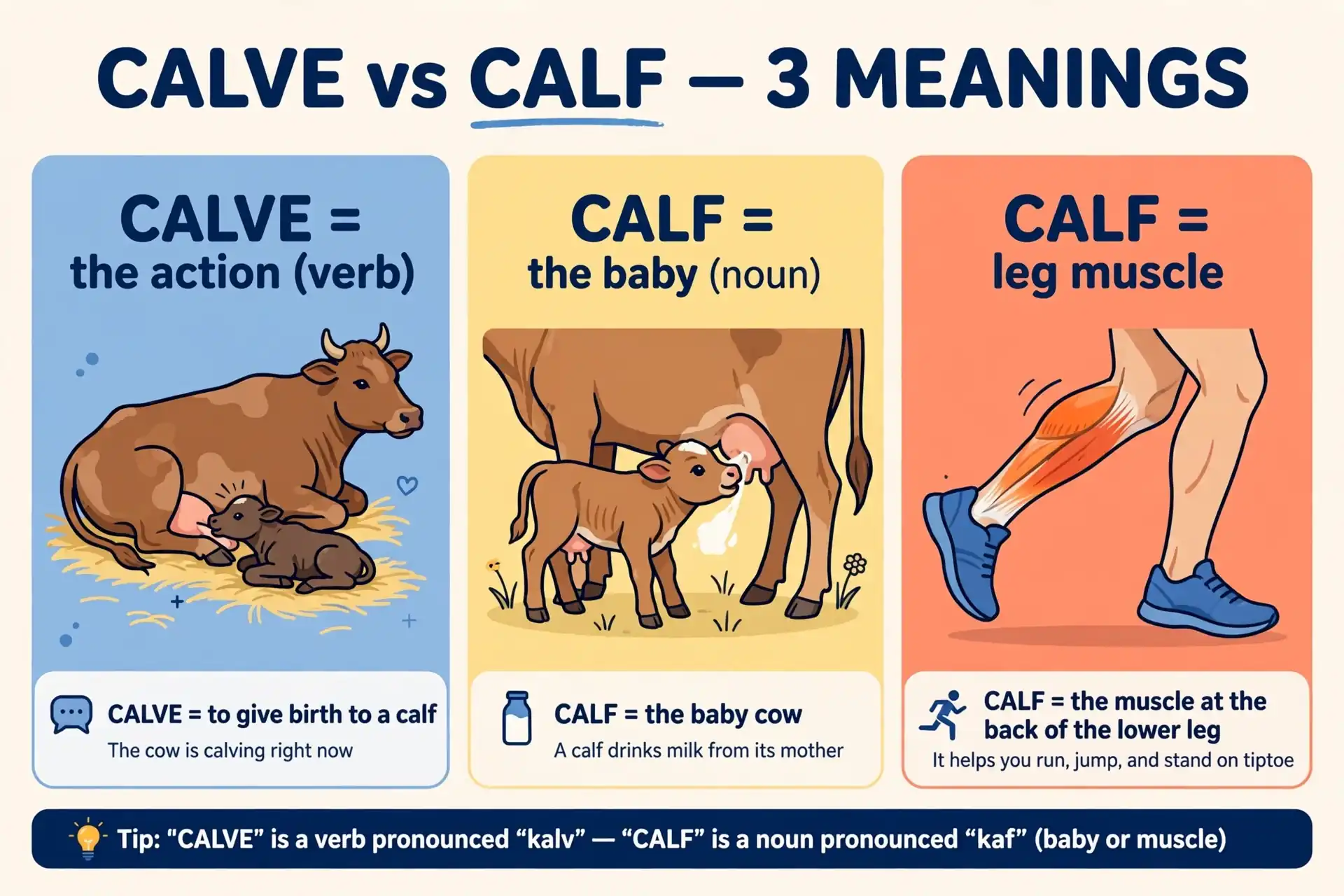
To calve is to give birth to a calf — it is what a pregnant cow does. The same verb describes glaciers, where “ice calving” means huge chunks of ice breaking off into the sea. See the full definition of calve in Merriam-Webster’s dictionary.
Examples:
- “Our oldest cow will calve sometime in March.”
- “She calved twins last spring, which is rare.”
- “The herd is calving right now, so the barn is busy.”
- “The glacier calved an iceberg the size of a football field.”
- “Scientists watch the ice sheet for signs it is about to calve.”
- “Heifers usually calve for the first time at around two years old.”
- “The whale calved far from shore, so the researchers only saw the spout.”
What Does Calf Mean?
A calf is a young cow or bull, usually under a year old. The same spelling also names the fleshy muscle at the back of your lower leg — two very different calves sharing one word.
Examples:
- “The newborn calf wobbled to its feet within minutes.”
- “Two calves were grazing beside their mothers.”
- “I pulled my calf muscle during the sprint.”
- “She felt a cramp in her left calf.”
- “The calf nursed while the farmer watched.”
Calve vs. Calf: Key Differences
| Feature | Calve | Calf |
|---|---|---|
| Part of speech | Verb | Noun |
| Core meaning | The act of giving birth | The baby animal, or the leg muscle |
| Pronunciation | Rhymes with “carve” (the V buzzes) | Rhymes with “half” (the F is soft) |
| Past tense / plural | Calved (“she calved yesterday”) | Calves (“three calves”) |
| Used for glaciers | Yes — ice calving | No |
| Used for legs | No | Yes — calf muscle |
They differ by a single letter and sound almost alike, but calve always does something while calf always names something.
Usage in Real Sentences
On the Farm
Calve: “The vet stayed overnight because three cows were due to calve.”
Calf: “By morning, three healthy calves were nursing in the barn.”
The verb describes the event of birth; the noun names the babies that arrived.
At the Gym
Calve: “Nobody at the gym is calving — that word belongs on the farm.”
Calf: “I do calf raises every morning to strengthen my lower legs.”
The leg muscle is always spelled calf; the verb never shows up in a workout.
Watching Nature
Calve: “We watched the glacier calve a slab of ice into the fjord.”
Calf: “A young elephant calf stayed close to its mother.”
Ice sheets calve, and baby animals — cows, elephants, whales — are calves.
Common Mistakes
English loves word pairs that differ by one letter — the cancelled or canceled debate and the isle or aisle mix-up prove it. Calve and calf are another member of that club, and these are the mistakes to dodge.
Mistake 1: “The cow calf yesterday”
❌ “The cow calf yesterday.”
✅ “The cow calved yesterday.”
Why: Giving birth is an action, so the sentence needs the verb calve in the past tense: calved.
Mistake 2: Calling a young cow a “calve”
❌ “A young cow is called a calve.”
✅ “A young cow is called a calf.”
Why: The baby animal is a noun, and the noun is spelled calf.
Mistake 3: “Calve muscle”
❌ “I pulled my calve muscle.”
✅ “I pulled my calf muscle.”
Why: The leg muscle is the noun calf, never the verb calve.
Mistake 4: “The cow will calf in May”
❌ “The cow will calf in May.”
✅ “The cow will calve in May.”
Why: A future birth is an action, so use the verb: will calve.
Pronunciation
Calve rhymes with “carve” — the V buzzes like a bee (/kɑːv/). Calf rhymes with “half” — the F is soft and breathy (/kɑːf/). The L is silent in both, so listen for the buzzing V versus the soft F.
How to Remember the Difference
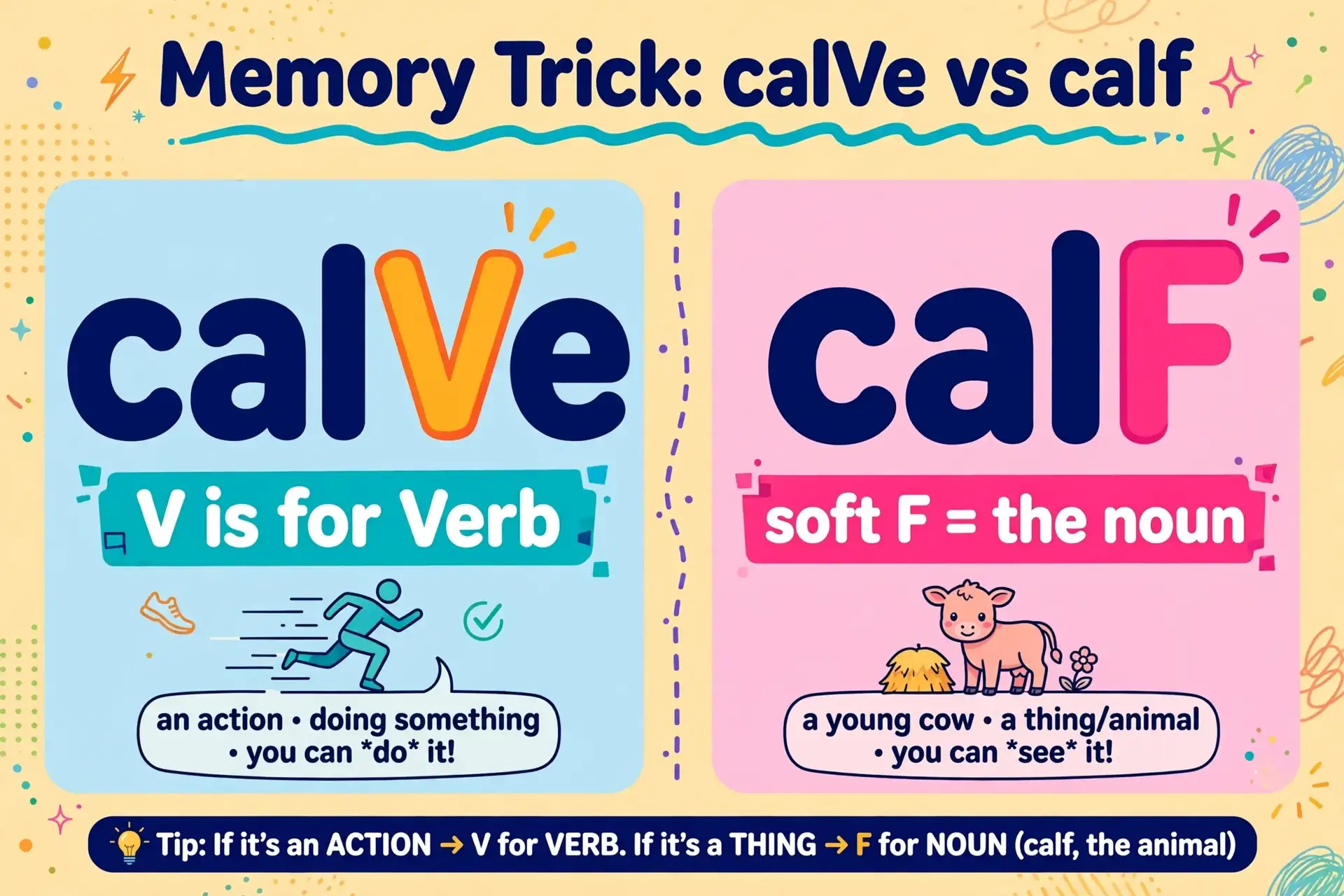
CalVe = Verb. The letter V in calVe stands for Verb — the action of giving birth. Calf ends in F, and the flesh of your leg is a calf — a thing, not an action.
- CalVe → Verb → the action of giving birth
- Calf → noun → the baby cow, or the leg muscle
- Hear a buzzing V? That is the verb. Hear a soft F? That is the noun.
FAQ
Is it calve or calf?
Use calve for the action of giving birth (“The cow will calve soon”). Use calf for the baby animal or the leg muscle (“The calf is adorable”; “My calves ache”).
What is the plural of calf?
Calves — “The field was full of calves.” Note the spelling overlap with the verb: “she calves” (present tense verb) and “three calves” (plural noun) look identical but sound different.
Can a glacier really calve?
Yes. “Ice calving” is the technical term for chunks of ice breaking off a glacier into the sea. It is the same verb, applied to ice instead of cows — one of the rare cases where a farm word and a climate-science word are spelled exactly the same.
What is the past tense of calve?
Calved — just add -d: “The cow calved during the night.”
Is the L silent in calf?
Yes. Calf is pronounced “kaf” and calve is pronounced “kav” — the L is silent in both.
Conclusion
Calve is what happens — the verb for a cow giving birth or a glacier shedding ice — while calf is what you get: the baby animal or the muscle in your leg. Remember that the V in calVe stands for Verb, and the buzzing V versus the soft F will keep them straight forever.