Crier or Cryer: What’s the Difference? (With Examples)
Only one of these spellings is standard. Crier is the correct spelling for a person who cries out — like a town crier — or someone who weeps. Cryer is a common misspelling, though you may recognize it as a surname.
Table of Contents
Quick Answer
| Word | Part of Speech | Main Meaning | Example |
|---|---|---|---|
| Crier | Noun | One who shouts announcements; one who weeps | “The crier announced the news in the square.” |
| Cryer | — (misspelling) | Not a standard English word (but a surname) | “He typed ‘cryer’ instead of ‘crier.'” |
Simple rule: a crier cries out — keep the IE from “cries” in the spelling.
What Does Crier Mean?
Crier is a noun for someone who cries — in both senses of the verb. Historically, a town crier was the official who walked the streets shouting public announcements. In modern use, it can also describe a person who weeps easily.
Examples:
- The town crier rang his bell and read the proclamation aloud.
- Before newspapers, the crier was how villages heard the news.
- She’s a crier at weddings — the vows always get her.
- The baby is a loud crier when he’s hungry.
- He works as a court crier, calling each case to order.
- The crier’s voice carried across the crowded marketplace.
- Every lost child in the park soon found the crier’s booth.
What Does Cryer Mean?
Cryer is not a standard English word — it is the misspelled form of “crier.” The one place you will legitimately see it is as a family name, famously borne by actor Jon Cryer. Surnames follow their own rules, but for the common noun, “cryer” is always an error. See Merriam-Webster’s entry for crier to confirm the standard spelling.
Examples:
- The sign said “town cryer” — it should have read “town crier.”
- She wrote “cryer” in her essay and the teacher circled it.
- Jon Cryer spells his surname with a Y, but the job title is “crier.”
- Autocorrect flagged “cryer” and suggested “crier.”
Crier vs. Cryer: Key Differences
| Feature | Crier | Cryer |
|---|---|---|
| Spelling | C-R-I-E-R | C-R-Y-E-R |
| Status | Correct, standard word | Misspelling (valid surname) |
| In dictionaries? | Yes | No (as a common noun) |
| Meaning | One who shouts or weeps | None |
| Plural | Criers | — |
| Safe to use | Yes | No — except as someone’s name |
The two differ by a single letter, but that letter decides whether you have a real word. Crier follows the verb “cry” → “cries”; cryer breaks the pattern.
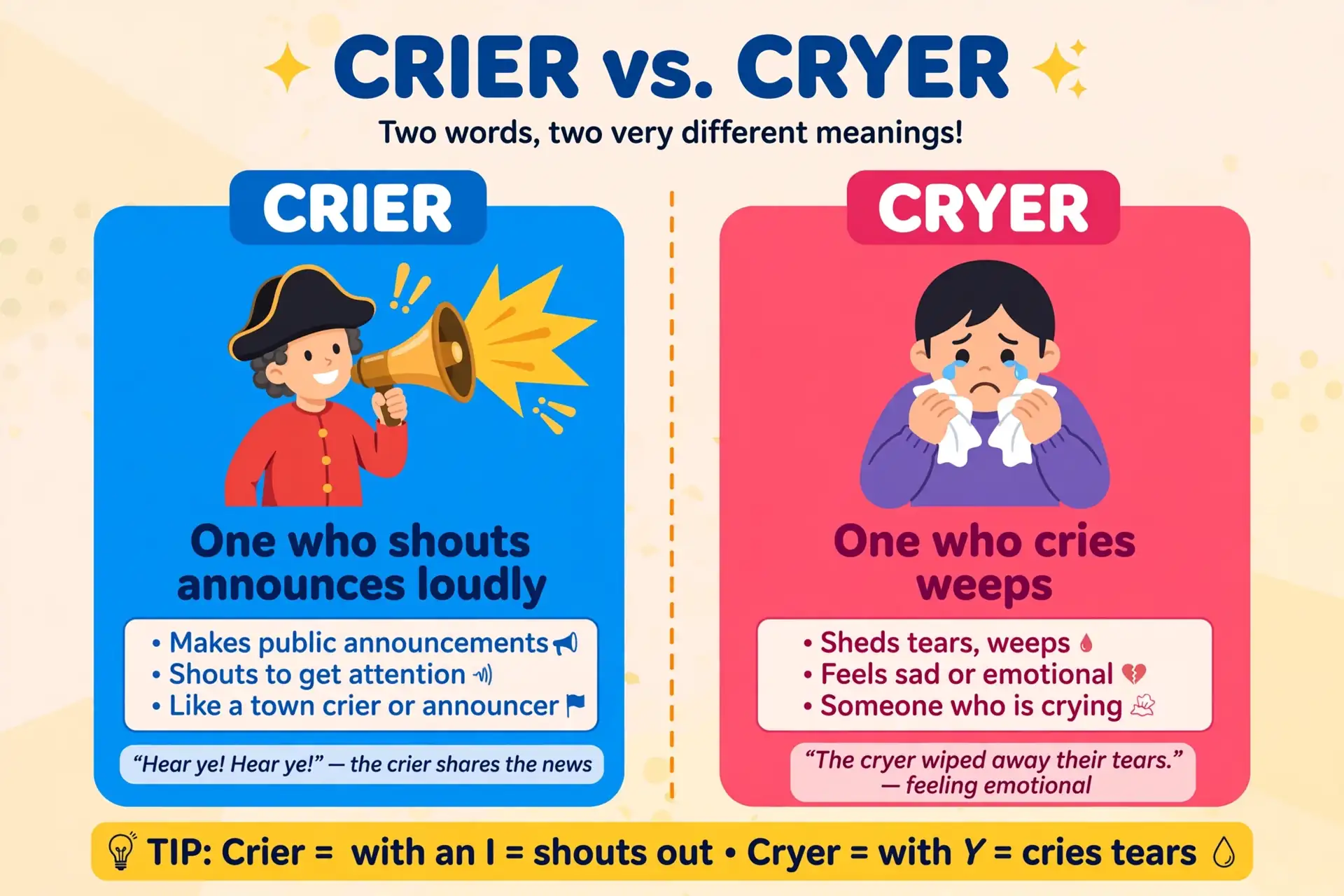
Crier vs. Cryer in Real Sentences
At Work
Crier: “The auctioneer’s assistant acted as crier for each lot.”
Cryer: “The job posting said ‘town cryer wanted’ — an embarrassing typo.”
Professional writing should always use “crier” for the role.
At Home
Crier: “Our toddler is a champion crier at bedtime.”
Cryer: “The parenting blog misspelled it as ‘cryer’ throughout.”
Even in casual writing, the IE spelling is the correct one.
In Conversation
Crier: “Don’t mind him — he’s a crier during sad movies.”
Cryer: “No, not Jon Cryer the actor — a crier, someone who weeps!”
The surname is the one exception where Y is right.
In History
Crier: “The town crier’s cry of ‘Hear ye!’ opened every market day.”
Cryer: “The museum plaque misspelled the role as ‘town cryer.'”
Historical writing uses “crier” for the official announcer.
Common Mistakes
Words built on “cry” confuse writers the same way pairs like recieve vs receive and dieing or dying do — the spelling changes when the ending changes.
Mistake 1: Keeping the Y from “cry”
❌ “The village cryer shouted the news.”
✅ “The village crier shouted the news.”
Why: when Y follows a consonant and a suffix is added, Y usually becomes IE — cry → crier, like “fly” → “flier.”
Mistake 2: Writing “cryer” for someone who weeps
❌ “She’s such a cryer at emotional scenes.”
✅ “She’s such a crier at emotional scenes.”
Why: both senses of the word — shouting and weeping — use the IE spelling.
Mistake 3: Copying the surname spelling
❌ “He was hired as the town cryer, like Jon Cryer.”
✅ “He was hired as the town crier — unlike Jon Cryer, whose name keeps the Y.”
Why: surnames keep their own spellings; common nouns follow the dictionary.
Mistake 4: Using “cryer” in formal writing
❌ “The court cryer called the session to order.”
✅ “The court crier called the session to order.”
Why: in legal and official titles, only “crier” is correct.
Pronunciation
Crier is pronounced “KRY-er” — one stressed syllable rhyming with liar, buyer, flyer, and fryer. It sounds identical to “cryer,” which is exactly why the spelling trips people up — but the dictionary spelling keeps the IE.
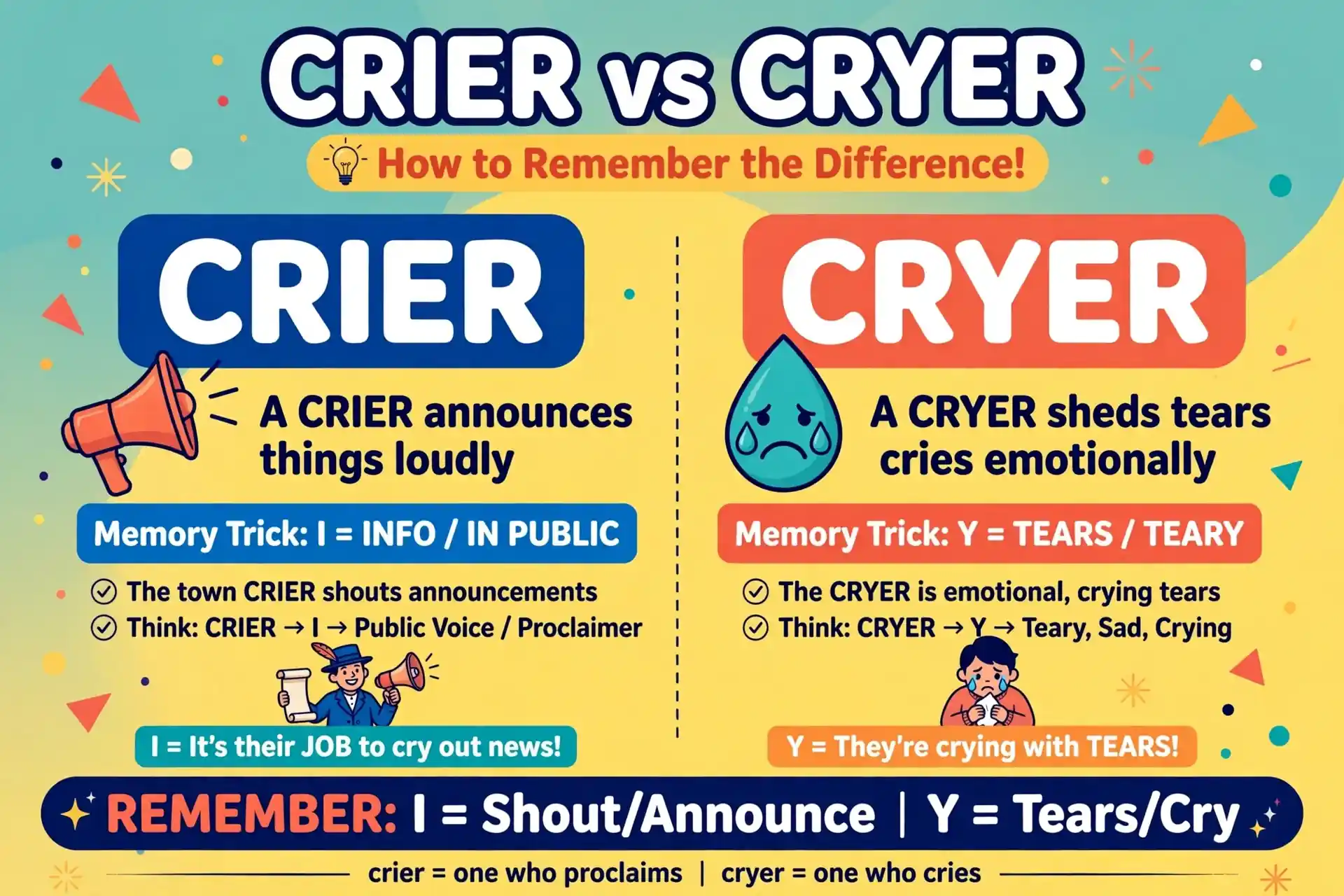
How to Remember the Difference
A crier cries — the IE from “cries” stays in the noun. When you add “-er” to a verb ending in consonant + Y, the Y turns into IE: cry → crier, just like “dry” → “drier” and “fly” → “flier.”
- Crier = C-R-I-E-R — the IE comes from “cries.”
- Cryer = the Y-spelling is only right in the surname Cryer.
- Think: “The town crier cries the news.”
Frequently Asked Questions
Is it crier or cryer?
It is crier. “Cryer” is a misspelling of the common noun, though it exists as a surname.
What is a town crier?
A town crier was an official who made public announcements by shouting them in the streets, historically ringing a bell to gather a crowd.
Why is it spelled “crier” and not “cryer”?
English usually changes Y to IE before a suffix when the Y follows a consonant — the same pattern behind “drier,” “flier,” and “cries.”
Is “cryer” ever correct?
Only as a proper noun — a family name like Jon Cryer’s. For the ordinary word meaning “one who cries,” always use “crier.”
What is the difference between a crier and a herald?
A crier was a local official who shouted announcements in the streets, while a herald was a higher-ranking messenger who carried news between nobles and courts. Both jobs are obsolete, but “herald” survives as a verb meaning “to announce.”
Do town criers still exist?
Yes, as ceremonial figures. Many British towns keep an official town crier for festivals and civic events, and there are even town crier competitions — all spelled with IE.
What is the plural of crier?
The plural is criers, as in “The two criers announced the festival dates.”
Conclusion
Crier is the correct spelling for someone who shouts announcements or sheds tears — the IE comes straight from “cries.” Cryer is a misspelling in ordinary writing, valid only as a surname. Keep the IE, and this pair will never trouble you again.