Echos or Echoes: What’s the Difference? (With Examples)
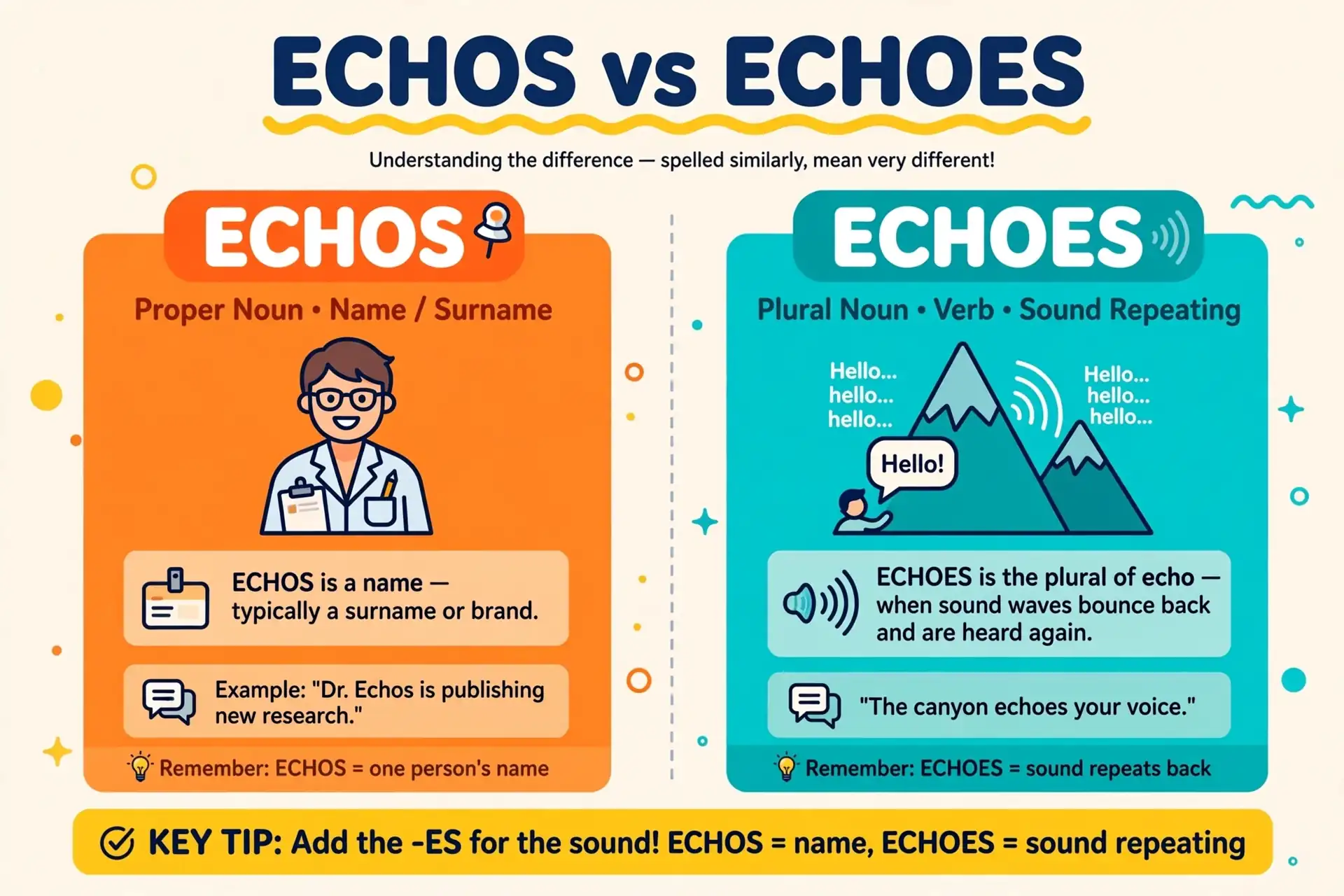
Only one of these spellings is standard. Echoes is the correct plural of ‘echo’ and the correct third-person verb form (‘she echoes’). Echos is a nonstandard variant that dictionaries do not list as the preferred form.
Table of Contents
Quick Answer
| Word | Part of Speech | Main Meaning | Example |
|---|---|---|---|
| Echoes | Noun (plural) / verb | Multiple reflected sounds; “she echoes” = she repeats | “Her words echo through the hall.” |
| Echos | — (nonstandard) | Variant spelling, not recommended | “He wrote ‘echos’ instead of ‘echoes.'” |
Simple rule: nouns ending in consonant + O take -es in the plural — potatoes, tomatoes, heroes, and echoes.
What Does Echoes Mean?
Echoes is the standard plural of the noun “echo” — reflected sounds — and the standard third-person singular of the verb “to echo,” meaning to repeat or resound. It follows the regular pattern for words ending in a consonant plus O. See Merriam-Webster’s entry for echo for the full conjugation.
Echoes as a Noun (Plural)
Two or more reflected sounds, or figuratively, lingering traces of something past.
Examples:
- The cave was full of strange echoes.
- Echoes of the war still shaped the country’s politics.
- We heard the echoes of laughter from the next room.
- The speech contained echoes of his father’s famous address.
Echoes as a Verb
Third-person singular present of “to echo” — he/she/it echoes, meaning repeats or resounds.
Examples:
- She echoes everything her older sister says.
- The stadium echoes with cheers after every goal.
- His opinion echoes mine exactly.
- The article echoes a claim made last year.
- The canyon echoes back every shout within seconds.
- Her laughter echoes down the hallway long after she’s gone.
What Does Echos Mean?
Echos is not the recommended spelling. It occasionally appears as an attempt to pluralize “echo” by simply adding S, the way most English nouns work — but “echo” belongs to the consonant-plus-O group that takes -es. Major dictionaries list “echoes” as the plural and verb form; “echos” gets no such listing.
Examples:
- The essay said “echos of the past” — it should have said “echoes.”
- She typed “the room echos” instead of “the room echoes.”
- The headline read “echos,” and the copy editor fixed it.
- He searched “echos” and the results all used “echoes.”
Echos vs. Echoes: Key Differences
| Feature | Echos | Echoes |
|---|---|---|
| Spelling | E-C-H-O-S | E-C-H-O-E-S |
| Status | Nonstandard variant | Standard, correct form |
| In dictionaries? | Not listed as the plural | Yes — plural and verb form |
| Follows the -O rule | No | Yes (like potatoes, heroes) |
| Verb form (“she —”) | — | Echoes |
| Safe to use | No — looks like an error | Yes |
The E before the S is doing real work: it marks the standard plural pattern for consonant-plus-O words. Echos drops it; echoes keeps it.
Echos vs. Echoes in Real Sentences
At Home
Echoes: “The empty house echoes every footstep.”
Echos: “The listing said ‘the hallway echos’ — a typo.”
The verb form needs the E just as much as the plural does.
At Work
Echoes: “Her proposal echoes the strategy we approved in June.”
Echos: “The draft said ‘echos our values’ and the editor corrected it.”
Professional documents should always use “echoes.”
In Conversation
Echoes: “‘I can’t believe it.’ ‘The whole room echoes that!'”
Echos: “His text read ‘echos’ and autocorrect didn’t even catch it.”
Short words hide the missing E easily — double-check it.
In Music
Echoes: “The guitarist’s delay pedal filled the venue with echoes.”
Echos: “The album review spelled the effect ‘echos’ twice.”
Music writing uses “echoes” for the sound effect, too.
Common Mistakes
Plural and verb endings confuse writers in pairs like loose or lose and desert or dessert. Here the mistake is treating “echo” like a regular noun.
Mistake 1: Adding only S to the plural
❌ “We heard echos in the tunnel.”
✅ “We heard echoes in the tunnel.”
Why: consonant + O nouns take -es — echoes, like potatoes and heroes.
Mistake 2: Writing “he echos” as a verb
❌ “He echos my sentiments exactly.”
✅ “He echoes my sentiments exactly.”
Why: the third-person singular follows the same -es rule: echoes.
Mistake 3: Using “echos” in published writing
❌ “Echos of the scandal lingered for years.”
✅ “Echoes of the scandal lingered for years.”
Why: editors and dictionaries recognize only “echoes” — “echos” reads as a mistake.
Mistake 4: Assuming “echos” is an American variant
❌ “Echos is the US spelling; echoes is British.”
✅ “Echoes is standard in both American and British English.”
Why: unlike some pairs, this one has no regional split — “echoes” everywhere.
Pronunciation
Echoes is pronounced “EK-ohz” — the stress is on the first syllable, and the ending sounds like a Z. It rhymes with meadows (loosely) and sounds like “echo” with a “z” tacked on. Echos would sound identical, which is why the error survives in speech — only writing reveals it.
How to Remember the Difference
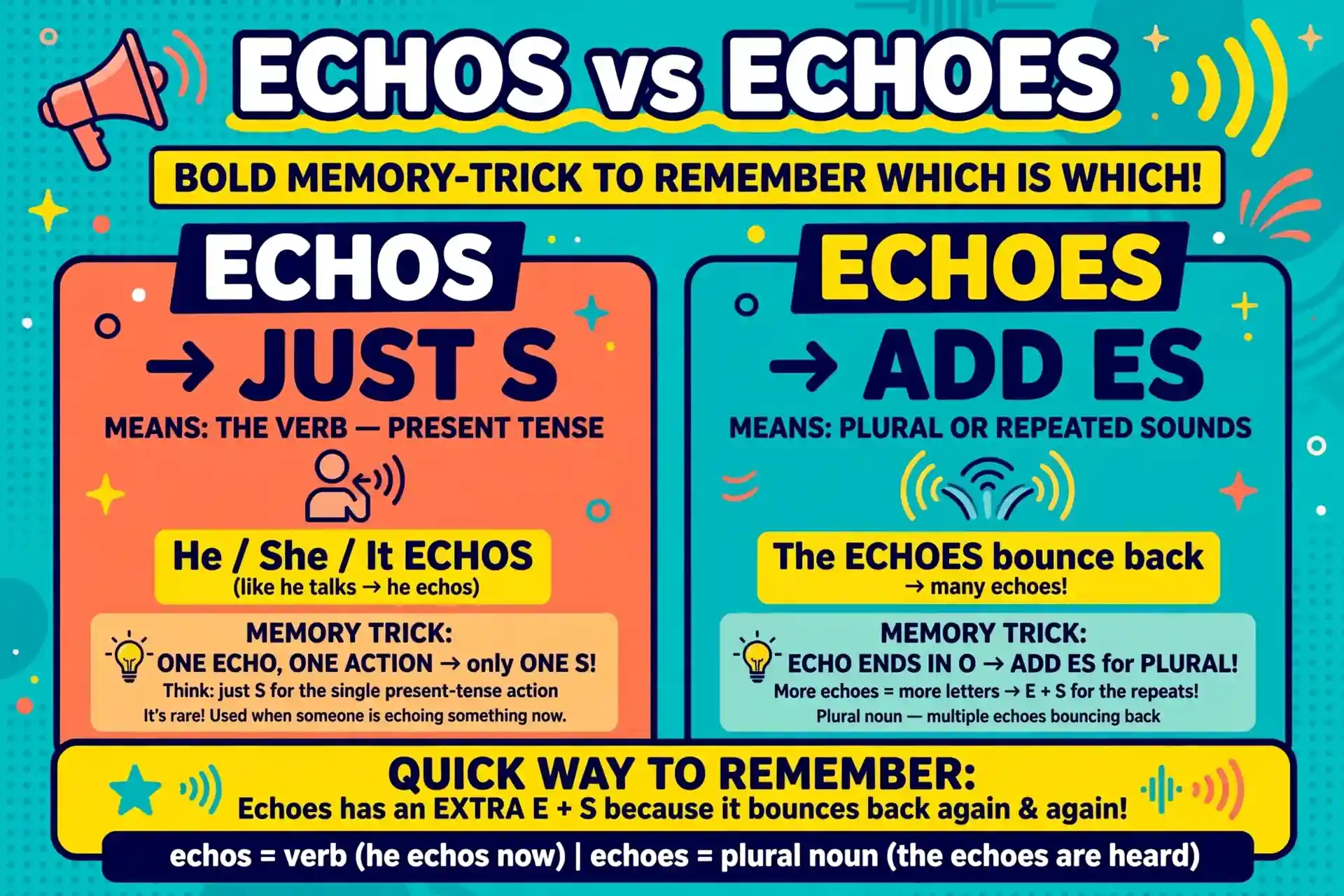
Think of the O-words that take -ES: potatoes, tomatoes, heroes — and echoes. When a noun ends in a consonant plus O, add ES, not just S. The E is the flag that says “this plural follows the rule.”
- Echoes = E-C-H-O-E-S — the standard -es plural.
- Echos = the missing-E variant — if there’s no E before the S, it’s wrong.
- Chant it: “potatoes, tomatoes, heroes, echoes.”
Frequently Asked Questions
Is it echos or echoes?
It is echoes. “Echos” is a nonstandard variant that dictionaries do not recommend.
What is the plural of echo?
The plural is echoes, following the consonant-plus-O rule (potatoes, tomatoes, heroes).
How do you conjugate “to echo”?
I echo, you echo, he/she/it echoes, we echo, they echo. The past tense is “echoed.”
Is “echos” ever acceptable?
Extremely rarely, and never in edited or professional writing. Always prefer “echoes.”
What is the past tense of echo?
The past tense is echoed (“The hall echoed with applause”), and the present participle is echoing. Only the plural and the he/she/it form take the -es ending.
Echo vs echoes: when do you use each?
Use echo for one reflected sound or with I/you/we/they (“I echo your concern”). Use echoes for multiple sounds or with he/she/it (“She echoes my view”).
Why the -es ending?
English adds -es (not just -s) to most nouns ending in a consonant plus O, which is why we write “echoes” rather than “echos.”
Conclusion
Echoes is the standard plural of “echo” and the correct verb form — it follows the same -es pattern as potatoes, tomatoes, and heroes. Echos is a nonstandard variant best avoided. Keep the E before the S, and this pair is settled.