Supposably or Supposedly: What’s the Difference?
Supposedly means “according to what is said or believed” — allegedly, putatively. It is the word you want in nearly every sentence. Supposably barely qualifies as a word at all: it mostly appears as a misspelling of supposedly (taken literally, it would mean “capable of being supposed”). When in doubt, the longer-looking option is the trap.
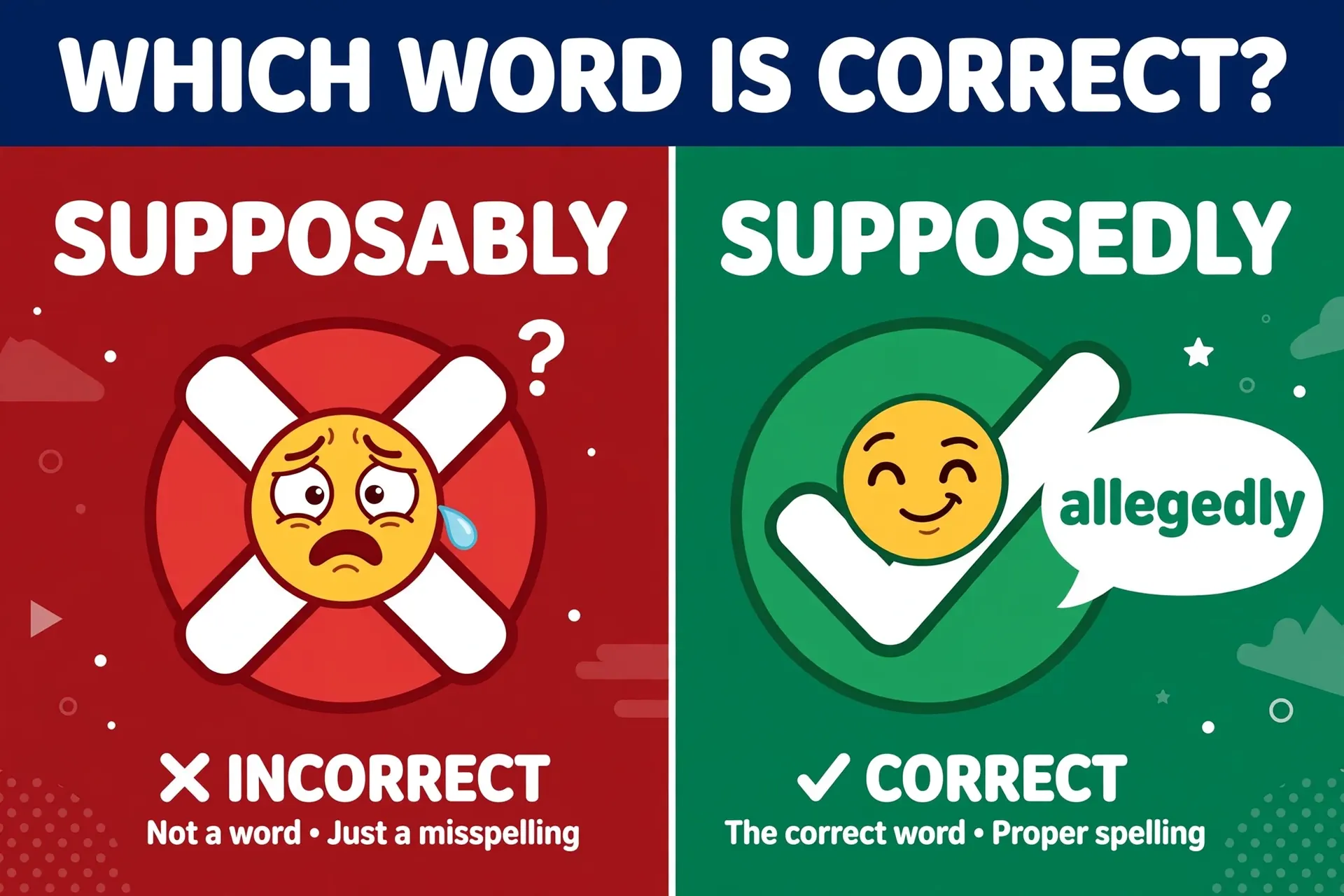
Table of Contents
Quick Answer
| Word | Part of Speech | Main Meaning | Example |
|---|---|---|---|
| Supposedly | Adverb | According to what is believed or claimed; allegedly | “The old house is supposedly haunted.” |
| Supposably | Nonstandard / rare | Would literally mean “capable of being supposed” — in practice, almost always a misspelling of supposedly | “He’s supposably the expert.” (incorrect) |
Simple rule: If you mean “people say” or “allegedly,” write supposedly — supposably is a slip of the pen.
What Does Supposedly Mean?
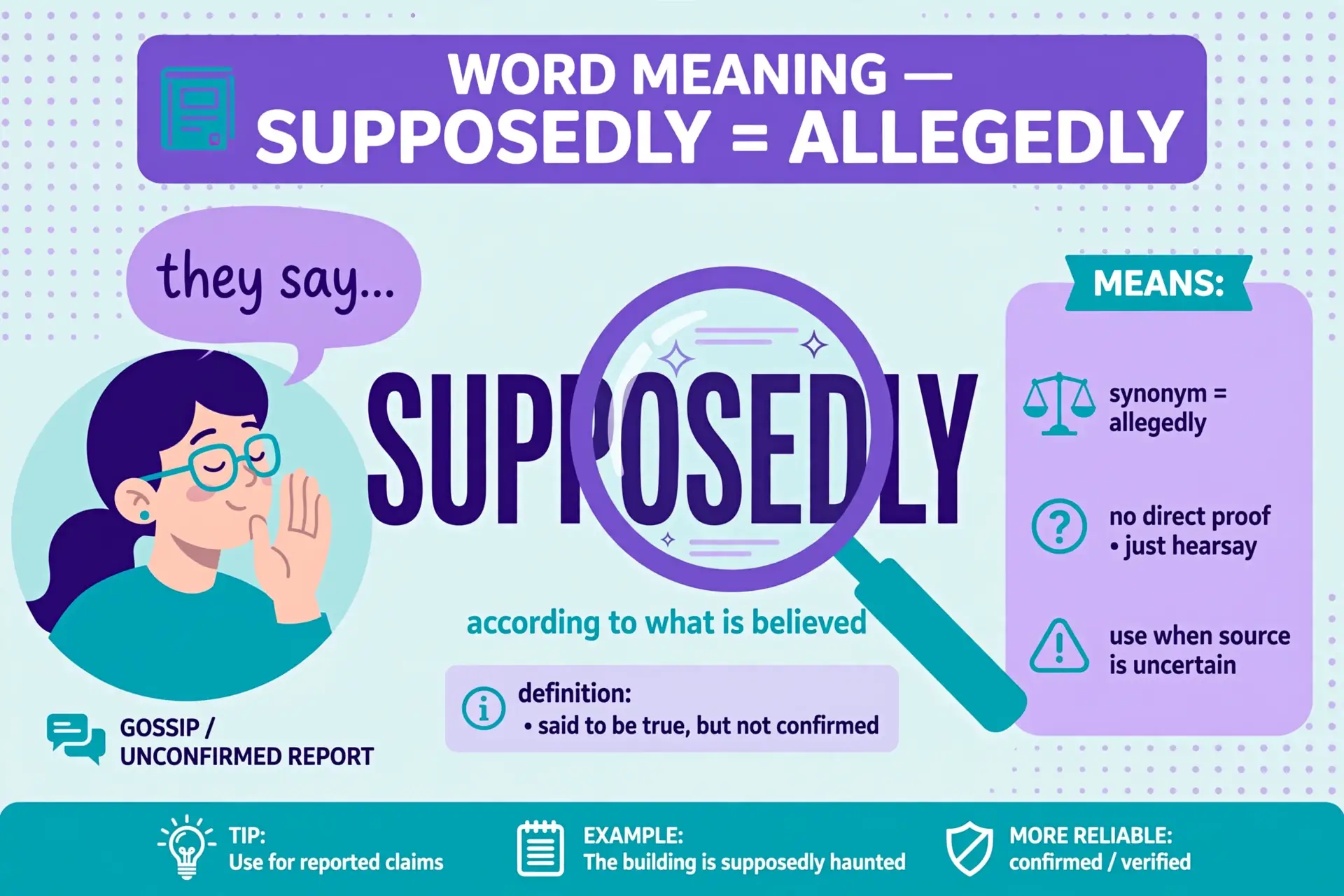
Supposedly is an adverb built on the verb suppose: it reports what is believed, claimed, or assumed without committing the speaker to it. It carries a gentle note of doubt — “that’s the story, anyway” — and news reports, gossip, and cautious opinions all lean on it constantly.
- The restaurant is supposedly the best in town, but I haven’t tried it yet.
- He was supposedly working late, yet his car was home by six.
- The package supposedly arrived yesterday, but there’s no sign of it.
- Supposedly, the new policy takes effect next month.
- She’s supposedly an expert, though she couldn’t answer a single question.
Supposedly vs. allegedly
The two overlap, but supposedly is the everyday choice — softer and slightly skeptical. “Allegedly” sounds legal, the word of courtrooms and news anchors. In most writing, supposedly does the same job with less starch.
What Does Supposably Mean?
Taken literally, supposably would mean “capable of being supposed” — but almost nobody uses it that way, and no major dictionary gives it a real entry. In the wild, it is simply what happens when fingers type supposedly too fast, swapping the D for a B.
Merriam-Webster defines supposedly as “as is supposed” or “according to what is believed” — the word you actually want. There is no matching entry for its B-spelled twin.
Its one claim to fame is comedic: Joey Tribbiani famously insisted “supposably” was a word on the sitcom Friends — and the joke stuck because so many viewers had been saying it themselves.
Where you’ll encounter the misspelling:
- Texts: “She’s supposably coming to the party.” (misspelled)
- Emails: “The client is supposably happy with the draft.” (misspelled)
- Comments: “This is supposably the director’s cut.” (misspelled)
Could supposably ever be right?
In theory, a philosopher could write of a “supposably true premise” — a premise capable of being supposed. In practice, every reader would assume a typo. Even its literal meaning is unusable: supposably fails as a misspelling and as a word.
Supposably vs. Supposedly: Key Differences
| Feature | Supposedly | Supposably |
|---|---|---|
| Correctness | Correct, standard English | Nonstandard — almost always a misspelling |
| Meaning | “Allegedly; according to what is believed” | Would mean “capable of being supposed” (unused) |
| Dictionary status | Full entry in every dictionary | No standard dictionary entry |
| The key letter | Contains SUPPOSED + ly | Swaps the D for a B |
| Tone it carries | Mild skepticism — “that’s the claim” | None — readers just see a typo |
| What to write | Always, when you mean “allegedly” | Never — correct it to supposedly |
The whole difference hangs on a single letter: supposedly contains the word supposed, exactly as its meaning requires.
Supposably and Supposedly in Real Sentences
At Home
Supposedly: “The plumber is supposedly arriving between nine and noon.” — we’ll believe it when the doorbell rings.
Supposably (avoid): “The plumber is supposably arriving between nine and noon.” — the typo steals the joke.
Tradespeople, deliveries, weather forecasts — supposedly‘s natural habitat.
In Conversation
Supposedly: “This café is supposedly famous for its pancakes.”
Supposably (avoid): “This café is supposably famous for its pancakes.”
Aloud they’re nearly identical — which is why the misspelling survives until the letters give it away.
At Work
Supposedly: “The report was supposedly finished last Friday.”
Supposably (avoid): “The report was supposably finished last Friday.”
In a status update, the wrong spelling makes the doubt look accidental.
In the News
Supposedly: “The documents were supposedly shredded before the investigation began.”
Supposably (avoid): “The documents were supposably shredded before the investigation began.”
For journalists, supposedly distances them from unverified claims — precision as self-defense.
Common Mistakes
One-letter swaps create some of English’s most persistent errors — the phantom word in invision vs envision and the extra E in smooth vs smoothe work exactly the same way. Watch for these four traps:
Mistake 1: Typing supposably in professional emails
❌ “The client is supposably happy with the draft.”
✅ “The client is supposedly happy with the draft.”
Why: Autocorrect often misses this one, so the typo sails straight to your boss with your name on it.
Mistake 2: Trusting your ears over the dictionary
❌ “I hear everyone say ‘supposably,’ so it must be right.”
✅ “Speech blurs the middle of the word; the spelling keeps the D.”
Why: In fast speech, “supposedly” and “supposably” sound almost identical — only the written form reveals which one you meant.
Mistake 3: Citing Joey Tribbiani as a source
❌ “It’s a word — Joey said so on Friends!”
✅ “It’s a joke — that’s precisely why the scene is funny.”
Why: The humor of the scene depends on “supposably” being wrong; quoting it as evidence proves the opposite of what you intend.
Mistake 4: Assuming the B-version carries a different meaning
❌ “I wrote ‘supposably’ because I meant something slightly different.”
✅ “There is no second meaning — use supposedly or rephrase.”
Why: Unlike genuine word pairs with distinct senses, this pair has one real word and one typo wearing a disguise.
Pronunciation
Supposedly is pronounced suh-POH-zid-lee: four syllables with the stress on “POH,” and the D softening into a “zid” sound in the middle. Supposably would be suh-POH-zuh-blee — and saying it aloud reveals the problem: the B pops out awkwardly where the smooth D belongs. If the word feels clumsy on your tongue, that’s your mouth filing a complaint.
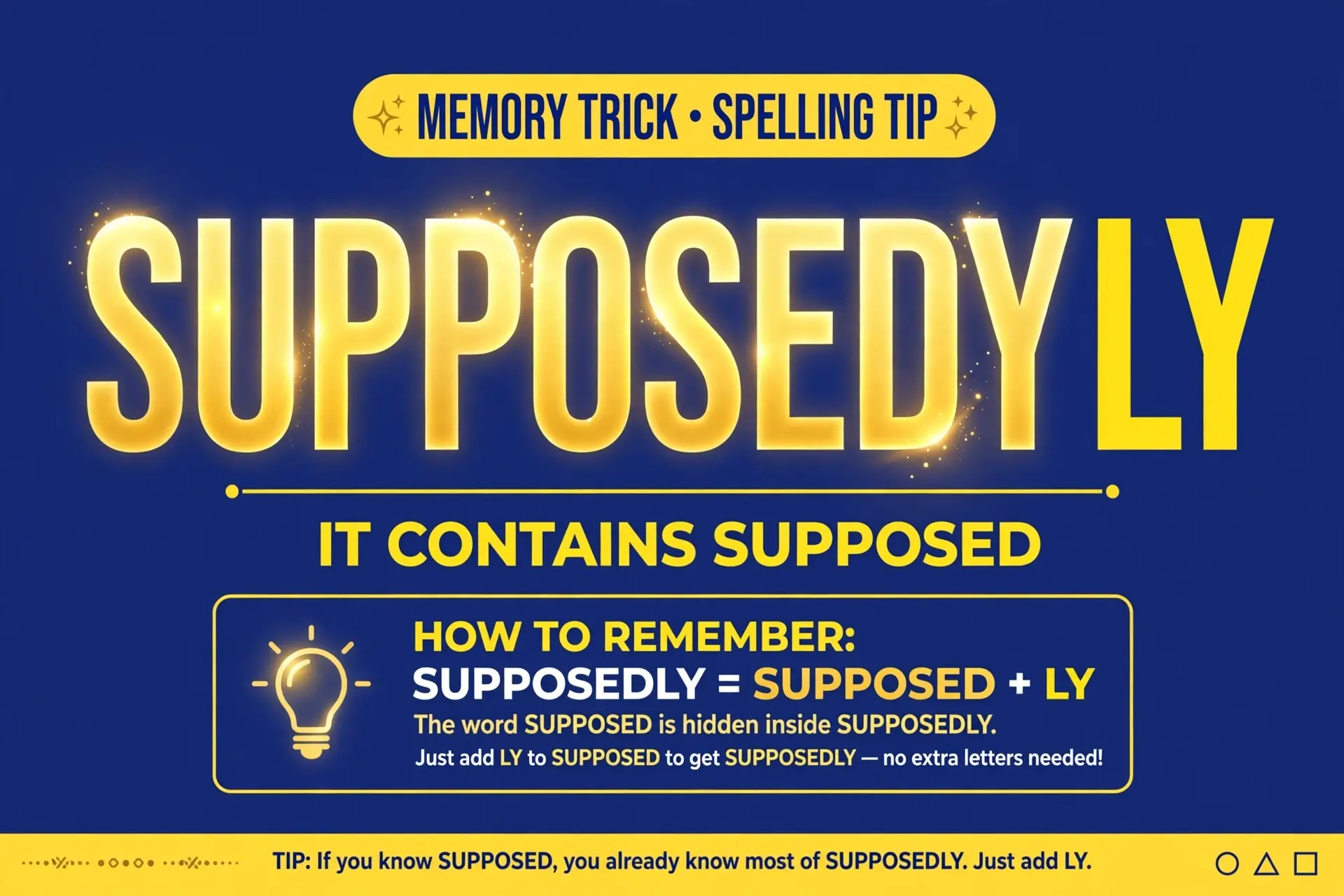
How to Remember the Difference
Supposedly contains the word SUPPOSED — and “as is supposed” is exactly what it means.
- Find SUPPOSED hiding inside supposedly: SUPPOSED-ly. The meaning is built into the spelling.
- Supposably swaps the D for a B — a bad trade. D is for “dictionary-approved.”
- Think “supposed to be”: she’s supposed to be an expert → she’s supposedly an expert.
Frequently Asked Questions
Is it supposably or supposedly?
It’s supposedly. That is the standard word meaning “allegedly” or “according to what is believed.” Supposably is a misspelling in virtually every real-world sentence.
Is supposably a word?
Not in any standard dictionary. Nobody uses its theoretical literal meaning, and every reader will take it for a typo of supposedly.
What’s the difference between supposedly and allegedly?
They overlap, but supposedly is the casual, everyday choice with a hint of gentle doubt, while “allegedly” sounds formal and legal. Use supposedly in conversation and most writing; save “allegedly” for accusations and courtrooms.
Why do people write supposably?
Two reasons: the middle of “supposedly” gets mumbled in speech, so the D and B blur together, and fast typing turns D into B easily on a keyboard. The ear can’t tell them apart — only careful spelling can.
Did Joey from Friends really say “supposably”?
Yes — in a classic Friends scene, Joey insists “supposably” is a word, and the joke lands because the audience knows it isn’t. The scene is so famous that it accidentally taught a generation the misspelling.
Can spellcheck catch supposably?
Sometimes — but many checkers wave it through, and phone keyboards may even learn it from you. The SUPPOSED-inside trick is the only reliable fix.
Conclusion
Supposedly is the real word — the adverb of mild doubt, built on supposed. Supposably is a typo with a sitcom credit to its name. Keep the D, drop the B.