Expresso or Espresso: What’s the Difference?
Ask for an expresso in a café and the barista will know exactly what you mean — but the menu will say espresso. Espresso is the correct Italian name for the small, strong coffee brewed by forcing hot water through finely ground beans. Expresso is simply a misspelling, born from the English word “express” and the tempting idea of a fast coffee.
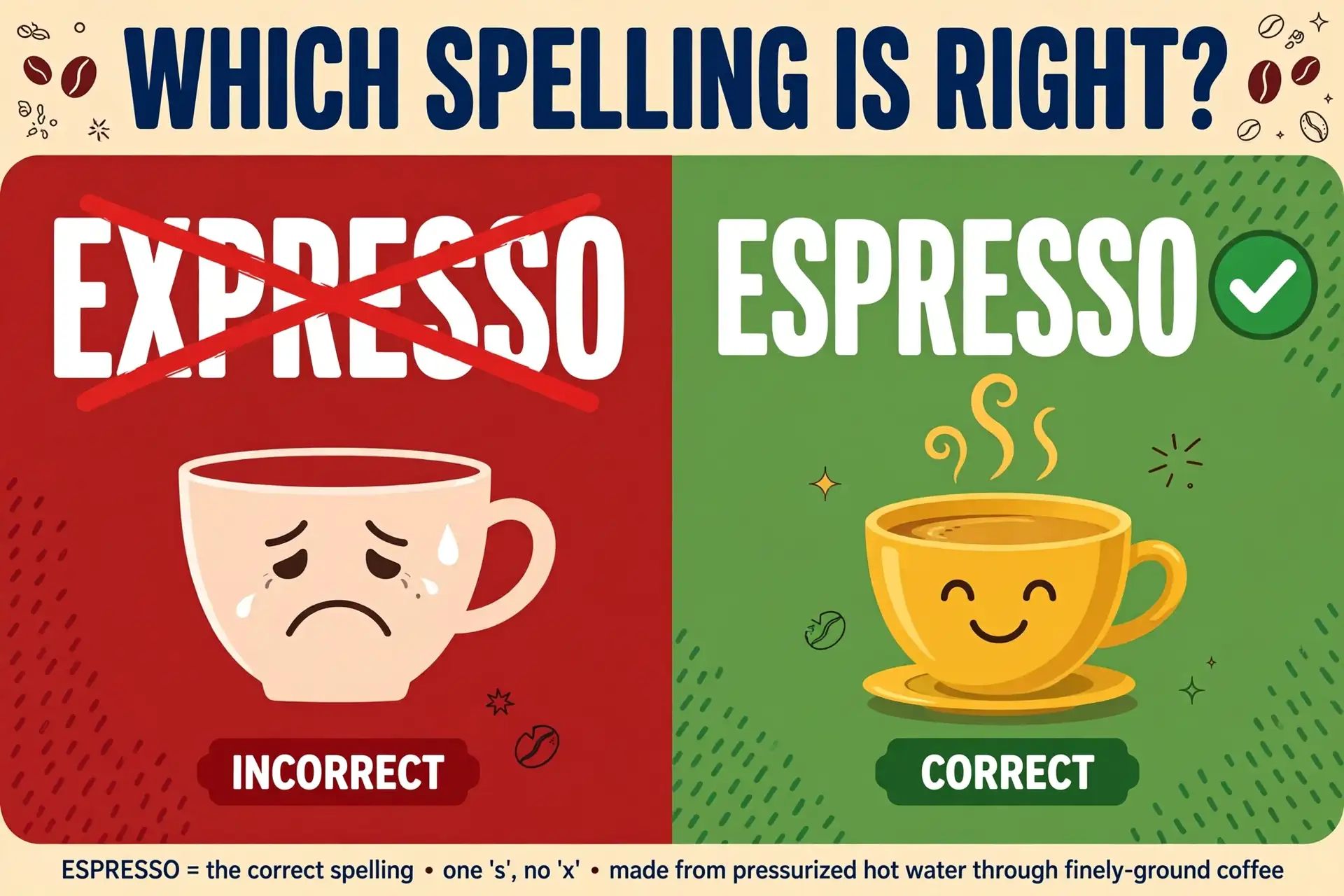
Table of Contents
Quick Answer
| Word | Part of Speech | Main Meaning | Example |
|---|---|---|---|
| Espresso | Noun | A strong coffee brewed by forcing hot water through finely ground coffee beans | “She ordered a double espresso after dinner.” |
| Expresso | Misspelling | Not an accepted word — a common misspelling of espresso | “He asked for an expresso.” (incorrect spelling) |
Simple rule: Espresso has an S, like the Italian word it comes from — never write it with an X.
What Does Espresso Mean?
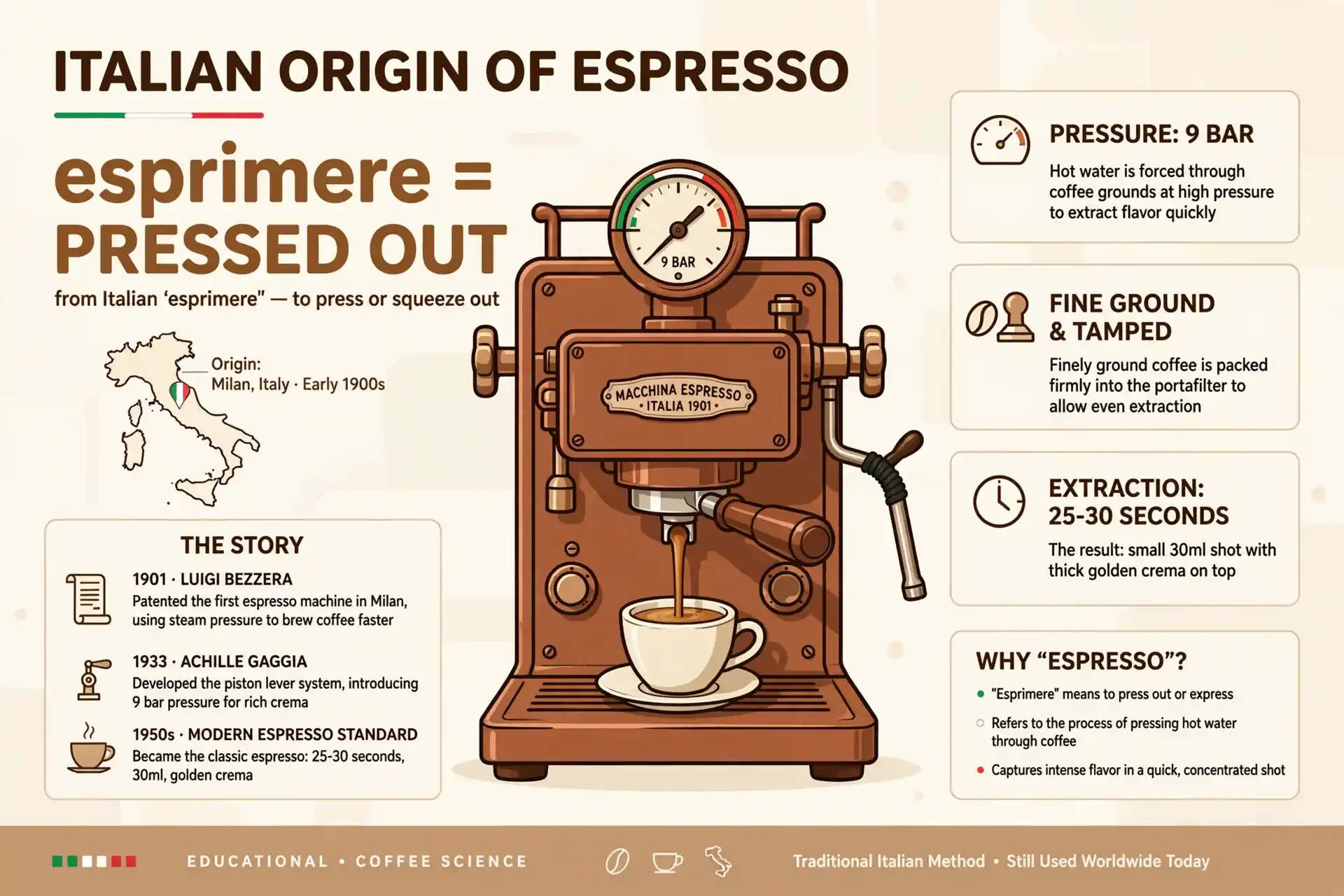
Espresso is both a drink and a brewing method: hot water forced under pressure through finely ground, tightly packed coffee, producing a small, intense shot crowned with golden crema. The word comes from the Italian past participle of esprimere, meaning “pressed out.” It is also the foundation of nearly every café drink: lattes, cappuccinos, macchiatos, and flat whites all start life as espresso.
- The barista pulled a rich espresso with thick, golden crema.
- She drinks a double espresso every morning before work.
- Tamping the grounds evenly is the real secret to great espresso.
- In Italy, an espresso at the counter costs about a euro and takes two minutes to drink.
Espresso the drink vs. espresso the method
When Italians say espresso, they usually mean the quick shot itself — un caffè at the bar, knocked back standing up. In English the word stretches wider to cover the method too, as in “espresso machine.” Either way, the spelling never changes.
What Does Expresso Mean?
Expresso means nothing at all — it is not an accepted English or Italian word in any dictionary. It survives purely as a misspelling, and its origin is easy to trace: English speakers hear “espresso,” connect it to the familiar word “express” (fast, like an express train or express delivery), and insert an X. Coffee is quick, the shot is tiny, the logic feels right — but the spelling is wrong every single time.
Merriam-Webster’s entry for espresso shows only one standard spelling — with an S — and no variant with an X.
Here is where the misspelling tends to surface:
- Café chalkboards: “Try our caramel expresso!” (misspelled)
- Text messages: “Grabbing an expresso before the meeting — need it fast.” (misspelled)
- Menus printed in a hurry: “Expresso Martini — $12″ (misspelled)
- Online reviews: “Best expresso in town, hands down!” (misspelled)
Why the mistake is so stubborn
“Express” is one of the most common English words, and an espresso genuinely is a fast, intense coffee — so your brain merges the two with total confidence. Knowing the Italian root breaks the spell: once you learn the word means “pressed out,” the X stops making sense.
Expresso vs. Espresso: Key Differences
| Feature | Espresso | Expresso |
|---|---|---|
| Correctness | The only correct spelling | A misspelling — not a word |
| Origin | Italian esprimere, “to press out” | False association with English “express” |
| The X factor | No X anywhere in the word | The X is the entire mistake |
| Dictionary status | Full entry in every dictionary | Appears in no standard dictionary |
| On café menus | What professionals print | A sign the menu wasn’t proofread |
| What to write | Always — in every context | Never — correct it on sight |
Bottom line: espresso is a word with a history; expresso is a typo with a fan club.
Expresso and Espresso in Real Sentences
At the Café
Espresso: “Could I get a double espresso, please?” — the barista nods with respect.
Expresso (avoid): “Could I get a double expresso, please?” — you’ll still get coffee, plus a quiet wince.
The right spelling marks you as someone who actually loves coffee.
At Home
Espresso: “Our new machine makes better espresso than the café downtown.”
Expresso (avoid): “Our new machine makes better expresso than the café downtown.”
Spelling the drink right is the easiest upgrade of all.
At Work
Espresso: “The office espresso machine is the only reason I survive Mondays.”
Expresso (avoid): “The office expresso machine is the only reason I survive Mondays.”
Nobody notices in Slack; everybody notices on the office kitchen sign.
Traveling in Italy
Espresso: “Un caffè, per favore” gets you a perfect espresso at any Roman bar.
Expresso (avoid): Asking for “expresso” gets you a puzzled look — the word doesn’t exist in Italian either.
In the drink’s homeland, the X is simply wrong.
Common Mistakes
Misspellings spread the same way everywhere — one confident mistake gets copied until it looks normal. The same sound-based slip drives the lazer vs laser error, and everyday words like donut vs doughnut show how variant spellings take hold. Dodge these four traps:
Mistake 1: Writing expresso on signs and menus
❌ Chalkboard special: “Iced Caramel Expresso — $5”
✅ Chalkboard special: “Iced Caramel Espresso — $5”
Why: A café that misspells its own product makes customers doubt everything else, including the coffee.
Mistake 2: Pronouncing it “ex-presso”
❌ “I’ll have an ex-presso, extra hot.”
✅ “I’ll have an ess-presso, extra hot.”
Why: The X-pronunciation is the audible version of the same mistake — baristas hear it as a signal you learned the word from a misspelled menu.
Mistake 3: Assuming expresso is the American spelling
❌ “Espresso must be the British version; Americans say expresso.”
✅ “Espresso is the spelling in every variety of English.”
Why: Unlike color/colour, this pair has no regional split — expresso is wrong in American, British, and Italian alike.
Mistake 4: “Correcting” someone’s espresso to expresso
❌ “Actually, I think it’s spelled expresso — like express.”
✅ “It’s espresso — from the Italian for ‘pressed out.'”
Why: Confident corrections of a correct spelling are the fastest way to lose a coffee argument.
Pronunciation
Espresso is pronounced ess-PRESS-oh: three syllables, stress on the middle one, with a crisp S where the X wants to sneak in. The common mispronunciation “ex-PRESS-oh” is worth unlearning — say the S-version ten times and your mouth will stop reaching for the X.
How to Remember the Difference
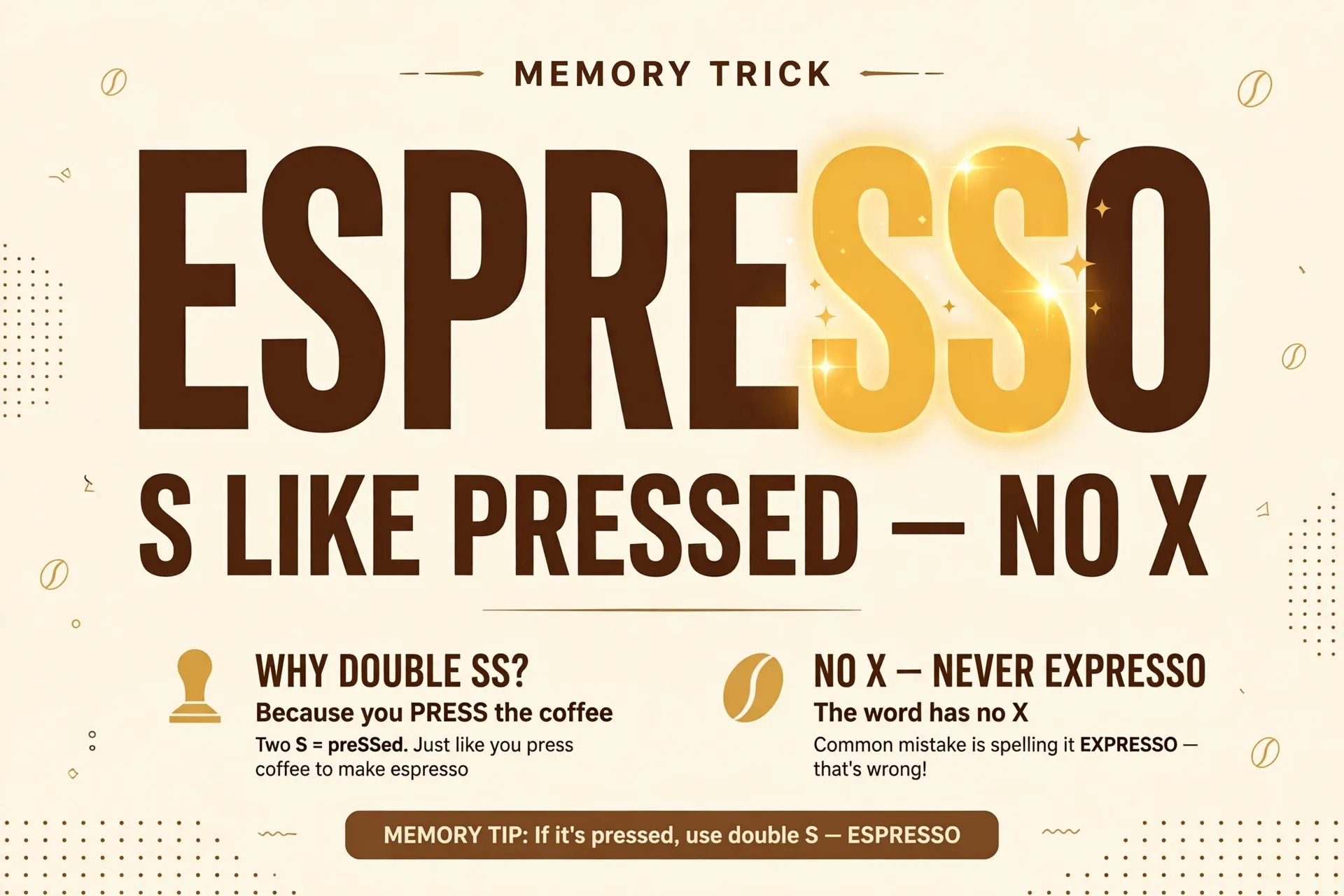
The trick lives in one letter: espresso is pressed, never expressed.
- S like pressed — the Italian root esprimere means “pressed out,” and both words share that double S.
- There is no X in Italy’s coffee.
- Slow down and savor the shot: three S-words to lock in the S-spelling.
Frequently Asked Questions
Is it expresso or espresso?
It’s espresso — always. Expresso is a misspelling with no dictionary entry and no regional variant to hide behind.
Is expresso ever correct?
No. No dictionary lists it, no style guide accepts it, and it isn’t even an Italian word. Anywhere you see expresso in print, it’s an error waiting for a proofreader.
Why do so many people write expresso?
The English word “express” is far more familiar than the Italian esprimere, and espresso genuinely is a fast, “express” coffee. The brain merges the two — a textbook case of a plausible mistake outrunning the correct spelling.
Is it pronounced “express-oh”?
No — it’s “ess-PRESS-oh,” with an S sound, not an X sound. Pronouncing the X is the spoken version of the same spelling mistake, and it’s the quickest way to sound unsure about coffee.
Does espresso mean “fast” in Italian?
Not exactly — it comes from esprimere, “to press out.” The “fast coffee” idea is a happy coincidence that likely helped the expresso misspelling along.
How do you order espresso in Italy?
Just ask for “un caffè” — in Italy that means an espresso, drunk standing up at the bar in about three sips.
Conclusion
Espresso is the real word — Italian, historic, and spelled with an S for “pressed.” Expresso is what happens when the English word “express” hijacks your spelling. Remember the S, order with confidence, and enjoy your coffee the way Italy intended.