Where or Were: What’s the Difference?
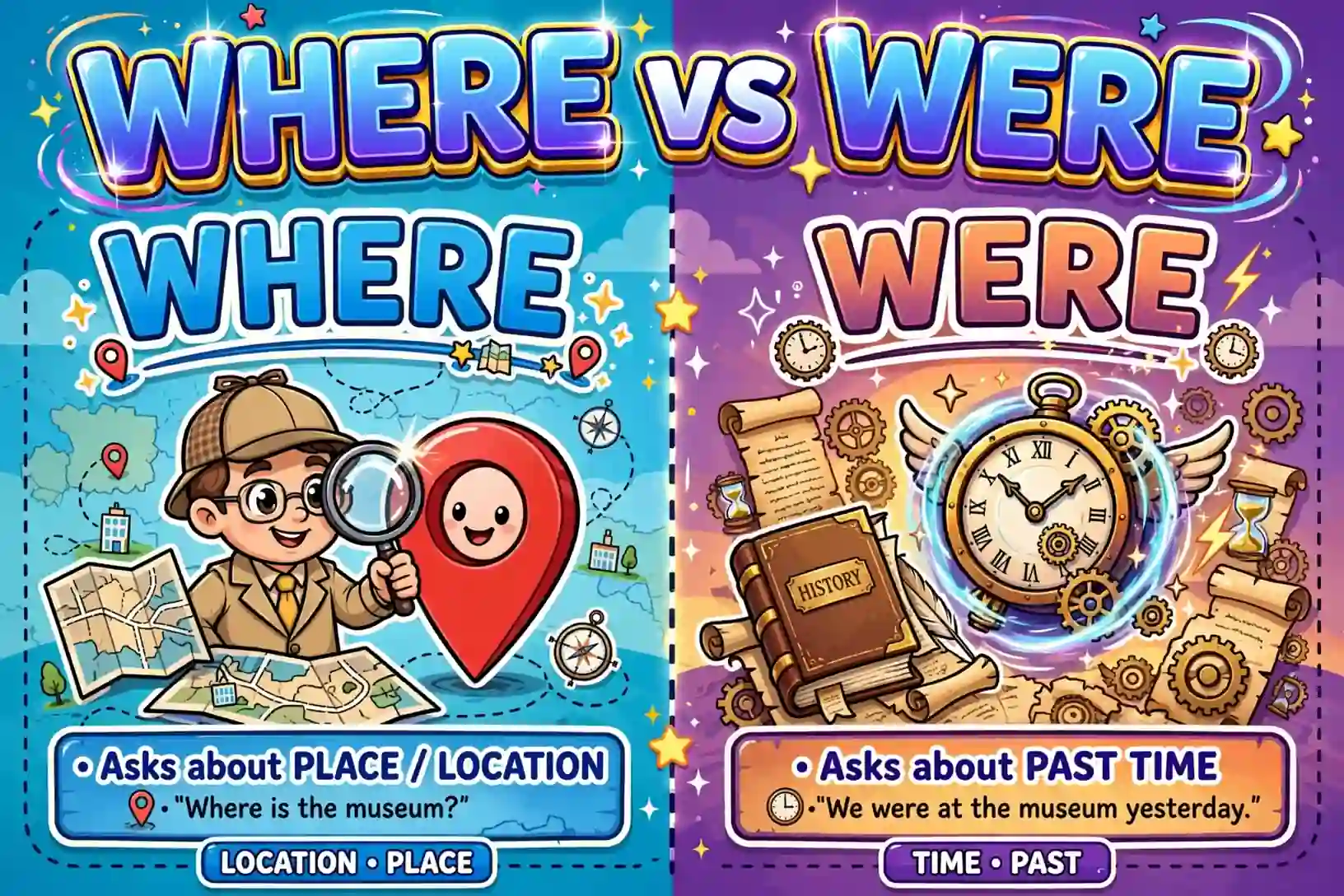
Where asks about a place or position (“Where are you?”). Were is the past tense of be for plural subjects and you (“We were happy”). They sound identical but do completely different jobs.
For example, “Where were you?” uses both correctly — where asks the place, were sets the past tense. Mixing them up is one of the most common writing errors in English.
Quick Answer
| Word | Part of Speech | Main Meaning | Example |
|---|---|---|---|
| Where | Adverb / conjunction | At what place; in what position | Where is my phone? |
| Were | Verb (past of be) | Past tense: you/we/they + be | We were late. |
Simple rule: Asking about a place? Write where. Talking about the past? Write were.
What Does Where Mean?
Where is about location. It asks “in what place?” as a question word, and it also introduces relative clauses (“the house where I grew up”).
Examples:
- Where did you put my keys?
- Where are we meeting tomorrow?
- This is the café where we first met.
- Where there’s smoke, there’s fire.
- She asked where the station was.
It never acts as a verb. If your sentence needs an action or a state of being, where is not your word. See where on Merriam-Webster.
What Does Were Mean?
Were is the past tense of the verb be, used with you (singular and plural), we, and they — plus I and he/she/it in subjunctive and conditional sentences (“If I were you”).
Examples:
- We were stuck in traffic for an hour.
- You were right about the movie.
- They were the first to arrive.
- Were you at the party last night?
- If I were taller, I’d play basketball.
It never asks about a place. If your sentence is locating something, were is not your word.

Where vs. Were: Key Differences
| Feature | Where | We |
|---|---|---|
| Job | Asks about place | Past tense of be |
| Part of speech | Adverb / conjunction | Verb |
| Used with | Questions, locations | You, we, they (+ subjunctive) |
| Contains | The word HERE | The word WE |
| Example | Where is it? | We were there. |
Homophones like this pair — words that sound alike but work differently — are a classic trap, just like lier vs. liar. The spelling is the only signal of meaning.
Examples of Where and Were in Real Sentences
At Home
Where: “Where is the remote control?”
Were: “We were watching a movie when it disappeared.”
The first asks the location; the second sets the past-tense scene.
At Work
Where: “Where should I save this file?”
Were: “You were supposed to save it yesterday.”
A question about place vs. a statement about the past.
In Conversation
Where: “Where were you last night?”
Were: “We were at the new restaurant downtown.”
The question needs where; the answer needs were.
Telling a Story
Where: “This is where it all started.”
Were: “We were so young back then.”
Location-setting vs. past-state describing.
Common Mistakes With Where and Were
Because they are perfect homophones, writers often type the wrong one on autopilot — the same kind of slip that affects other sound-alike pairs.
Mistake 1: Writing “Were” for a Place Question
❌ Were is the nearest gas station?
✅ Where is the nearest gas station?
Why: The sentence asks about a location — that is where‘s job.
Mistake 2: Writing “Where” for Past Tense
❌ They where very tired.
✅ They were very tired.
Why: The sentence needs the past tense of be — that is were‘s job.
Mistake 3: Confusing “Were” With “We’re”
❌ Were going to be late.
✅ We’re going to be late. (= we are)
Why: We’re is the contraction of “we are” (present); were is past tense. Different words, different times.
Pronunciation: Where vs. Were
Both are pronounced /wɛr/, rhyming with there, their, and care.
They are perfect homophones — no accent distinguishes them. Only the spelling, chosen by meaning, tells the reader which one you intend.

How to Remember the Difference
Memory trick: WHERE has HERE hiding inside it — and “here” is a place. WERE has WE at the start — and “we were” is the classic past-tense pair.
- WHERE → tHERE → a place. All the location words share those letters.
- WERE → we were, you were, they were — the verb follows its subjects.
- Ask: “Am I locating something?” → where. “Am I time-traveling to the past?” → were.
Frequently Asked Questions
Is it where or were?
It depends on meaning: use where for places and location questions (“Where are you?”), and were as the past tense of be (“We were there”).
Do where and were sound the same?
Yes — both are pronounced /wɛr/. They are perfect homophones, so spelling is the only way to show which meaning you intend.
What is the difference between “were” and “we’re”?
Were is the past tense of be (“we were happy”). We’re is the contraction of “we are” (“we’re happy now”). Past vs. present.
Can “were” be used with “I”?
Yes, in the subjunctive mood: “If I were you,” “I wish I were taller.” In plain past statements, I takes was: “I was tired.”
Is “where” ever a verb?
No. Where is an adverb or conjunction — it never acts as a verb. If your sentence needs a verb, you want were (or another verb entirely).
Conclusion
Where locates — it asks about place, with here tucked inside. Were time-travels — it is the past tense of be, starting with we. Same sound, different jobs: pick by meaning, and the spelling follows.