Tries or Trys: What’s the Difference? (With Examples)
Tries is the correct spelling — the third-person singular of try (she tries) and the plural of the noun try (three tries). Trys is a misspelling; it is never correct in standard English.
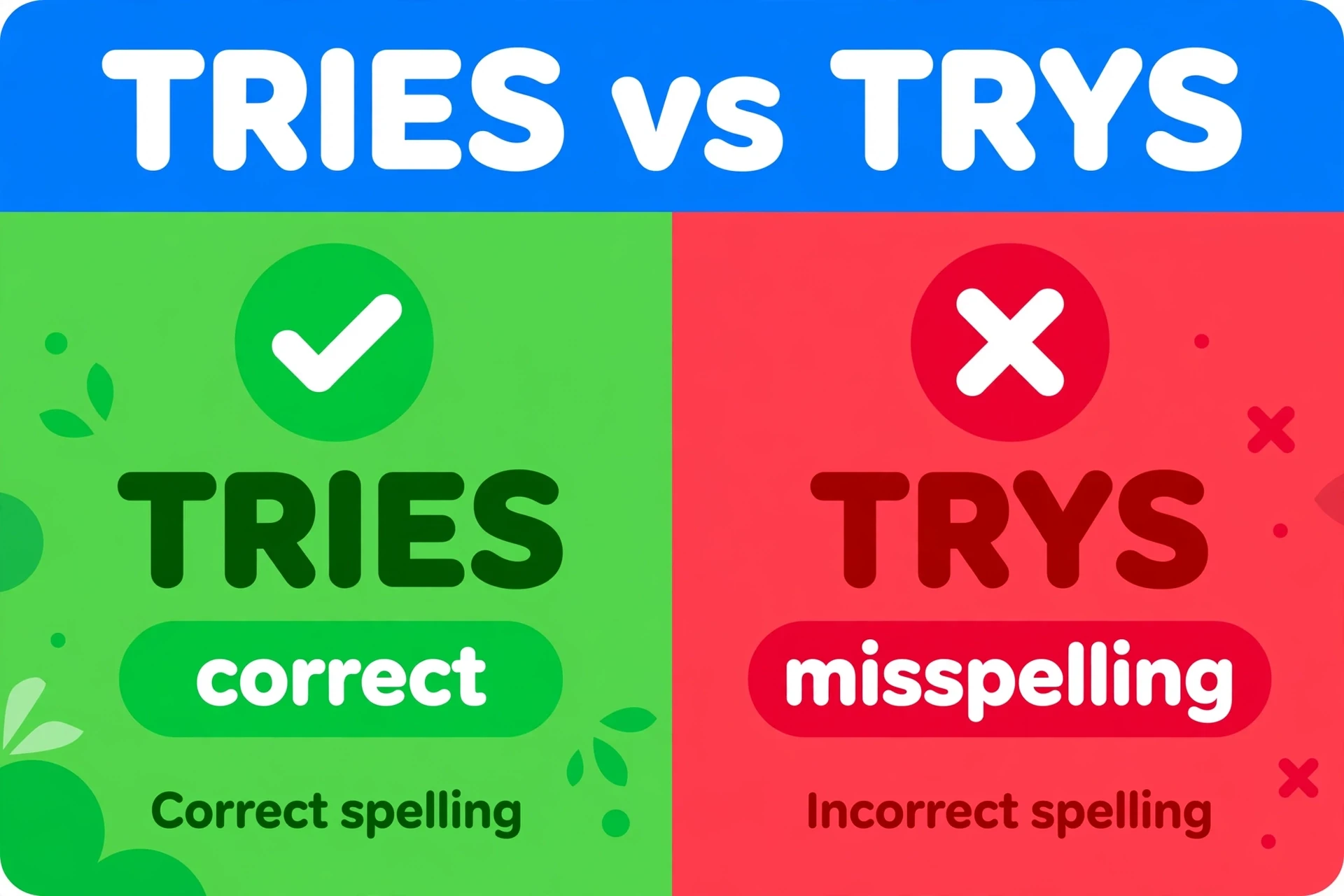
Table of Contents
Quick Answer
| Word | Part of Speech | Main Meaning | Example |
|---|---|---|---|
| Trys | Not a standard word | Misspelling of “tries” | ❌ “He trys hard” → ✅ “He tries hard” |
| Tries | Verb / noun (plural) | Third-person singular of “try” / plural of “try” (an attempt) | She tries again. / He had three tries. |
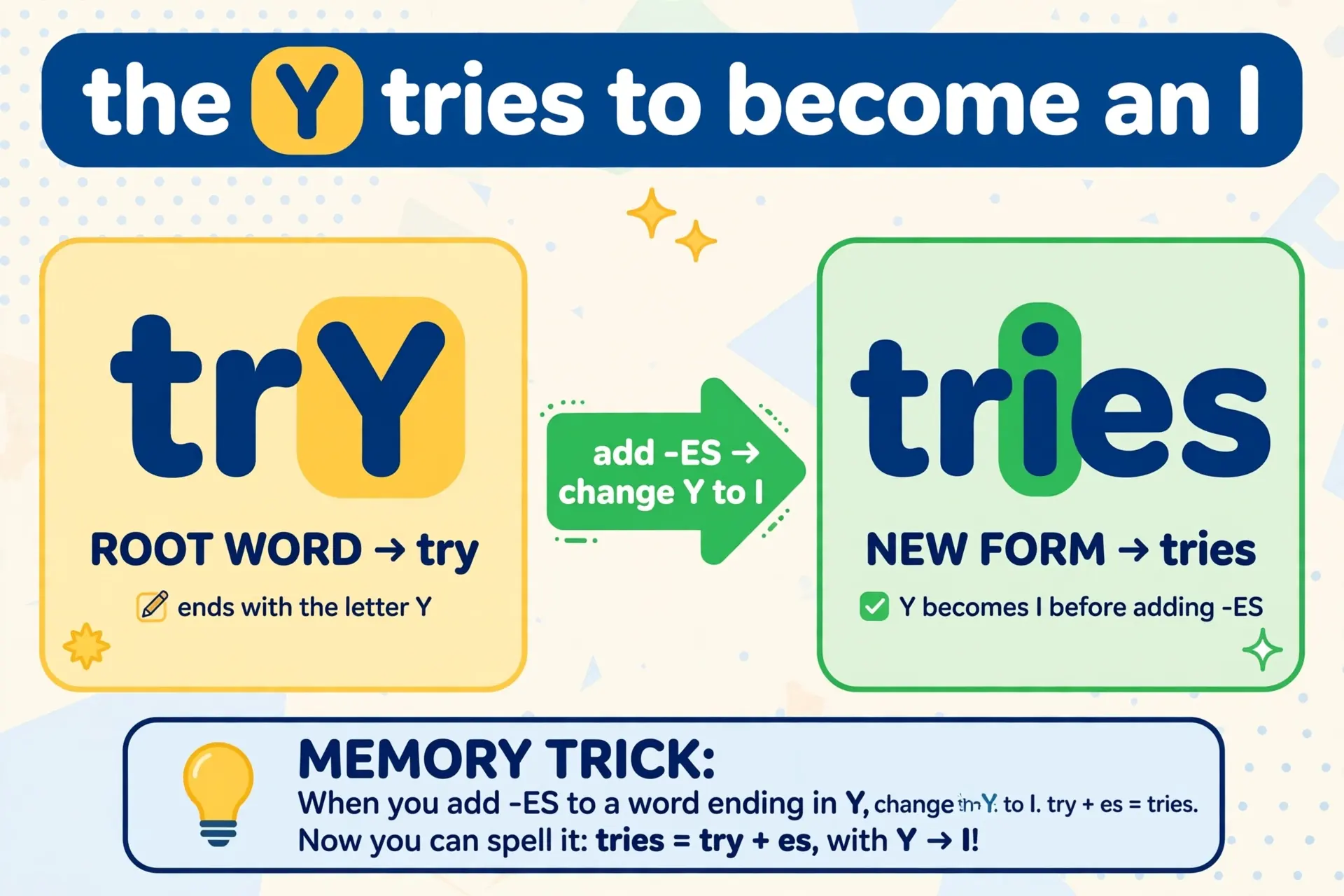
Simple rule: When a verb ends in a consonant + y, the y becomes i before -es: try → tries, cry → cries, fly → flies.
What Is “Trys”?
Trys appears in no standard English dictionary. It is a straightforward misspelling, usually written by people applying the “just add -s” habit without the y-to-i change. Because it looks close to the real word, it often slips past a quick proofread.
Examples of the mistake (all incorrect):
- ❌ “He trys to help whenever he can.” → ✅ “He tries to help whenever he can.”
- ❌ “She only gets two trys at the exam.” → ✅ “She only gets two tries at the exam.”
- ❌ “The baby trys to stand up.” → ✅ “The baby tries to stand up.”
- ❌ “Give it another trys.” → ✅ “Give it another try.”
Spelling-change errors like this are a whole family in English — similar traps include dieing vs dying and heros vs heroes.
What Does Tries Mean?
Tries is a real word with two jobs, both built on try. Merriam-Webster’s entry for the base word shows the verb senses — to attempt, to test, to taste — from which both uses of tries grow.
Tries as a verb
As a verb, tries is the third-person singular present tense of try: he tries, she tries, it tries.
Examples:
- She tries a new recipe every weekend.
- He tries to arrive before eight.
- The cat tries to catch the red dot.
- My coach tries different drills each practice.
- It tries my patience when the Wi-Fi drops.
Tries as a noun (plural)
As a noun, tries is the plural of try, meaning attempts.
Examples:
- You get three tries at the high jump.
- After several tries, the key finally turned.
- His first two tries missed the target.
- Keep track of how many tries it takes you.

Tries vs. Trys: Key Differences
| Feature | Tries | Trys |
|---|---|---|
| Status | Standard English word | Misspelling — not a word |
| Dictionary entry | Yes | None |
| Meaning | “He/she/it tries”; plural “attempts” | None |
| Spelling rule | Consonant + y → ies | Breaks the rule |
| Pronunciation | /traɪz/ | Would sound identical |
The identical pronunciation is the trap: trys would sound exactly like tries, so your ear never flags the error. Only the y-to-i spelling rule protects you.
Usage in Real Sentences
At Home
❌ “He trys to fix the sink himself.” → ✅ “He tries to fix the sink himself.”
With he/she/it, the verb try always takes the -ies ending — the y cannot survive next to the e.
At Work
❌ “She trys a different approach with each client.” → ✅ “She tries a different approach with each client.”
In professional writing this is one of the most noticeable small errors, because the correct form is so common.
In Conversation
❌ “Give it a couple more trys.” → ✅ “Give it a couple more tries.”
As a plural noun meaning “attempts”, tries follows the same y-to-i rule as the verb form.
Common Mistakes With Tries and Trys
Nearly every trys error comes from skipping the y-to-i step. Learn the pattern once and it fixes a dozen words — the same family of errors appears in dieing vs dying.
Mistake 1: “He trys” instead of “he tries”
❌ He trys hard, but the puzzle beats him.
✅ He tries hard, but the puzzle beats him.
Why: Third-person singular of a consonant + y verb changes y to i and adds -es.
Mistake 2: “Two trys” instead of “two tries”
❌ You only get two trys at the test.
✅ You only get two tries at the test.
Why: The plural noun follows the same rule — try (an attempt) becomes tries.
Mistake 3: Repeating the error with similar verbs
❌ She crys every time she watches that movie.
✅ She cries every time she watches that movie.
Why: The rule covers all consonant + y verbs: cry → cries, fly → flies, dry → dries, carry → carries.
Mistake 4: “Another trys” instead of “another try”
❌ Give it another trys tomorrow.
✅ Give it another try tomorrow.
Why: After another you need the singular noun try (one more attempt), not any plural or verb form.
Pronunciation
Tries is pronounced /traɪz/ — one syllable, rhyming with prize, rise, and wise. If trys were a word it would sound exactly the same, which is why the misspelling survives: it sounds right even though it is spelled wrong.
How to Remember the Difference
Memory trick: The y tries so hard it turns into an i — try → tries. Whenever you add an ending to a consonant + y word, picture the y swapping itself for an i first.
- Trys = ❌ the y never survives — not a word.
- Tries = ✅ y becomes i, then add -es.
- Same pattern: cries, flies, dries, carries.
Frequently Asked Questions
Is it “tries” or “trys”?
It is tries. Trys is a misspelling and is never correct in standard English.
Why is it “tries” and not “trys”?
English changes a final y to i before adding -es when the y follows a consonant. So try + es becomes tries, not trys.
Is “trys” ever correct?
No. There is no standard English word spelled trys — not as a verb, not as a noun, not anywhere.
What about “trying” and “tried”?
Trying keeps the y (before -ing, the y stays). Tried changes y to i before -ed. Only trys breaks the pattern — because it is wrong.
What is the plural of “try” as a noun?
Tries — as in “three tries at the goal”. The noun follows the same consonant + y → -ies rule.
Does the rule apply to words like “play”?
No — when y follows a vowel, you just add -s: play → plays, buy → buys, enjoy → enjoys. The y-to-i change only happens after a consonant.
Conclusion
Trys is always a misspelling — the correct form is tries, whether you mean “she tries” or “three tries”. Remember the y-to-i rule: a consonant + y always becomes -ies, and you will spell it right every time.