Rhythm or Rythm: What’s the Difference?
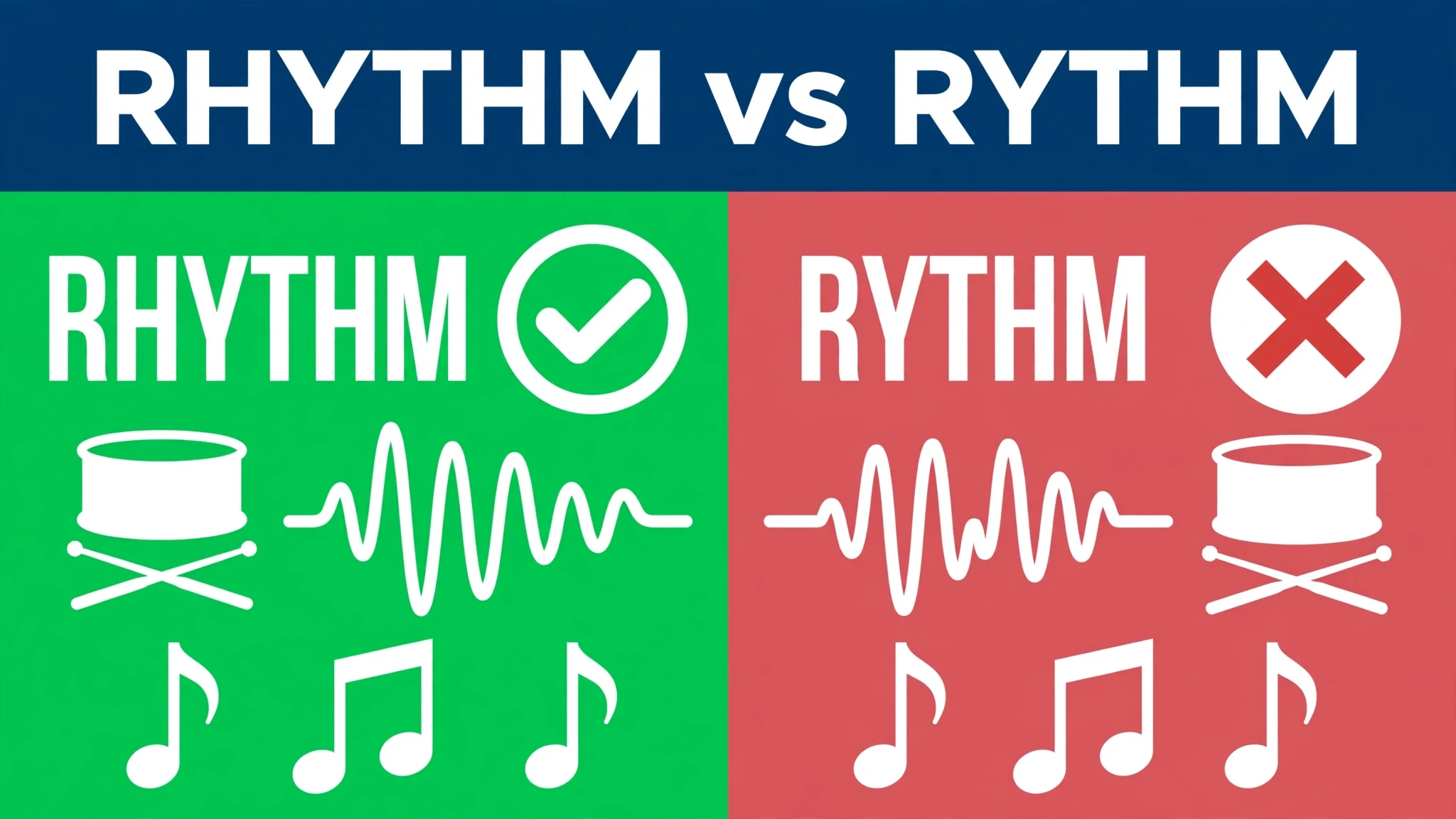
Rhythm is the correct spelling — the word for a repeated pattern of sound or movement, from a drumbeat to your morning routine. Rythm is not a word at all; it is simply what “rhythm” looks like when the first H goes missing. The fix is easy once you see where the two H’s sit, and this guide will make the right spelling stick.
Quick Answer
| Word | Part of Speech | Main Meaning | Example |
|---|---|---|---|
| rhythm | Noun | A regular, repeated pattern of sound, movement, or time | ✅ “The drummer kept a steady rhythm.” |
| rythm | — | Not a word; a common misspelling of “rhythm” | ❌ “I love the rythm of this song.” |
Simple rule: When you mean a beat or a pattern, always write R-H-Y-T-H-M — two H’s, and not a single written vowel in sight.
What Does Rhythm Mean?
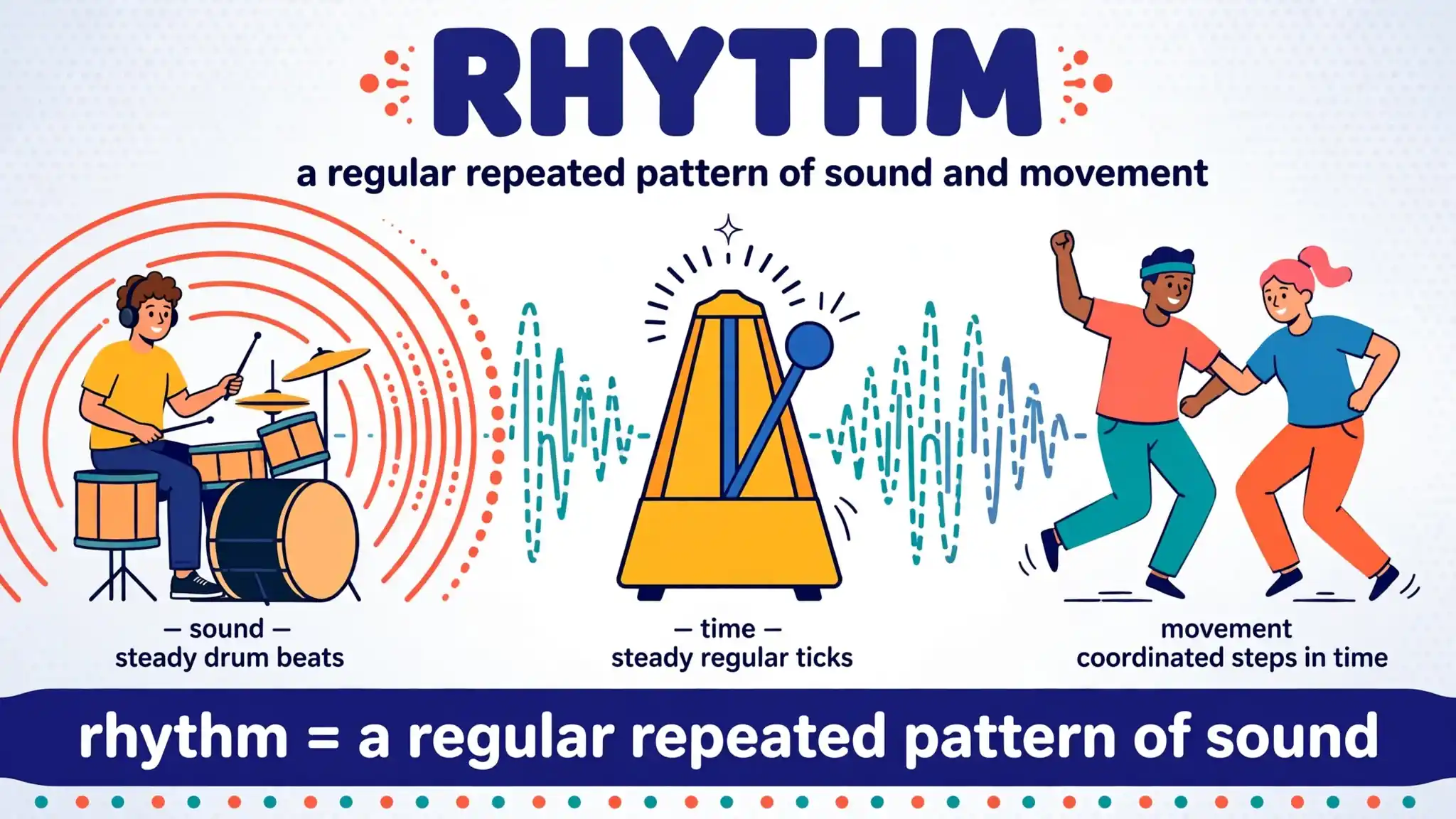
Rhythm is a noun meaning a regular, repeated pattern — usually of sound, movement, or time. A song has rhythm, a heartbeat has rhythm, and so does a well-run school day. Merriam-Webster defines rhythm as an ordered, recurring alternation of strong and weak elements in the flow of sound and silence — in plain terms, the beat you feel under everything else.
Examples:
- “The drummer locked into a steady rhythm and the whole band followed.”
- “I love the rhythm of rain on the roof.”
- “Her running rhythm never wavered, even on the hills.”
- “Good writing has rhythm — short sentences, then long ones.”
- “It took me a week to find my rhythm in the new job.”
Rhythm in music
In music, rhythm is one of the three core elements, alongside melody and harmony. It is the arrangement of notes in time: which beats are stressed, how long each note lasts, and where the silences fall. A waltz moves in a 1-2-3 rhythm, a march in 1-2, and a skilled drummer can layer several rhythms at once without losing the thread.
Rhythm beyond music
Outside music, rhythm describes any repeating cycle you can settle into. People talk about the rhythm of a city, the rhythm of the seasons, or getting into a workout rhythm. In each case the meaning is the same: a pattern steady enough to predict and comfortable enough to follow.
What Does Rythm Mean?
Rythm has no meaning, because it is not an English word — it is the most common misspelling of “rhythm.” Spellcheckers flag it, dictionaries don’t list it, and no style guide accepts it. It survives in drafts and texts because “rhythm” is genuinely hard to spell: it contains no written vowel letters, its H’s are nearly silent, and the consonant cluster R-H-Y-T-H-M looks like it shouldn’t be pronounceable — yet it is.
The H’s do real work. Drop the first one and you get “rythm,” which a reader’s brain wants to pronounce “rim.” The H’s soften the sounds around them and carry the word’s Greek ancestry (it comes from rhythmos, via Latin). Keeping both H’s isn’t decoration; it’s what makes the word the word.
Rhythm vs. Rythm: Key Differences
| Feature | rhythm | rythm |
|---|---|---|
| Spelling status | Correct, standard spelling | Misspelling — not a word |
| Meaning | A repeated pattern of sound, movement, or time | None |
| Part of speech | Noun (adjective form: “rhythmic”) | — |
| In dictionaries | Listed everywhere | Not listed |
| Usage | Music, speech, nature, daily life | Never correct in any context |
| Letter pattern | R-H-Y-T-H-M: two H’s, no written vowels | Missing the first H |
The difference is binary: one is a real word with a rich meaning, and the other is an error to delete on sight.
Rhythm and Rythm in Real Sentences
At the Concert
✅ “The bassist and drummer share the same rhythm, so the groove feels effortless.”
Writing “rythm” in a review of the show would mark you as careless — the word is always “rhythm,” with both H’s.
At the Gym
✅ “Find your breathing rhythm early in the run and the miles get easier.”
There is no sentence where “rythm” belongs; it is a misspelling in every context, from texts to term papers.
In Conversation
✅ “‘Sorry, I’m still finding my rhythm with the new schedule,’ she told her manager.”
The figurative sense — settling into a pattern — uses exactly the same spelling as the musical one.
At Work
✅ “The team’s weekly rhythm — plan on Monday, build midweek, review Friday — keeps projects on track.”
Even in a quick Slack message, “rythm” gets the red underline; taking a second to place both H’s keeps the writing clean.
Common Mistakes
Most “rythm” errors come from the same place as other classic spelling slips — the ones behind the “dieing” or “dying” spelling rule and the “loose” vs “lose” spelling confusion: English spelling doesn’t always match the sounds you hear, so writers guess and guess wrong.
Mistake 1: Dropping the first H
❌ “The rythm was infectious.”
✅ “The rhythm was infectious.”
Why: “Rhythm” starts with RH, not R — the H after the R is silent but required.
Mistake 2: Inserting a vowel that isn’t there
❌ “I can’t get the rythem right.”
✅ “I can’t get the rhythm right.”
Why: “Rhythm” has no written vowel letters; the Y does the vowel’s job. Adding an E creates a word that doesn’t exist.
Mistake 3: Confusing “rhythm” with “rhyme”
❌ “The poem’s rhythm scheme is AABB.”
✅ “The poem’s rhyme scheme is AABB.”
Why: Rhyme means matching end sounds (cat/hat); rhythm means a beat or pattern. A poem can have both, but they are different things.
Mistake 4: Scrambling the H’s
❌ “He drummed a steady rhytm.”
✅ “He drummed a steady rhythm.”
Why: The order is fixed — R-H-Y-T-H-M. The H’s sit right after the R and right after the T, nowhere else.
Pronunciation
Rhythm is pronounced “RITH-um” (/ˈrɪð.əm/), with the stress on the first syllable. The TH is voiced — the buzzy TH in “this” or “breathe,” not the hissy TH in “think.” The second syllable is a quick, unstressed “um.” A handy shortcut: say “with ’em” quickly and put an R in front — “rith-’em” lands very close to the real thing. The misspelling “rythm” has no pronunciation because it has no entry in any dictionary.
How to Remember the Difference
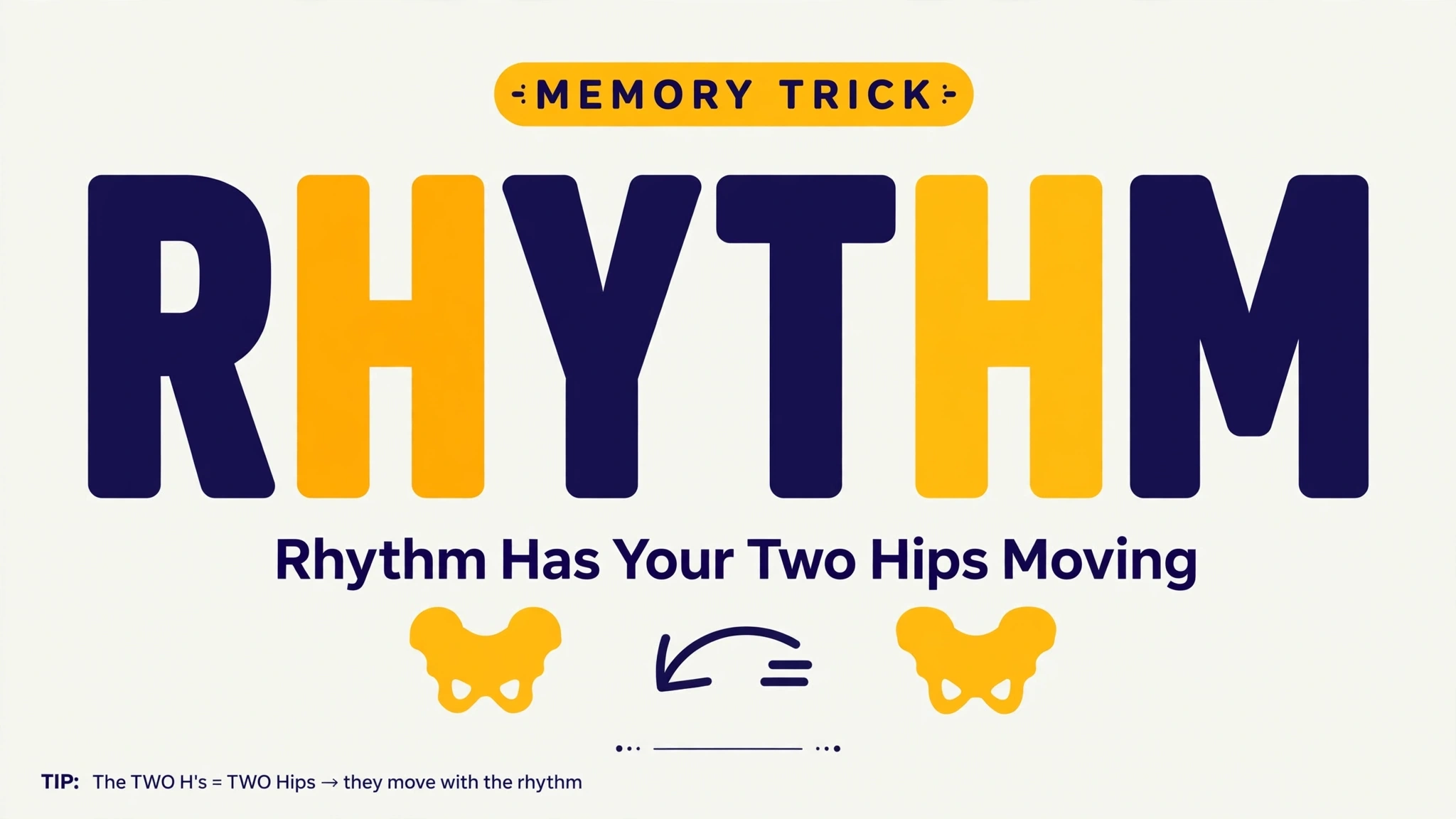
Use the sentence “Rhythm Has Your Two Hips Moving” — its capital letters spell R-H-Y-T-H-M exactly. The two H’s are the whole battle, and the phrase hands them to you in order.
- Two H’s, fixed spots: one right after the R, one right after the T.
- No written vowels: if your spelling contains an A, E, I, O, or U, it’s wrong — the Y covers the vowel sound.
- Ends in -THM: that odd cluster is the word’s fingerprint; “rhythm” is almost the only common English word that ends this way.
- Check the meaning: if the sentence is about a beat or pattern, the word is “rhythm” — “rythm” never means anything.
Frequently Asked Questions
Is it rhythm or rythm?
It’s rhythm. “Rythm” is always a misspelling — no dictionary lists it, and spellcheckers flag it in every context.
Why does rhythm have two H’s?
The word comes from Greek rhythmos (via Latin), and English kept the classical spelling. Both H’s survived centuries of spelling reform, so modern writers just have to memorize their positions.
What is the plural of rhythm?
Rhythms — add a plain S. “The song layers three different rhythms over one bassline.”
Can rhythm be a verb?
Not in standard English. Use the noun (“find your rhythm”) or the adjective rhythmic (“rhythmic clapping”). If you need a verb, “keep time” or “follow the beat” does the job.
Why is rhythm so hard to spell?
Three reasons: it has no written vowel letters, both H’s are nearly silent, and the consonant cluster looks unpronounceable. That combination makes it one of the most misspelled words in English — which is exactly why the memory trick above is worth learning.
Conclusion
Rhythm is the only correct spelling, and rythm is always a mistake. Remember the two H’s with “Rhythm Has Your Two Hips Moving,” and the red underline will never bother you again.