Questionnaire or Questionaire: What’s the Difference?
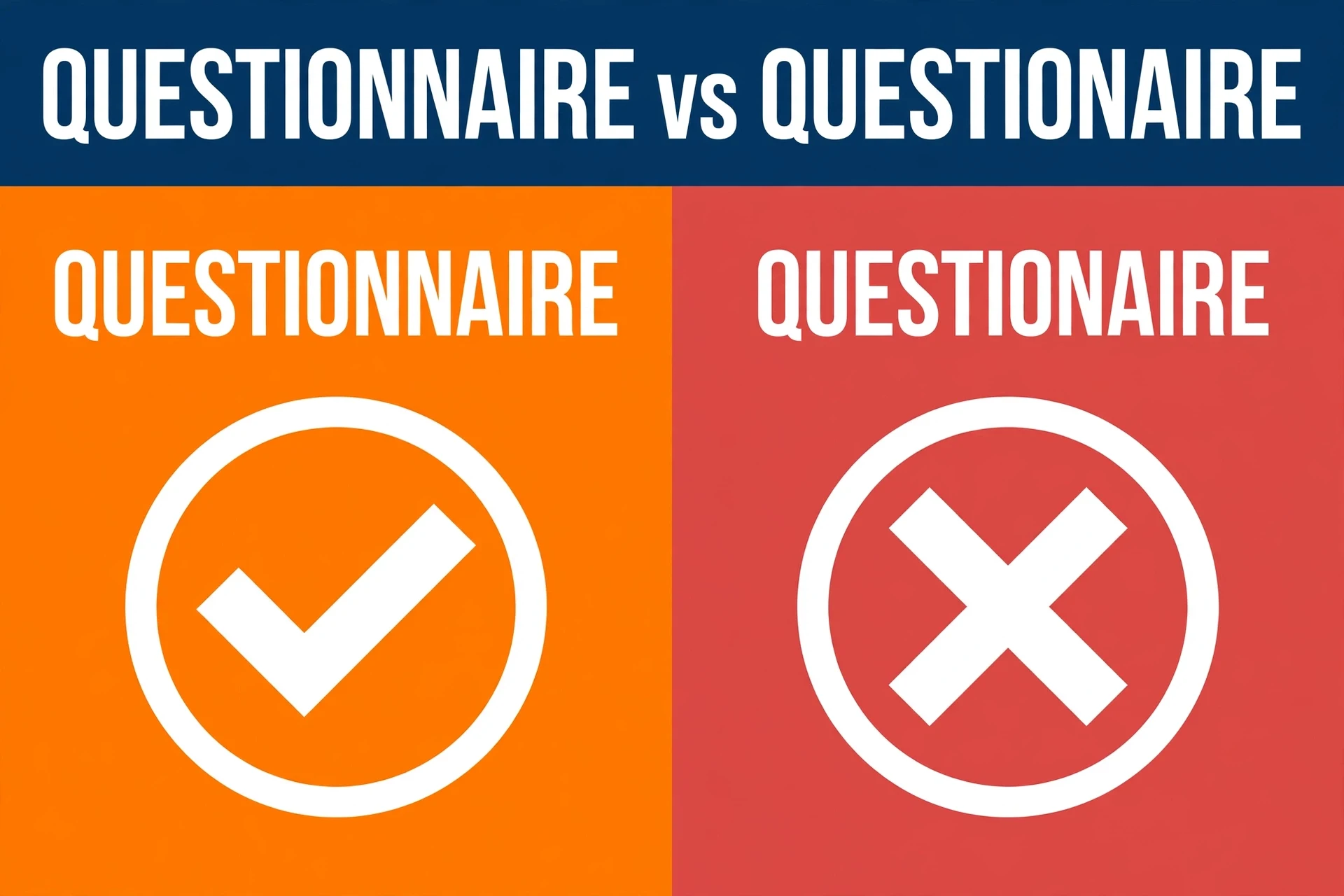
Questionnaire is the correct spelling — a set of written questions used to gather information. Questionaire is a misspelling, missing one of the two N’s that the French original demands. The missing letter is small but decisive: “Please complete the questionnaire before Friday,” while “questionaire” is never correct.
Quick Answer
| Word | Part of Speech | Main Meaning | Example |
|---|---|---|---|
| questionnaire | Noun | A written set of questions used to collect information or opinions | ✅ “She filled out the health questionnaire.” |
| questionaire | Not a word | A misspelling of “questionnaire” | ❌ “She filled out the health questionaire.” |
Simple rule: Questionnaire keeps the French double NN — question-NAIRE, with two N’s, never one.
What Does Questionnaire Mean?
Questionnaire is a noun naming a formal set of written questions given to many people — surveys, intake forms, customer feedback sheets, and exam papers of multiple-choice items. It arrived in English from French in the 1800s, and it kept its French spelling: question + naire, with the double N intact. Merriam-Webster’s entry for “questionnaire” defines it as a set of questions for obtaining statistically useful or personal information from individuals.
Surveys and research
This is the classic use — researchers, pollsters, and companies gathering data from large groups. The word carries a formal tone: a questionnaire is designed, distributed, and analyzed, not just casually asked.
- “The university sent a questionnaire to all recent graduates.”
- “Over 2,000 people completed the customer satisfaction questionnaire.”
- “Researchers designed a short questionnaire about commuting habits.”
- “The election poll used a twenty-question questionnaire.”
- “An anonymous questionnaire revealed widespread concerns about the policy.”
Forms and applications
Doctors’ offices, HR departments, and airlines all hand out questionnaires — structured forms where the questions matter as much as the answers.
- “Please complete the medical questionnaire before your appointment.”
- “The job application included a personality questionnaire.”
- “Travelers filled out a health questionnaire at the airport.”
- “Her therapist asked her to finish a weekly mood questionnaire.”
What Does Questionaire Mean?
Questionaire means nothing — it is “questionnaire” with one N dropped, and no dictionary accepts it. The mistake is natural: English speakers rarely double the N after “question,” and the single-N version sounds identical to the correct one. But every “questionaire” is meant to be questionnaire.
The misspelling is common in emails, school assignments, and workplace forms — always standing in for the real word:
- “Please return the completed questionaire by Monday.” (meant: questionnaire)
- “The questionaire asked about our shopping habits.” (meant: questionnaire)
- “I designed a short questionaire for the class project.” (meant: questionnaire)
- “Her answers on the questionaire were very detailed.” (meant: questionnaire)
- “The HR questionaire took twenty minutes.” (meant: questionnaire)
Because the error changes nothing in pronunciation, it survives proofreading by ear — the fix has to be visual.
Questionnaire vs. Questionaire: Key Differences
| Feature | questionnaire | questionaire |
|---|---|---|
| Status | Correct, standard spelling | Misspelling — not a word |
| Meaning | A written set of questions; a survey form | None (meant as “questionnaire”) |
| The N’s | Double N: question-NAIRE | Single N: the dropped letter |
| Origin | French, borrowed in the 1800s with French spelling | Typo, not an etymology |
| Pronunciation | kwes-chuh-NAIR | Same — pronounced identically |
| Example | ✅ “a feedback questionnaire” | ❌ “a feedback questionaire” |
The French root keeps its double N even in English — drop one and the word is simply wrong.
Questionnaire and Questionaire in Real Sentences
At Home
✅ “The school sent a questionnaire about the lunch menu.”
❌ “The school sent a questionaire about the lunch menu.”
Permission slips and parent surveys bring this word to the kitchen table — parents filling it out in a hurry are prime candidates for the dropped N.
At Work
✅ “HR asked everyone to complete the onboarding questionnaire.”
❌ “HR asked everyone to complete the onboarding questionaire.”
In an office document, “questionaire” reads as sloppy — especially ironic in a form whose entire job is precision.
In Conversation
✅ “Did you get the questionnaire about the new gym hours?”
❌ “Did you get the questionaire about the new gym hours?”
In a text message, the single-N version slips through constantly — autocorrect usually catches it, but not always.
In Research and Writing
✅ “The study’s questionnaire contained both open and closed questions.”
❌ “The study’s questionaire contained both open and closed questions.”
Academic and formal writing is where “questionnaire” appears most often, and where the correct double N matters most.

Common Mistakes
Doubled and dropped letters cause the same slips across the dictionary — the “eightteen” vs “eighteen” spelling trap shows how doubling goes wrong in the other direction, and the “accidently” vs “accidentally” mix-up shows what happens when a word’s doubled letters get thinned. The questionnaire traps:
Mistake 1: Dropping one N
❌ “questionaire”
✅ “questionnaire”
Why: The ear hears one N, and English rarely doubles consonants after “question.” But the word is French — questionnaire — and French keeps the NN. Spell the borrowing, not the sound.
Mistake 2: Splitting it into two words
❌ “question naire” / “question-naire”
✅ “questionnaire”
Why: Long borrowed words tempt writers to break them apart. It is one word in French and one word in English — no space, no hyphen.
Mistake 3: The “questionare” variant
❌ “questionare”
✅ “questionnaire”
Why: Some writers drop an N and an I at once, collapsing “-naire” to “-are.” The ending is -NAIRE with an I before the RE, exactly like the French original.
Mistake 4: Confusing it with “quiz” or “poll”
❌ “The teacher handed out a questionnaire for Friday’s quiz.” (meant: quiz paper)
✅ “The teacher handed out a quiz for Friday’s test.”
Why: A questionnaire collects information from respondents — opinions, habits, data. A quiz tests knowledge. The word carries a research/formal tone; use it where information is being gathered, not where answers are graded.
Pronunciation
Questionnaire is pronounced kwes-chuh-NAIR — stress on the final syllable, with the French-flavored -NAIRE ending. The double N doesn’t change the sound; like “consience” and “conscience,” questionaire would sound identical, which is why the difference is purely a spelling matter.

How to Remember the Difference
Think question-NAIRE: split the word at the hyphen and the answer appears — NAIRE has two N’s, like the word double needs two of nothing. Or use the French link: French words love double letters (think “croissant,” “baguette”), and this French borrowing is no exception.
- The hyphen trick: question-NAIRE — say “naire” and you can hear it needs two N’s to stand up straight.
- The French clue: it came from French in the 1800s and kept French spelling habits — double N included.
- Pair it with “millionaire”: both end in -NAIRE with double N — questionnaire, millionaire.
- Ending check: -NAIRE ends with an I before the RE — never “-are” or “-ere.”
Frequently Asked Questions
Is it questionnaire or questionaire?
It is “questionnaire” — Q-U-E-S-T-I-O-N-N-A-I-R-E, with a double N. “Questionaire” with a single N is a misspelling.
What does “questionnaire” mean?
A written set of questions used to gather information — surveys, intake forms, feedback sheets, and research instruments.
Why does “questionnaire” have two N’s?
It was borrowed from French (questionnaire), and French spelling keeps the double N. English adopted the word with its spelling intact.
Is “questionaire” ever correct?
No. No dictionary lists it, and no regional variant accepts it — it is always a typo for “questionnaire.”
How do you pronounce “questionnaire”?
kwes-chuh-NAIR — stress on the last syllable, rhyming roughly with “millionaire,” which conveniently shares the same -NAIRE ending.
What is the plural of “questionnaire”?
“Questionnaires” — simply add an S. The French plural would be the same, so English follows suit.
Conclusion
Questionnaire is the French-born word for a set of survey questions, double N and all; questionaire is that word with a letter knocked out. Split it as question-NAIRE, and the two N’s will never go missing again.