Eaten or Ate: What’s the Difference? (With Examples)
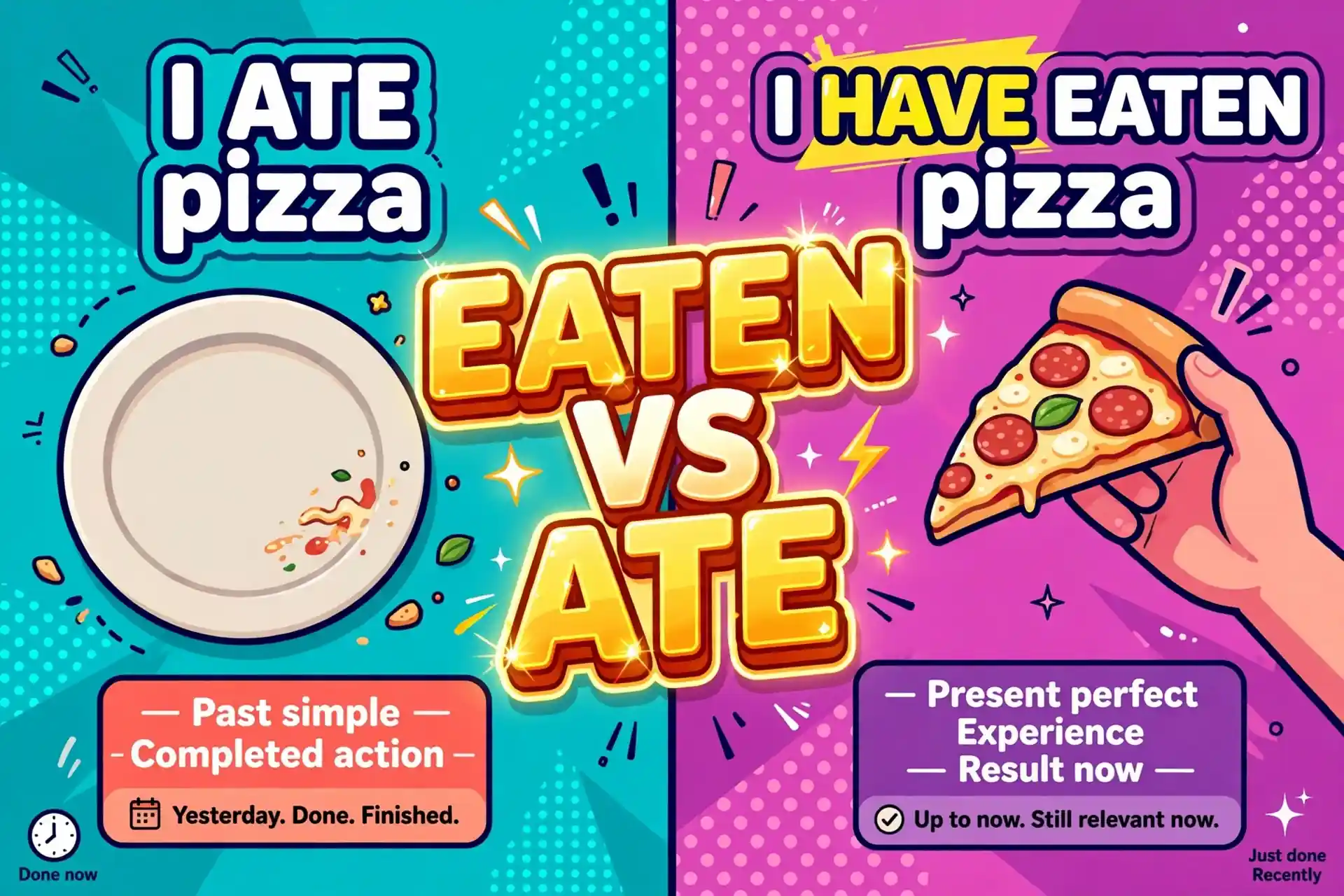
Ate is the simple past tense of eat: “I ate lunch.” Eaten is the past participle, used with helpers like have, has, or had: “I have eaten lunch.” Using one where the other belongs is one of the most common verb errors in English.
For example, “She ate the cake” describes a finished action. “She has eaten the cake” connects that action to the present. The helper verb decides which form you need.
Quick Answer
| Word | Part of Speech | Main Meaning | Example |
|---|---|---|---|
| Ate | Verb (simple past) | Finished action in the past | We ate at noon. |
| Eaten | Verb (past participle) | Used with have/has/had | We have eaten already. |
Simple rule: No helper verb? Use ate. See have, has, or had nearby? Use eaten.
What Does Ate Mean?
Ate is the simple past tense of the irregular verb eat. It describes a completed act of eating at a specific past time, and it stands alone without a helper verb.
Examples:
- I ate breakfast at seven.
- They ate pizza after the game.
- She ate the last cookie and didn’t tell anyone.
- We ate too much at the wedding.
- He ate in silence, thinking about the exam.
- The kids ate all the strawberries.
- We ate early because the show started at seven.
Ate answers “what happened?” — a finished event, full stop.
What Does Eaten Mean?
Eaten is the past participle of eat. It cannot stand alone as the main verb; it must pair with have, has, or had (perfect tenses), or appear in passive constructions.
Eaten in Perfect Tenses
- I have eaten already, thanks.
- She has eaten at that restaurant twice.
- They had eaten before we arrived.
Eaten in Passive Voice
- The cake was eaten in minutes.
- Half the harvest had been eaten by pests.
For the full dictionary entry, see ate on Merriam-Webster.
Eaten vs. Ate: Key Differences
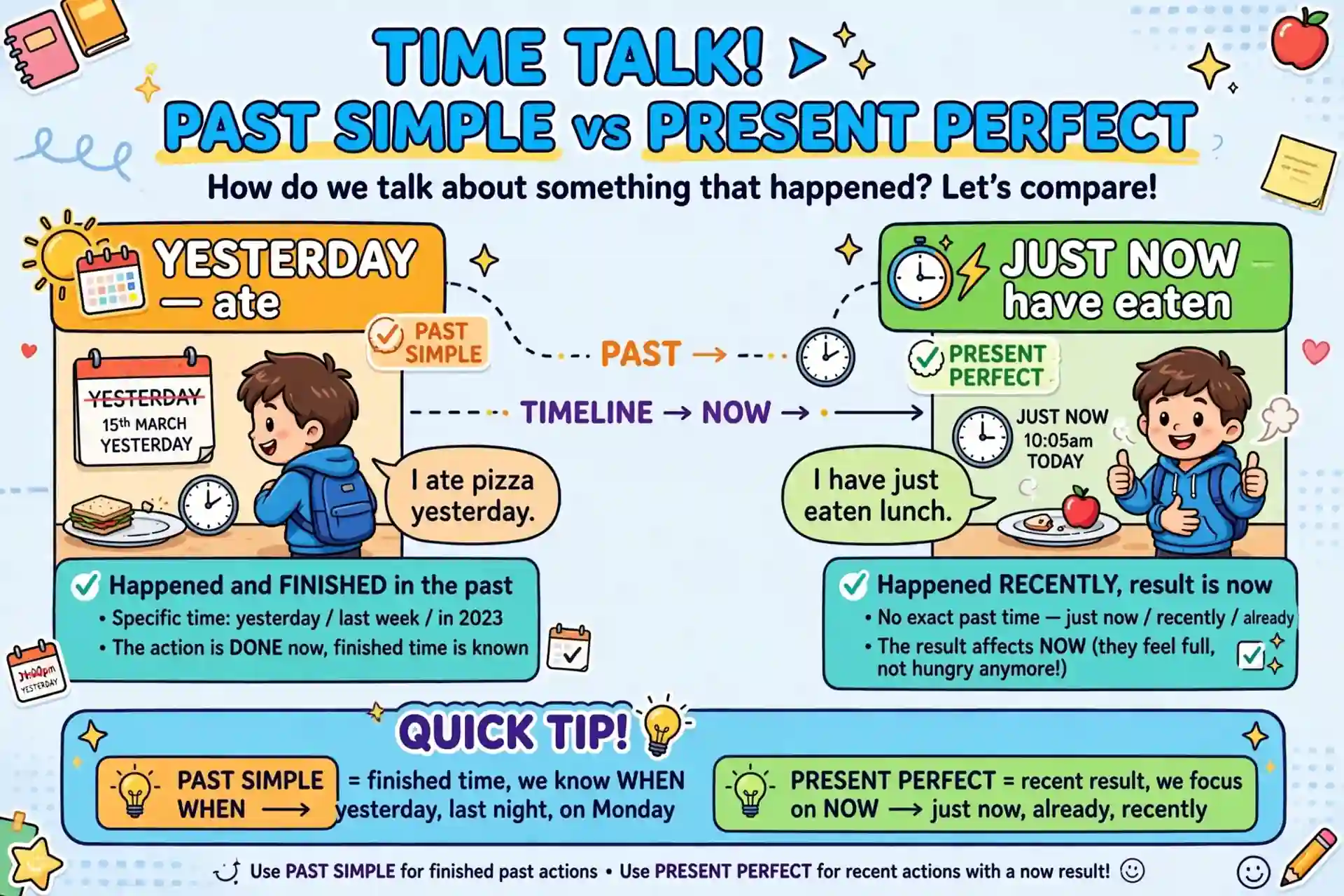
| Feature | Ate | Eaten |
|---|---|---|
| Verb form | Simple past | Past participle |
| Helper needed? | No | Yes (have/has/had) |
| Time feeling | Finished, specific past time | Connected to present or earlier past |
| Example | I ate an apple. | I have eaten an apple. |
English irregular verbs often split this way — the same trap behind verb-form confusions like dieing vs dying. Learn the helper-verb test and the choice becomes mechanical.
Examples of Eaten and Ate in Real Sentences
At Dinner
Ate: “We ate dinner at six and were done by seven.”
Eaten: “We’ve eaten, so we’ll just have coffee.”
The first reports a finished event; the second explains the present situation.
At the Doctor’s Office
Ate: “What did you eat this morning?” the nurse asked.
Eaten: “Have you eaten anything since midnight?” the nurse asked.
Questions about a specific time use ate; questions about experience up to now use have eaten.
Telling a Story
Ate: “The wolf ate the cookies and ran off.”
Eaten: “By the time we got home, the cookies had been eaten.”
The storyteller switches forms as the timeline shifts.
Common Mistakes With Eaten and Ate
Mistake 1: “Have Ate” Instead of “Have Eaten”
❌ I have ate already.
✅ I have eaten already.
Why: After have/has/had, English requires the past participle eaten.
Mistake 2: “Eaten” Standing Alone
❌ I eaten lunch at noon.
✅ I ate lunch at noon.
Why: Without a helper verb, the participle cannot work alone. Use ate.
Mistake 3: “Had Ate” in Past Perfect
❌ They had ate before the meeting.
✅ They had eaten before the meeting.
Why: Past perfect is had + past participle — always eaten.
Pronunciation: Eaten vs. Ate
Ate is pronounced /eɪt/, rhyming with late and date. Eaten is pronounced /ˈiːtən/, rhyming with beaten.
These two sound clearly different, unlike many easily confused everyday words — the challenge here is grammar, not sound.
How to Remember the Difference
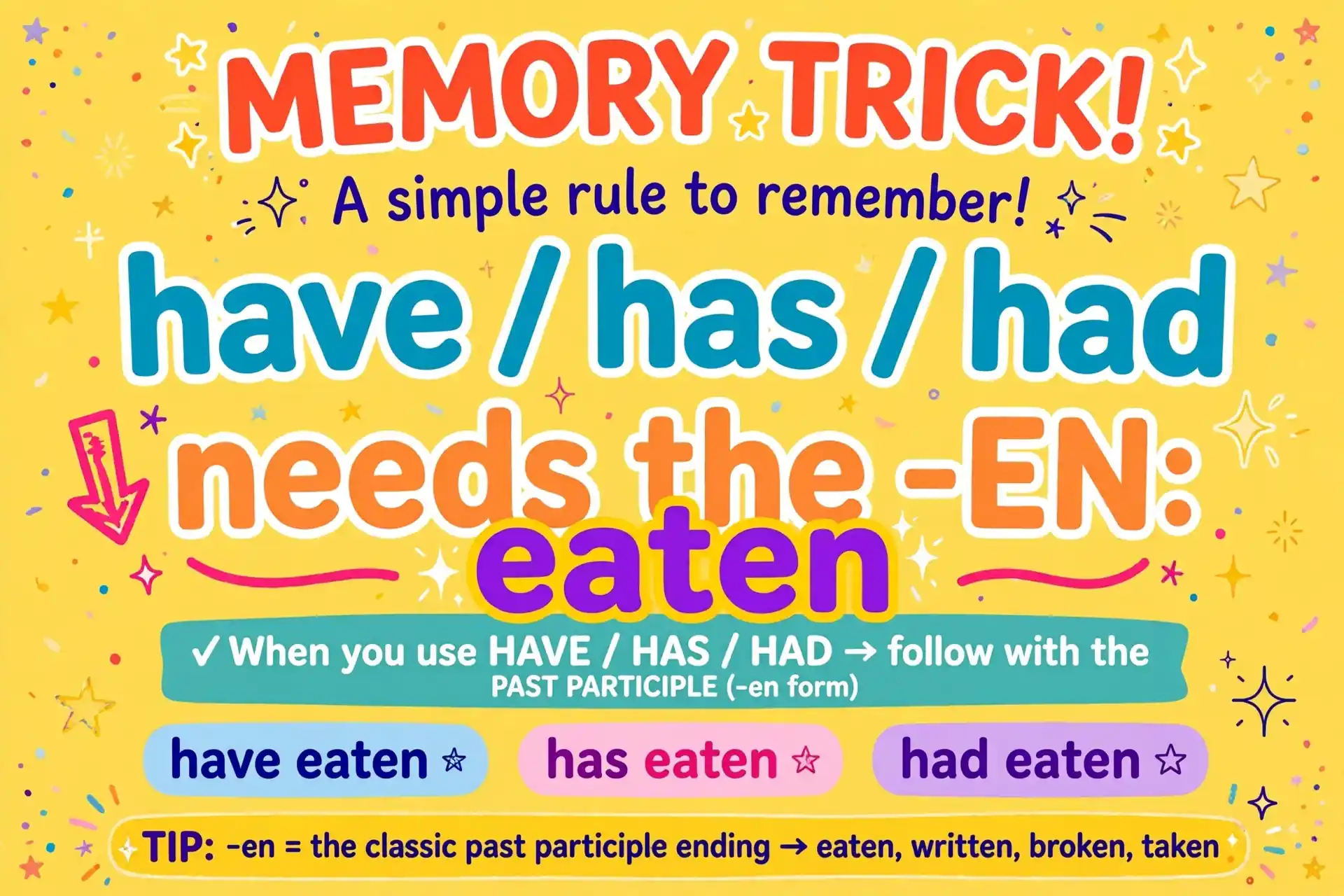
Memory trick: Have/has/had needs the -en: eatEN. The en at the end of eaten is the clue.
- No helper → ate (“I ate”).
- Have/has/had → eaten (“I have eaten”).
- Passive (was/were + verb) → eaten (“was eaten”).
Spot the helper first; the form follows automatically.
Frequently Asked Questions
Is it eaten or ate?
Use ate for a simple finished past action (“I ate”). Use eaten with have/has/had (“I have eaten”) or in passives (“was eaten”).
Is “I have ate” ever correct?
No. In standard English, have always pairs with the participle: “I have eaten.” “I have ate” appears in some dialects but is considered nonstandard.
What is the past participle of eat?
Eaten. The three principal parts are: eat (base), ate (past), eaten (participle).
Can “eaten” be an adjective?
Yes, in phrases like “half-eaten sandwich.” Here it describes the noun, but it still comes from the participle form.
Why is “eat” irregular?
Eat is an old Germanic strong verb that changes its vowel instead of adding -ed (eat/ate/eaten, like beat/beat/beaten). These patterns predate modern regular verbs.
Is “had ate” ever correct?
No. Standard English requires the participle after had: “had eaten.” “Had ate” appears in some regional speech but is considered nonstandard in writing.
Conclusion
Ate stands alone for finished past actions; eaten teams up with have/has/had or appears in passives. Check for the helper verb first, and you will never mix them up again. Once you spot the helper, the choice makes itself: no helper means ate; have, has, or had means eaten.