Unphased or Unfazed
If you want to say someone stayed calm under pressure, the word you want is unfazed — not disturbed or disconcerted. Unphased looks like it should mean the same thing, and the trap is understandable: “phased” really is a word (a phased rollout happens in stages). But “unphased” never means calm or unbothered. Every time you mean “not shaken,” spell it with an f.
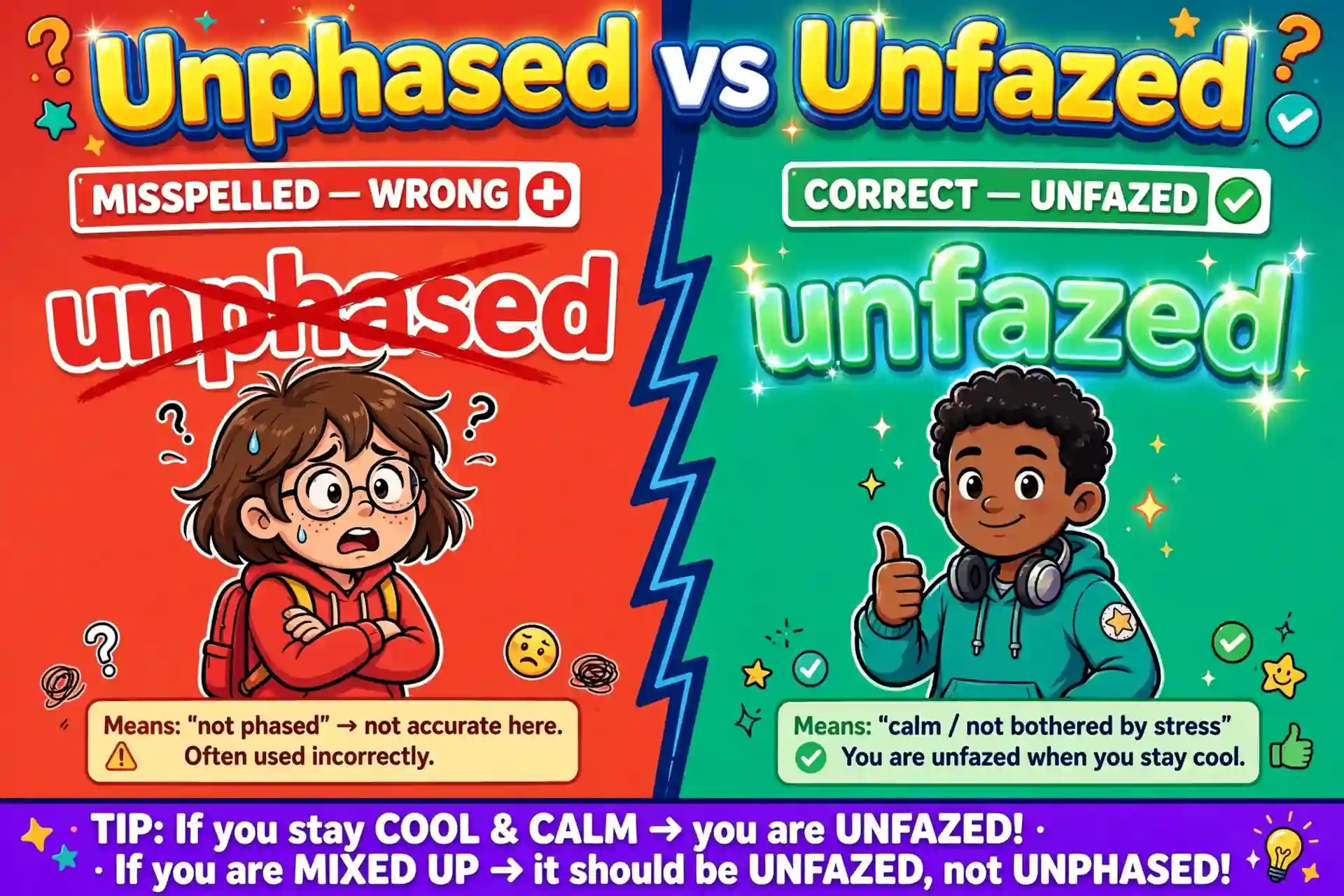
Quick Answer
| Word | Part of Speech | Main Meaning | Example |
|---|---|---|---|
| unfazed | Adjective | Not disturbed, disconcerted, or shaken | “She stayed unfazed by the heckler.” |
| unphased | — | Not a standard word; a misspelling of unfazed | ❌ “He seemed unphased by the delay.” |
Simple rule: calm and unbothered is always unfazed — with an f, because it comes from faze.
What Does Unfazed Mean?
Unfazed means not bothered, disturbed, or thrown off by something — calm and steady in a situation that might rattle other people. It is built from the verb faze (to disturb or disconcert) plus the negative prefix un-: if something can faze you, you can also remain unfazed by it. See the full definition in the Merriam-Webster entry for unfazed.
Examples:
- The goalkeeper remained unfazed as the crowd roared.
- She was completely unfazed by the tough questions.
- Despite the flight delay, the kids were unfazed.
- He seemed unfazed by the bad reviews and kept posting.
- Years of night shifts had left her unfazed by emergencies.
What Does Unphased Mean?
Unphased is not an accepted English word in the sense of “calm” or “unbothered.” It is the spelling people reach for by mistake when they hear “unfazed” and assume it relates to phase. The confusion is easy to see: phased is a real word — “a phased reopening” means one carried out in stages — so “unphased” looks plausible. But dictionaries do not recognize it as a synonym of unfazed, and editors will flag it as an error.
What writers usually mean:
- ❌ “He was totally unphased by the criticism.” → ✅ “He was totally unfazed by the criticism.”
- ❌ “She stayed unphased throughout the storm.” → ✅ “She stayed unfazed throughout the storm.”
- The one legitimate use of “phased” is in stages: “The vaccine rollout was phased by age group.”
- A “phased” schedule means planned in steps — it says nothing about anyone’s nerves.
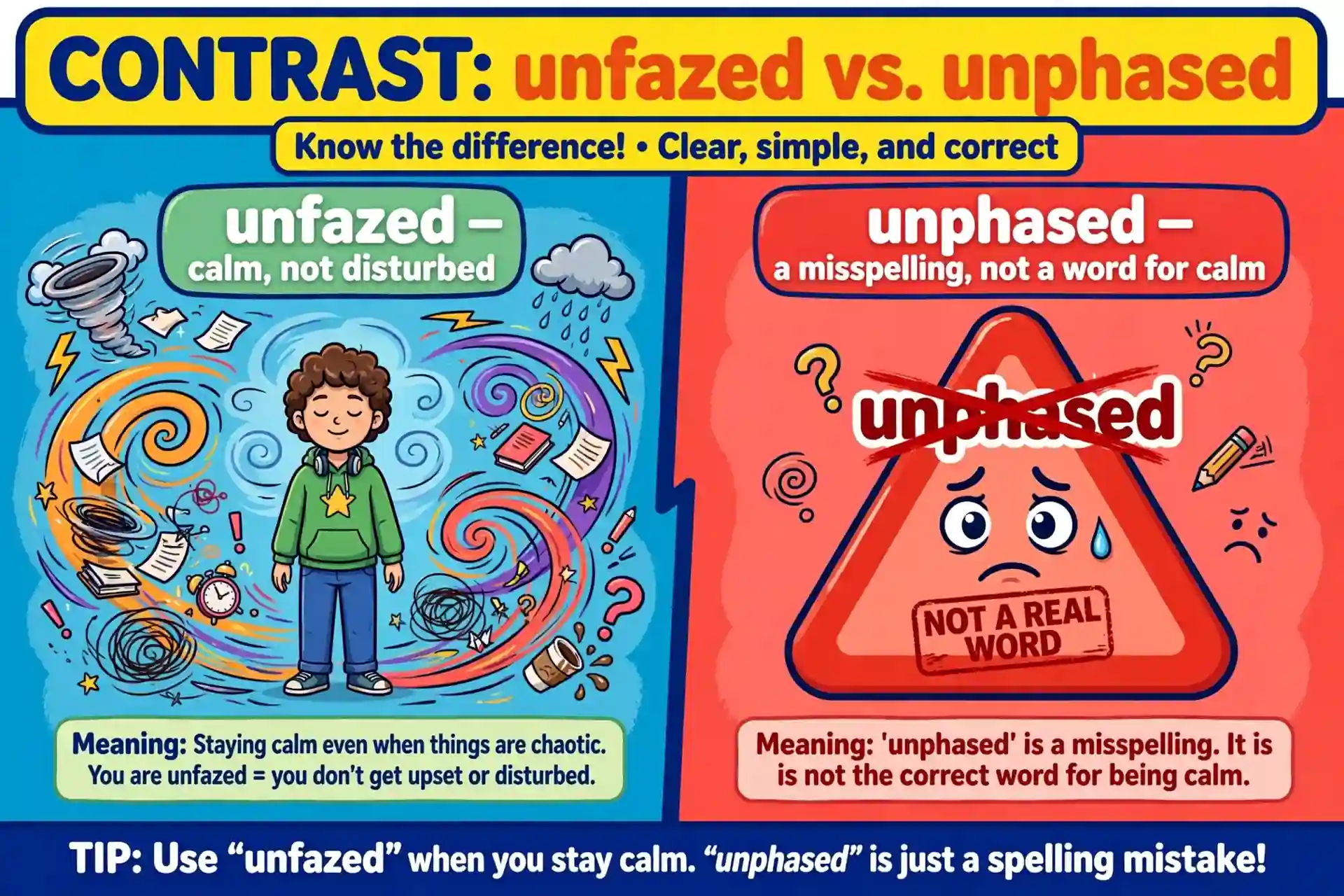
Unphased vs. Unfazed: Key Differences
| Feature | unphased | unfazed |
|---|---|---|
| Word status | Not a standard word (for “calm”) | Standard adjective |
| Meaning | — (misspelling when “unbothered” is meant) | Not disturbed or disconcerted |
| Root word | phase (a stage) | faze (to disturb) |
| Spelling | p-h | f |
| Typical context | A typo in drafts and comments | Describing composure under pressure |
| Example | ❌ “unphased by the news” | ✅ “unfazed by the news” |
The mix-up survives because “phased” is a real word about stages — but stages have nothing to do with staying calm, and that is why the ph spelling is always wrong here.
Unphased and Unfazed in Real Sentences
At Home
Unphased: ❌ “Mom was unphased by the broken vase.”
unfazed: ✅ “Mom was unfazed by the broken vase — she just grabbed the dustpan.”
Nothing was done “in stages” at home; she simply was not rattled.
At Work
Unphased: ❌ “The team lead seemed unphased by the deadline change.”
unfazed: ✅ “The team lead seemed unfazed by the deadline change and reprioritized calmly.”
Composure at work comes from the verb faze, not the noun phase.
In Conversation
Unphased: ❌ “I was unphased when he hung up.”
unfazed: ✅ “I was unfazed when he hung up — I just called back.”
If someone’s nerves were not shaken, unfazed is the only correct spelling.
Common Mistakes
This is one of the most common “sounds right, spells wrong” errors in English, in the same family as dieing or dying and cancelled or canceled. Here is how to catch it:
Mistake 1: Writing “unphased” for calm
❌ “She was completely unphased by the power outage.”
✅ “She was completely unfazed by the power outage.”
Why: unfazed (from faze) means not disturbed; “unphased” is not a word in this sense.
Mistake 2: Trusting the “phased” logic
❌ “A phased rollout means done in stages, so unphased must mean not in stages — like calm.”
✅ “A phased rollout means done in stages; calm is still unfazed.”
Why: “phased” is a real word about stages, but bolting un- onto it does not create a word for composure.
Mistake 3: Mixing up faze and phase in the root
❌ “Nothing could phase her.” (meaning nothing could rattle her)
✅ “Nothing could faze her.”
Why: faze (with an f) means to disturb; phase (with ph) means a stage. Get the root right and unfazed follows naturally.
Mistake 4: Letting autocorrect decide
❌ Typing “unfased” and accepting the suggestion “unphased.”
✅ Type unfazed carefully and double-check the f.
Why: spellcheckers often suggest the wrong fix for this one because “unphased” looks like a plausible word — your own memory of the root faze is the better check.
Pronunciation
Unfazed is pronounced /ʌnˈfeɪzd/ — “un-FAYZD.” It rhymes with “amazed” and “unfazed” is often paired with it in speech: “amazed but unfazed.” Note the z sound at the end, which comes from faze. Since “unphased” is not a word you should be saying, there is no correct pronunciation for it in this sense — but people who write it are usually pronouncing it the same way, which is exactly the problem.
How to Remember the Difference
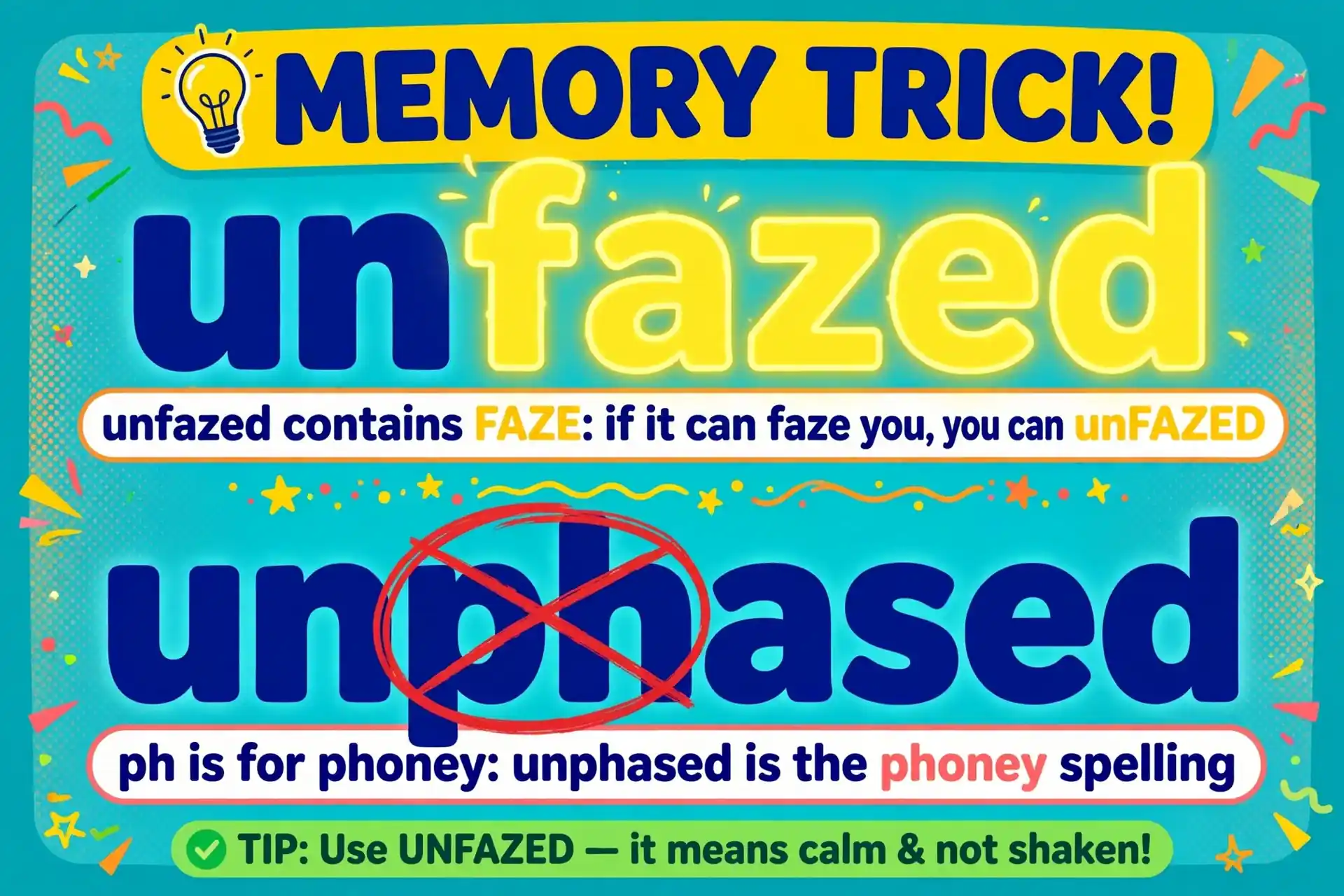
Unfazed contains faze — if something can faze you, you can be unfazed by it. The f stands for “firm nerves.” Unphased has ph, like “phoney” — it is a phoney spelling whenever you mean calm.
- unfazed = not bothered (built on faze, with an f)
- phased = done in stages (a real word, but a different one)
- unphased = not a word for “calm” — do not use it that way
Frequently Asked Questions
Is it unphased or unfazed?
Unfazed. When you mean calm, unbothered, or not shaken, the correct spelling is u-n-f-a-z-e-d. “Unphased” is a misspelling in that meaning.
Is unphased ever correct?
Essentially no. “Phased” is a real word meaning arranged in stages (“a phased return to the office”), but “unphased” is not recognized by dictionaries as a word meaning “calm” or “unbothered.” Use unfazed.
What does “faze” mean?
Faze is a verb meaning to disturb, disconcert, or daunt: “The boos didn’t faze her.” Unfazed is its negated adjective form — not fazed.
What is the difference between phase and faze?
Phase (with ph) is a noun meaning a stage: “the first phase of the project.” Faze (with f) is a verb meaning to rattle: “Nothing fazes him.” This root confusion is the entire reason “unphased” gets written.
Can I use “unfazed” in formal writing?
Yes. Unfazed is standard in both formal and informal English: “The committee remained unfazed by the objections.”
Conclusion
There is no contest here: unfazed is the correct word for calm and unbothered, built on the verb faze. Unphased is a misspelling born from the real word “phased” (done in stages), which has nothing to do with composure. Remember the f in faze, and you will spell it right every time.