Indica or Sativa: What Is the Difference?
Indica and sativa are two commonly used labels for cannabis plants. They traditionally describe differences in plant shape, growth patterns, and origins. In everyday cannabis discussions, people also use them to describe expected effects. However, research shows that these labels do not reliably predict how a cannabis product will affect someone.
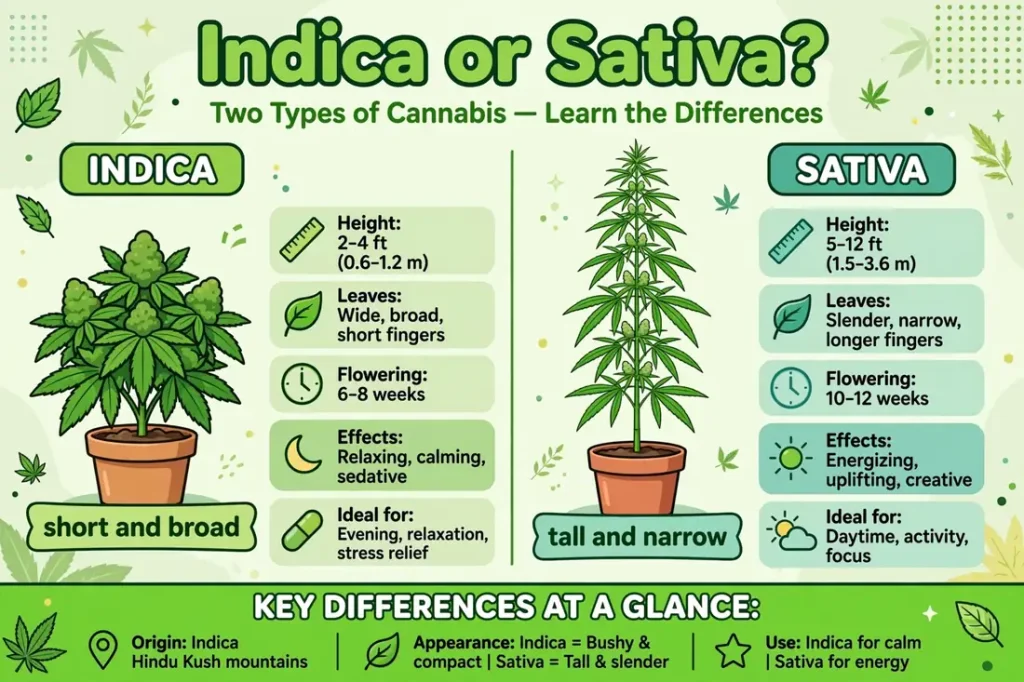
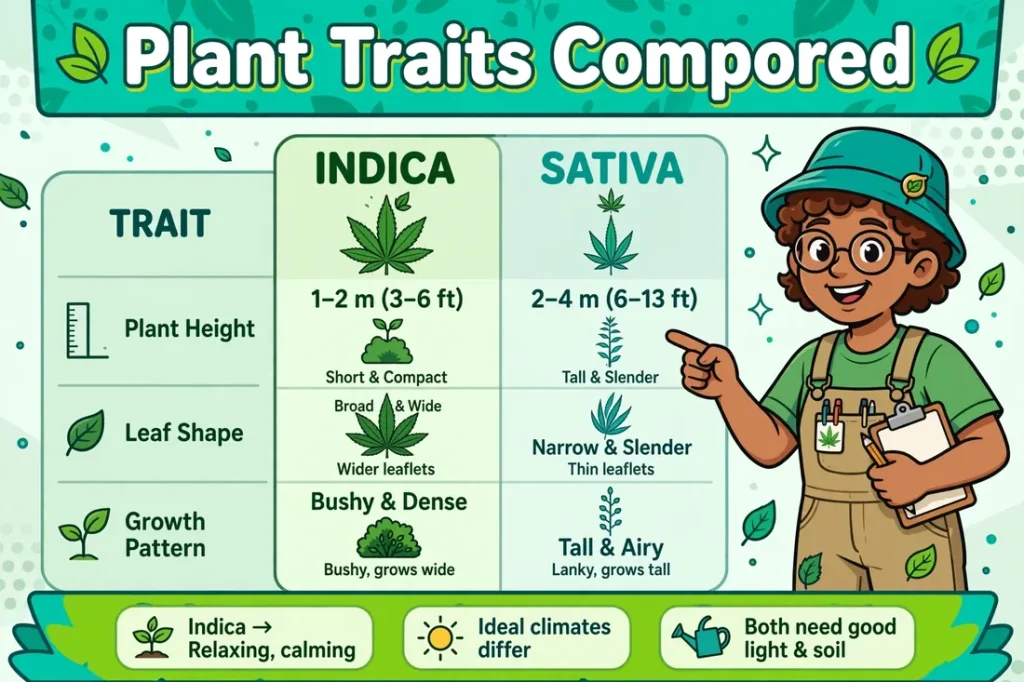
The main difference is that indica plants are traditionally described as shorter and broader, while sativa plants are taller and narrower. Modern cannabis products often
come from hybrid plants, so the distinction is not always clear.
Quick Answer: Indica or Sativa?
Indica and sativa are both terms associated with cannabis. Indica traditionally describes shorter plants with broader leaves. Sativa traditionally describes taller plants with narrower leaves.
People often associate indica with relaxing effects and sativa with energizing effects. These descriptions are common, but they are not reliable scientific rules. A product’s chemical composition, including its THC, CBD, and terpene content, may provide more useful information than its indica or sativa label.
Quick Facts About Indica and Sativa
|
Feature |
Indica |
Sativa |
|
Traditional plant shape |
Shorter and bushier |
Taller and more slender |
|
Leaf shape |
Broader leaflets |
Narrower leaflets |
|
Traditional origin associations |
Central and South Asia |
South Asia and other regions |
|
Common consumer description |
Relaxing or calming |
Uplifting or energizing |
|
Scientific reliability of effect labels |
Limited |
Limited |
|
Modern commercial products |
Often hybridized |
Often hybridized |
|
Main distinction |
Traditional botanical and commercial label |
Traditional botanical and commercial label |
These descriptions reflect common classifications. They do not guarantee a particular product’s chemical profile or effects.
What Is Indica?
Indica is a term used to describe certain types of cannabis. In traditional botanical descriptions, indica plants tend to be shorter, bushier, and broader-leaved than sativa plants.
The term also appears on commercial cannabis products. Retailers and consumers often use it to describe products associated with relaxation or physical calm.
However, the word has different meanings in botanical and commercial contexts. A product labeled indica does not necessarily have one fixed chemical composition.
Traditional Characteristics of Indica Plants
Indica plants are commonly described through their physical features.
These include:
These features help explain the traditional distinction. They do not establish how a finished cannabis product will affect a person.
What Does Indica Mean in Everyday Cannabis Language?
In commercial settings, indica often refers to a product marketed as calming or relaxing. Some consumers associate it with nighttime use.
These associations come largely from consumer descriptions and industry conventions. They should not be treated as guaranteed effects.
Cannabis products can vary considerably in their chemical composition. Two products carrying the same indica label may contain different amounts of THC, CBD, and other compounds.
What Is Sativa?
Sativa is another term used to describe cannabis plants. Traditional descriptions characterize sativa plants as taller and more slender, with narrower leaflets.
In commercial cannabis language, sativa is often associated with uplifting or energizing effects. Some consumers connect the label with alertness or creativity.
These descriptions are not dependable predictions. The label alone cannot establish how a particular product will affect someone.
Traditional Characteristics of Sativa Plants
Sativa plants are commonly described as having these features:
Actual plant characteristics depend on genetics, growing conditions, and hybridization. A plant may not match every traditional description.
What Does Sativa Mean in Everyday Cannabis Language?
In the cannabis market, sativa often describes products marketed as uplifting or stimulating.
Some consumers use the term to distinguish these products from those labeled indica. However, the distinction is not a reliable scientific measure of mood, energy, or other effects.
A sativa label does not mean a product will always feel energizing. Individual responses can vary, and the product’s chemical profile matters.
Indica vs. Sativa: Key Differences
The traditional difference between indica and sativa concerns plant characteristics. Modern commercial use also connects these labels with expected effects.
It is important to separate these two meanings. Physical plant descriptions are not the same as evidence about a product’s effects.
Physical Differences
Indica plants are traditionally described as shorter and broader. Sativa plants are traditionally described as taller and narrower.
These descriptions can help explain the terms. However, modern breeding has produced many plants with mixed characteristics.
Differences in Expected Effects
Commercial descriptions often present indica as relaxing and sativa as energizing. These are broad consumer associations rather than dependable scientific conclusions.
Research on commercial cannabis products has found that common labels do not consistently match their chemical composition. This makes it difficult to predict effects from the label alone.
Differences in Chemical Composition
Cannabis contains many chemical compounds. Two important groups are cannabinoids and terpenes.
THC, or tetrahydrocannabinol, is the main intoxicating compound in cannabis. CBD, or cannabidiol, is another cannabinoid that does not produce the same intoxicating effect as THC.
Terpenes are compounds that contribute to a plant’s aroma and may interact with other cannabis compounds. Their effects in people are still being studied.
A product’s measured chemical profile can offer more specific information than a broad indica or sativa label.
Indica vs. Sativa vs. Hybrid
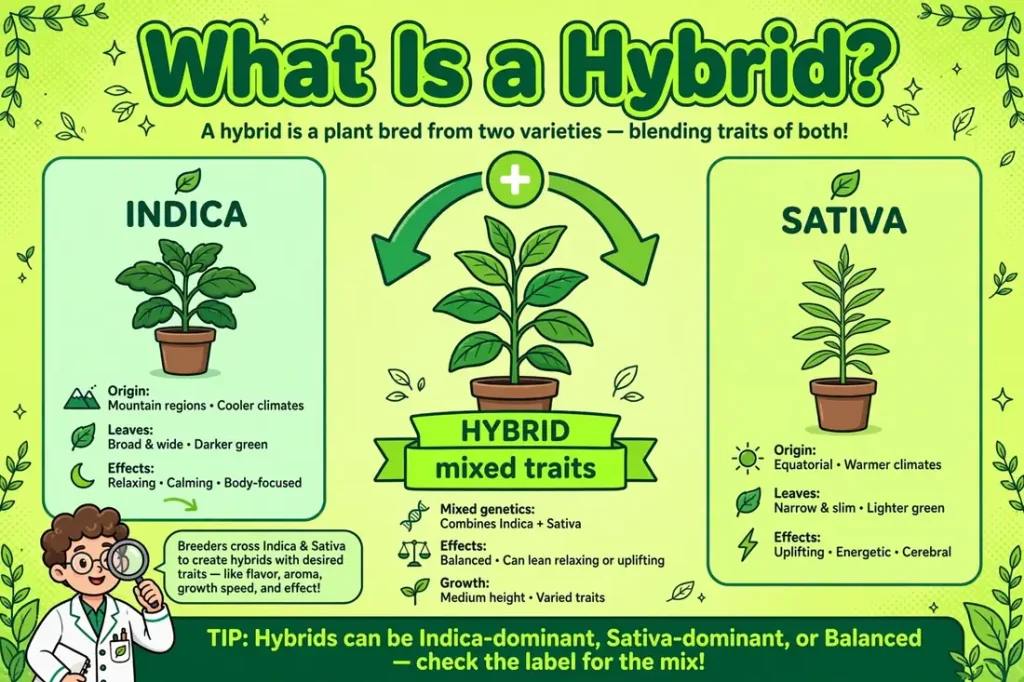
A hybrid is a cannabis plant developed from parent plants with different genetic backgrounds. Many modern commercial products are described as hybrids.
The term may indicate that a product has ancestry associated with both traditional categories. It does not reveal the exact balance of its genetics or chemical compounds.
|
Label |
Common description |
Important limitation |
|
Indica |
Traditionally shorter, broader plants; often marketed as relaxing |
The label does not guarantee effects |
|
Sativa |
Traditionally taller, narrower plants; often marketed as energizing |
The label does not guarantee effects |
|
Hybrid |
Plants with mixed genetic backgrounds |
The label does not reveal exact chemistry |
Some products are marketed as indica-dominant or sativa-dominant hybrids. These terms describe commercial classifications, not precise measurements of effects.
Why Do People Associate Indica With Relaxation and Sativa With Energy?
The association between indica and relaxation, and sativa and energy, is common in cannabis marketing and consumer conversations.
It developed as people used the labels to describe different plant types and reported experiences. Over time, these descriptions became familiar shortcuts.
However, a familiar description is not the same as a proven biological rule.
Individual Responses Can Differ
People may respond differently to the same cannabis product. Factors such as THC concentration, other compounds, personal sensitivity, and previous exposure can affect the experience.
The same person may also respond differently under different circumstances.
Labels Do Not Fully Describe a Product
A product labeled indica may have a chemical profile similar to one labeled sativa. Commercial labels do not always correspond closely to measured cannabinoid and terpene levels.
This is one reason researchers question whether the traditional categories can predict effects reliably.
Marketing Can Reinforce Simple Categories
The cannabis market often uses easy-to-understand labels. Indica, sativa, and hybrid provide a familiar way to group products.
But simple categories can hide meaningful differences between individual products. A label should not replace detailed product information.
What Matters More Than the Indica or Sativa Label?
The label alone provides limited information. A product’s chemical composition and verified testing details may provide a clearer description.
THC Content
THC is the primary intoxicating compound in cannabis. Its concentration is relevant when assessing a product’s potential intoxicating effects.
A higher THC concentration does not automatically mean a product will produce a particular emotional or physical response. Individual reactions vary.
CBD Content
CBD is a cannabinoid that does not produce the same intoxicating effect as THC. Its amount can differ widely between cannabis products.
The ratio of THC to CBD may be more informative than the indica or sativa label. However, it still cannot predict every individual response.
Terpene Profile
Terpenes contribute to cannabis aroma and flavor. Different products can contain different terpene profiles.
Researchers continue to study how terpenes interact with cannabinoids and affect human experiences. Current evidence does not support using a terpene name as a guarantee of a specific effect.
Independent Testing
Where cannabis products are legally sold, laboratory testing may provide information about cannabinoid levels and other product characteristics.
Testing standards and labeling requirements vary by jurisdiction. Consumers should not assume that every product has the same testing or disclosure requirements.
Are Indica and Sativa Scientifically Different?
The answer depends on how the terms are being used.
In botanical classification, researchers have studied differences among cannabis populations. Some classifications recognize distinct groups or varieties based on genetics, physical traits, and chemical characteristics.
In everyday commercial language, however, indica and sativa often refer to broad product categories. These categories do not consistently match the chemical profiles of modern products.
Botanical Classification vs. Commercial Labels
Botanical classification examines plant relationships and characteristics. Commercial labels are often designed to help consumers recognize product categories.
The two systems are not interchangeable.
For example, the scientific name Cannabis sativa does not mean that every plant marketed as sativa belongs to one clearly defined commercial group. Scientific naming and retail terminology follow different conventions.
Why Modern Cannabis Is Difficult to Classify
Cannabis plants have been crossbred for many generations. Hybridization has blurred some traditional differences.
Researchers studying commercial cannabis samples have found that indica, sativa, and hybrid labels do not consistently align with measured chemical profiles.
This does not mean the plants have no genetic or physical differences. It means common market labels can be too broad to describe those differences accurately.
Examples of How Indica and Sativa Are Used
The words appear in different contexts. The following examples show how people commonly use them.
Example 1: Discussing a Product Label
“The package describes the product as indica.”
Here, indica identifies the commercial category printed on the package. It does not prove the product will produce a specific effect.
Example 2: Comparing Two Products
“The retailer uses sativa and indica labels to separate its products.”
The sentence describes a retail classification. It does not establish a scientific distinction between the products.
Example 3: Discussing Plant Appearance
“The plant has broad leaves and a compact shape, features traditionally associated with indica.”
This sentence refers to physical characteristics rather than a guaranteed effect.
Example 4: Explaining Scientific Uncertainty
“Researchers have questioned whether indica and sativa labels accurately predict the chemical composition of modern cannabis products.”
This sentence distinguishes common terminology from scientific measurement.
Common Misconceptions About Indica and Sativa
Several popular claims oversimplify the distinction.
Misconception 1: Indica Always Makes You Sleepy
Indica is often marketed as relaxing. However, the label does not guarantee sleepiness or sedation.
The product’s chemical profile and individual response can differ.
Misconception 2: Sativa Always Gives You Energy
Sativa is commonly associated with uplifting effects. That association is not a reliable prediction for every product or person.
Misconception 3: Indica and Sativa Have Completely Separate Chemical Profiles
Modern cannabis products often have mixed genetic backgrounds. Their chemical profiles can overlap.
A label alone cannot establish the amount of THC, CBD, or terpenes.
Misconception 4: Hybrid Means an Exact 50/50 Mix
Hybrid does not necessarily mean equal genetic contributions. It is a broad term for mixed ancestry.
The label also does not reveal a product’s exact chemical composition.
Misconception 5: The Scientific Name and Retail Label Mean the Same Thing
Scientific plant names and commercial cannabis categories are different systems. The word sativa in a scientific name does not automatically match the retail meaning of “sativa.”
Is Indica or Sativa Better?
Neither label is universally better. They describe broad categories, and their meanings depend on context.
If the question concerns plant appearance, traditional descriptions can help explain the difference. If it concerns expected effects, the labels are not reliable enough to provide a definite answer.
Cannabis can carry health risks, including impairment and adverse mental or physical effects. THC-containing products can affect attention, memory, coordination, and judgment. Laws also vary by location.
People should not use indica or sativa labels as medical guidance. Anyone considering cannabis for a health concern should discuss the issue with a qualified healthcare professional.
How to Remember the Difference
A simple way to remember the traditional descriptions is:
You can also remember the common consumer associations:
Treat these associations as marketing shorthand, not guaranteed effects.
Frequently Asked Questions
Is indica or sativa more relaxing?
Indica is commonly marketed as relaxing, but the label does not guarantee that response. Product chemistry and individual differences can influence the experience.
Is sativa an upper or a downer?
Sativa is often described as an upper because of its association with energizing effects. This is a common consumer description, not a dependable scientific classification.
What is the main difference between indica and sativa?
Traditionally, indica plants are described as shorter and broader, while sativa plants are taller and narrower. Modern commercial labels do not consistently predict chemical composition or effects.
Are indica and sativa both cannabis?
Yes. Both terms refer to cannabis classifications. Their exact meaning depends on whether someone is discussing botanical taxonomy or commercial product labels.
What does hybrid mean in cannabis?
Hybrid describes cannabis plants with mixed genetic backgrounds. Many modern commercial products are hybrids, and the term does not indicate an exact genetic or chemical balance.
Can indica and sativa labels predict how a product will affect someone?
Not reliably. The labels are broad categories and do not provide a complete chemical profile. Individual responses can also vary.
Conclusion
Indica and sativa are traditional cannabis classifications with differences in plant appearance and historical associations. Indica is commonly described as shorter and broader, while sativa is described as taller and narrower.
In modern cannabis markets, the labels also suggest different expected effects. However, research shows that these categories do not consistently match product chemistry or predict individual experiences. Understanding the limits of these labels provides a more accurate view of the difference between indica and sativa.