Complement or Compliment: What’s the Difference?
Complement with an E means something that completes or pairs perfectly with something else — “the wine complements the meal.” Compliment with an I is an expression of praise — “she complimented my cooking.” Both are real words, both can be nouns or verbs, and mixing them up is one of English’s most common errors.
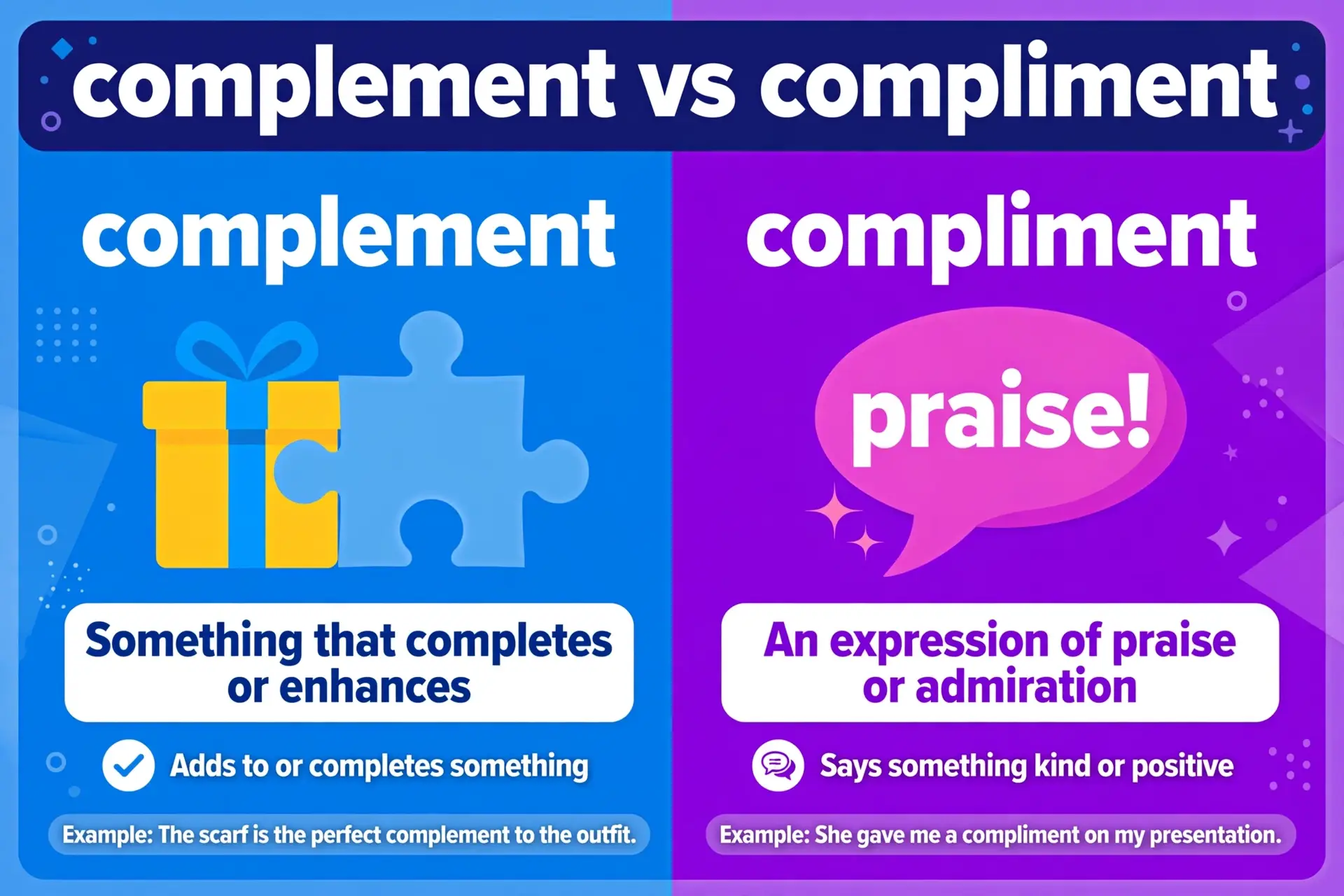
Quick Answer
| Word | Part of Speech | Main Meaning | Example |
|---|---|---|---|
| Complement | Noun / verb | Something that completes or goes well with another thing | ✅ “The scarf complements her coat.” |
| Compliment | Noun / verb | Praise or admiration expressed to someone | ✅ “He complimented her presentation.” |
Simple rule: Complement with an E completes something; compliment with an I is what “I” say when I praise you.
What Does Complement Mean?
Complement (with an E) is about completion and pairing. As a noun, it is something that fills out or perfects another thing — a full complement of staff, a ship’s complement of sailors, or colors that complement each other. As a verb, it means to go well with or enhance: “the sauce complements the fish.” Merriam-Webster’s entry for “complement” covers these senses, from grammar’s subject complements to the everyday “goes well with” meaning.
Examples:
- “A glass of red wine complements the steak perfectly.”
- “Her calm temperament complements his energetic style.”
- “The hotel hired a full complement of lifeguards for the summer.”
- “Blue and orange are complementary colors on the wheel.”
- “The new wing complements the historic building’s architecture.”
In grammar, “complement” has a technical life too — a subject complement (“she is a doctor”) completes the meaning of the verb — but in daily use it almost always means “pairs well with.”
What Does Compliment Mean?
Compliment (with an I) is about praise. As a noun, it is a flattering remark — “she paid him a compliment.” As a verb, it means to express admiration: “they complimented the chef.” The fixed phrases give it away: “a backhanded compliment,” “fishing for compliments,” “compliments of the house” (the free dessert the restaurant sends over).
Examples:
- “She complimented him on his sharp suit.”
- “Thank you for the compliment — I love this dress too.”
- “The dessert arrived with the compliments of the chef.”
- “He took her criticism as a backhanded compliment.”
- “Strangers kept complimenting the baby’s bright blue eyes.”
Notice the pattern: “compliment” always involves words spoken (or written) to make someone feel good — if nobody is being praised, it is not a compliment.
Complement vs. Compliment: Key Differences
| Feature | Complement | Compliment |
|---|---|---|
| Key letter | E (like “complete”) | I (like “I praise”) |
| Core idea | Completing, pairing, enhancing | Praising, flattering |
| As a noun | A completing part or perfect match | A flattering remark |
| As a verb | To go well with | To praise |
| Involves people? | Usually things pairing with things | Always someone being praised |
| Example | ✅ “The tie complements the shirt.” | ✅ “She complimented his tie.” |
One completes the outfit; the other praises the person wearing it.
Complement and Compliment in Real Sentences
At Home
✅ “These curtains complement the sofa beautifully.”
✅ “He complimented her on the redecorated living room.”
The curtains complete the room’s look; his words complete her evening.
At Work
✅ “Her data skills complement his design eye — a strong team.”
✅ “The manager complimented the team on the launch.”
Skills pair up to finish a project; praise keeps the people doing it motivated.
In Conversation
✅ “A squeeze of lemon complements grilled fish.”
✅ “Everyone complimented the host’s cooking.”
Lemon finishes the dish; kind words finish the dinner party.
While Shopping
✅ “This belt complements those shoes.”
✅ “‘Great taste,’ the clerk said, complimenting her choice.”
The accessories match each other; the compliment is aimed at the shopper.
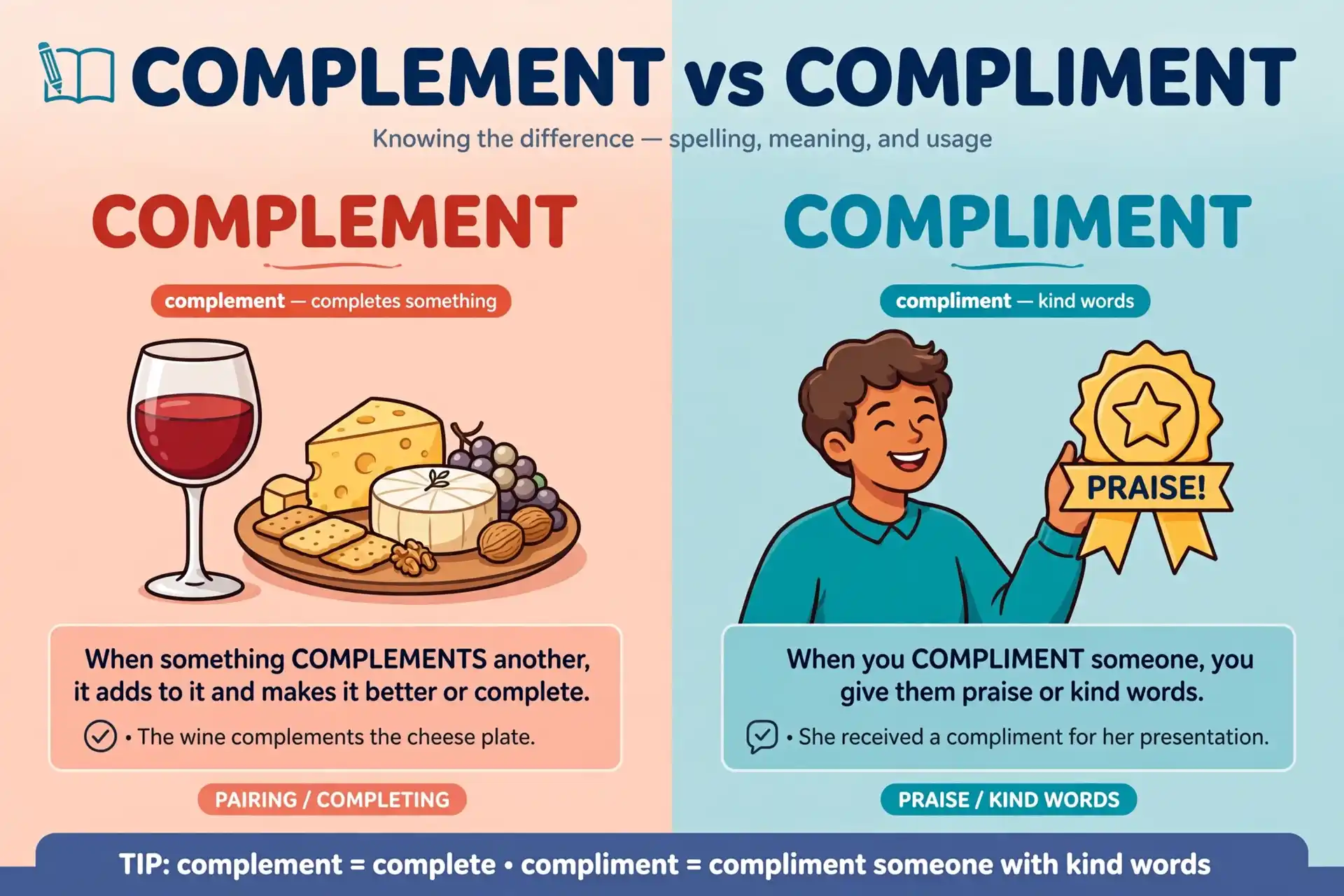
Common Mistakes
One-letter word pairs fool even careful writers — the “desert” vs “dessert” spelling trap works the same single-letter switch, and the “further” vs “farther” difference shows how close meanings drift apart. The complement/compliment traps:
Mistake 1: Praising with an E
❌ “He complemented her on the promotion.”
✅ “He complimented her on the promotion.”
Why: “Complemented her” says he completed her, like a puzzle piece. Praise needs the I — “complimented.”
Mistake 2: Pairing with an I
❌ “The flavors compliment each other.”
✅ “The flavors complement each other.”
Why: Flavors don’t praise each other; they pair well. Pairing and completing always take the E.
Mistake 3: “Complimentary” confusion
❌ “The hotel gave us complimentary robes, so the staff must like us.”
✅ “The hotel gave us complimentary robes — free with the room.”
Why: “Complimentary” usually means free (from “compliments of the house”), not “full of compliments.” Don’t read praise into a freebie.
Mistake 4: Assuming they’re interchangeable
❌ “The two words basically mean the same thing.”
✅ “They share a Latin root but diverged centuries ago — one completes, one praises.”
Why: Both come from Latin “complere” (to fill up), but modern English split them firmly. Treating them as variants guarantees an error half the time.
Pronunciation
Both words are pronounced KOM-pluh-ment — identical in speech, which is precisely why the confusion survives. The adjective “complimentary” (free) is kom-pluh-MEN-tuh-ree, while “complementary” (completing) is kom-pluh-MEN-tuh-ree too — even the derivatives sound alike, so the E/I distinction lives entirely on the page.
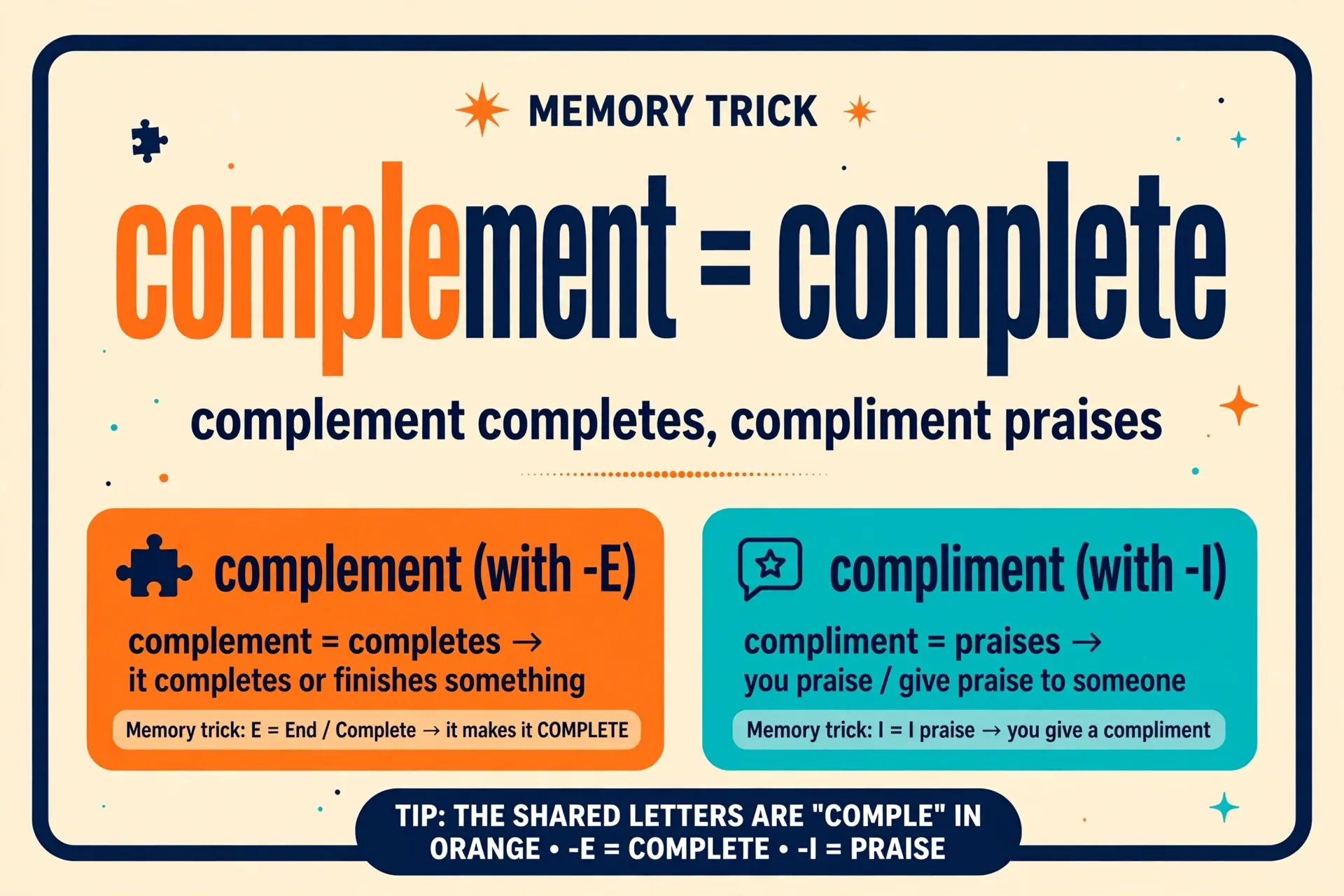
How to Remember the Difference
Complement shares its first six letters with complete — complement completes. Compliment has an I in it, and “I” is the one who gives praise. One letter, two opposite jobs.
- E test: complement = complete — if it finishes or pairs with something, use E.
- I test: compliment = “I” praise you — if someone is being flattered, use I.
- Substitution test: swap in “praise” — if the sentence still works (“she praised his cooking”), you want “compliment”; if not, you want “complement.”
Frequently Asked Questions
Is it complement or compliment?
It depends on meaning: use “complement” (E) for something that completes or pairs well, and “compliment” (I) for praise or flattery.
What is the difference between complement and compliment?
A complement completes something (“the wine complements the meal”); a compliment praises someone (“she complimented the chef”). Different meanings, different spellings, identical pronunciation.
Is it “complimentary colors” or “complementary colors”?
“Complementary colors” (with E) — colors that complete each other on the color wheel. “Complimentary” with an I means free of charge or full of praise.
Can “compliment” be a verb?
Yes: “to compliment” means to praise, as in “they complimented her work.” And “to complement” (E) means to pair well with — both words work as nouns and verbs.
Why are they spelled so similarly?
Both descend from the Latin “complere,” meaning “to fill up.” English split the spelling centuries ago to mark the two meanings: E for completing, I for the praise “I” give.
Which is more common in everyday use?
“Compliment” (praise) appears more often in conversation, while “complement” (pairing) dominates in design, food, business, and grammar contexts.
Conclusion
Complement with an E completes — it pairs, finishes, and goes well with. Compliment with an I praises — it flatters and admires. Remember “completes” and “I praise,” and the two will never trade places again.