Stationary or Stationery: What’s the Difference?
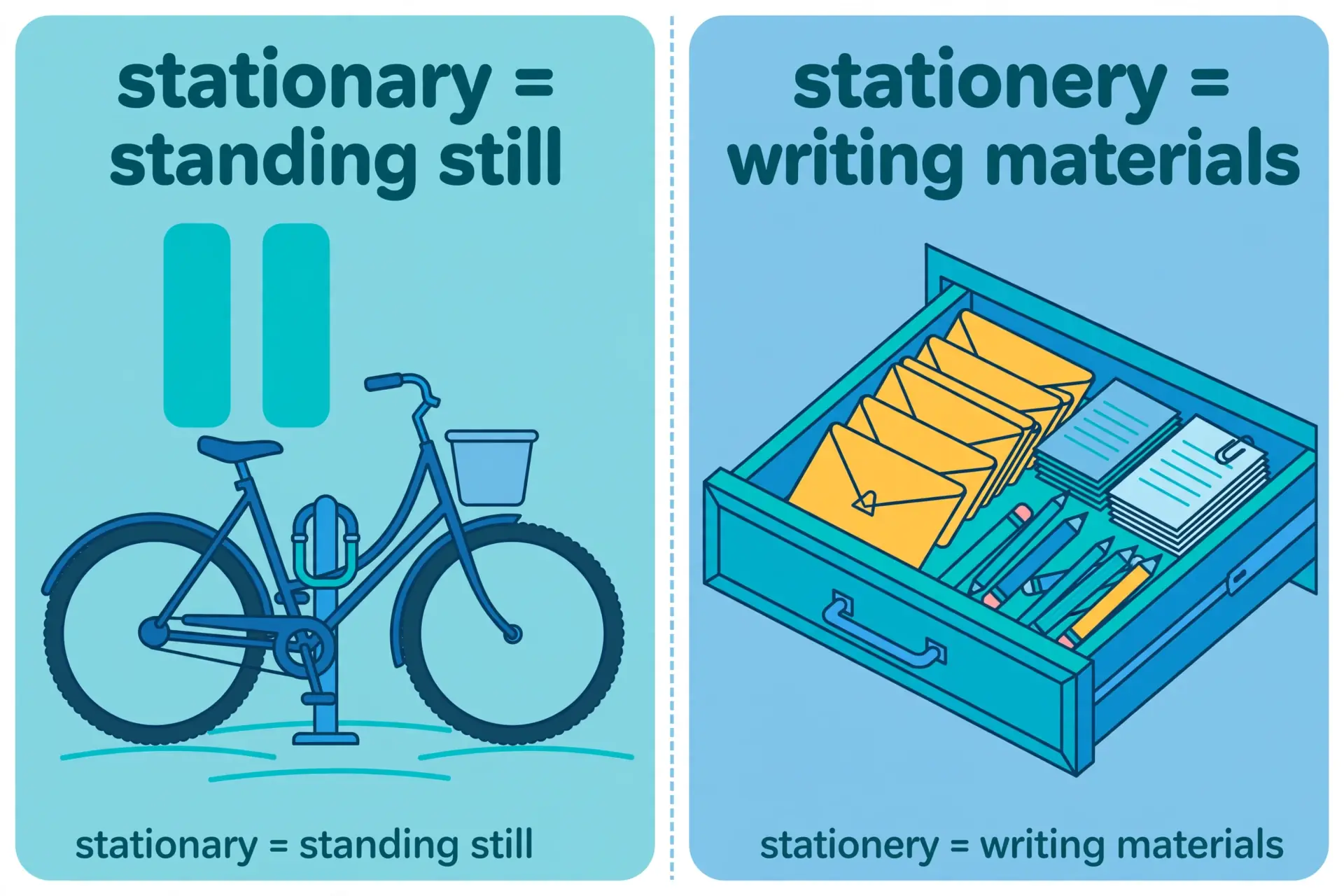
Stationary with an -a- means standing still — a stationary bike never moves. Stationery with an -e- means paper and writing materials — the stationery drawer holds envelopes, notepads, and pens. A single vowel flips the meaning completely, which is why office supply orders and gym memberships alike get tangled in this pair.
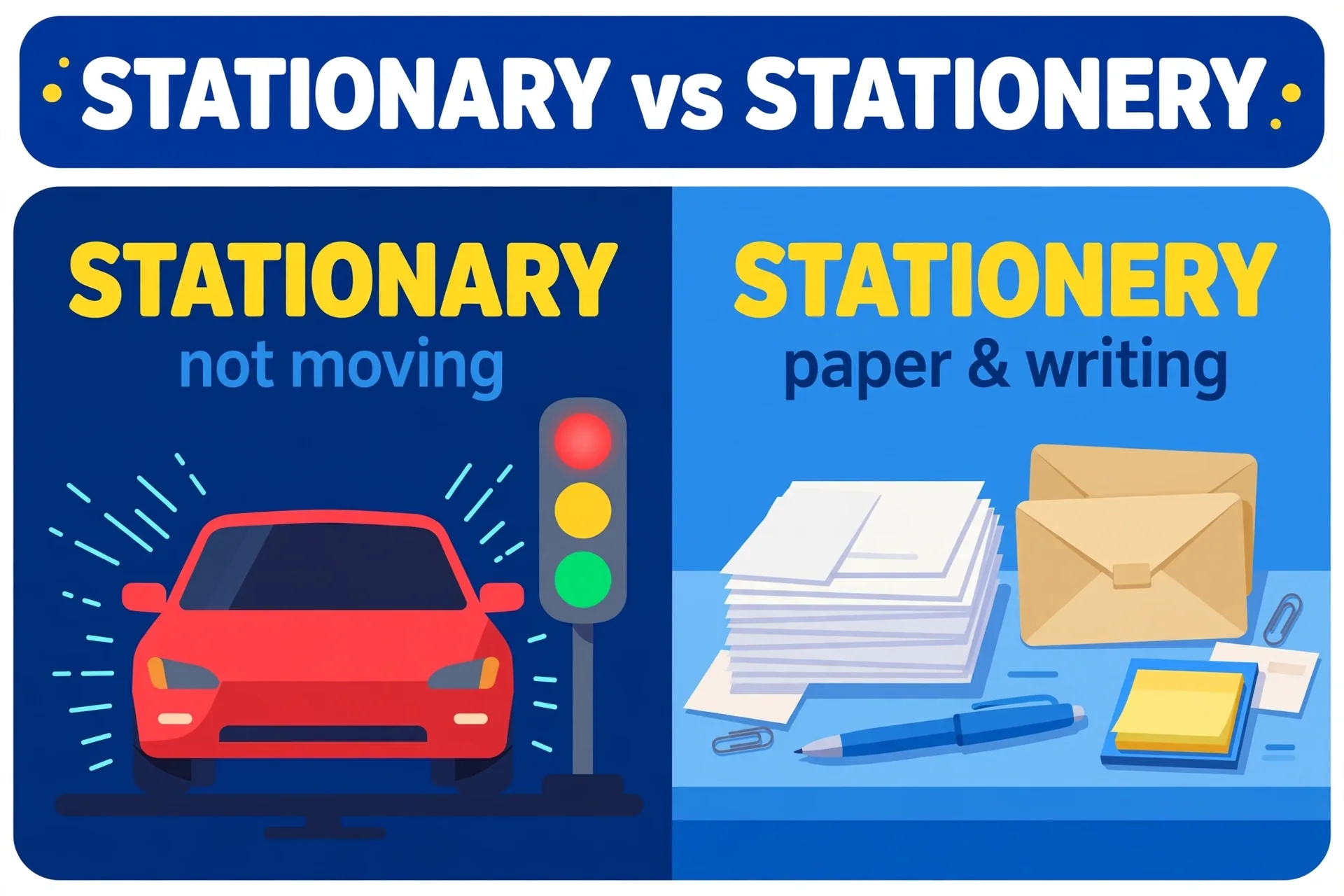
Quick Answer
| Word | Part of Speech | Main Meaning | Example |
|---|---|---|---|
| stationary | Adjective | Not moving; fixed in one place | ✅ “The car remained stationary at the red light.” |
| stationery | Noun | Paper, envelopes, and other writing materials | ✅ “She ordered new stationery for the office.” |
Simple rule: If it stands still, spell it stationary with an -a-; if you can write on it, spell it stationery with an -e-.
What Does Stationary Mean?
Stationary is an adjective describing something that is not moving — fixed, still, parked, or standing in one place. A vehicle in gridlock is stationary, a parked bicycle is stationary, and a surveillance camera bolted to a wall is stationary. The word comes from the Latin stationarius, meaning belonging to a standing post, which is also why a “station” (train station, space station) is a fixed place. Merriam-Webster’s entry for “stationary” defines it as “fixed in a station, course, or mode,” covering everything from exercise bikes to orbiting satellites.
Examples:
- “Traffic was stationary for nearly an hour after the accident.”
- “He held the ladder stationary while she climbed onto the roof.”
- “A stationary bike lets you pedal hard without going anywhere.”
- “The geostationary satellite stays stationary above the equator.”
- “Keep the camera stationary while you film the scene.”
Related forms stay in the same family: “to station” means to place someone at a fixed post (“troops were stationed along the border”), and “stationarily” is the rare adverb form. None of these has anything to do with paper.
What Does Stationery Mean?
Stationery is a noun meaning writing materials — paper, envelopes, notepads, pens, pencils, cards, and folders. The word dates back to the days when booksellers sold their wares from a fixed “station” (a stall or shop) rather than wandering, so a “stationer” was a seller of writing goods. Today the term covers everything from a child’s crayon set to a company’s branded letterhead: “office stationery” typically means printed paper, envelopes, and business cards carrying the company logo.
Examples:
- “The new hire’s desk came stocked with fresh stationery.”
- “She wrote the thank-you note on her best stationery.”
- “The company ordered custom stationery with its new logo.”
- “He browsed the stationery aisle looking for a birthday card.”
- “Their wedding invitations were printed on thick cotton stationery.”
Note that stationery behaves as an uncountable noun — you buy “stationery,” not “stationeries.” The person who sells it is a “stationer,” a job title that has nearly vanished along with the high-street paper shop.
Stationary vs. Stationery: Key Differences
| Feature | stationary | stationery |
|---|---|---|
| Word type | Adjective | Noun |
| Core meaning | Not moving; fixed in place | Paper and writing materials |
| The vowel that matters | -a- (as in “stAy”) | -e- (as in “lEttErs”) |
| Can it be plural? | No — adjectives don’t pluralize | Treated as uncountable (“stationery,” not “stationeries”) |
| Verb relatives | “to station” (to place at a post) | None — it’s a thing, not an action |
| Example | ✅ “The target was stationary.” | ✅ “The target was printed on stationery.” |
An adjective describes stillness; a noun names the paper drawer. Once you see which job the sentence needs, the right vowel follows.
Stationary and Stationery in Real Sentences
At Home
✅ “The dog stayed perfectly stationary during the thunderstorm.”
✅ “I keep the good stationery in the top desk drawer.”
One sentence freezes a frightened pet mid-room; the other reaches for nice paper.
At the Office
✅ “The delivery van was stationary in the loading bay all morning.”
✅ “Please restock the stationery cupboard before Monday.”
Facilities managers deal with both — vehicles that shouldn’t move and paper that always runs out.
At the Gym
✅ “She warmed up on the stationary bike for ten minutes.”
✅ “The front desk hands out schedules printed on cheap stationery.”
Gyms love this pair: one word powers the cardio room, the other the paperwork.
In Conversation
✅ “We were stationary on the motorway for ages.”
✅ “Do you still buy actual stationery, or is everything digital now?”
Spoken aloud they sound identical, so the spelling only matters once you write them down — which is exactly when it trips people up.
Common Mistakes
Near-identical spellings cause the same slip everywhere — the “cloths vs clothes” lookalike noun pair shows how one vowel reshapes a familiar word, and the “effective vs affective” adjective confusion covers another near-miss pair. The stationary/stationery traps:
Mistake 1: Writing “stationary” when you mean paper
❌ “I need to buy stationary for the office.”
✅ “I need to buy stationery for the office.”
Why: “Stationary” describes something that doesn’t move. An office supply order for unmoving paper makes no sense — you want the noun with an -e-, the writing materials.
Mistake 2: Writing “stationery” when you mean not moving
❌ “The car remained stationery at the light.”
✅ “The car remained stationary at the light.”
Why: A car waiting at a light is fixed in place — an adjective job. “Stationery” would turn the sentence into nonsense about the car being made of paper.
Mistake 3: Confusing “stationary” with “station”
❌ “I’ll meet you at the stationary.”
✅ “I’ll meet you at the station.”
Why: A station is a place (train station, bus station); stationary is the adjective “not moving.” They’re related — a station is a fixed place — but you can’t swap one for the other.
Mistake 4: Pluralizing stationery as “stationeries”
❌ “That shop sells beautiful stationeries.”
✅ “That shop sells beautiful stationery.”
Why: Stationery is an uncountable noun, like “paper” or “furniture.” Use “items of stationery” or “stationery products” if you need to count it.
Pronunciation
Stationary and stationery are pronounced identically: STAY-shuh-ner-ee, rhyming with “missionary” and “visionary.” There is no stress shift and no vowel difference in speech — the distinction lives entirely on the page, in that single -a- versus -e-.
How to Remember the Difference
Two tricks, one for each spelling — pick the one that sticks:
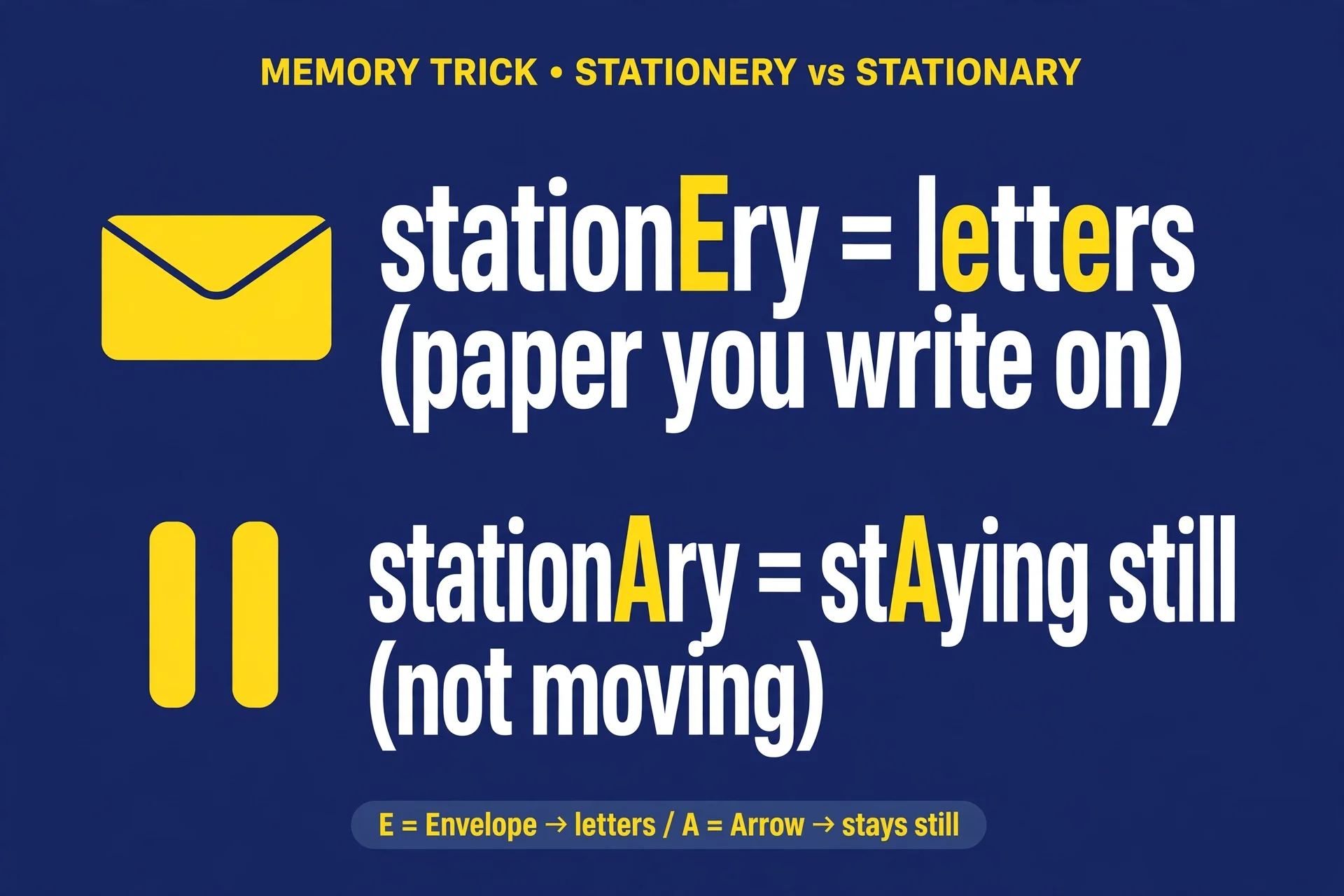
- Stationery contains er, like lettERs — and letters are written on paper. Paper = stationery with an -e-.
- Stationary contains a, like stAying still or At rest. Not moving = stationary with an -a-.
- The -a- word is an adjective; the -e- word names everything in the paper drawer.
Frequently Asked Questions
Is it stationary bike or stationery bike?
Stationary bike — with an -a-. The bike doesn’t move, so you need the adjective meaning “not moving.” A “stationery bike” would be a bicycle made of paper.
Is it stationary shop or stationery shop?
Stationery shop — with an -e-. The shop sells paper and writing materials, so it’s the noun. (A “stationary shop” would be a shop that never moves — technically true of most shops, but not the word you want.)
What is the difference between stationary and stationery?
Stationary is an adjective meaning not moving or fixed in place. Stationery is a noun meaning paper, envelopes, and other writing materials. They are homophones — identical in speech, different in spelling and meaning.
Can “stationary” be used as a noun?
No. Stationary is strictly an adjective in standard English. If you need the noun for a fixed place, that’s “station” — a train station, a space station, a work station.
Why is paper called stationery?
It traces back to medieval “stationers” — booksellers who sold from a fixed station (stall) instead of wandering. Their goods, chiefly paper and writing materials, became known as stationery.
Is “stationeries” ever correct?
Essentially never in everyday use. Stationery is uncountable, like “paper.” Dictionaries list no standard plural; write “items of stationery” or “stationery products” instead.
Conclusion
Stationary with an -a- is the adjective for anything standing still, while stationery with an -e- is the noun for paper and writing supplies. Remember “stAying still” and “lEttErs on paper,” and this pair will never trip you up again.