Annual or Perennial: What’s the Difference? (With Examples)
Both annual and perennial are correct English words, but they describe plants with very different life spans. An annual sprouts, blooms, and dies within a single growing season, while a perennial lives for several years and returns each spring.
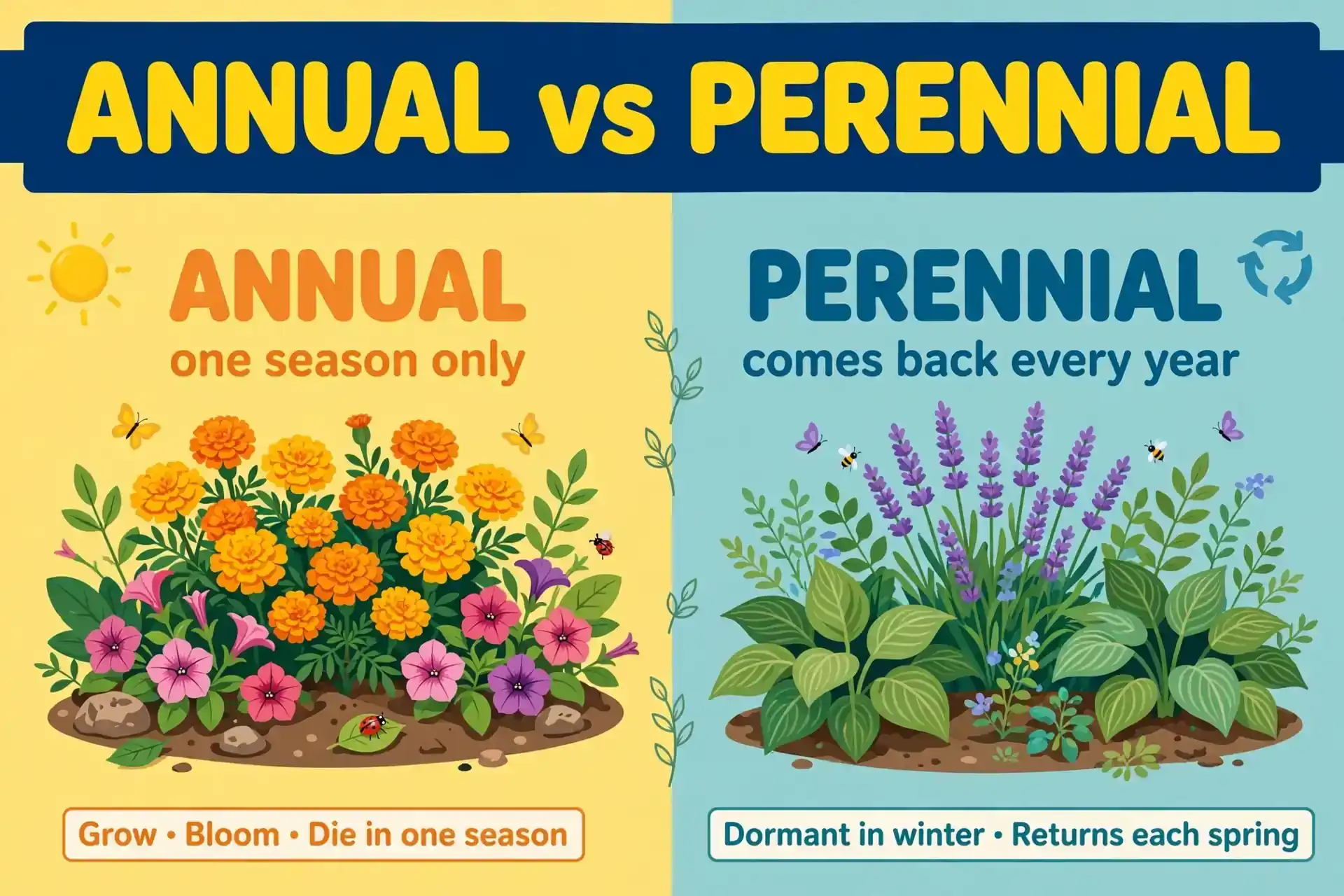
Table of Contents
Quick Answer
| Word | Part of Speech | Main Meaning | Example |
|---|---|---|---|
| annual | noun / adjective | a plant that completes its life cycle in one growing season; “yearly” | “Petunias are annuals, so I replant them every spring.” |
| perennial | noun / adjective | a plant that lives for three or more years, regrowing each season | “Hostas are perennials that return every May.” |
Simple rule: If it dies after one season, it is an annual; if it survives winter and returns on its own, it is a perennial.
What Does Annual Mean?
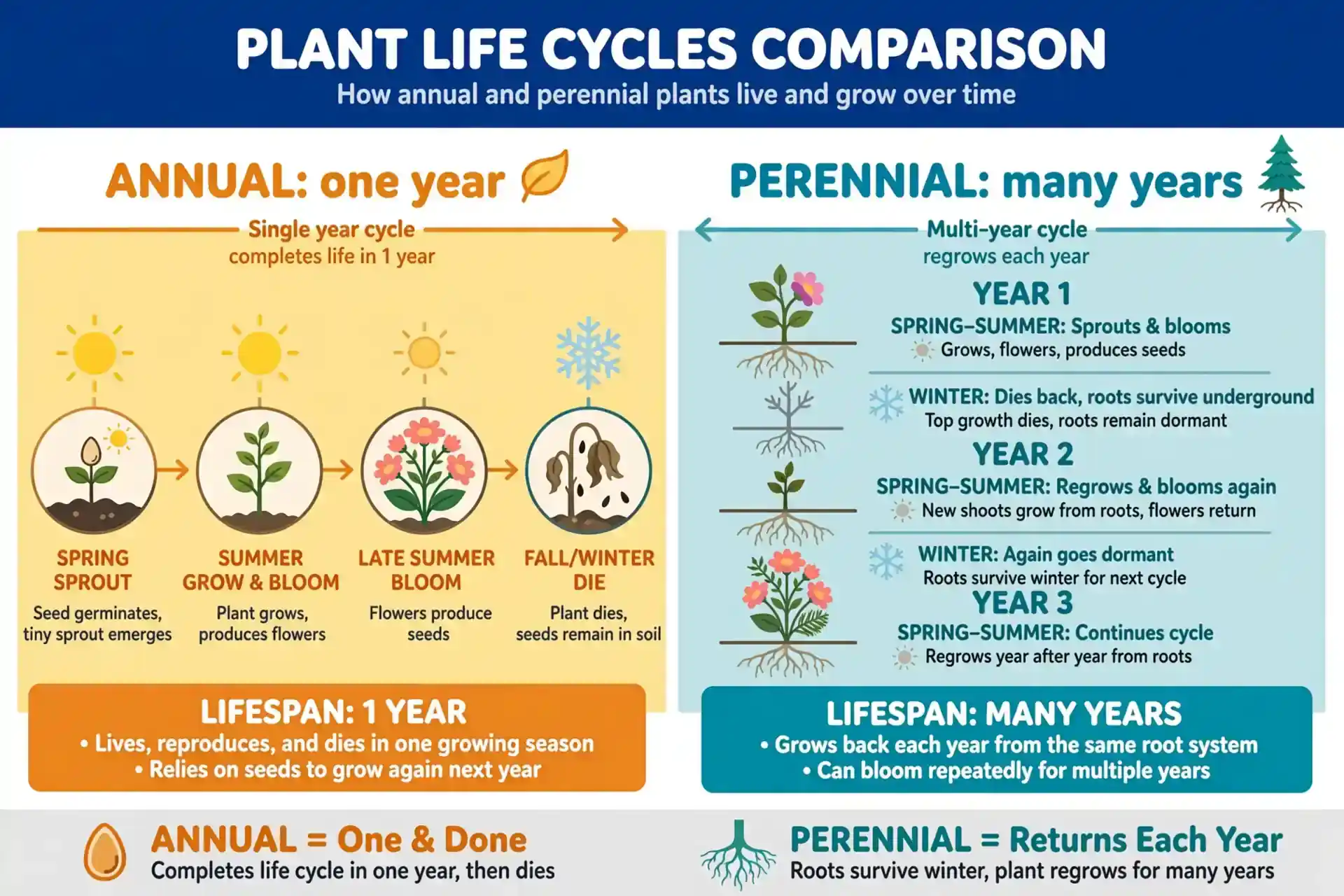
An annual is a plant that germinates, flowers, sets seed, and dies all within one growing season. Gardeners treat annuals as disposable color: plant them, enjoy a summer of blooms, and start over next year.
Examples:
- Marigolds, petunias, and zinnias are classic bedding annuals.
- “Tomatoes are grown as annuals in cold climates, even though they are technically tropical perennials.”
- “The school planted sunflowers as annuals along the fence.”
- As an adjective, annual simply means “yearly”: “Our annual garden party happens every June.”
- “An annual rainfall of 800 mm keeps the beds lush.”
What Does Perennial Mean?
A perennial is a plant that lives for more than two years, usually dying back in winter and regrowing from its roots each spring. Perennials are the backbone of a low-effort garden: pay once, enjoy for years. See the full definition of perennial in Merriam-Webster’s dictionary.
Examples:
- Lavender, hostas, and peonies are beloved perennials.
- “Asparagus is a perennial vegetable — plant it once and harvest for a decade.”
- “The black-eyed Susans are perennials, so leave their roots alone in autumn.”
- As an adjective, perennial means “lasting a long time”: “Her novel is a perennial favorite of book clubs.”
- “He has a perennial habit of arriving late.”
Annual vs. Perennial: Key Differences
| Feature | Annual | Perennial |
|---|---|---|
| Lifespan | One growing season | Three or more years |
| Winter survival | Dies with the frost | Dies back; roots survive |
| Replanting | Every single year | Once, for many years |
| Long-term cost | Cheap plants, recurring cost | Pricier upfront, cheaper over time |
| Typical examples | Marigolds, petunias, zinnias | Lavender, hostas, peonies |
| As an adjective | Yearly (an annual report) | Long-lasting (a perennial favorite) |
The trade-off is simple: annuals give you instant, all-season color for one year, while perennials ask for patience and reward you with years of growth.
Usage in Real Sentences
At Home
Annual: “I fill the window boxes with annuals every May.”
Perennial: “The roses are perennials, so I just prune them in March.”
The window boxes need new plants each spring, but the rose bushes keep going on their own.
At the Garden Center
Annual: “The clerk pointed me to the annual section for instant summer color.”
Perennial: “I spent more on perennials because they will fill the bed for years.”
One shelf sells you this summer; the other sells you the next five summers.
In Conversation
Annual: “Our annual picnic is the one event nobody misses.”
Perennial: “Complaining about the heat is a perennial topic in July.”
The picnic happens once a year like clockwork, while the complaining never really stops.
Common Mistakes
One-letter mix-ups are a whole genre of English mistakes — just ask anyone tangled up in loose or lose, or the eternal recieve or receive debate. Annual and perennial trip people up the same way, usually in the garden aisle.
Mistake 1: Calling lavender an annual
❌ “Lavender is my favorite annual.”
✅ “Lavender is my favorite perennial.”
Why: Lavender lives for many years, so it is a perennial, not an annual.
Mistake 2: Expecting annuals to come back
❌ “My petunias will come back next spring — they are annuals.”
✅ “My hostas will come back next spring — they are perennials.”
Why: Annuals die after one season; only perennials return on their own.
Mistake 3: Using “annual” as an adverb
❌ “The magazine arrives annual.”
✅ “The magazine arrives annually.”
Why: The adjective annual needs its adverb form, annually, when describing how something happens.
Mistake 4: Assuming tomatoes are always annuals
❌ “Tomatoes are annuals, end of story.”
✅ “Tomatoes are grown as annuals in cold climates.”
Why: Tomatoes are biologically tropical perennials; gardeners in cold zones just grow them as annuals.
Pronunciation
Annual stresses the first syllable (AN-yoo-uhl) and rhymes with “manual”. Perennial stresses the second syllable (puh-REN-ee-uhl) and rhymes with “millennial”.
How to Remember the Difference
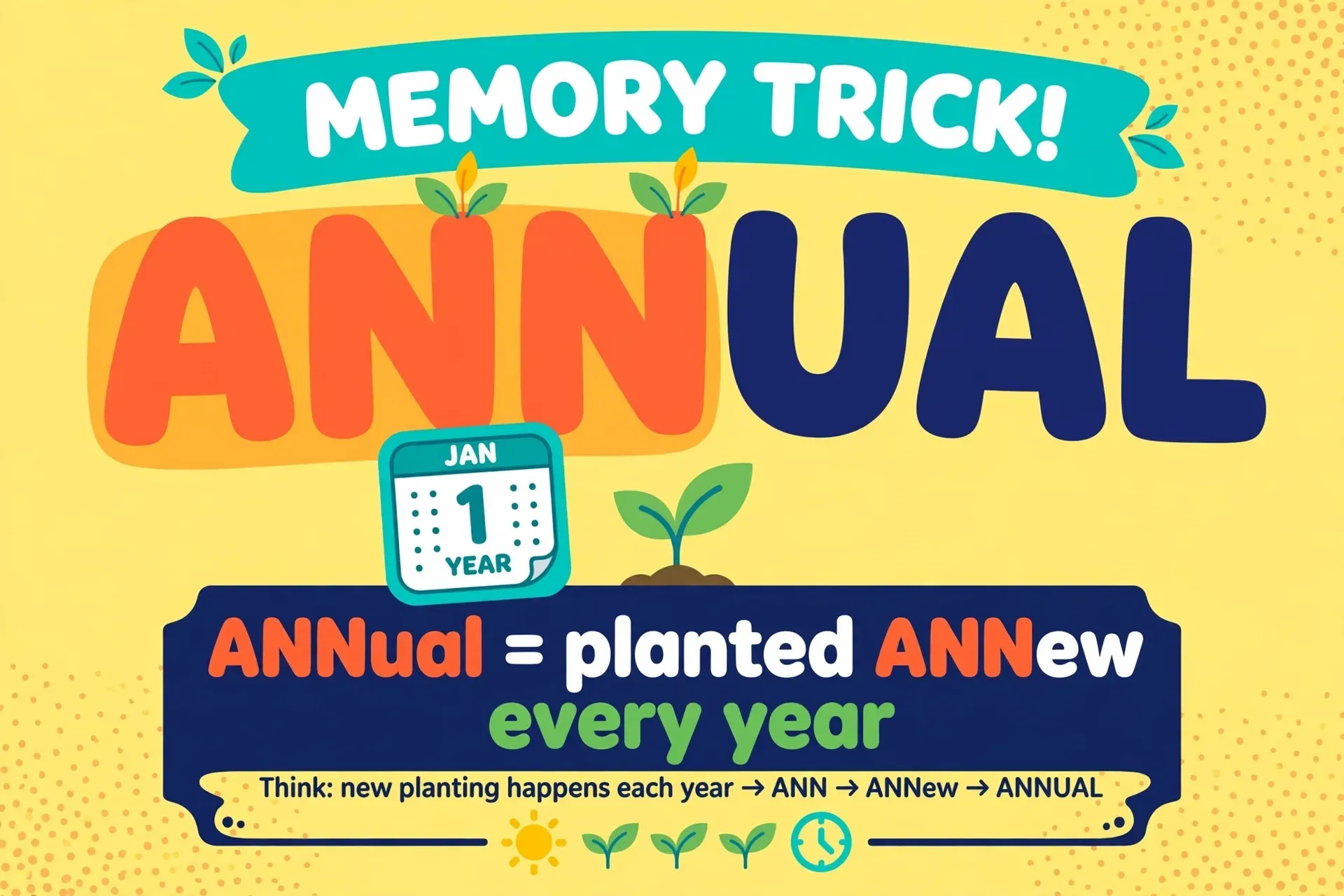
Think ANNual = planted ANNew every year. The first three letters of annual sound like “a new” — a new plant, every single year. Perennial has no such luck: it stays put, year after year.
- ANNual → ANNew plant each year
- Perennial → “per” + “ennial” (year) — it persists, year after year
- Nursery tags literally say “annual” or “perennial” — trust the tag
FAQ
Is it annual or perennial?
It depends on the plant. Marigolds, petunias, and zinnias are annuals; lavender, hostas, and peonies are perennials. When in doubt, check the plant tag at the nursery.
Can a plant be both annual and perennial?
Sometimes. Tomatoes and peppers are biologically perennials that gardeners in cold climates grow as annuals. The label often describes how the plant is grown, not just its biology.
Are tomatoes annual or perennial?
Biologically perennial, practically annual in most gardens. Frost kills them, so gardeners replant every year.
How long do perennials live?
Most garden perennials live three to ten years, and some — like peonies and asparagus — can thrive for decades.
What does “annual” mean outside gardening?
Simply “yearly”: an annual report, an annual checkup, an annual fee.
What is a biennial — and does it matter here?
A biennial is the in-between case: it lives for two years. Carrots, foxgloves, and parsley grow leaves in year one, then flower, seed, and die in year two. Knowing the term completes the picture — annual (one season), biennial (two years), perennial (three or more) — and explains why some “annuals” from the nursery surprise you by reseeding themselves the next spring.
Do annuals or perennials cost more over time?
Annuals are cheaper per plant, but you buy them every single year; a flat of petunias can cost more over five years than one peony that blooms for a decade. Perennials demand more money and patience up front — many barely flower in year one — but their cost per bloom drops sharply over time. Smart gardeners mix both: perennials for the backbone, annuals for instant color.
Conclusion
Annuals give you one glorious season and then bow out, while perennials settle in and return year after year. Knowing which is which saves you money at the nursery and disappointment in the spring. Now you can plan your garden — and your vocabulary — with confidence.