Lite or Light: What’s the Difference? (With Examples)
Both exist, but they are not equal: light is the standard English word — not heavy, and also the brightness that lets you see — while lite is an informal, commercial respelling used in brand and product names. You would write “a light breakfast,” but you would order a “lite beer.”
Table of Contents
Quick Answer
| Word | Part of Speech | Main Meaning | Example |
|---|---|---|---|
| light | Adjective / noun / verb | Not heavy; illumination; to ignite | “The bag is light.” / “Turn on the light.” |
| lite | Adjective (informal) | Low-calorie or simplified version of a product | “He ordered a lite beer.” |
Simple rule: Use light everywhere except product names and casual branding, where lite is a deliberate style choice.
What Does Light Mean?
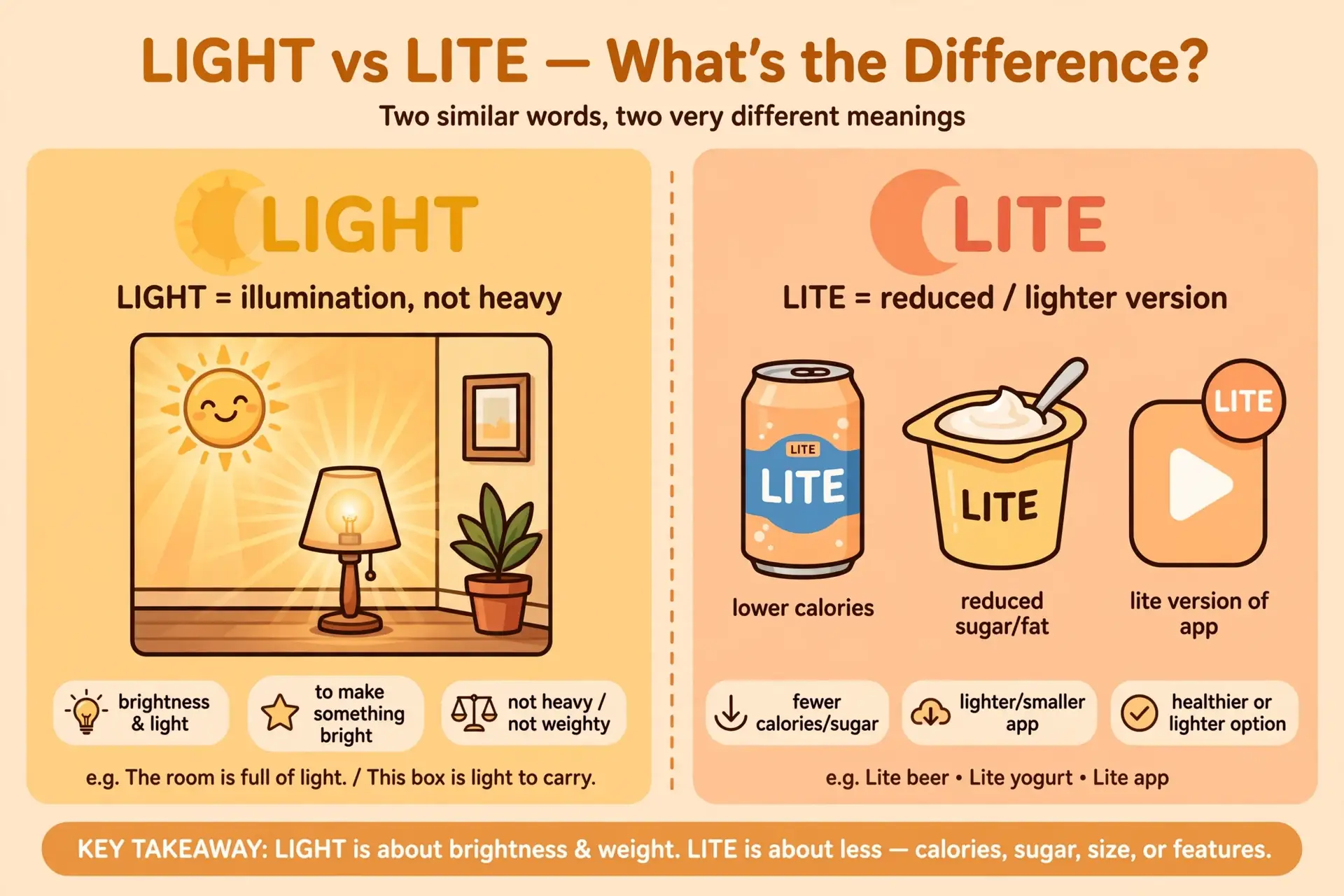
Light is the standard English word with several related senses. As an adjective, it means not heavy — “a light bag” — or pale in color — “light blue.” As a noun, it is the brightness that lets you see — “morning light,” “turn on the light.” As a verb, it means to set fire to something (“light the candles”) or to become less serious (“lighten the mood”). All of these belong in formal writing, speech, and every register in between.
Examples:
- The suitcase was surprisingly light.
- Morning light filled the kitchen.
- He prefers light novels to heavy textbooks.
- Can you turn the porch light on?
- The fabric is light enough for summer.
- She lit the candles before dinner.
- His light blue shirt matched the sky.
What Does Lite Mean?
Lite is a casual respelling of “light,” popularized by advertisers to suggest fewer calories, less weight, or a simpler version. On packaging, it flags diet products — lite beer, lite mayonnaise, lite yogurt. In tech, it marks stripped-down software — a “lite” app that uses less storage and data. In pricing, it names the cheaper tier — a “lite” plan with fewer features. You will see it on labels, menus, and app stores — never in formal writing.
Examples:
- He grabbed a lite beer from the fridge.
- She downloaded the lite version of the app.
- The menu listed a lite yogurt parfait.
- Their “lite” plan costs half the regular price.
- The chips bag bragged “50% less fat — now lite!”
Lite vs. Light: Key Differences
| Feature | Lite | Light |
|---|---|---|
| Status | Informal / commercial respelling | Standard English |
| Meaning | Low-calorie or simplified version | Not heavy; illumination; to ignite |
| Where it is used | Brand names, packaging, ads | Everywhere |
| Formal writing | Avoid it | Always correct |
| Pronunciation | /laɪt/ (“lyte”) | Identical: /laɪt/ |
| Origin | 20th-century marketing coinage | Old English “lēoht” |
Same sound, same root — lite is simply light with the “gh” dropped for shelf appeal.
Usage in Real Sentences
At Home
Lite: “Dad keeps lite milk in the fridge now.”
Light: “The curtains let in plenty of light.”
A product label and an everyday description do different jobs.
At Work
Lite: “The team shipped the lite edition of the software.”
Light: “Keep the presentation light and upbeat.”
One is a product name; the other is plain English.
In Conversation
Lite: “I’ll just have a lite salad, thanks.”
Light: “Pack light — we’re only going for two days.”
Casual speech accepts “lite”; the standard word still covers everything else.
At the Store
Lite: “The ‘lite’ label promised fewer calories.”
Light: “She chose the light blue wrapping paper.”
Marketing spelling and normal spelling share the same shelf.
Lite: “He compared the regular and lite versions of the peanut butter.”
Light: “The shopping basket felt light with just a few items.”
The product name keeps its “lite”; the description of the basket needs “light.”
On Social Media
Lite: “The ad promised a ‘lite’ editing app with no watermark.”
Light: “Comments praised the app’s light, clean design.”
Brands write “lite”; reviewers still write “light.”
Lite: “Influencers unboxed the ‘lite’ edition of the phone.”
Light: “Everyone noted how light the phone felt in hand.”
The marketing term and the ordinary adjective appear in the same thread.
Common Mistakes
Mixing up casual and standard spellings is as easy as mixing up desert or dessert or cancelled or canceled — context decides which one fits.
Mistake 1: Using “Lite” in Formal Writing
❌ “The report was lite on details.”
✅ “The report was light on details.”
Why: “Lite” in an essay or report looks like a typo — use “light.”
Mistake 2: “Correcting” a Brand Name
❌ Writing “Light Beer” when the can says “Lite.”
✅ Copying the brand’s spelling: “Miller Lite.”
Why: Product names are proper nouns — spell them exactly as the company does.
Mistake 3: Assuming “Lite” Is the American Spelling
❌ “Americans write ‘lite’ instead of ‘light.'”
✅ “Both countries use ‘light’; ‘lite’ is marketing slang everywhere.”
Why: The Merriam-Webster entry for “light” treats “lite” only as an informal variant for commercial use.
Mistake 4: Overusing “Lite” for Style
❌ “A lite lunch, a lite workout, a lite read…”
✅ “A light lunch, a light workout, a light read…”
Why: Outside branding, repeated “lite” reads as gimmicky.
Pronunciation
Lite and light are pronounced identically: “lyte” (/laɪt/), rhyming with “bite,” “kite,” and “night.” The difference is purely visual — one spelling for the dictionary, one for the label.
How to Remember the Difference
LITE is LIGHT on a diet — it dropped the GH to look slimmer on the label.
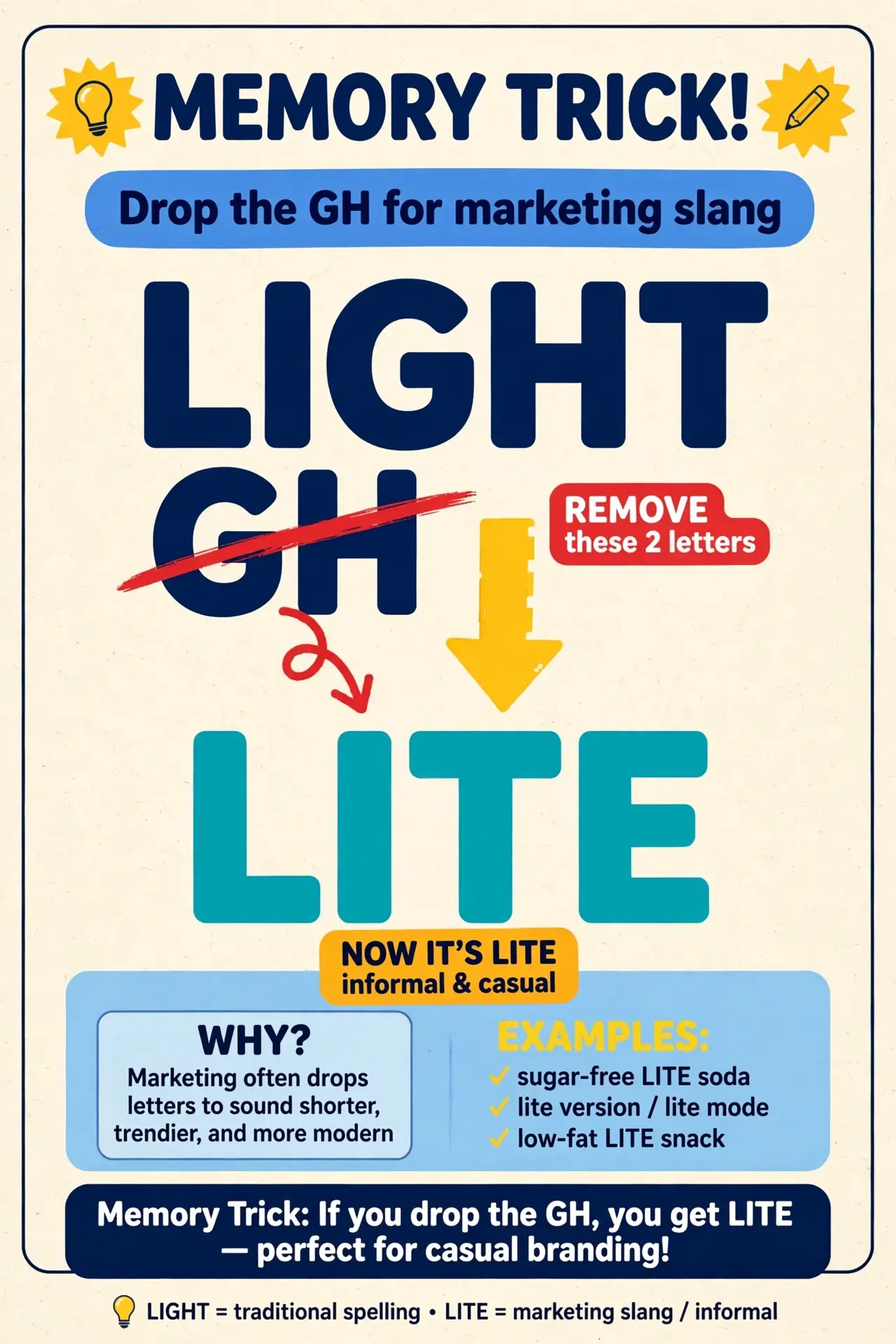
- Light keeps its GH for real writing.
- Lite drops the GH for marketing.
- If it is not a product name, keep the GH.
Frequently Asked Questions
Is it lite or light?
Standard English uses light. Lite is an informal variant reserved for branding, product names, and casual marketing copy.
Is “lite” a real word?
It is a recognized informal respelling, but dictionaries mark it as a variant rather than standard. That means spellcheckers may accept it, but teachers and editors will not — do not use it in formal writing.
Why do companies write “lite” instead of “light”?
Shorter spellings look modern and catchy on packaging — “lite” signals fewer calories or a simpler version at a glance. It started with diet products in the 20th century and spread to apps, pricing tiers, and media.
Can I use “lite” in an essay?
No — use “light.” “Lite” in school or work writing reads as an error, because the reader has no way to know you meant it as a style choice.
What does “lite version” mean?
A simplified or lower-calorie edition of a product, like a lite app or a lite beer. In software it usually means fewer features and a smaller download; in food it means reduced fat or calories.
Do “lite” and “light” sound the same?
Yes — both are pronounced “lyte.” The difference is purely visual: one spelling for the dictionary, one for the label.
Conclusion
Light is the standard word for everyday writing; lite belongs on product labels and in casual branding. Keep the “gh” unless a brand name tells you otherwise.