Worshipped or Worshiped: What’s the Difference? (With Examples)
Both worshipped and worshiped are correct — the difference is regional, not grammatical. Worshipped (double p) is the preferred spelling in British English, while worshiped (single p) is preferred in American English. The meaning is identical either way.
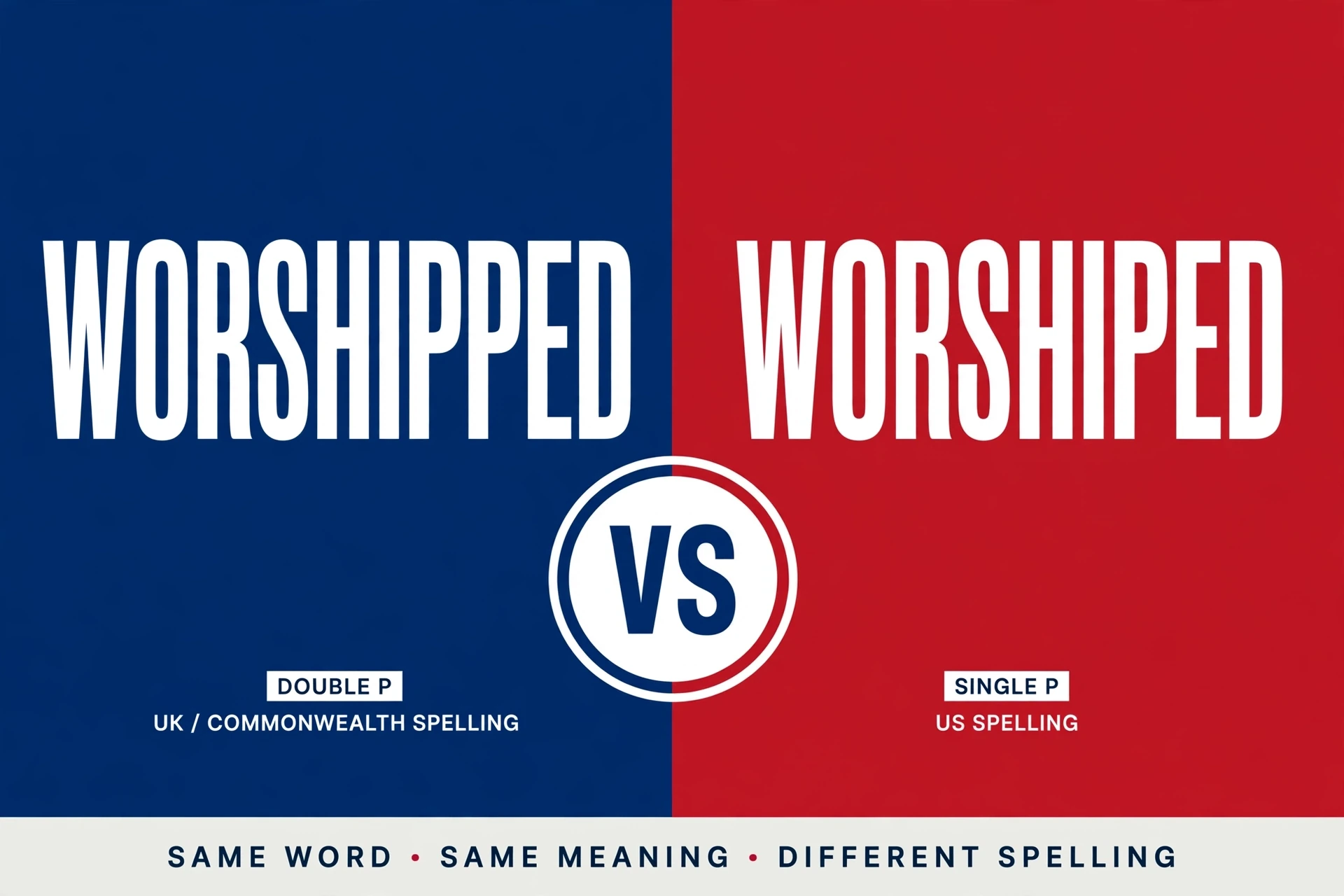
Table of Contents
Quick Answer
| Word | Part of Speech | Main Meaning | Example |
|---|---|---|---|
| worshipped | Verb (past tense / past participle) | Past form of worship; the standard spelling in British English | They worshipped at the old chapel. |
| worshiped | Verb (past tense / past participle) | Past form of worship; the standard spelling in American English | They worshiped at the old chapel. |
Simple rule: writing for a British audience? Double the p: worshipped. Writing for an American audience? Keep it single: worshiped.
What Does Worshipped Mean?
Worshipped is the British-English past tense and past participle of worship — to show deep reverence for a god, or, informally, to adore a person or thing. British spelling traditionally doubles the final consonant when adding -ed to a verb ending in a single consonant after a short vowel, which is where the double p comes from. You will see it in British newspapers, novels, and exam papers, and no British reader will blink at it.
Examples:
- The congregation worshipped together every Sunday morning.
- Ancient Greeks worshipped a whole family of gods.
- She worshipped her grandmother and copied everything she did.
- For years, fans worshipped the band like rock royalty.
- They had worshipped at that shrine for generations.
Worth knowing: quite a few American writers use worshipped too. It is never wrong — just less common in the US.
What Does Worshiped Mean?
Worshiped is the American-English past tense and past participle of worship, carrying exactly the same meaning as worshipped. American spelling generally skips the extra consonant when the stress falls on an earlier syllable (WOR-ship), which is why the US form keeps a single p. Merriam-Webster lists both forms in its dictionary entry for “worship”, giving “worshiped” first as the American standard.
Examples:
- The congregation worshiped together every Sunday morning.
- Ancient Greeks worshiped a whole family of gods.
- She worshiped her grandmother and copied everything she did.
- For years, fans worshiped the band like rock royalty.
- They had worshiped at that shrine for generations.
Worshipped vs. Worshiped: Key Differences
| Feature | Worshipped | Worshiped |
|---|---|---|
| Spelling | Double p | Single p |
| Preferred in | British English | American English |
| Pronunciation | Identical: WUR-shipt | Identical: WUR-shipt |
| Meaning | Same | Same |
| Grammatical role | Past tense and past participle | Past tense and past participle |
| Acceptability | Accepted everywhere; standard in the UK | Accepted everywhere; standard in the US |
Unlike most confused word pairs, nothing about grammar or meaning changes here — the choice is purely about which side of the Atlantic your reader is on.
Usage in Real Sentences
At Home
Worshipped: “Growing up in London, we worshipped at the parish church each Christmas.”
Worshiped: “Growing up in Texas, we worshiped at the parish church each Christmas.”
Same sentence, same meaning — the spelling quietly tells you where the writer learned English.
In Conversation
Worshipped: “She worshipped that singer through her entire teens.”
Worshiped: “She worshiped that singer through her entire teens.”
The informal “adore” sense of worship works identically in both spellings.
In Writing
Worshipped: “The British report noted that locals had worshipped at the site for centuries.”
Worshiped: “The American report noted that locals had worshiped at the site for centuries.”
When a publication has a style guide, match the spelling to it — consistency matters more than preference.
In a Story
Worshipped: “The villagers worshipped the river god with flowers and song.”
Worshiped: “The settlers worshiped the same river god with flowers and song.”
Fiction set in Britain leans toward the double p; fiction set in America leans toward the single p.

Common Mistakes
This is the same consonant-doubling question behind cancelled or canceled — and like loose or lose, the extra letter changes nothing about meaning. The real errors people make are these four.
Mistake 1: Switching spellings inside one document
❌ “They worshipped on Sunday and worshiped on Wednesday.”
✅ “They worshipped on Sunday and worshipped on Wednesday.”
Why: mixing both forms in one piece of writing looks careless. Pick one spelling per document and stick with it.
Mistake 2: “Correcting” worshiped in American writing
❌ Changing “worshiped” to “worshipped” in a US school essay.
✅ Leave “worshiped” as it is.
Why: worshiped is the American standard, not a typo — “fixing” it introduces an inconsistency with US style guides.
Mistake 3: “Correcting” worshipped in British writing
❌ Changing “worshipped” to “worshiped” in a UK publication.
✅ Keep “worshipped” as it is.
Why: worshipped is the British standard. British readers and editors expect the double p.
Mistake 4: Pronouncing an extra syllable
❌ “wor-ship-ped” (three syllables).
✅ “WUR-shipt” (two syllables).
Why: the -ed after p is pronounced /t/, exactly like shipped. The double p changes the look of the word, never its sound.
Pronunciation
Both spellings are pronounced WUR-shipt — two syllables, rhyming with shipped and clipped. The extra p in worshipped is completely silent; it changes the spelling, not a single sound.
How to Remember the Difference
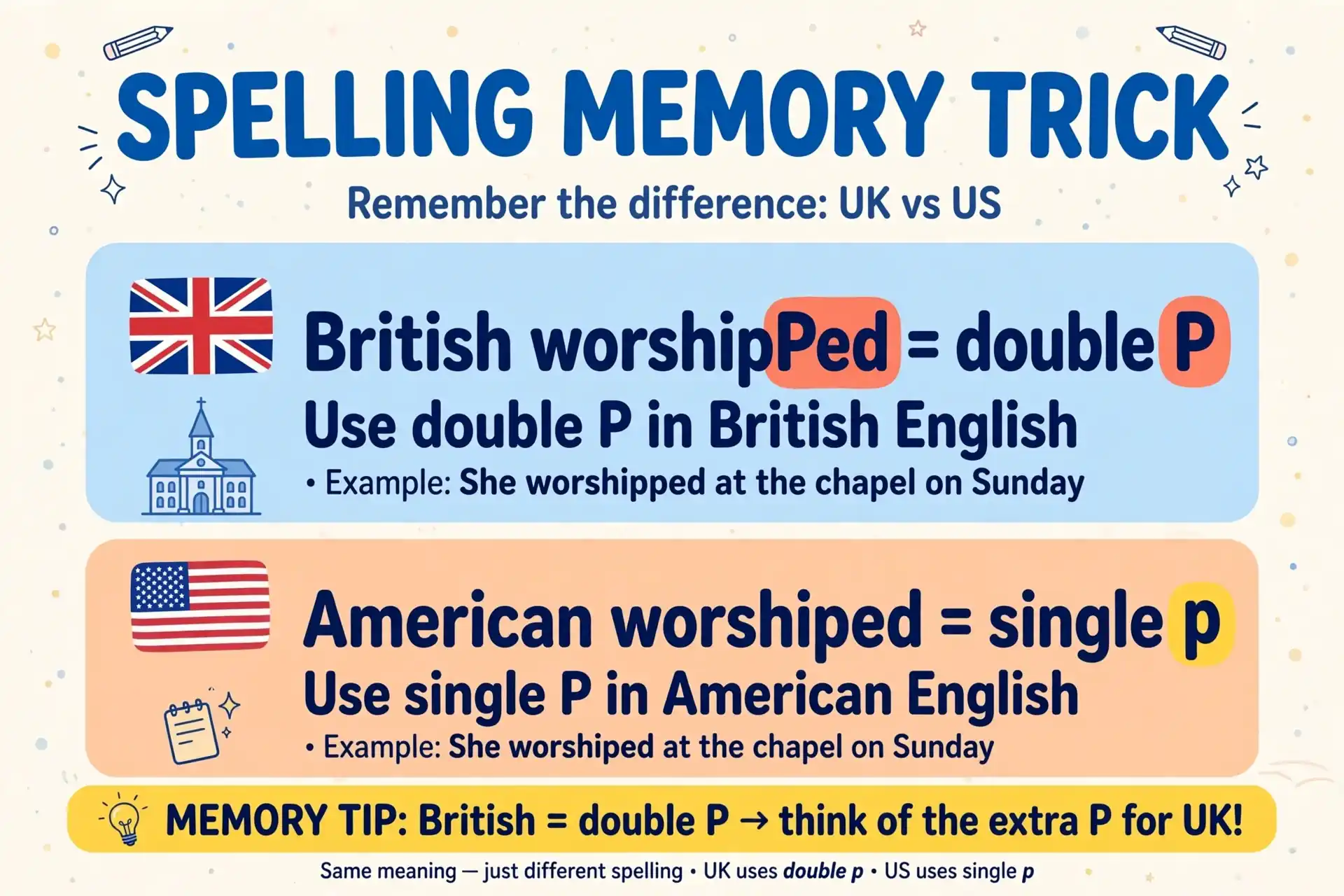
British worshipped keeps the double P — think Proper British doubling, the same habit behind travelled and cancelled. American worshiped trims it to a single p — the shorter American way.
- Worshipped = double p = British preference.
- Worshiped = single p = American preference.
- Same meaning, same pronunciation — only the audience changes.
- Never mix both spellings in one document.
Frequently Asked Questions
Is it worshipped or worshiped?
Both are correct. Worshipped is the British spelling and worshiped is the American spelling — choose based on who will read your writing.
Which spelling does Merriam-Webster prefer?
Merriam-Webster lists “worshiped or worshipped,” giving the single-p form first as the American standard. Either form is accepted in American dictionaries.
Do the two spellings mean different things?
No. They are the same word with the same meaning and the same pronunciation. Only the regional preference differs — the double p is a spelling convention, not a meaning change.
Is “worshipped” wrong in American English?
No. It is less common in the US, but it is fully accepted and many American writers use it. Still, “worshiped” is the safer match for American style guides.
What is the present tense of worshipped/worshiped?
Worship — as in “they worship every Sunday.” Both longer forms are simply its past tense and past participle, used the same way.
Why does British English double the p?
British spelling doubles a final consonant after a short vowel when adding -ed (worship → worshipped, travel → travelled). American spelling usually skips the doubling when the word’s stress falls on an earlier syllable.
Conclusion
Worshipped or worshiped — you cannot go wrong on meaning, only on consistency. Pick the spelling your reader expects and stick with it from the first sentence to the last.