Whose or Who’s: What Is the Difference?
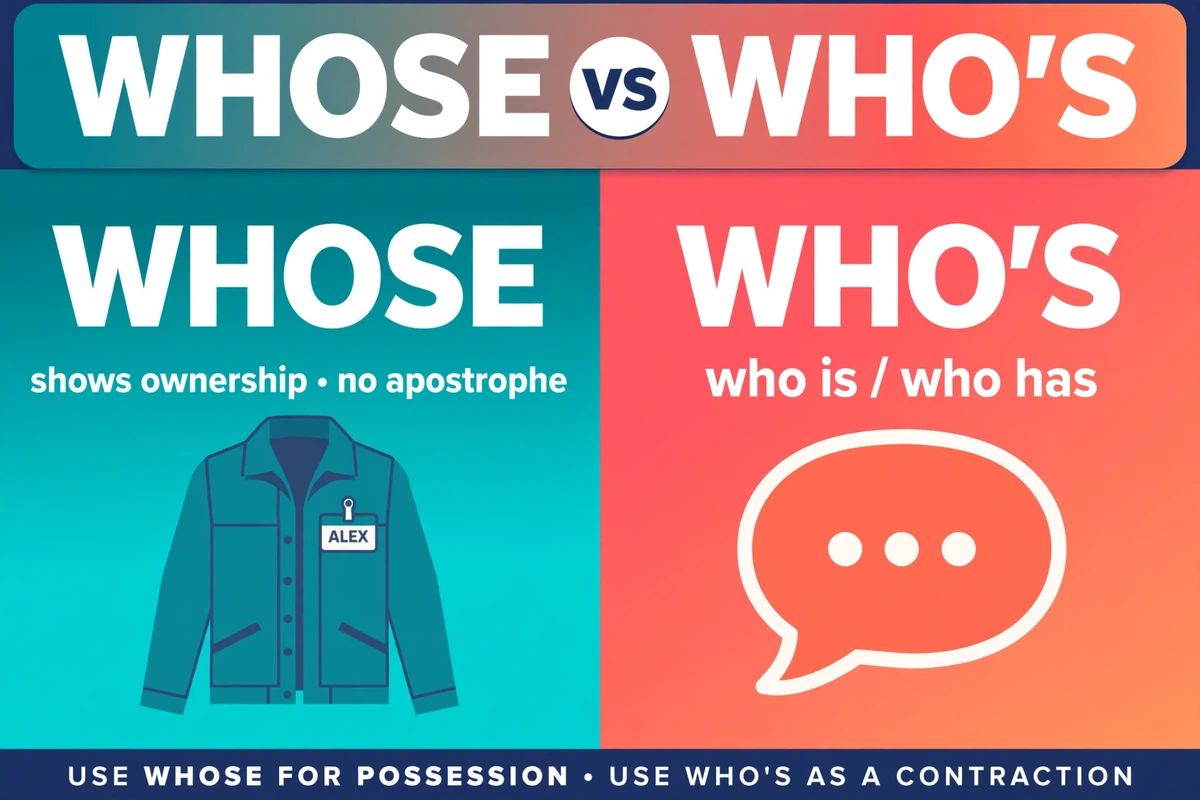
Whose and who’s are both correct English words, but they serve different grammatical purposes. Whose shows possession or asks who owns something. Who’s is a contraction of who is or who has.
The apostrophe makes the difference. Use whose when asking about ownership or describing something that belongs to a person. Use who’s when you can replace it with who is or who has.
Quick Answer: Whose or Who’s?
- Whose shows ownership: Whose jacket is this?
- Who’s means who is: Who’s coming to dinner?
- Who’s can also mean who has: Who’s finished the assignment?
A quick test can help: replace who’s with who is or who has. If the sentence still makes sense, the apostrophe belongs there. If not, use whose.
Quick Facts About Whose and Who’s
| Feature | Whose | Who’s |
| Word type | Possessive determiner or pronoun | Contraction |
| Main function | Shows ownership | Shortens “who is” or “who has” |
| Contains apostrophe | No | Yes |
| Common question | Whose bag is this? | Who’s at the door? |
| Example with a clause | The student whose book is missing called. | Who’s going to lead the meeting? |
| Can indicate possession? | Yes | Not by itself |
| Can be expanded? | No | Who is or who has |
What Does Whose Mean?
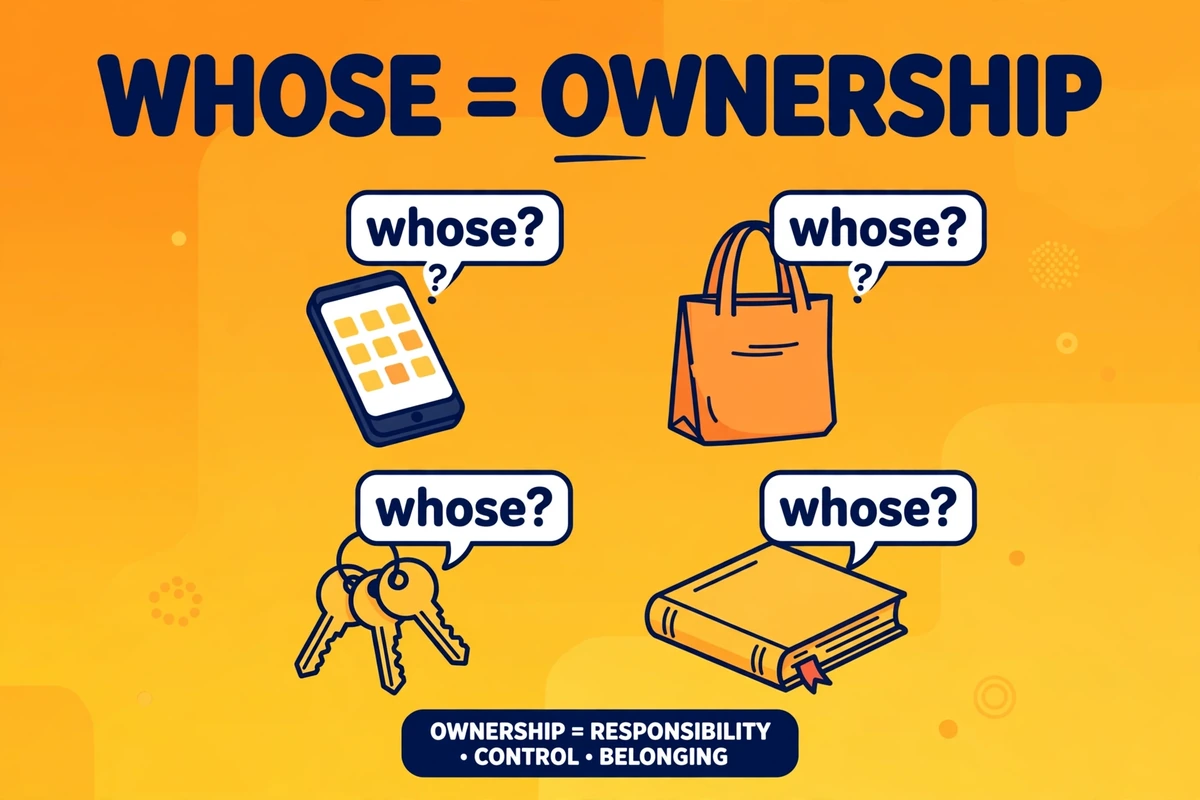
Whose is a possessive form of who. It asks who owns something or identifies a person connected to something.
It can work as a possessive determiner before a noun. It can also work as a possessive pronoun when the noun is understood from context.
1. Whose as a Possessive Determiner
Use whose before a noun to ask about ownership or show a relationship.
Examples:
- Whose phone is ringing?
- Whose shoes are by the door?
- Whose idea was it to change the schedule?
- Whose car is parked outside?
- Whose name appears on this document?
In each sentence, whose comes before a noun. It asks which person the item or idea belongs to.
2. Whose in Relative Clauses
Use whose to connect a person or thing with something associated with them.
This structure often appears in longer sentences.
Examples:
- I met a writer whose books are popular.
- She is the student whose project won the award.
- We visited a family whose house was damaged.
- The manager whose office is upstairs will help you.
- He spoke to a neighbor whose dog had gone missing.
Here, whose introduces information about the person or thing mentioned earlier.
3. Whose as a Possessive Pronoun
Whose can also appear without a noun immediately after it. The noun is understood from the conversation.
Examples:
- Whose is this?
- Whose are those?
- I found a wallet, but I do not know whose it is.
- These keys are not mine. Whose are they?
In these examples, whose asks who owns the item.
What Does Who’s Mean?
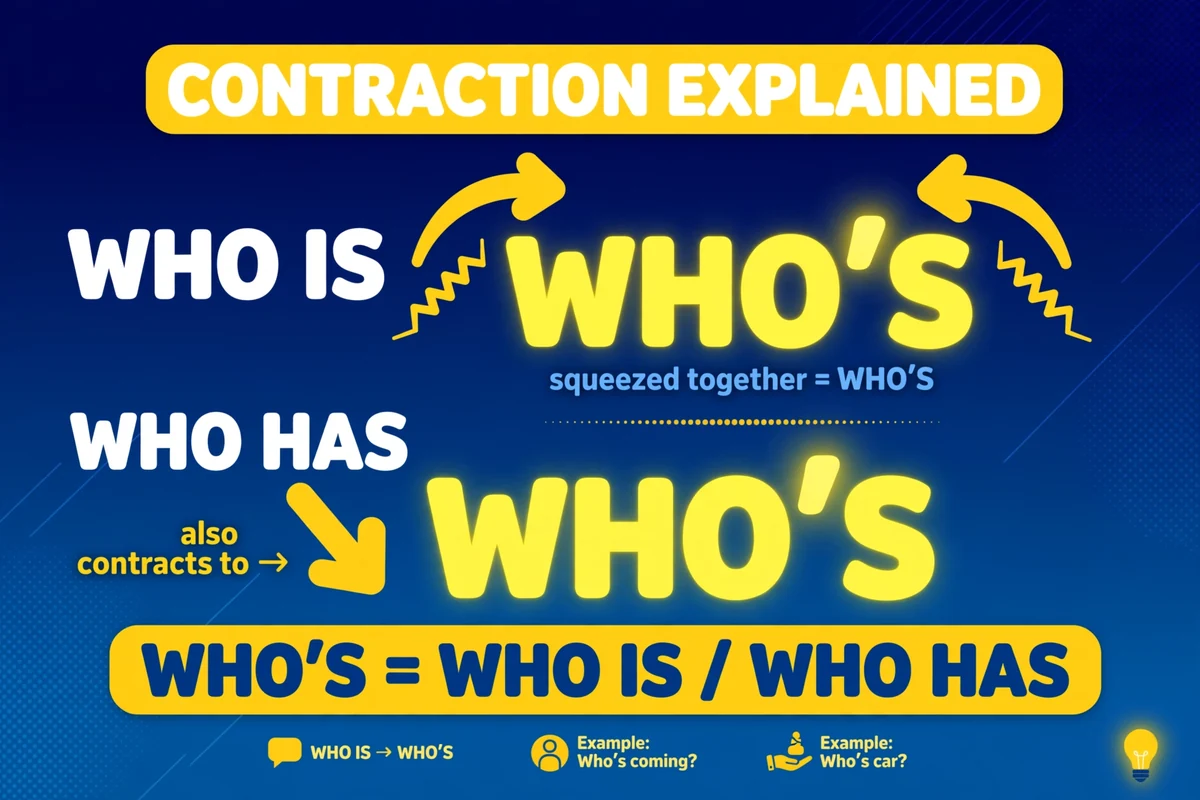
Who’s is a contraction. It combines who with either is or has.
The apostrophe marks letters removed from the original words. It does not show ownership.
1. Who’s Meaning Who Is
Use who’s when you mean who is.
It commonly appears before a noun, adjective, or verb ending in “-ing.”
Examples:
- Who’s waiting outside?
- Who’s your new teacher?
- Do you know who’s responsible for this?
- Who’s coming to the party tonight?
- She wants to know who’s available tomorrow.
- Who’s ready for the next lesson?
Try replacing who’s with who is. Each sentence keeps its meaning.
2. Who’s Meaning Who Has
Use who’s when you mean who has.
This usually happens when has acts as a helping verb in the present perfect tense.
Examples:
- Who’s finished the report?
- Who’s eaten the last slice of cake?
- Do you know who’s taken my notebook?
- Who’s been working on this project?
- She asked who’s seen the missing file.
In each example, who’s means who has.
Remember that who’s does not replace every use of who has. The contraction works when the sentence structure allows it.
For example:
- Correct: Who’s completed the assignment?
- Correct: Who has completed the assignment?
Both sentences are grammatically correct.
3. Who’s in Relative Clauses
Who’s can also appear in a clause that gives more information about a person.
Examples:
- My brother, who’s studying engineering, lives nearby.
- I know a woman who’s training to become a doctor.
- The student who’s sitting near the window won the prize.
- She hired a designer who’s worked on several major projects.
In these sentences, who’s means who is.
Key Differences Between Whose and Who’s
The simplest distinction is grammatical.
Whose shows possession. Who’s replaces two words: who is or who has.
| Sentence | Correct word | Reason |
| ___ phone is this? | Whose | Asks who owns the phone |
| ___ coming to dinner? | Who’s | Means “who is coming” |
| The woman ___ car was stolen called the police. | Whose | Shows whose car it was |
| ___ been using my computer? | Who’s | Means “who has been using” |
| Do you know ___ responsible? | Who’s | Means “who is responsible” |
| I met a writer ___ novel became popular. | Whose | Shows the writer’s connection to the novel |
When to Use Whose or Who’s
Use the following guidance when choosing between the two words.
Use Whose for Ownership
Choose whose when asking who owns something.
Examples:
- Whose jacket is on the chair?
- Whose bicycle did you borrow?
- Whose responsibility is this?
- Do you know whose bag was left here?
You can also use it to describe something connected to a person, animal, or thing.
Examples:
- The dog whose collar is blue belongs to my neighbor.
- We visited a town whose streets were very narrow.
- She bought a laptop whose screen was damaged.
Use Who’s for “Who Is”
Choose who’s when the sentence means who is.
Examples:
- Who’s calling me?
- I wonder who’s at the door.
- Who’s your favorite singer?
- Tell me who’s joining the meeting.
Use Who’s for “Who Has”
Choose who’s when the sentence means who has.
Examples:
- Who’s finished the test?
- Do you know who’s taken my book?
- Who’s been waiting here?
- I wonder who’s completed the task.
Can Whose Refer to Animals and Things?
Yes. Whose can refer to people, animals, and things.
Some writers assume it only applies to people. However, standard English also uses it to show possession or association involving animals and inanimate objects.
Examples involving animals:
- The cat whose tail is white belongs to Sarah.
- I saw a bird whose wings were injured.
- The dog whose owner moved away needs a new home.
Examples involving things:
- This is the house whose roof needs repair.
- I read a book whose ending surprised me.
- They visited a country whose history interested them.
- The phone whose screen was cracked belongs to my brother.
Using whose for things often sounds more natural than using the phrase of which.
For example:
- Natural: The house whose roof was damaged needs repairs.
- More formal: The house, the roof of which was damaged, needs repairs.
Both forms can be correct, but the first is usually easier to read.
Whose or Who’s in Questions
Both words can appear in questions, but they ask different things.
Whose asks about ownership or association.
Who’s asks about a person’s identity or describes what someone is doing.
Compare these examples:
| Question | Meaning |
| Whose phone is this? | Who owns this phone? |
| Who’s on the phone? | Who is speaking on the phone? |
| Whose house are we visiting? | Who owns the house? |
| Who’s visiting us today? | Who is visiting today? |
| Whose turn is it? | Who should take the next turn? |
| Who’s next? | Who is next? |
The meaning can change significantly when you switch the words.
Whose Home vs. Who’s Home
Consider these two phrases:
Whose home? asks who owns or lives in a particular home.
Who’s home? means who is home? It asks which person is currently at home.
The apostrophe changes the grammatical meaning.
Whose Back vs. Who’s Back
These phrases also have different meanings.
Whose back? asks which person’s back is being discussed.
Who’s back? can mean who is back? It asks who has returned.
Context helps readers understand the intended meaning.
Whose vs. Who’s vs. Whom
Another word sometimes confused with whose is whom.
All three relate to the pronoun who, but they have different grammatical functions.
| Word | Function | Example |
| Whose | Shows possession | Whose bag is this? |
| Who’s | Means who is or who has | Who’s coming today? |
| Whom | Refers to the object of a verb or preposition | Whom did you invite? |
What Does Whom Mean?
Whom is an object form of who.
Use it when the person receives an action or follows a preposition in formal English.
Examples:
- Whom did you call?
- To whom should I send the letter?
- Whom are you waiting for?
In everyday conversation, many speakers use who instead of whom.
However, whom remains useful in formal writing.
Do not confuse it with whose. The words have different meanings and grammatical roles.
Common Mistakes With Whose and Who’s
These errors often happen because writers associate apostrophes with possession.
However, who’s is a contraction, while whose is possessive.
Mistake 1: Using Who’s Before a Noun to Show Ownership
Incorrect: Who’s jacket is hanging by the door?
Correct: Whose jacket is hanging by the door?
The sentence asks who owns the jacket. Therefore, it needs whose.
Mistake 2: Using Whose Instead of Who’s
Incorrect: Whose coming to the meeting?
Correct: Who’s coming to the meeting?
The intended meaning is who is coming. Use the contraction.
Mistake 3: Using Who’s When You Mean Who Has
Incorrect: Whose finished the assignment?
Correct: Who’s finished the assignment?
Here, who’s means who has.
Mistake 4: Assuming the Apostrophe Shows Possession
Incorrect: The teacher who’s class I joined is very helpful.
Correct: The teacher whose class I joined is very helpful.
The sentence describes a class connected to the teacher. It does not mean who is class or who has class.
Mistake 5: Confusing Who’s With Whose in Indirect Questions
An indirect question reports or embeds a question inside another sentence.
Incorrect: I wonder who’s car this is.
Correct: I wonder whose car this is.
The embedded question still asks about ownership.
More examples:
- Correct: Do you know whose keys these are?
- Correct: Can you tell me who’s available?
- Correct: She asked whose idea it was.
- Correct: He wondered who’s been calling.
How to Remember the Difference
Use this simple substitution test.
The Two-Word Test
WHO’S = WHO IS
Example: Who’s at the door?
Test: Who is at the door?
WHO’S = WHO HAS
Example: Who’s finished the work?
Test: Who has finished the work?
WHOSE = OWNERSHIP
Example: Whose book is this?
Test: Who owns this book?
If who is or who has fits your sentence, use who’s.
If the sentence asks about ownership or shows a relationship, use whose.
A Simple Memory Trick
Think of the apostrophe in who’s as a sign that two words have been shortened.
- Who is becomes who’s.
- Who has becomes who’s.
- Ownership uses whose, without an apostrophe.
You can also compare these words with its and it’s.
- Its shows possession: The dog wagged its tail.
- It’s means it is or it has: It’s raining.
The same general pattern applies to whose and who’s.
Frequently Asked Questions
Is whose or who’s correct?
Both are correct, but they have different meanings. Whose shows ownership or association. Who’s is a contraction of who is or who has.
Is whose a possessive pronoun?
Yes. Whose is the possessive form of who. It can work as a determiner before a noun or as a pronoun when the noun is understood.
Does who’s mean who has?
Yes. Who’s can mean who has when has acts as a helping verb. For example, “Who’s finished the assignment?” means “Who has finished the assignment?”
Can whose be used for things?
Yes. Whose can refer to people, animals, and things. For example, “The house whose roof was damaged needs repairs” is grammatically correct.
Why does whose not have an apostrophe?
Whose is already a possessive form. English possessive pronouns and determiners, such as his, hers, ours, and whose, do not need apostrophes.
How can I check whether to use whose or who’s?
Replace who’s with who is or who has. If the sentence still makes sense, use who’s. If you mean ownership or association, use whose.
Conclusion
Whose and who’s sound alike, but they perform different jobs.
Use whose to ask about ownership or describe something connected to a person, animal, or thing. Use who’s when you mean who is or who has.
When you are unsure, try expanding the contraction. If neither phrase fits, whose is likely the word you need.