Effective or Affective: What’s the Difference? (With Examples)
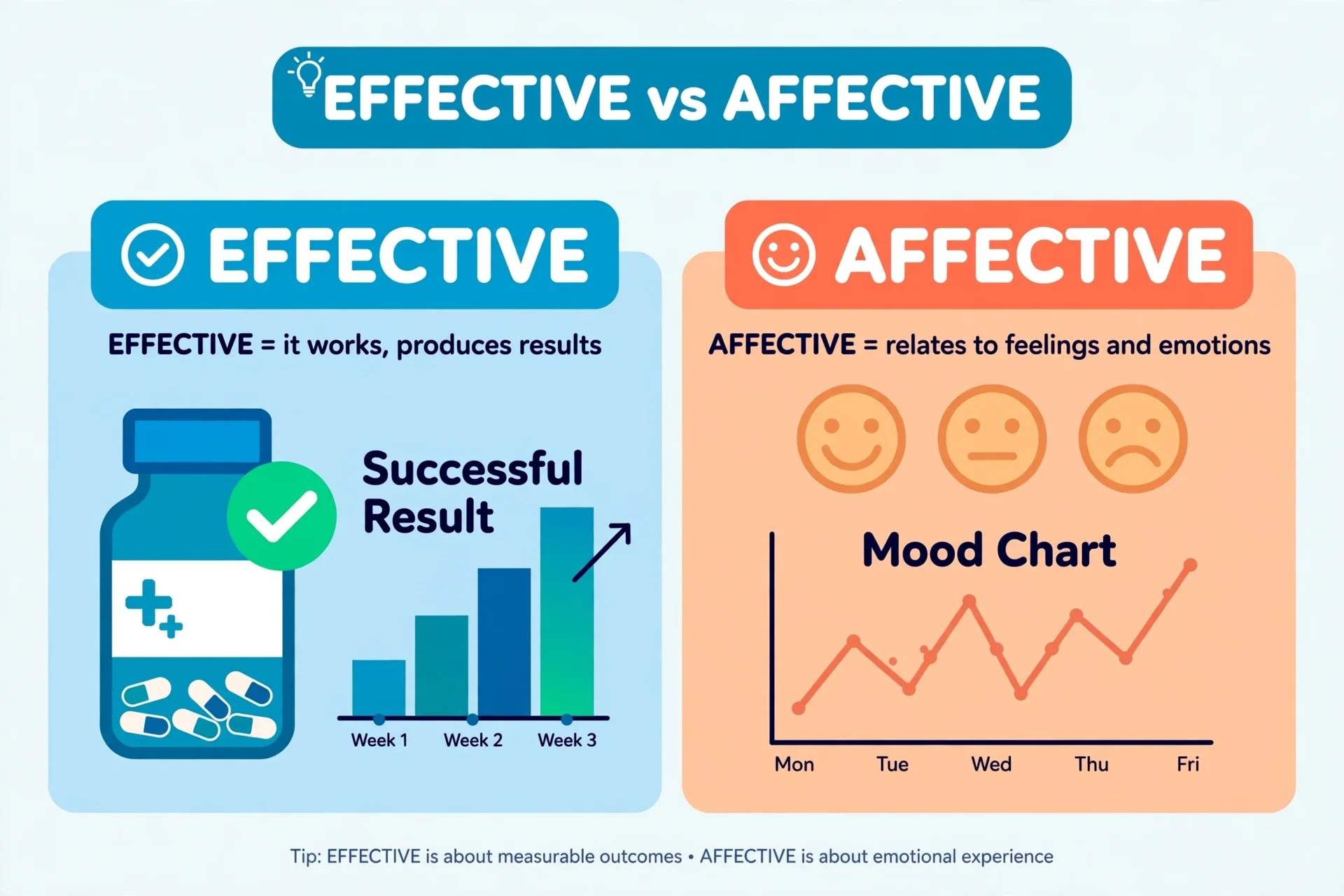
Effective and affective are both real English adjectives, but they describe completely different things. Effective means producing the result you want — an effective treatment works. Affective relates to moods and emotions — affective disorders involve feelings.
The mix-up happens because they look nearly identical and because affect (verb) and effect (noun) are confusing on their own. But the distinction is clean: effective = it works; affective = it involves emotion.
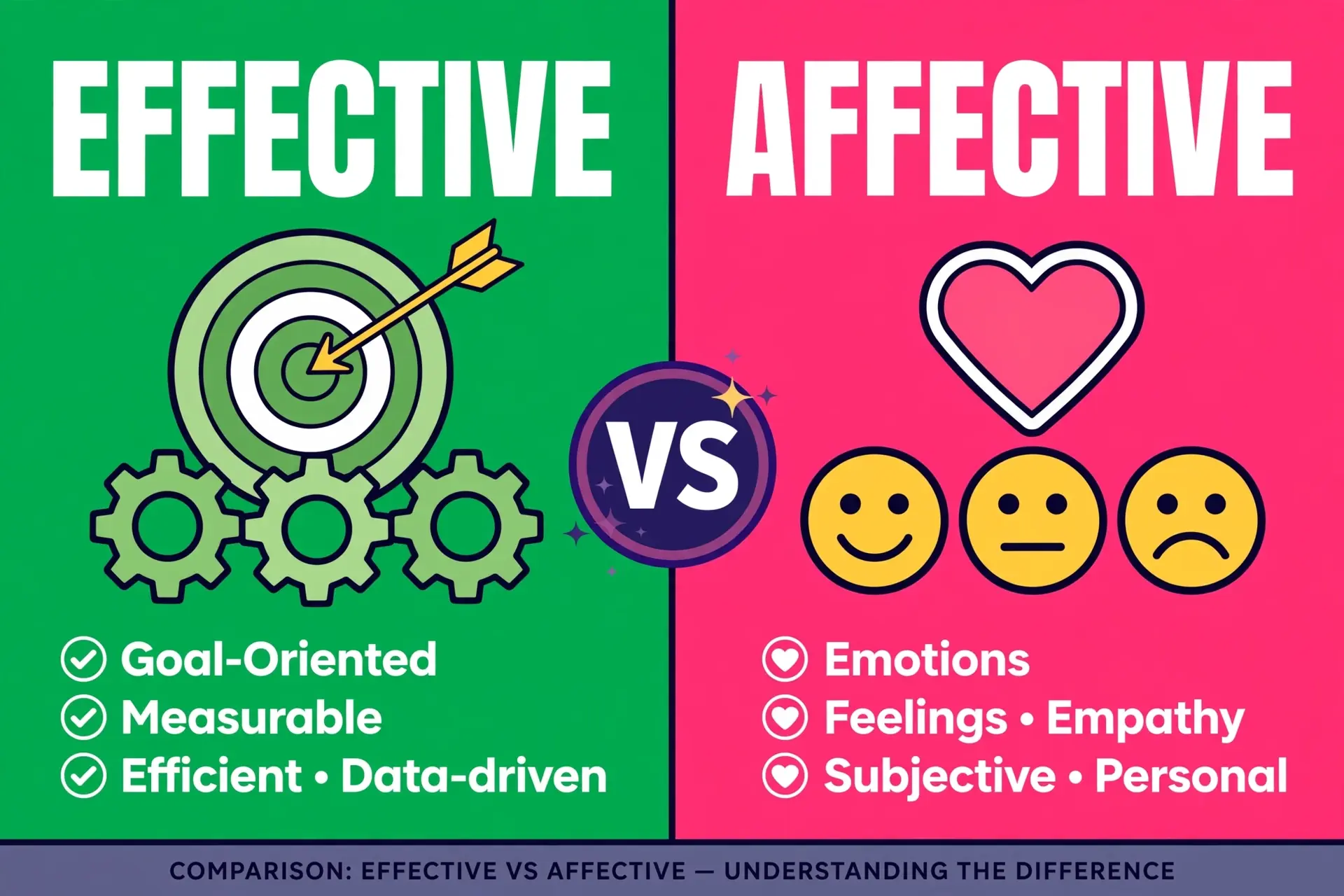
Table of Contents
Quick Answer
| Word | Part of Speech | Main Meaning | Example |
|---|---|---|---|
| effective | adjective | producing the desired result; working well | “This is a simple but effective way to save money.” |
| affective | adjective | relating to moods, feelings, or emotions | “The study measured the patients’ affective responses.” |
Simple rule: effective = it produces an effect; affective = it relates to affect (feelings).
What Does “Effective” Mean?
Effective describes something that produces a decided, decisive, or desired result. An effective medicine cures, an effective argument persuades, an effective policy achieves its goal. It can also mean “in operation” — “the new law becomes effective in January.”
Examples:
- “The coach’s half-time talk was remarkably effective — the team won 3–0.”
- “Washing your hands is one of the most effective ways to avoid infection.”
- “She gave an effective presentation that won over the whole board.”
- “The new policy will be effective from the first of next month.”
- “Regular practice is more effective than last-minute cramming.”
Effective vs. efficient
These two are often confused as well. Effective means it achieves the goal; efficient means it achieves the goal without wasting time or resources. A slow, expensive solution can still be effective — it just is not efficient.
What Does “Affective” Mean?
Affective relates to moods, feelings, and emotions. It is the adjective form of affect (the noun meaning emotion, pronounced /ˈæfekt/, used in psychology). You will meet it in phrases like “affective disorders” (conditions involving mood, such as depression) and “affective computing” (technology that recognizes human emotion).
Examples:
- “Seasonal affective disorder causes low mood during the darker months.”
- “The researchers recorded the children’s affective responses to music.”
- “Her speech had a strong affective impact on the audience — many were moved to tears.”
- “Affective computing aims to make machines read human emotions.”
- “The therapist noted his flat affective tone throughout the session.”
Effective vs. Affective: Key Differences
| Feature | Effective | Affective |
|---|---|---|
| Core meaning | produces the desired result | relates to moods and emotions |
| Comes from | effect (noun — the result) | affect (noun — emotion) |
| Typical contexts | medicine, policy, techniques, communication | psychology, medicine, computing |
| Opposite | ineffective (it does not work) | no direct opposite; “unaffective” is rare and nonstandard |
| Frequency | very common everyday word | mostly academic and clinical |
| Pronunciation | /ɪˈfektɪv/ | /əˈfektɪv/ |
In everyday writing you almost always want effective; affective belongs mainly to psychology and research.
Usage Examples in Real Sentences
At Work
“The new scheduling system is far more effective than the old one.” / “The training included an affective module on reading customers’ emotions.” — The system works; the module deals with feelings.
At the Doctor’s
“The doctor prescribed an effective treatment for the infection.” / “She was diagnosed with seasonal affective disorder.” — The treatment produces results; the disorder concerns mood.
In Conversation
“Short, honest feedback is the most effective.” / “He gave a speech with real affective power — the room went silent.” — Feedback that works versus words that stir emotion.
At School
“Flashcards are an effective way to memorize vocabulary.” / “The lesson on poetry had a clear affective goal — to make students feel the rhythm.” — Study techniques that produce results versus teaching aimed at emotional response.
Common Mistakes
Lookalike words trap even careful writers — just like desert or dessert and whose or who’s. Here are the typical slips with this pair:
Mistake 1: “Affective treatment”
❌ “The new drug is an affective treatment for migraines.”
✅ “The new drug is an effective treatment for migraines.”
Why: the drug works — it produces an effect — so it is effective. See Merriam-Webster’s definition of effective for the “producing a desired effect” sense.
Mistake 2: “Effective disorders”
❌ “She studies effective disorders in adolescents.”
✅ “She studies affective disorders in adolescents.”
Why: disorders of mood and emotion are affective disorders.
Mistake 3: “Affectively communicating”
❌ “He affectively communicated the new plan.”
✅ “He effectively communicated the new plan.”
Why: he communicated it well, producing the intended result — effectively.
Mistake 4: Assuming “affective” is just a fancy “effective”
❌ Using affective in business writing to sound impressive.
✅ Reserve affective for contexts involving emotion; use effective everywhere else.
Why: they are not synonyms at different formality levels — they mean different things.
Pronunciation
Effective = /ɪˈfektɪv/ — stress on the second syllable, “ih-FEK-tiv”. Affective = /əˈfektɪv/ — “uh-FEK-tiv”. In normal speech the difference is tiny (just the first vowel), which is exactly why the confusion survives — spelling is the reliable signal.
How to Remember the Difference
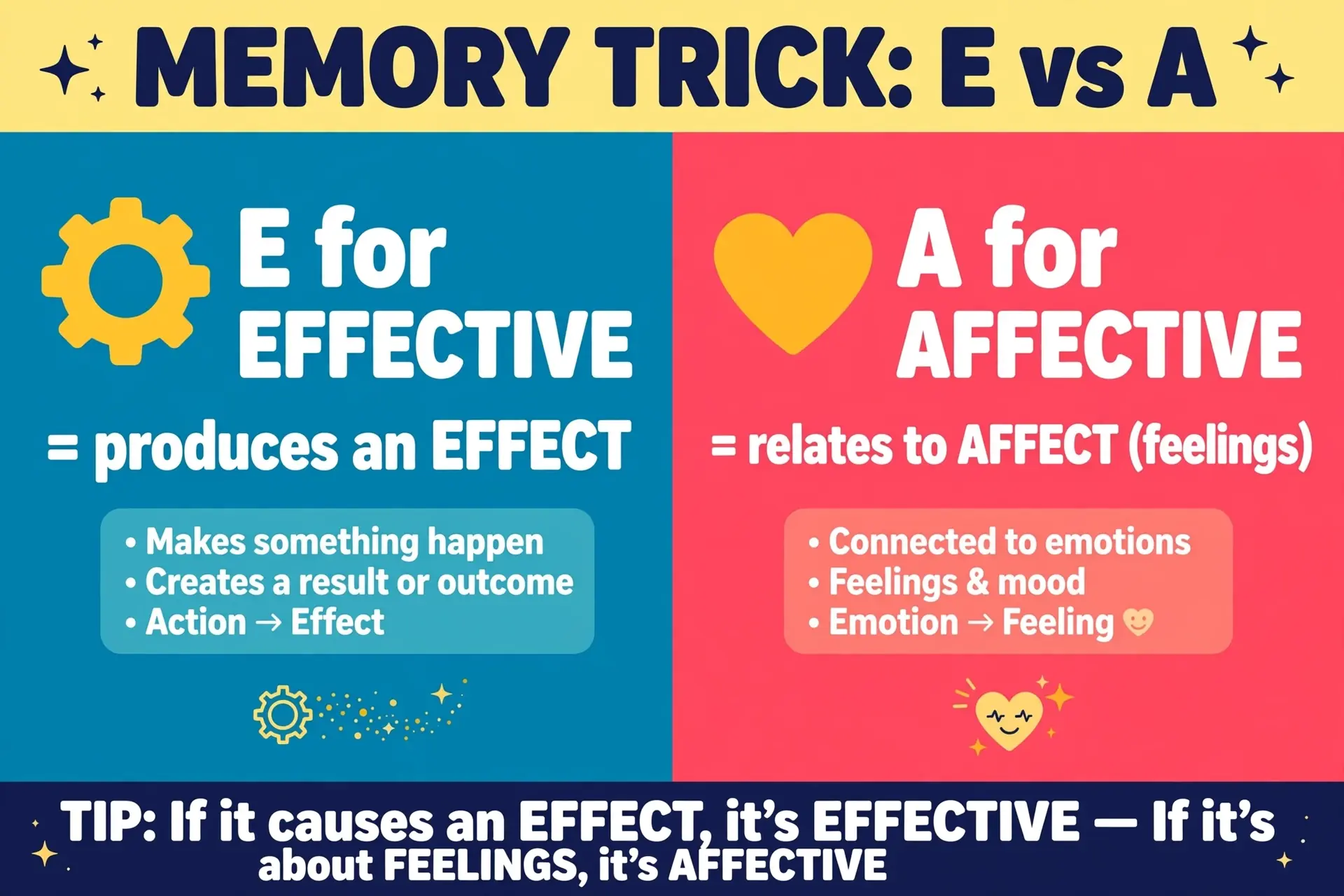
Anchor each word to its root. Effective starts with e like effect — it produces an effect (a result). Affective starts with a like affect — the noun for feelings and emotion. “An effective tool has an effect; an affective moment stirs affect.”
- Effective = produces the desired result (“it works”).
- Affective = relates to moods and emotions.
- E for effect/result; A for affect/feeling.
- Opposite of effective is ineffective.
Frequently Asked Questions
Is it effective or affective communication?
Effective communication — communication that works and achieves its purpose. When a manager gives feedback that changes behavior, or a teacher explains something so the class truly understands, that is effective communication. “Affective communication” would mean communication dealing with emotions — a real phrase in psychology, but not what people mean when they praise a good speaker.
What is the difference between affect and effect?
Affect is usually a verb meaning to influence (“the weather affected our plans”), and in psychology it is also a noun meaning emotion (“a flat affect”). Effect is usually a noun meaning a result (“the effect of the new law”). Effective comes from effect, so it means producing results; affective comes from the noun affect, so it means relating to feelings.
What does affective mean in psychology?
Relating to moods, feelings, and emotions — for example “affective disorders” (conditions like depression and bipolar disorder that disturb mood) or “affective responses” (the emotional reactions people show to music, images, or events). The term appears constantly in clinical and research writing, which is why most people only meet it there.
Is “affectiveness” a word?
It is extremely rare and most dictionaries do not list it — using it in writing will look like a mistake. The standard noun from effective is effectiveness, as in “the effectiveness of the treatment”. Affective has no common noun form; writers usually rephrase, saying “emotional impact” instead.
Can a person be effective?
Yes — an effective leader or teacher is one who accomplishes what they set out to accomplish, and the word fits people, methods, and things alike. A person is rarely described as “affective” outside clinical psychology, where it would describe someone’s emotional expression rather than their competence. For everyday praise of someone’s ability, effective is the word.
What is the opposite of effective?
Ineffective — meaning it fails to produce the desired result, as in “an ineffective remedy”. There is no standard opposite of affective; “unaffective” is not an accepted word. If you mean the opposite of emotional, use “unemotional” instead.
Conclusion
Effective means it works — it produces the result you want. Affective means it involves feelings and emotions. Keep e for effect and a for affect, and the pair stops being confusing.