Synonyms for Manage: 12+ Words With Examples
Manage quietly carries three different jobs — running things, coping with things, and achieving things. Using one vague word for all three blurs your meaning. These synonyms for manage are grouped by the job you actually mean, each with a definition and a natural example sentence. The Merriam-Webster thesaurus entry for manage confirms the range, but only a grouped guide shows you which word fits your sentence.
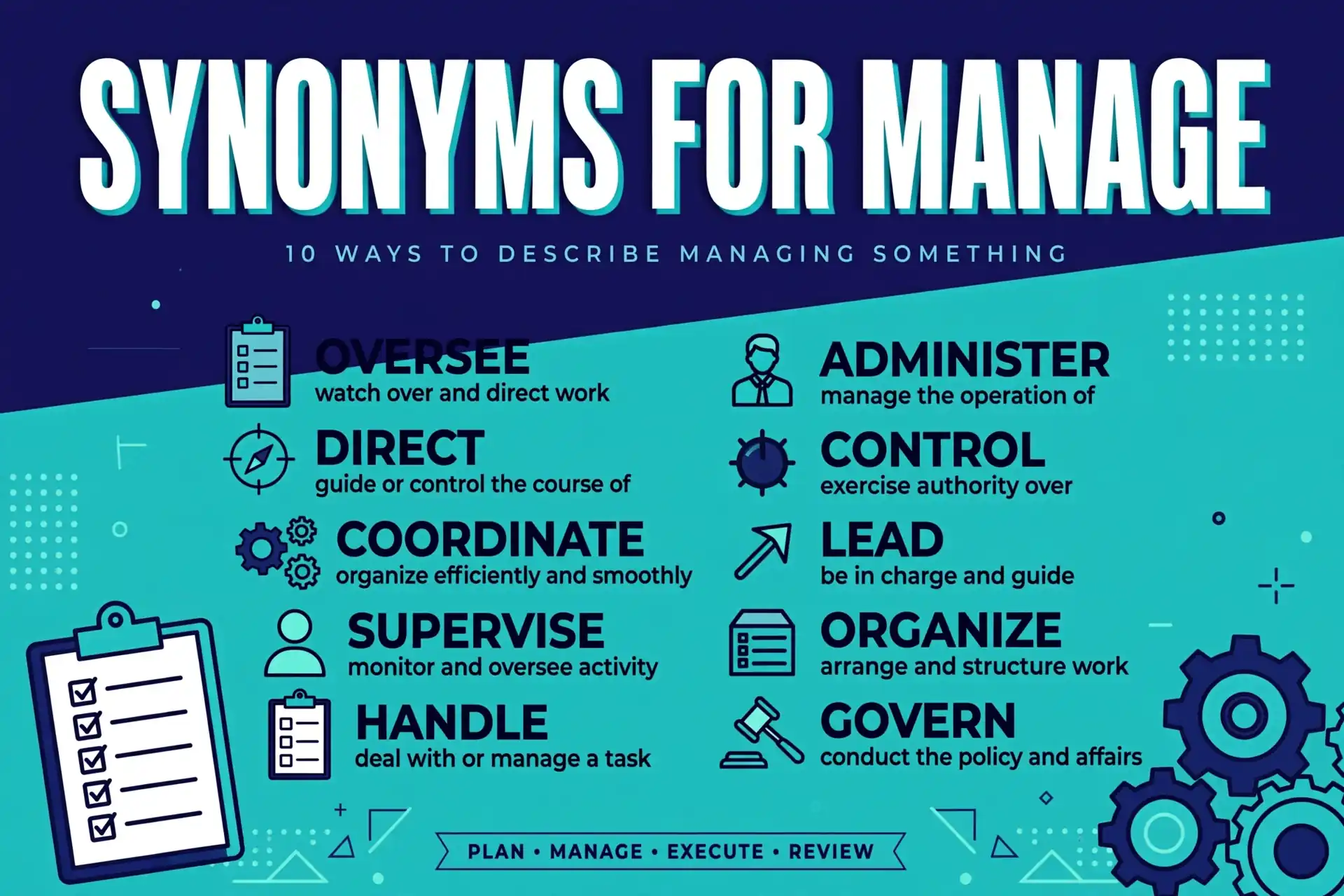
Table of Contents
Quick Answer
The 12 best synonyms for manage at a glance, matched to the job each one does.
| Word | Nuance / When to use it |
|---|---|
| run | Be in charge of day-to-day operations; plain and direct |
| administer | Manage formally, often an organization or system |
| oversee | Supervise from above; watchful responsibility |
| supervise | Directly watch over people or work |
| cope | Deal with difficulty and keep going |
| handle | Take care of a task or situation competently |
| deal with | Face and resolve a problem or person |
| get by | Manage with difficulty; just enough to survive |
| accomplish | Complete something successfully, often impressive |
| achieve | Reach a goal through effort |
| pull off | Succeed at something difficult; casual and vivid |
| carry out | Perform a plan, order, or duty as intended |
Simple rule: decide whether you mean running, coping, or achieving — then pick from that group and you cannot go wrong.
Run and Lead
When manage means being in charge — of people, projects, or organizations — these are the precise verbs.
- run — be in charge of the day-to-day operations; plain and direct. Example: She runs a bakery with twelve employees.
- administer — manage formally, often an organization, fund, or system. Example: The charity administers scholarship programs in four countries.
- oversee — supervise from above with watchful responsibility. Example: He oversees all construction projects in the northern region.
- supervise — directly watch over people or work as it happens. Example: Two lifeguards supervise the pool during public hours.

Cope and Handle
When manage means dealing with difficulty — getting through something hard — reach for this group.
- cope — deal with difficulty and keep going. Example: She coped with the loss by throwing herself into her work.
- handle — take care of a task or situation competently. Example: He handled the angry customer with impressive calm.
- deal with — face and resolve a problem, task, or difficult person. Example: The new policy helps tenants deal with maintenance issues faster.
- get by — manage with difficulty; having just enough to survive. Example: On a student budget, they got by on rice and part-time shifts.
Achieve and Pull Off
When manage means succeeding — getting the thing done against the odds — these verbs say so clearly.
- accomplish — complete something successfully, often something impressive. Example: The team accomplished in a month what was expected to take a year.
- achieve — reach a goal or standard through effort. Example: She achieved the highest sales figures in company history.
- pull off — succeed at something difficult or surprising; casual and vivid. Example: Against all odds, they pulled off a last-minute victory.
- carry out — perform a plan, order, or duty as intended. Example: The researchers carried out the experiment exactly as designed.
Common Mistakes
Manage is a verb with a noun twin and a tricky infinitive, so small errors snowball — much like mixing up cancelled vs canceled or labelled vs labeled in formal writing. Steer clear of these four mistakes:
Mistake 1: Using “manager” as a verb
❌ Wrong: She manager the team very well.
✅ Better: She manages the team very well.
Why: Manager is the noun for the person; manages is the verb form. “She is the manager” and “she manages the team” are both correct — never cross them.
Mistake 2: Dropping “to” after “managed”
❌ Wrong: He managed finish the report on time.
✅ Better: He managed to finish the report on time.
Why: In the “succeed” sense, manage always takes the full infinitive: managed to finish, manage to attend. The bare verb after managed is never correct.
Mistake 3: Saying “managed” when you failed
❌ Wrong: I managed to fix it, but it is still broken.
✅ Better: I tried to fix it, but it is still broken.
Why: “Managed to” implies success — the thing got done. If the attempt failed, say tried, attempted, or worked on instead.
Mistake 4: Leaving “manage” vague
❌ Wrong: Can you manage this project?
✅ Better: Can you oversee this project? / Can you handle the client calls?
Why: Manage covers running, coping, and achieving, so on its own it tells the listener almost nothing. Name the actual job — oversee, handle, carry out — and the request becomes clear.

How to Choose the Right Synonym
- Sort by meaning first. Running something? Use run, administer, oversee, or supervise. Surviving something? Use cope, handle, deal with, or get by. Finishing something? Use accomplish, achieve, pull off, or carry out.
- Match the formality. Administer and accomplish suit reports and resumes; pull off and get by belong in conversation and casual writing.
- Check who does what. Supervise and oversee need people or work beneath them; cope and get by describe the speaker’s own struggle. Point the verb at the right subject.
- Respect “manage to.” It promises success, so only use it — or its synonyms accomplish and pull off — when the outcome was actually achieved.
- Prefer the vivid verb. “She pulled off the event” paints a picture that “she managed the event” never will; specificity is the whole point of a synonym.
Frequently Asked Questions
What is a synonym for manage?
For running things: run, administer, oversee, supervise. For coping: cope, handle, deal with, get by. For achieving: accomplish, achieve, pull off, carry out. The right synonym depends on which of the three meanings you intend.
What is the difference between manage and administer?
Manage is the general, everyday verb; administer is its formal cousin, used for organizations, funds, programs, and systems. You manage a shop but administer an estate or a national program.
Is it “manage to do” or “manage doing”?
Always “manage to do” — the full infinitive. “She managed to finish” is correct; “she managed finishing” is not. The phrase always implies the action succeeded.
What is a formal synonym for manage?
Administer for running organizations, oversee for supervision, and accomplish for achievements. All three sound natural in reports, resumes, and academic writing.
Can “manage” mean “barely survive”?
Yes — “we managed on one income” means you got by with difficulty. For that sense, get by and cope are the most natural synonyms, and they carry the struggle more honestly than manage does.
Conclusion
Manage is three verbs wearing one coat. Strip it down to the meaning you actually want — oversee for leading, cope for enduring, pull off for succeeding — and every sentence gets sharper. Your readers will thank you for the precision.